
Oil

Oil

c/oil

What’s next for oil prices? Share your views.

publiccommoditiesStarted Mar 2026140 posts39 members
Log in to join

Join to post, ask questions, and follow the conversations that fit your market style.

Why join c/oil?

Real conversations

Ask what you are missing and compare notes.

Focused and relevant

One community, one cleaner thread of discussion.

Learn and grow

Read first, then post when you have a view.

ranjeet_singh
1 month ago

Brent at $91.94 — the small move that still raises costs

Brent crude just ticked up to $91.94, a modest 0.35% gain that keeps it near recent highs. The driver is the same old supply worry, and the real story for most investors is the extra cost it pushes onto everything from fuel to plastic. Why the move happened Markets are pricing in tighter supply, mostly from ongoing geopolitical tensions that cut expected output. No sudden shortage yet, but the fear premium keeps bids firm and prevents prices from sliding back. Who feels the squeeze Higher crude directly lifts input costs for airlines, paint makers, tyre companies, and any business that ships goods. In India that hits operators like IndiGo or…

0
ranjeet_singh
1 month ago

Oil near $93 isn't just a headline — here's who actually pays

Oil holding near $93 keeps energy costs sticky even after the tariff pause headline. That extra price is the market's way of pricing in supply risk from Middle East tensions, and it shows up downstream faster than most headlines suggest. Why the price stays firm Brent near $93 and WTI around $85.80 reflect a persistent risk premium — the extra dollars buyers pay when they fear barrels might disappear. The tariff pause news took some heat out of the trade story, but it didn't touch the physical supply worries, so the premium hasn't faded. Who feels it first Energy producers and refiners tend to benefit as margins expand with the higher price.…

0
ranjeet_singh
2 months ago

Oil ticked up a little today — the quiet ripple most people miss

Oil's modest bump today isn't huge on its own, but it quietly pushes up the cost of fuel, transport and a bunch of everyday goods if it sticks around. Why the price edged up Brent settled near 87.82 and WTI near 82.62 on light buying tied to geopolitical tension and tighter supply worries. Those concerns add a small risk premium — the extra price buyers pay when they fear disruptions — without any sudden supply cut or demand spike showing up yet. Who feels it first Upstream producers gain : ONGC and similar exploration firms see better margins as their output fetches more. Oil marketers and downstream get squeezed : IOC, BPCL and HPCL face hi…

0
ranjeet_singh
2 months ago

Brent slips 0.2% — the quiet relief for Indian downstream names

Brent's tiny 0.2% dip to $86.87 doesn't scream "crisis," but it quietly eases pressure on Indian fuel costs and inflation math. Why the slide happened Prices gave back a bit of the week's earlier gains once geopolitical worries cooled. Less fear means less risk premium baked into the barrel, so the futures eased off the prior close near $86.89. Who actually feels it Oil-marketing companies (IOC, BPCL, HPCL) get breathing room on procurement costs and can protect margins or even pass on lower prices at the pump. Airlines, paint makers, and tyre makers see input costs tick down — jet fuel, resins, and synthetic rubber all move with crud…

0
ranjeet_singh
2 months ago

Brent near 89.35 on Iran risks — the premium that actually matters

Brent sitting steady near $89.35 on Iran supply worries is mostly noise for most portfolios right now, but the real story is the risk premium that stays baked in. Why the price is holding Geopolitical tension around the Strait of Hormuz — the narrow shipping lane that carries a big chunk of global oil — keeps traders adding a fear premium on top of normal supply and demand. That premium is why Brent has not dropped even though no actual barrels have been cut yet. Who feels it first Upstream producers and exporters gain from any sustained lift in realised prices. Downstream refiners, airlines, paint makers and tyre companies see higher input c…

0
ranjeet_singh
2 months ago

Trump's Iran demands just nudged oil higher — the simple supply angle

Trump's new demands on Iran just dimmed hopes for a quick deal to reopen the Strait of Hormuz, so oil prices edged a little higher on fresh supply worries. The move is modest so far, but the mechanism is straightforward: any hint that the key Gulf shipping route stays tight adds a risk premium to crude because so much global oil has to pass through it. Why the price ticked up Tehran wants reparations before talks can move forward. Washington responded with tougher conditions. That combination lowers the odds of an early reopening, so traders price in a slightly tighter supply picture. No big jump yet, just an edge higher on geopolitics. Who f…

0
ranjeet_singh
2 months ago

Brent hovering near $87.80 after the surge – the real cost ripple

Brent crude sitting near $87.80 after a quick 5% jump tells regular investors one clear thing: energy input costs just got stickier, and that pressure flows straight into transport, manufacturing and fuel bills. Why the price is holding here Geopolitical tensions are keeping a supply-risk premium baked into the barrel. Traders are waiting to see if Middle East disruptions spill into the Asian session. No big new barrels are coming online fast, so the market is pricing in the chance of tighter supply. Who feels it first Energy producers win – higher realized prices lift revenue for upstream names and the broader energy sector. Downstream and h…

0
ranjeet_singh
2 months ago

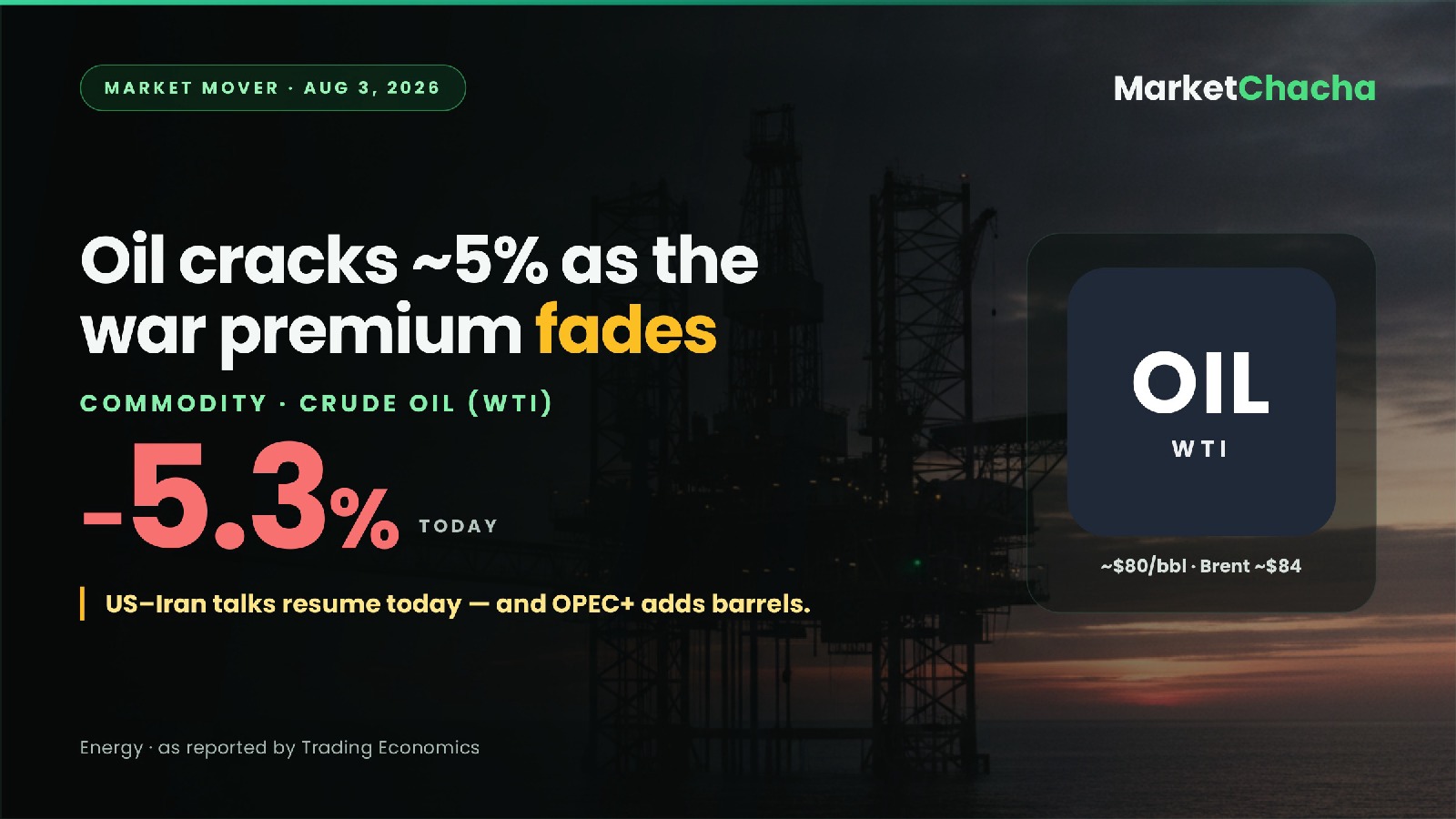
Why is oil down ~5% today? The Iran war premium is unwinding

Crude just handed back a big slice of its July war premium. WTI fell about 5.3% to ~$80/bbl and Brent dropped ~4.6% to ~$84 on Monday (Aug 3), per Trading Economics — after crude spent July climbing on fears the US–Iran fight would choke off Gulf supply. Two things flipped the tape 1) The shooting is pausing. President Trump said US–Iran talks resume today after he called off a planned strike, and repeated his push to reopen the Strait of Hormuz — the chokepoint roughly a fifth of the world's seaborne oil passes through. That fear is exactly what drove Brent up ~24% in July (its best month since March). With the guns quiet, traders are pricin…

Why is oil down ~5% today? The Iran war premium is unwinding
0
ranjeet_singh
2 months ago

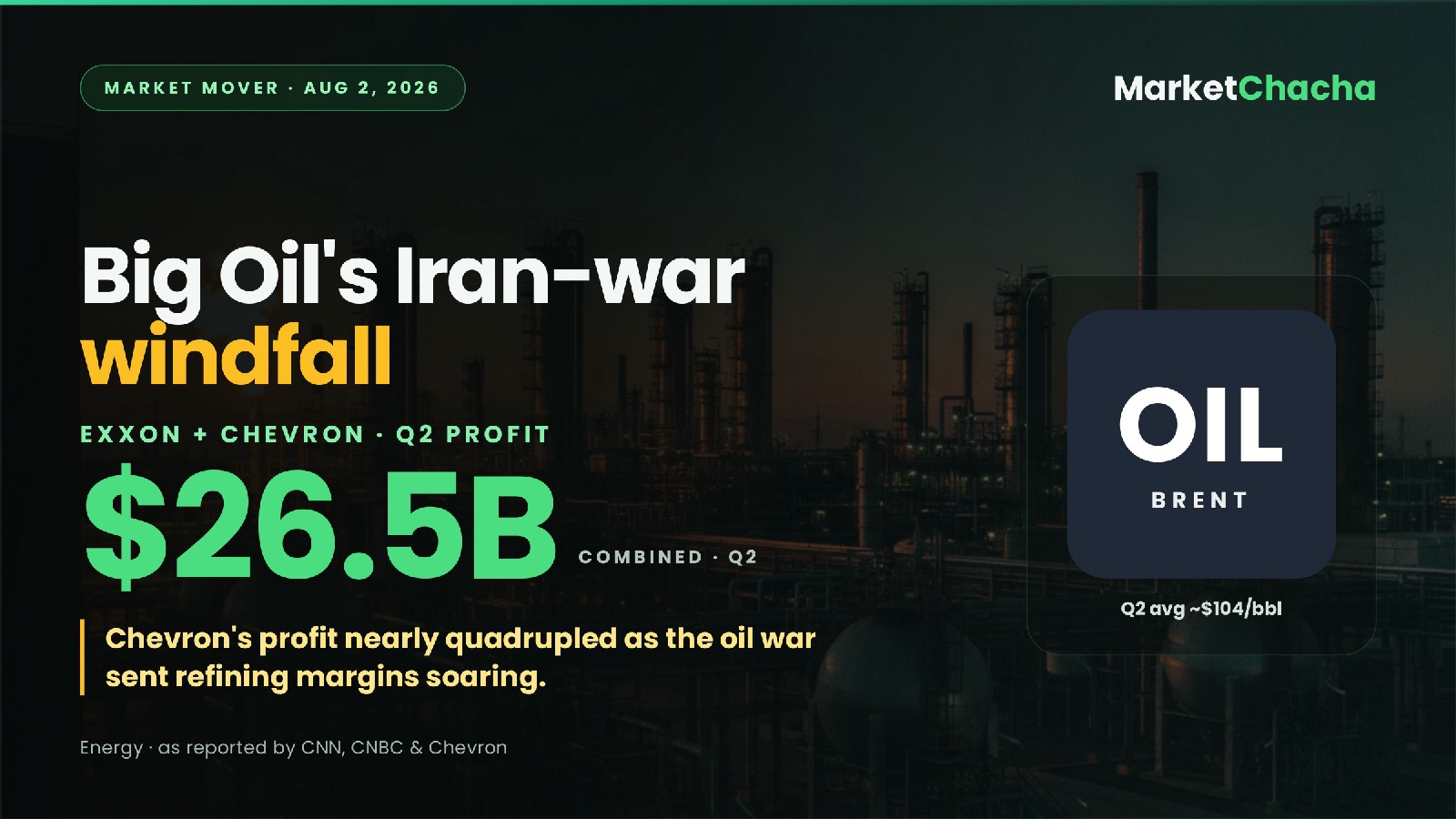
Big Oil's Iran-war windfall: Chevron's profit just quadrupled

Exxon and Chevron just booked a combined ~$26.5 billion in Q2 profit — a wartime windfall powered almost entirely by the US–Iran conflict, which pushed Brent crude to an average of about $104 a barrel for the quarter (reported Friday, Jul 31; figures via CNBC, CNN and the companies' releases). The eye-popper is Chevron (NYSE: CVX) : net income of $12.1 billion , up roughly 384% from $2.5 billion a year ago — its best quarter in six years. The engine wasn't drilling, it was refining: downstream profit jumped ~500% to $4.9 billion (from $737 million) as war-driven petrol and diesel prices fattened the "crack spread" — the gap between wh…

Big Oil's Iran-war windfall: Chevron's profit just quadrupled
0
ranjeet_singh
2 months ago

Oil snapped back 3% today — here’s the real ripple for investors

Brent crude just bounced hard off its recent lows, closing at 86.86 after a 3.3% jump from 83.76. For regular investors the immediate takeaway is simple: energy stocks get a short-term tailwind, while the broader market has to price in stickier inflation and a more cautious Fed. Why the rebound happened The move is a classic reversal after multi-week lows. Nothing in the data changed overnight; it was mainly short covering and a bit of risk-premium returning to the barrel as volatility stayed elevated. Higher prices now feed straight into gasoline and diesel costs, which lift the inflation prints the Fed watches. Who feels it first Energy pro…

Oil snapped back 3% today — here’s the real ripple for investors
0
ranjeet_singh
2 months ago

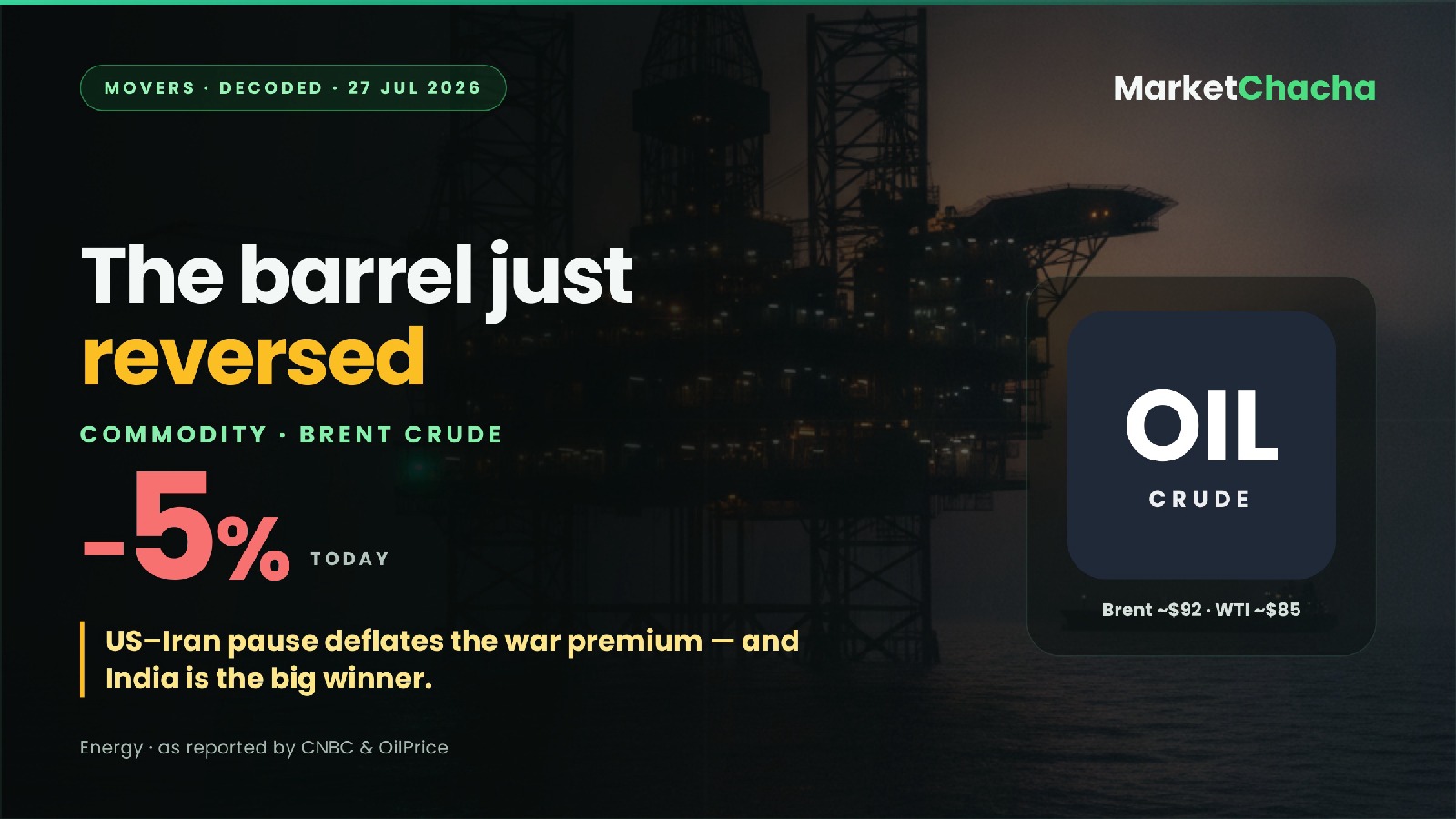
Why did crude crack ~5% today — and why is India quietly cheering?

Brent crude dropped about 5% to roughly $92 a barrel on Monday, and US WTI fell a similar ~5% to about $85 — as reported by CNBC and OilPrice. The trigger wasn't a new oil well. It was a ceasefire. Over the weekend the US and Iran both paused their strikes, and Tehran said it will keep its own attacks on hold as long as the US halt stays in place. Why it moved For two weeks the barrel had been carrying a "war premium" — extra dollars traders pay just in case the fighting chokes off supply. As recently as last Thursday, Brent was above $100 after tanker attacks in the Gulf. The single biggest fear was the Strait of Hormuz, the narrow s…

Why did crude crack ~5% today — and why is India quietly cheering?
0
ranjeet_singh
2 months ago

Brent still near $100 — the second-order costs most headlines skip

Brent crude is still sitting near the $100 mark even after a small pullback, and that keeps energy costs front and center for inflation and company margins. Why the price is sticky Geopolitical supply worries are keeping a floor under the market. Traders aren't rushing to sell because any fresh disruption could tighten barrels quickly, so the price only gave back about half a percent from the recent spike and settled in the 100.13-100.54 range. Who gets squeezed, who gets helped Higher oil feeds straight into diesel and petrol prices, lifting costs for truckers, airlines, and paint makers that use oil derivatives. In India that hits companies…

Brent still near $100 — the second-order costs most headlines skip
0
ranjeet_singh
2 months ago

Brent just cleared $100 after the tanker attacks — the ripple effects beyond oil

Brent crude just spiked above $100 a barrel again after Houthi attacks hit Saudi tankers in the Red Sea. The jump came fast — over 6% in a day — and WTI followed with a 5%+ move. This isn't just an oil headline; it feeds straight into higher costs for everything that moves or uses fuel. Why the price jumped The Red Sea is a key route for Middle East crude heading to Europe and Asia. Attacks raise the risk that tankers get hit or rerouted around Africa, which adds days and cost. That extra fear gets priced in immediately as a risk premium on the barrel. No actual big supply cut yet, but the market is front-running the threat. Who feels it firs…

Brent just cleared $100 after the tanker attacks — the ripple effects beyond oil
0
ranjeet_singh
2 months ago

Oil at $92 on Iran strikes – the real cost beyond the headline

Oil just hit $92 on fresh US strikes in Iran and Trump downplaying any quick peace deal. For anyone filling up a tank or running a business with transport costs, this means higher fuel bills soon and a bit more pressure on prices everywhere else. Why prices moved Middle East tensions directly threaten oil supply flows. When strikes happen and talks look stalled, traders add a risk premium because any real disruption in that region hits global barrels fast. Brent is now at $92.20, up 1.3 percent, and WTI at $85.40, up 1.2 percent. Who feels it next Higher crude feeds straight into inflation. Consumers spend more at the pump and on goods that g…

Oil at $92 on Iran strikes – the real cost beyond the headline
0
ranjeet_singh
2 months ago

Oil edges up after US strikes on Iran — the ripple effects that actually matter

Oil's move is tiny so far — Brent up just half a percent, WTI even less — but the trigger is fresh US strikes on Iran that have markets nervous about supply routes. Why the price ticked up Geopolitical tension adds a risk premium, which is simply the extra price buyers pay when they fear barrels might get disrupted. The strikes raise the chance of wider conflict in a region that ships a big slice of global crude through the Strait of Hormuz. No actual barrels have been cut yet, so the reaction stays modest. Who feels it first in India Upstream producers like ONGC and Oil India stand to gain from higher realisations. Oil marketing companies (I…

Oil edges up after US strikes on Iran — the ripple effects that actually matter
0
ranjeet_singh
2 months ago

Brent at 88.10 after the 4.6% jump — who actually gets hit

Brent crude closed at 88.10 after a 4.59% jump on July 17, driven by geopolitical tensions. The price has since held steady with no fresh moves into the weekend close. Why the price moved Geopolitical tensions add a risk premium — extra money traders pay when supply looks shaky. That single factor pushed prices higher last session. Nothing new has hit the wires in the last hour, so the level has simply stuck. Who feels it first in India Upstream producers win : ONGC and Oil India see higher realisations on every barrel they sell. Downstream and transport lose : IOC, BPCL and HPCL face wider under-recoveries; airlines and tyre makers pay more…

Brent at 88.10 after the 4.6% jump — who actually gets hit
0
ranjeet_singh
2 months ago

Brent's 4.6% spike—what the Hormuz worry actually means for Indian energy names

Brent jumped 4.6% to 88.10 on fresh US-Iran tension. The move is the biggest one-day gain in months and came after the price sat at 84.23 the day before. Why the price moved The trigger is supply worry around the Strait of Hormuz, the narrow waterway that carries a big share of Middle East crude. When tensions rise, traders add a risk premium—the extra price buyers pay to cover possible disruption. No barrels have been cut yet, but the fear alone is enough to lift futures fast. Who wins and who pays Upstream producers benefit directly: higher realised prices improve margins for ONGC and Oil India. Downstream players get squeezed: IOC, BPCL an…

Brent's 4.6% spike—what the Hormuz worry actually means for Indian energy names
0
ranjeet_singh
3 months ago

Brent above $85.50 on Iran flare-up — the supply risk that actually matters

Brent just pushed above $85.50 on fresh US-Iran clashes and reports of naval activity near the Strait of Hormuz. The move is driven by one simple fear: any real blockage there cuts off a big chunk of global supply overnight. Why the price jumped Tensions escalated with new strikes and blockade chatter. Traders added a risk premium because roughly 20% of the world's oil moves through that narrow waterway. No substitute route exists at scale, so even the threat pushes prices higher fast. Brent sat around 85.50-85.96, up more than 1% intraday. Who feels it first Upstream producers win — ONGC and similar names get higher realization on every barr…

Brent above $85.50 on Iran flare-up — the supply risk that actually matters
1
ranjeet_singh
3 months ago

Brent at 85.70 on Middle East worries — the move is still tiny

Brent's up just 1.14% to 85.70 with WTI at 80.05 — a small move even with Middle East supply worries hanging around. Why the price barely budged Geopolitical jitters usually add a risk premium (extra money traders pay to cover possible supply cuts). Here the concerns are real but the market isn't pricing in a big disruption yet, so the lift stays modest. Who feels it Upstream producers like ONGC gain when crude holds higher because their revenue rises directly with the barrel price. Downstream players — IOC, BPCL, HPCL — and fuel users such as airlines and tyre makers face higher input costs that squeeze margins. Regular investors see the eff…

Brent at 85.70 on Middle East worries — the move is still tiny
0
ranjeet_singh
3 months ago

Brent near 87 on supply jitters — who actually wins and loses

Brent sitting at 87.03 after a 1.21% lift isn't a massive swing, but the supply-jitters driver tells you exactly who wins and loses next. Why the price is moving Traders are pricing in tighter physical barrels because of ongoing geopolitical risks. When those risks rise, the extra cost (the risk premium) gets baked straight into the futures price. No big new demand spike, just fear that some barrels won't reach the market. Who actually feels it Benefits: upstream producers (ONGC, Oil India) and refiners with export exposure — higher realizations drop straight to margins. Gets squeezed: oil-marketing companies (IOC, BPCL, HPCL), airlines, tyre…

Brent near 87 on supply jitters — who actually wins and loses
0