

Compounding & the Rule of 72 Explained: How Money Doubles Over Time (Beginner's In-Depth Guide)
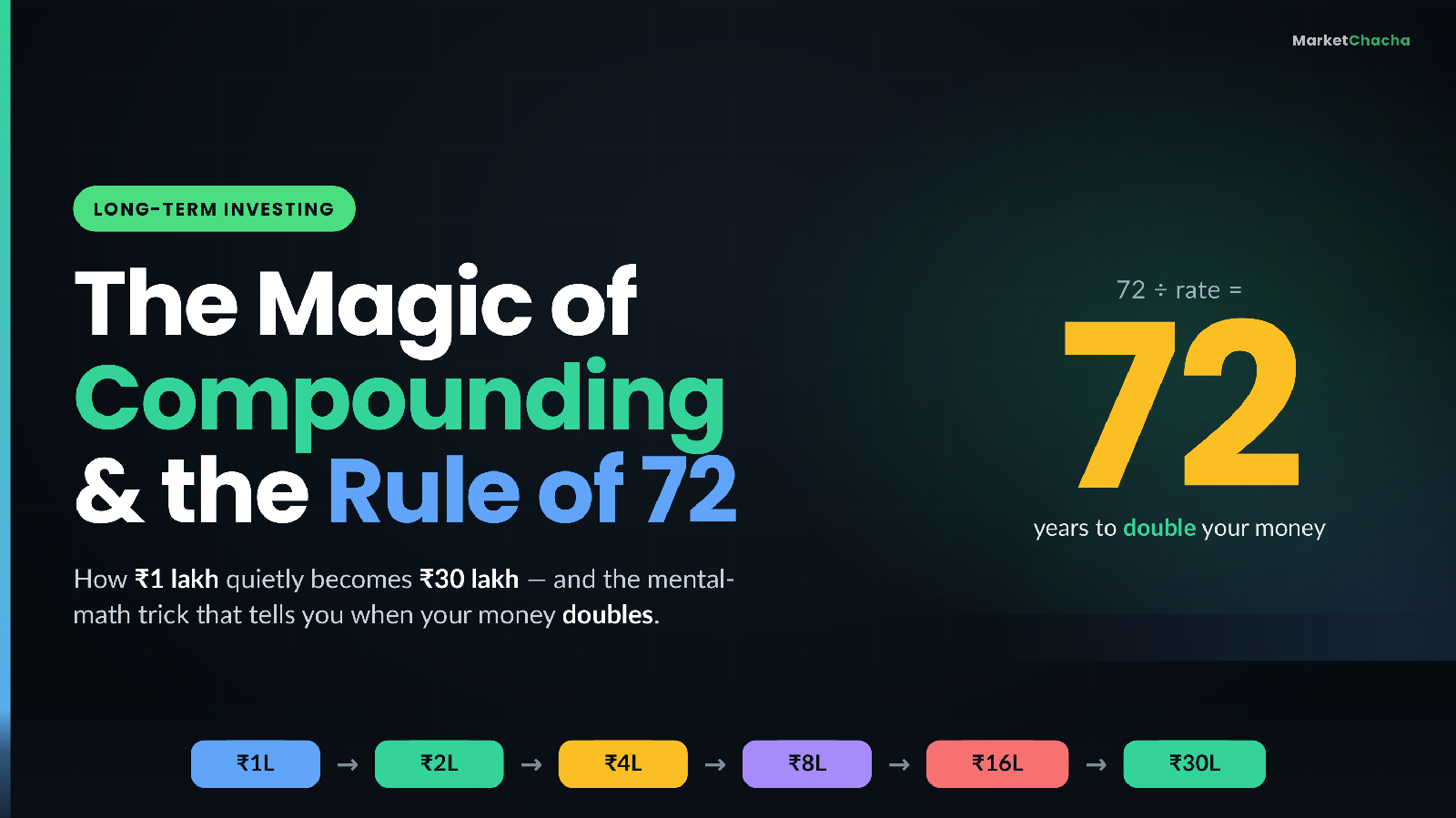
Compounding is the process of earning returns not just on the money you invest, but also on the returns that money has already generated — so your gains start generating their own gains. The Rule of 72 is a mental-math shortcut that estimates how many years it takes for money to double at a given annual return: years to double ≈ 72 ÷ return (%). Together, these two ideas explain why a modest sum, left alone for decades, can grow into a figure that feels almost unreasonable. This guide walks through what compounding actually is, a worked rupee example, how the Rule of 72 works and how accurate it is, why time matters more than the amount you start with, how compounding shows up in real investing, and the mistakes that quietly cancel it out.
What compounding really means
Imagine you invest ₹100 and it grows 10% in a year. You now have ₹110. In year two, you don't earn 10% on the original ₹100 — you earn 10% on the full ₹110, which is ₹11, taking you to ₹121. That extra ₹1 (the return earned on last year's return) is the whole idea. It looks tiny at first. But each year the base you earn on gets a little bigger, so the amount you add gets a little bigger, and the curve slowly bends upward.
The key mental shift is this: compounding is not addition, it is multiplication repeated. Your money grows by a percentage of a steadily rising number, so growth feeds on itself. Albert Einstein is often (probably apocryphally) quoted calling it the eighth wonder of the world — the quote may be invented, but the maths behind the awe is real.
Simple interest vs compound interest: a worked example
The fastest way to feel the difference is to put the two side by side. Suppose you invest ₹1,00,000 at 12% a year for 30 years.
With simple interest, you earn 12% only on the original ₹1 lakh every year — a flat ₹12,000 annually. Over 30 years that is 30 × ₹12,000 = ₹3,60,000 of interest, so you end with ₹4,60,000.
With compound interest, each year's 12% is calculated on the growing balance. The formula is Final value = P × (1 + r)n, where P is the starting amount, r is the annual rate as a decimal, and n is the number of years. Here that is ₹1,00,000 × (1.12)30 ≈ ₹29,96,000 — roughly ₹30 lakh. Same rate, same starting amount, same 30 years — yet compounding produces about 6.5 times more money than simple interest. The chart below shows how the two paths separate: for the first several years they look almost identical, and then the compound curve pulls away sharply.
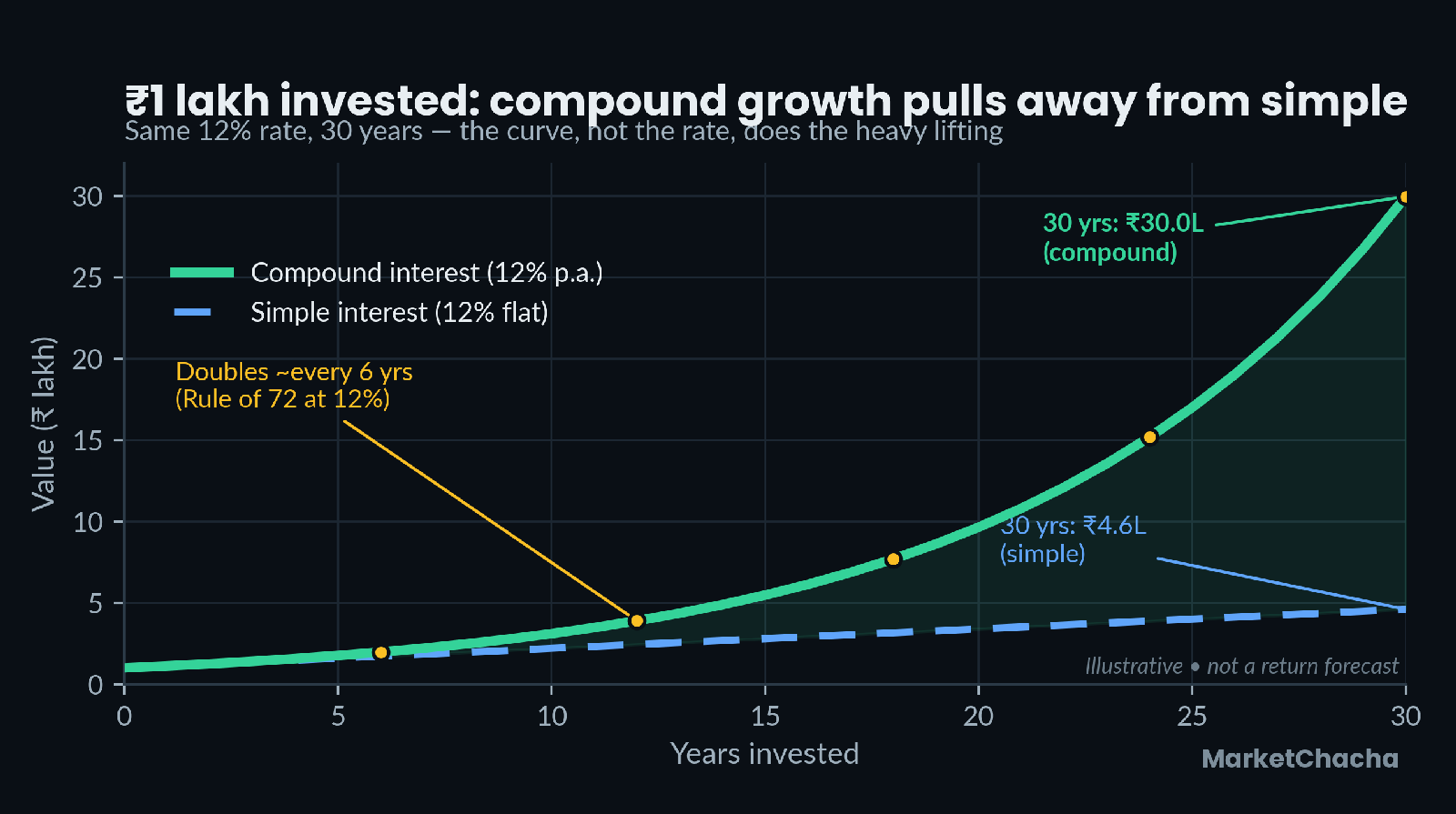
Notice where the gap opens up. In year 5, the two lines are close. It is the final third of the timeline — years 20 to 30 — where compounding does most of its work. This is the single most important and most counter-intuitive feature of compounding, and we will return to it below.
The Rule of 72: doubling time in one line of mental math
You rarely have a calculator handy when someone quotes a return. The Rule of 72 gives you a fast estimate of how long money takes to double: divide 72 by the annual return percentage. At 8% a year, money doubles in about 72 ÷ 8 = 9 years. At 12%, about 72 ÷ 12 = 6 years. At 6%, about 12 years. You can also flip it around: if you want your money to double in 5 years, you need roughly 72 ÷ 5 ≈ 14.4% a year.
Why 72 and not some other number? The mathematically exact constant for continuous doubling is about 69.3 (it comes from the natural logarithm of 2). But 72 is chosen because it is close enough and divides cleanly by 2, 3, 4, 6, 8, 9 and 12 — the return figures people actually use — making the division easy to do in your head. The reference card below turns this into a quick lookup.
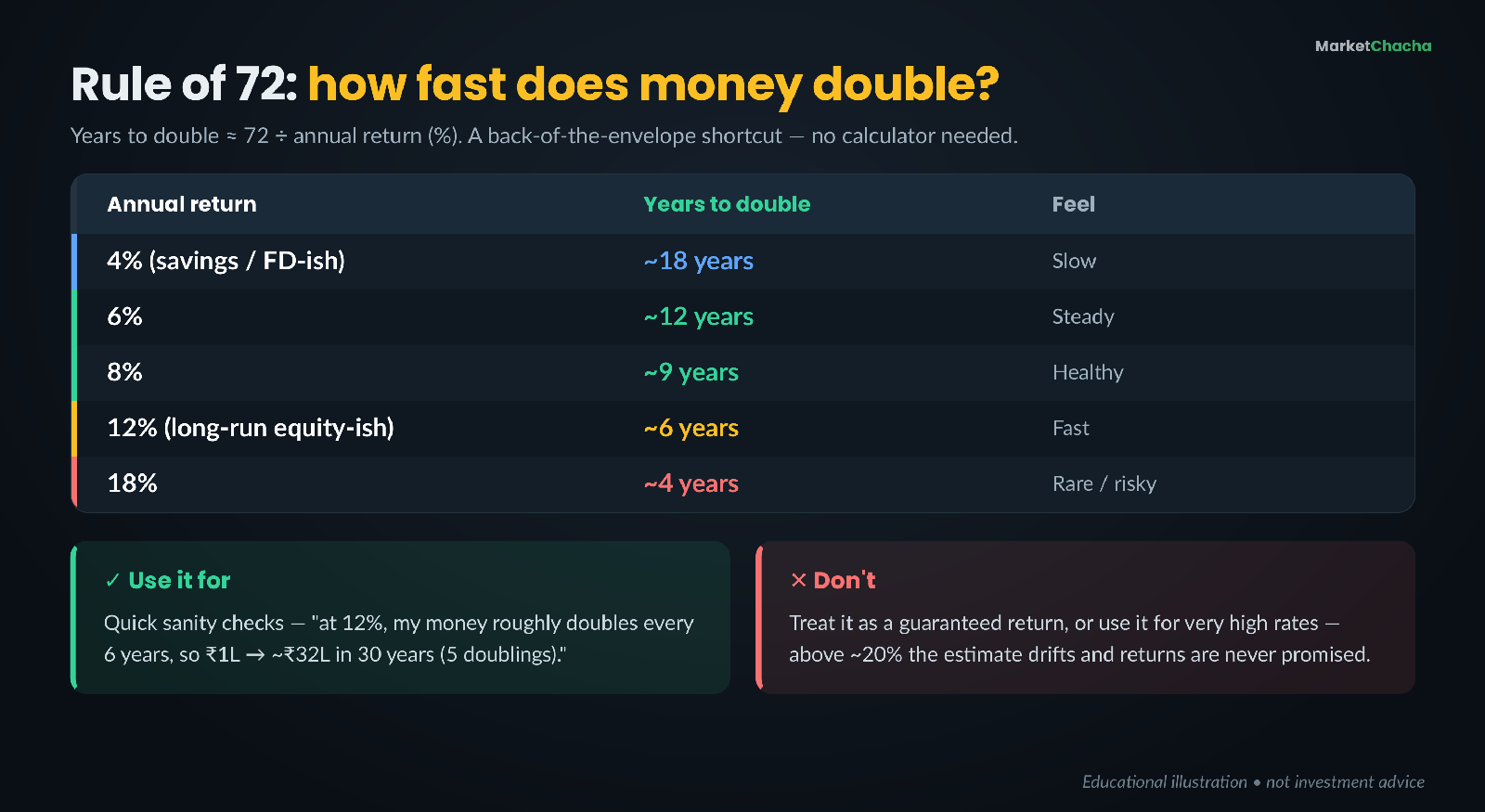
The Rule of 72 also explains the ₹30 lakh figure from earlier. At 12%, money doubles roughly every 6 years, so over 30 years it doubles about 5 times: ₹1L → ₹2L → ₹4L → ₹8L → ₹16L → ₹32L. The shortcut predicts about ₹32 lakh; the exact formula gives about ₹30 lakh. Close enough for a back-of-the-envelope sanity check.
How accurate is the Rule of 72?
It is an approximation, and it is most accurate in the range of returns most long-term investors care about — roughly 5% to 12%. At 8%, the rule says 9 years; the true doubling time is about 9.0 years. Nearly exact. As rates climb higher, the rule drifts and starts to slightly overstate how fast doubling happens; for very high rates some people switch to 73 or 74. For very low rates, a divisor of 69 or 70 is a touch more accurate. For everyday use, though, 72 is the sensible default.
Two useful cousins: the Rule of 114 estimates how long money takes to triple (114 ÷ rate), and the Rule of 144 estimates how long to quadruple (144 ÷ rate). At 12%, that is roughly 9.5 years to triple and 12 years to become four times as large.
Why time beats the amount you start with
Because compounding is multiplication repeated, the number of years is the most powerful lever — more powerful than either the rate or the starting amount. Each additional doubling period adds as much growth as everything that came before it combined. In the 12% example, the jump from year 24 to year 30 (₹16L to ₹32L in rule-of-72 terms) adds ₹16 lakh — more than the entire first 24 years produced. That is why starting early, even with small amounts, tends to beat starting later with larger amounts.
A classic illustration: an investor who puts money to work for 30 years and then stops can end up ahead of someone who invests the same monthly amount but starts a decade later, precisely because the early investor bought more doubling cycles. The lesson is not about picking winners — it is that time in the market gives the compounding curve room to reach its steep part.
Compounding in real investing: SIPs, index funds and dividends
In practice, most people compound through regular investing rather than a single lump sum. A Systematic Investment Plan (SIP) in a mutual fund invests a fixed amount every month, and each instalment then compounds for however long it stays invested. As an illustration, investing ₹10,000 a month for 30 years at an assumed 12% annual return would turn roughly ₹36 lakh of contributions into approximately ₹3.5 crore — again, most of that gap is the returns-on-returns, not the money you put in.
Compounding also shows up when you reinvest dividends instead of spending them (each reinvested payout buys more units that themselves earn future dividends), and in the way an index fund quietly rolls a broad market's growth forward year after year. The mechanism is always the same: keep the gains invested so they can generate their own gains. These figures are illustrative and assume a steady return; real markets rise and fall, and no return is guaranteed.
The silent enemies: inflation, fees and taxes
Compounding cuts both ways. Inflation compounds against you: at 6% inflation, the Rule of 72 says your money's purchasing power halves in about 12 years. So a return must first out-run inflation before it builds real wealth — which is why simply leaving cash idle quietly loses value. Fees compound too: a seemingly small 1% annual fee, dragging on the balance every year for decades, can quietly consume a large slice of your final corpus, because that 1% is skimmed off the very base that would otherwise have kept doubling. And taxes on frequent withdrawals interrupt compounding, since money paid out in tax is no longer in the pot earning future returns. Minimising these three leaks is often more reliable than chasing a slightly higher headline return.
Common mistakes beginners make
Expecting fireworks early. The first few years of compounding look boring and almost flat — many people give up before the curve reaches its steep section. Breaking the chain. Withdrawing or stopping resets the base and forfeits future doublings. Confusing the Rule of 72 with a promise. It estimates doubling time if a return holds; it does not guarantee any return, and market returns are lumpy, not smooth. Ignoring inflation and fees, and so overestimating real growth. Chasing very high advertised returns — the higher the promised rate, the more scrutiny it deserves, because "guaranteed" high returns are a classic warning sign.
FAQ
What is the Rule of 72 in simple words? It is a shortcut to estimate how many years it takes for an investment to double: divide 72 by the annual return percentage. At 9% a year, money doubles in about 72 ÷ 9 = 8 years.
How is compound interest different from simple interest? Simple interest is calculated only on your original amount each year, so it grows in a straight line. Compound interest is calculated on the original amount plus all previously earned returns, so it grows on a curve that accelerates over time.
How long does it take to double money at 12%? About 6 years, using the Rule of 72 (72 ÷ 12 = 6). The precise figure is close to 6.1 years, so the shortcut is a good estimate.
Does the Rule of 72 actually work, or is it just a myth? It genuinely works as an approximation and is most accurate for returns between roughly 5% and 12%. It is an estimate, not an exact formula, and it does not promise that any particular return will happen.
Why do people say to start investing early? Because the number of years is compounding's strongest lever. Each extra doubling period adds more growth than everything before it combined, so starting early gives the curve time to reach its steep, powerful stage.
Can compounding work against me? Yes. Inflation, annual fees and taxes all compound against your wealth over time, so a real return must beat inflation and costs before it builds purchasing power.
Educational content only — not investment advice, not a buy/sell recommendation. No guaranteed returns; all figures above are illustrative and assume a steady return that real markets do not deliver. Always do your own research.
This article is for educational and informational purposes only. It is not financial advice, investment recommendation, or a solicitation to buy or sell securities. Investing involves significant risks. I am not a SEBI-registered investment advisor. Readers should consult their own financial advisor and conduct their own research before making any investment decisions.
Comments
Join the conversation
Sign in to join the conversation.
Follow replies, add your view, and take part in the discussion.
Sign in to commentLoading comments...