

Adani Green Energy: what their latest filing actually means
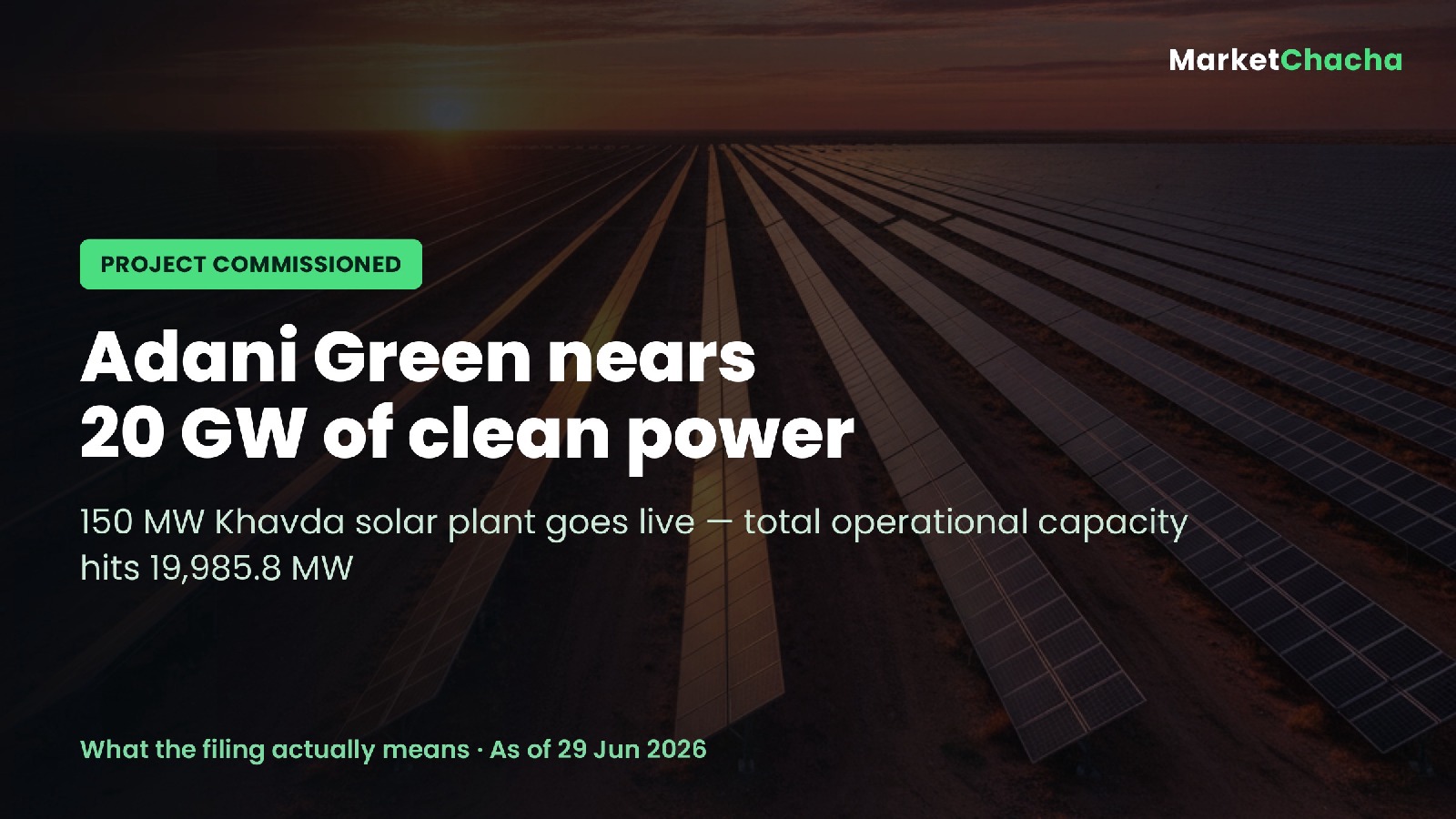
Adani Green Energy (AGEL) told the exchanges it has commissioned a new 150 MW solar power plant at Khavda, Gujarat, built through its step-down subsidiary Adani Renewable Energy Eight Ltd. Commercial generation began on 28 June 2026, taking the group's total operational renewable capacity to 19,985.8 MW — within a whisker of the symbolic 20 GW mark.
What was announced
This is an "operationalisation of project" filing — a company telling the exchange that a plant it was building has started producing and selling electricity. The specifics here: 150 MW of solar at Khavda (AGEL's giant renewable park in the Rann of Kutch), generation live from 28 June 2026, lifting cumulative operational capacity to 19,985.8 MW. It is an incremental addition, not a new business line.
What this type of filing means
For a power producer, capacity moves through stages: announced, under construction, and finally operational (commissioned). Only operational capacity earns revenue, because that is when electrons flow to the grid under a power-purchase agreement (PPA). So an "operationalisation" filing is the moment a project converts from cash-burning capex into a cash-generating asset. Companies file these regularly as each block of a large park goes live.
Why it matters / potential impact
More operational megawatts mean more contracted electricity sales and EBITDA over time. The flip side: AGEL adds capacity almost every month, so a single 150 MW block (under 1% of its base) rarely moves the needle on its own — markets largely expect it. What investors watch alongside capacity is the heavy capex and debt that building it requires; AGEL's net debt has climbed sharply as it scales toward its long-term capacity goals. (No price prediction here — just the mechanics.)
Is it expensive?
AGEL carries a market cap of roughly ₹2.5 lakh crore and a trailing P/E of about 150x (P/B near 8.4) — a very rich valuation that prices in years of fast capacity growth rather than today's earnings. For context among listed peers: pure-play NTPC Green Energy is even pricier at a P/E around 200x (market cap ~₹80,000 crore), while JSW Energy — which mixes thermal, hydro, wind and solar — trades far cheaper at a P/E near 38x (market cap ~₹1.05 lakh crore). So renewable "pure-plays" command premium multiples; a diversified generator like JSW is valued much more modestly. Rich, fair or cheap is ultimately about how much future growth you believe the price already assumes. This is framing, not a buy/sell call.
The business
Adani Green Energy is India's largest renewable energy company. It develops, builds and operates solar, wind and hybrid power plants and sells the electricity under long-term PPAs to distribution utilities and corporates. Khavda in Gujarat is its flagship mega-park and the main engine of its capacity growth. This filing affects that core generation business directly — it is not a side segment.
Beginner takeaway
A plant going "operational" is the point where a power company's investment finally starts earning. For a serial builder like Adani Green, each commissioning is a small, expected step, so the bigger story is the march toward 20 GW and how much debt it takes to get there — not any single 150 MW block.
FAQ
Does commissioning a plant mean immediate profit? Not instantly — it starts generating revenue under its PPA, but profit also depends on costs, interest on the debt used to build it, and how the tariff was set.
Why didn't the stock jump on a new plant? Because Adani Green adds capacity continuously, a sub-1% addition is already baked into expectations; investors react more to surprises than to routine progress.
What is a PPA? A power-purchase agreement is a long-term contract (often 20-25 years) under which a buyer agrees to purchase the plant's electricity at a set tariff, giving the producer predictable revenue.
Is a high P/E automatically bad? No — it signals investors expect strong future growth. The risk is that if growth or margins disappoint, a rich multiple has more room to fall.
As of 29 June 2026. Source: official BSE/NSE filing — read it directly here. We summarise filings for education and may make errors, so always verify against the official document. Educational content only — not investment advice, not a buy/sell recommendation.
This article is for educational and informational purposes only. It is not financial advice, investment recommendation, or a solicitation to buy or sell securities. Investing involves significant risks. I am not a SEBI-registered investment advisor. Readers should consult their own financial advisor and conduct their own research before making any investment decisions.
Comments
Join the conversation
Sign in to join the conversation.
Follow replies, add your view, and take part in the discussion.
Sign in to commentLoading comments...