

CoreWeave 8-K: a $3B convertible plus a 35M-share ATM — what it means
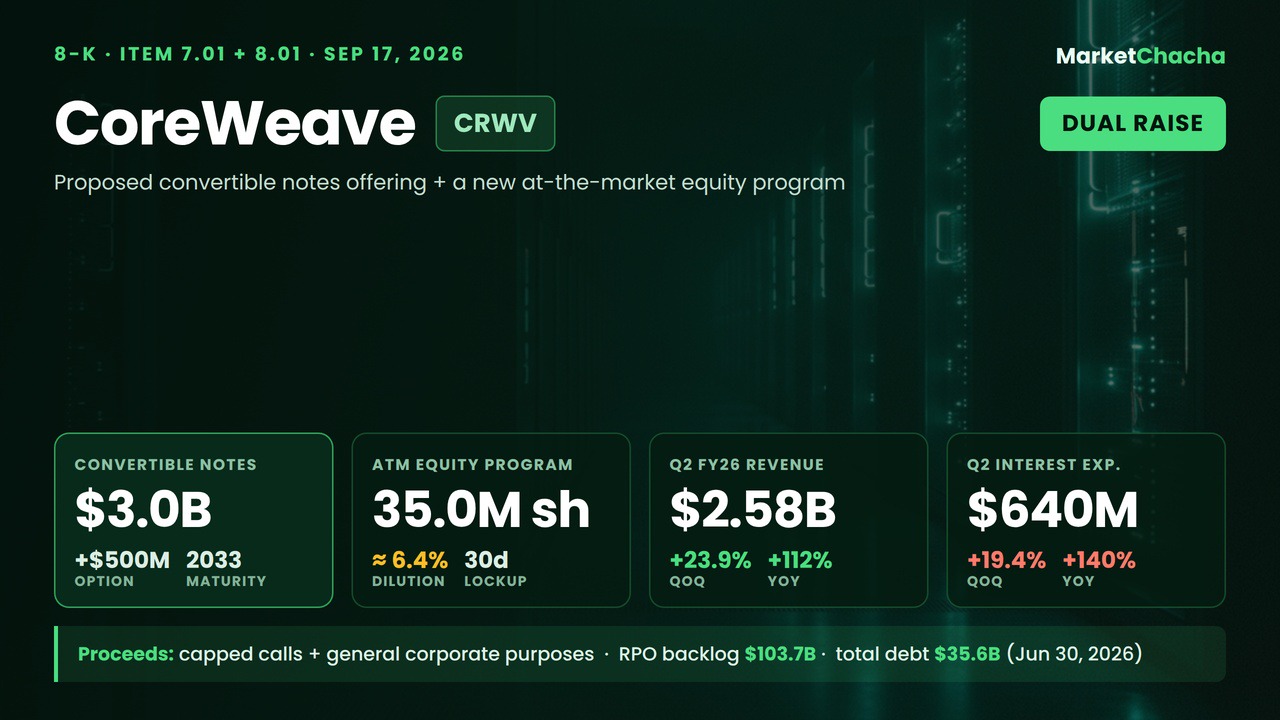
CoreWeave filed an 8-K before the bell on 17 September 2026 announcing two fundraises at once: a proposed $3.0 billion of convertible senior notes due 2033 (plus a $500 million option, taking it to $3.5 billion), and — disclosed only in the body of the filing, not the press release — a new at-the-market (ATM) equity programme for up to 35,000,000 shares.
The terms
- Convertible notes: $3.0bn principal, maturing 1 April 2033, senior unsecured, sold privately under Rule 144A. Coupon and conversion rate are set at pricing, not today.
- Capped calls: bought alongside the notes to blunt dilution if they convert, up to a cap.
- ATM programme: up to 35m Class A shares via eleven banks, commissions up to 2.0%, off a Form S-3 shelf filed 5 June 2026. No shares may be sold for at least 30 days after the convertible purchase agreement.
- Use of proceeds: funding the capped calls, then "general corporate purposes" — deliberately broad language.
What Item 7.01 and Item 8.01 mean
An 8-K is the "something happened" form, filed between quarterly reports. Item 7.01 (Regulation FD Disclosure) is used when a company releases information it wants all investors to get at once — here, the notes announcement. It is "furnished" rather than "filed", a lighter legal standard. Item 8.01 (Other Events) is the catch-all for material news with no dedicated box.
That distinction matters today. The press release covered only the convertible notes; the 35m-share ATM appears solely under Item 8.01 in the filing itself. Read the headline and stop, and you miss half the story — the best argument there is for opening the actual document, as when CoreWeave filed an 8-K on a $2.6bn loan in August.
Why it matters
Cost of capital is the point. CoreWeave's existing borrowings are expensive: its delayed-draw term loans carried effective rates of 15%, 11% and 9% at 30 June 2026, and its straight bonds run from 8.500% to 9.750%. Its two existing convertibles cost just 1.75%, because the investor accepts a low coupon in exchange for an option on the shares. When CoreWeave ran this play in April 2026 it announced $3.0bn, upsized to $3.5bn and priced at 1.75%. Swapping 9%-plus money for sub-2% money is a real saving — Cloudflare's 0% convertible was the same trade.
The interest bill is the pressure. In the June 2026 quarter revenue was $2,575m, up 112% year on year and about 24% on the prior quarter. But net interest expense was $640m — up 140% year on year and far larger than the $49m operating loss. Interest, not operations, drove the $626m net loss. Total debt maturities stood at $35.6bn and total liabilities at $72.0bn, against $5.5bn of cash.
Dilution is the trade-off. 35m shares is roughly 6.4% of the ~551m Class A and B shares outstanding at 30 June 2026. That is authorisation, not issuance — an ATM lets a company drip shares out over time, and CoreWeave may sell none. The capped calls and the 30-day standstill both suggest management is alert to the dilution optics.
The demand case. CoreWeave reported $103.7bn of remaining performance obligations at 30 June, 41% of it due to become revenue within 24 months. Filling data centres with Nvidia GPUs to serve that backlog is capital-hungry — hence the repeated trips to the market. Customer concentration is easing but high: the largest customer was 36% of quarterly revenue, down from 71%.
Beginner takeaway
A convertible note is a loan that can turn into stock, so the lender accepts a low interest rate for that upside — cheaper cash today, possible dilution later. An ATM is standing permission to sell shares gradually. Both on one morning says a company is funding a very large build-out and wants flexibility in paying for it.
FAQ
Does this mean CoreWeave is running out of money? Not on the face of the filing — it reported $5.5bn of cash at 30 June 2026. It signals heavy planned capital spending and a wish to refinance expensive debt, not distress.
Why announce the notes before knowing the interest rate? Converts are marketed to institutions first and priced hours later, usually after the close — which is why today's filing leaves the coupon and conversion price blank.
Are 35m shares hitting the market now? No. It is a maximum authorisation, and no shares may be sold for at least 30 days after the convertible purchase agreement. Upcoming catalysts sit on the calendar.
As of 17 September 2026. Source: official SEC filing — read it directly here. June-quarter figures are from CoreWeave's Form 10-Q filed 12 August 2026. We summarise filings for education and may make errors, so always verify against the official document. Educational content only — not investment advice, not a buy/sell recommendation.
This article is for educational and informational purposes only. It is not financial advice, investment recommendation, or a solicitation to buy or sell securities. Investing involves significant risks. I am not a SEBI-registered investment advisor. Readers should consult their own financial advisor and conduct their own research before making any investment decisions.
Comments
Join the conversation
Sign in to join the conversation.
Follow replies, add your view, and take part in the discussion.
Sign in to commentLoading comments...