

Grasim: what their latest filing actually means
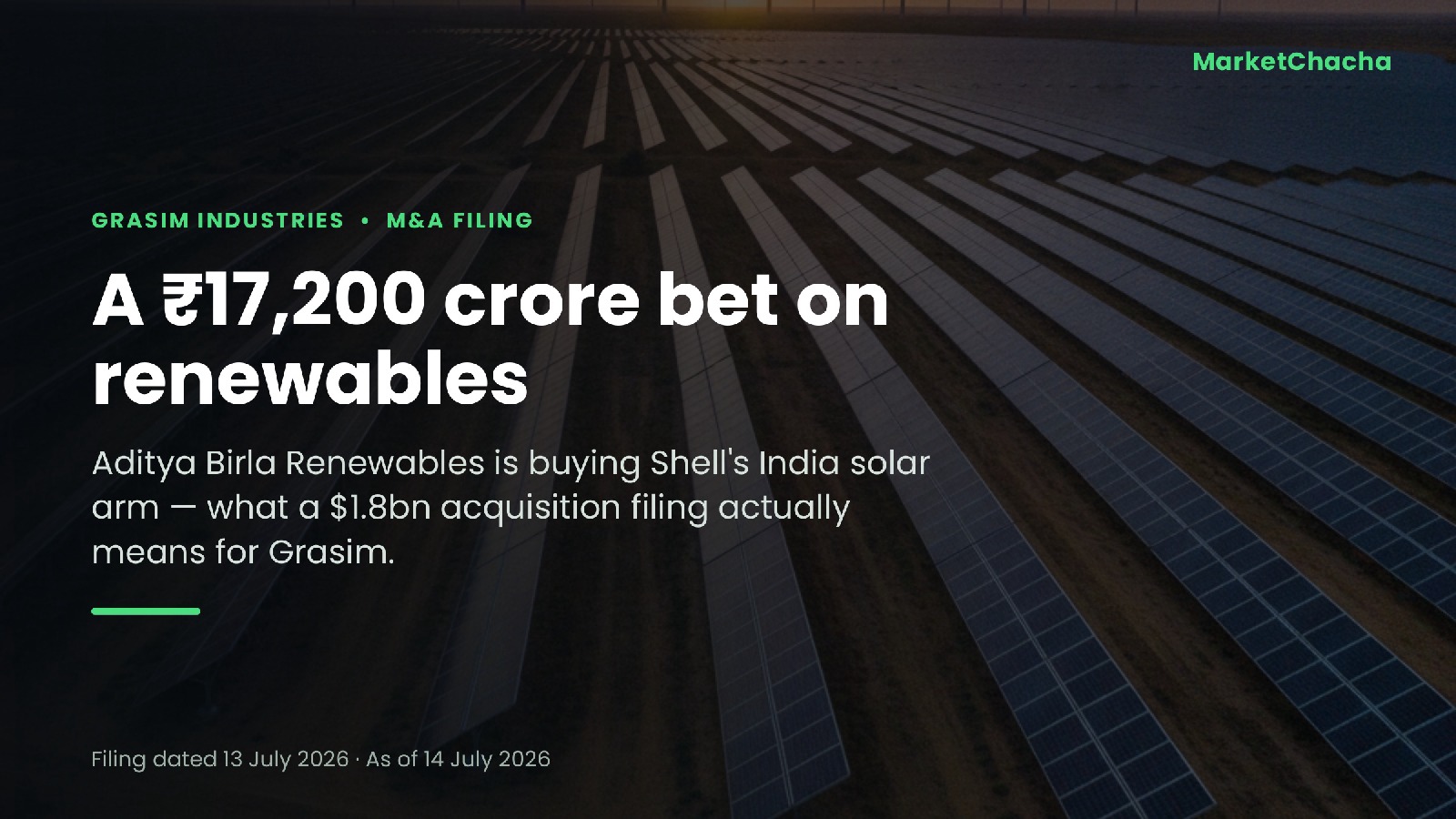
Grasim Industries told the exchanges on 13 July 2026 that Aditya Birla Renewables Limited (ABRen) — its subsidiary — has signed a definitive agreement to buy 100% of Solenergi Power Private Limited (Shell's Indian renewables business, better known as Sprng Energy) from Shell Overseas Investment BV. The deal values Solenergi at an enterprise value of about $1.8 billion (~₹17,200 crore), and would take ABRen's renewable portfolio from roughly 4.4 GW to about 9.4 GW.
What was announced
- Buyer: Aditya Birla Renewables Ltd, a subsidiary of Grasim.
- Target: Solenergi Power Pvt Ltd — a contracted renewable portfolio of roughly 5 GWp, of which about 3.3 GWp is already operational and about 1.7 GWp is under construction.
- Price: enterprise value of about $1.8 billion (~₹17,200 crore).
- Seller: Shell Overseas Investment BV, as Shell continues to trim non-core assets.
- Timeline: completion expected before the end of calendar 2026, subject to regulatory approvals and customary conditions.
What this type of filing means
This is an M&A intimation under Regulation 30 of SEBI's LODR rules. When a listed company (or a material subsidiary) signs a deal big enough to move the needle, it must tell the exchanges promptly so every investor learns about it at the same time. Two words worth knowing:
- Definitive agreement — the binding contract. It is not the same as a completed deal: money and ownership only change hands at "closing", after regulators (here, likely the CCI and sector approvals) sign off. Deals can still lapse between signing and closing.
- Enterprise value (EV) — the value of the whole business including the debt sitting inside it, not just the cheque written to the seller. In infrastructure assets like solar farms, a large chunk of EV is typically existing project debt that the buyer inherits.
The business
Grasim is a holding-cum-operating company of the Aditya Birla Group, and it is far more than one business:
- Cement — through its listed subsidiary UltraTech Cement, which is the biggest single driver of Grasim's consolidated profits.
- Viscose staple fibre & yarn — its historic core.
- Chemicals — chlor-alkali, one of India's largest.
- Financial services — through Aditya Birla Capital.
- Paints (Birla Opus), B2B e-commerce and renewables — the newer, cash-hungry growth bets. This filing sits in the renewables bucket.
So this acquisition affects one growth arm, not the whole group's earnings engine. But it is large enough — ₹17,200 crore against a Grasim market cap of roughly ₹1.87 lakh crore — that the market reads it as a statement about where group capital is going.
Why it matters / potential impact
- Scale, bought instead of built. Adding ~5 GWp instantly is far faster than winning auctions and constructing farms over years. It vaults ABRen into the top tier of Indian renewable developers alongside Adani Green, ReNew, Tata Power Renewables and NTPC Green.
- Contracted cash flows. Operational solar assets with long-term power purchase agreements generate fairly predictable, annuity-like revenue — attractive, but low-return-on-capital unless bought at the right price.
- Leverage is the live question. Renewable assets are debt-heavy by nature. Brokerages have flagged ABRen's balance sheet (net debt/EBITDA around 3.9x in FY26) and the capital-allocation question: Grasim is simultaneously funding paints, chemicals and now a ₹17,200 crore renewables buyout. More debt at the subsidiary level eventually shows up in consolidated numbers.
- Execution and approval risk. The deal must clear regulators and close; integration of a large third-party platform is never free.
Is it expensive?
As reported on Screener/Moneycontrol, Grasim trades at a P/E of roughly 40x with a market cap of about ₹1.87 lakh crore (share price around ₹3,160, near its 52-week high of ₹3,246). That is a rich multiple in absolute terms — though holding companies are awkward to value on P/E, because much of Grasim's "earnings" come as a consolidated share of UltraTech rather than from its own factories.
For context on named peers: UltraTech Cement — the crown jewel inside Grasim — trades around a P/E of 46x at a market cap of about ₹3.38 lakh crore, i.e. UltraTech alone is worth materially more than the whole of Grasim (the classic holding-company discount). On the renewables side, JSW Energy trades at a P/E north of 100x on a market cap near ₹1.01 lakh crore — a reminder that the market prices green-power growth on optimism, not on current earnings. None of this is a target or a call; it is simply where the multiples sit today.
Beginner takeaway
A signed deal is not a closed deal, and a big number in a press release is not automatically value creation. What decides whether this acquisition is good for a Grasim shareholder is the price paid per GW, how much debt comes with it, and whether the returns beat the cost of that debt. Watch the next few quarterly filings for consolidated net debt and any equity infusion into ABRen — that is where the truth shows up.
FAQ
Does buying a 5 GW solar business make Grasim's profit go up immediately? No. Nothing changes until the deal closes (expected by end-2026), and even then the assets bring both earnings and the debt and depreciation attached to them.
Why did the stock not simply rocket on a $1.8bn deal? Because the market weighs the cost too. Analysts publicly flagged leverage and capital-allocation concerns — investors are asking how a group already funding paints and chemicals will pay for this.
What is "enterprise value" versus what Shell actually receives? EV includes the debt inside the target. The cash equity cheque to Shell will be EV minus the net debt that ABRen takes on, so the headline figure overstates the cash outgo.
Is Grasim the same as UltraTech? Not quite — Grasim is the parent that holds a controlling stake in UltraTech, plus fibre, chemicals, paints, financial services and renewables. Buying Grasim is buying the whole basket, usually at a discount to the sum of its parts.
As of 14 July 2026. Source: official BSE/NSE filing — read it directly here. We summarise filings for education and may make errors, so always verify against the official document. Educational content only — not investment advice, not a buy/sell recommendation.
This article is for educational and informational purposes only. It is not financial advice, investment recommendation, or a solicitation to buy or sell securities. Investing involves significant risks. I am not a SEBI-registered investment advisor. Readers should consult their own financial advisor and conduct their own research before making any investment decisions.
Comments
Join the conversation
Sign in to join the conversation.
Follow replies, add your view, and take part in the discussion.
Sign in to commentLoading comments...