

Welspun Corp: what their latest filing actually means
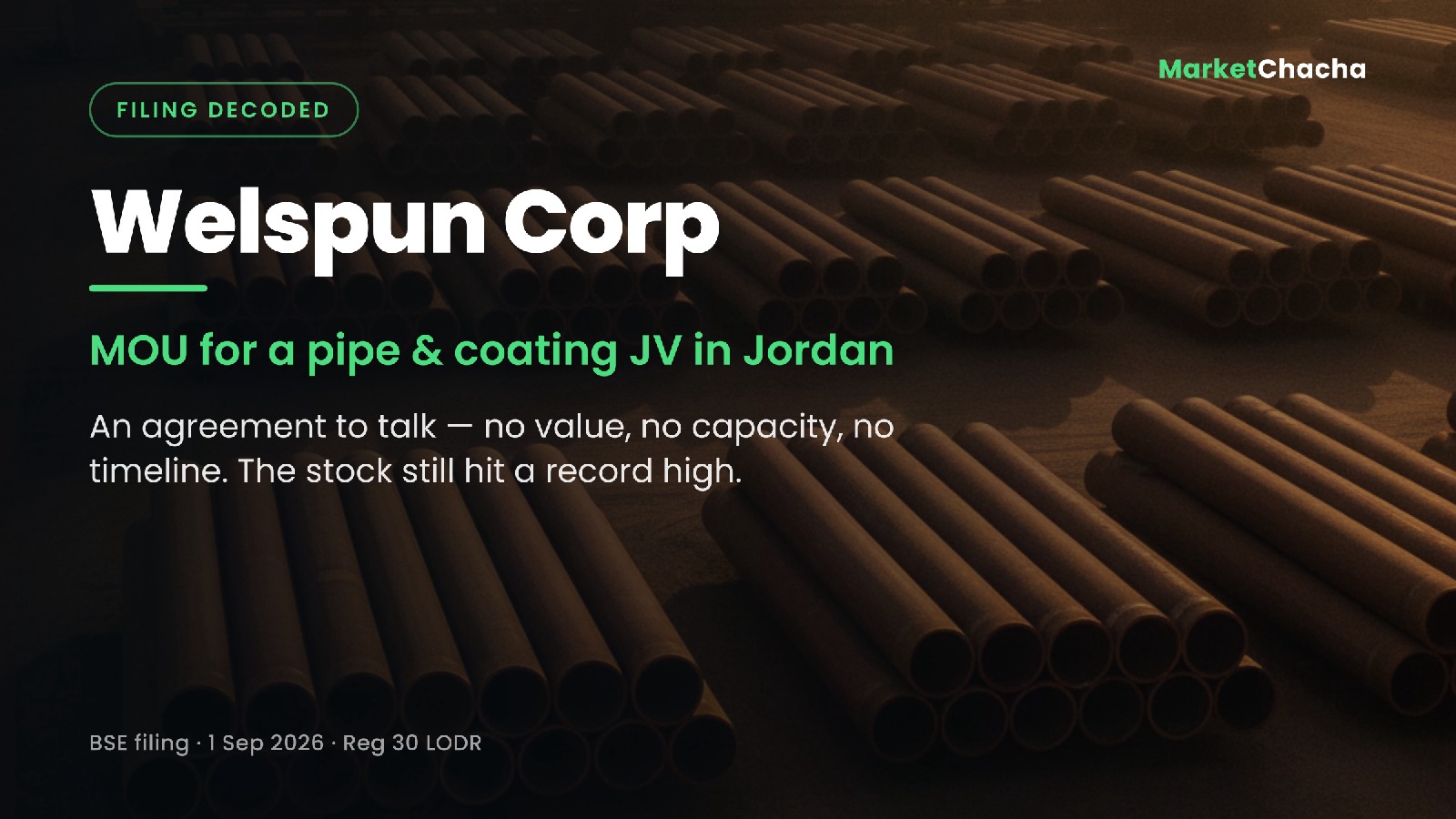
Welspun Corp told the exchanges on 1 September 2026 that it has signed a Memorandum of Understanding — not a contract, not an order — with US-listed Perma-Pipe International Holdings, the developers of Jordan's National Water Carrier Project and the Government of Jordan, to work towards a joint venture that would build pipe manufacturing and advanced coating facilities in Jordan. The stock responded by hitting a fresh record high the next morning.
What was announced
The filing was made under Regulation 30 of SEBI's LODR rules (BSE scrip 532144 / NSE: WELCORP). In plain terms:
- Welspun Corp and Perma-Pipe have jointly signed an MOU with Jordan's National Water Carrier Project developers and the Jordanian government.
- The parties "intend to establish a joint venture" to build and run an integrated large-diameter pipe manufacturing and anti-corrosion coating platform in Jordan.
- Welspun brings the large-diameter steel pipe manufacturing; Perma-Pipe brings anti-corrosion coating systems and engineered piping.
- Target end-markets: water, oil & gas, energy and infrastructure projects in Jordan and the wider Levant. The release also flags possible future demand from reconstruction in Syria, Lebanon, Iraq and Gaza, oil and gas rerouting toward the Port of Aqaba, and emerging hydrogen and carbon-capture pipelines.
- Quotes from Vipul Mathur (MD & CEO, Welspun Corp) and Saleh Sagr (President & CEO, Perma-Pipe) frame it as a "core products, core geographies" expansion.
Here is the part most headlines skipped. The filing says explicitly that the parties are still working through "technical, commercial, financing and regulatory requirements", and that "additional details regarding investment in the JV, ownership structure, capacity, and project timeline will be announced as the project progresses and definitive agreements are completed."
So there is no rupee value, no capacity number, no ownership split and no timeline in this document. Nothing has been ordered and nothing has been contracted.
What this type of filing means
An MOU sits at the earliest, softest end of the corporate-announcement ladder. It is worth knowing where each rung sits, because Indian exchanges require companies to disclose all of them and retail investors routinely treat them as equivalent:
- MOU / Letter of Intent — the parties agree they want to do something together and will now negotiate. Usually non-binding on commercials. No revenue attaches. This is what Welspun filed.
- Definitive agreement / JV agreement — binding, with ownership percentages, capital commitments and obligations. This is the one that changes the balance sheet.
- Letter of Award (LOA) / order win — a customer has actually placed work with you. This is what feeds the order book and eventually revenue.
- Execution and revenue recognition — the money finally shows up in the P&L, often years later.
MOUs fall out for perfectly ordinary reasons: financing does not close, a government changes the project scope, the economics do not work at the studied capacity. A company that files an MOU has done nothing wrong — it is disclosing early, as SEBI requires. The mistake is on the reading side, when the market prices an MOU as though it were an LOA.
A useful habit: after any such announcement, wait for the next filing on the same subject. If a definitive agreement follows within a few quarters, the MOU was real. If nothing follows for a year, you have your answer.
Why it matters / potential impact
The market reaction, for context. On 2 September the stock traded up roughly 5% at about ₹2,523 against the previous close of ₹2,405.80, after touching an intraday high near ₹2,592 — a fresh record, and up close to 8% at the peak. That was on a day when the broader Indian market was falling on crude and global rate worries, so this was a stock-specific move, not the tide.
Strategically, the logic is sound. Large-diameter line pipe is heavy, bulky and expensive to ship; freight is a real share of delivered cost. That is why pipe makers build near demand rather than exporting everything from one base. A plant in Jordan would put Welspun inside the Levant market rather than shipping into it, and next to a specific anchor project — the National Water Carrier, Jordan's flagship desalination-and-conveyance programme.
Financially, nothing has changed yet. No capex has been committed, no debt raised, no equity issued, no order booked. Whenever the JV does get signed, the questions to ask are the usual ones for an overseas greenfield plant: how much capital, funded how, what ownership share, what utilisation is assumed, and is there a firm anchor order or only a hoped-for pipeline?
There is also a real risk column. This is a Middle East infrastructure project announced into a week when crude is spiking on renewed US–Iran tension. Regional instability cuts both ways: it can create reconstruction demand, and it can freeze financing and delay projects for years. The filing's own list of potential markets — Syria, Lebanon, Iraq, Gaza — is a list of places where timelines are, to put it gently, uncertain.
Is it expensive?
Welspun Corp trades at a P/E of roughly 37.8 on trailing EPS of about ₹87.5, with a market capitalisation near ₹60,965 crore and a price-to-book around 6.5. Against a 52-week range of roughly ₹710 to ₹2,575, the stock has more than tripled over the past year and is trading at the very top of that band.
Compare with a named listed peer in Indian pipes: Ratnamani Metals & Tubes trades at a P/E of about 34.2 with a market cap near ₹16,502 crore and price-to-book of about 3.9. So Welspun is roughly four times Ratnamani's size, carries a modestly higher earnings multiple, and a materially higher multiple of book value.
Honest framing: this is not a cheap stock on either measure. A near-38x multiple and 6.5x book on a steel-pipe manufacturer is a growth-and-order-book valuation, not a value one — it embeds an expectation that the record order book converts and that overseas expansion keeps working. That may well happen. But it does mean the price already assumes good news, which is exactly the setting in which a non-binding MOU can be over-rewarded. None of this is a view on where the price goes.
The business
Welspun Corp is one of India's largest makers of large-diameter welded steel pipe — the kind used for oil and gas transmission lines and bulk water conveyance. Its range spans submerged-arc welded (LSAW/HSAW) and ERW line pipes, ductile iron pipes, and steel plates and coils, and it also has power generation. It manufactures in India and overseas, including a US facility that recently booked a landmark order, and reported FY26 consolidated revenue near ₹17,000 crore with EBITDA margins above 14%.
Why that matters for reading this filing: pipes are the core, not a sideline. A Jordanian pipe-and-coating JV, if it happens, would sit squarely in the main business rather than in some small diversified corner — which is the case for treating it as strategically relevant. It is also, for now, additive optionality on top of an already large order book, not a rescue of a weak core.
Beginner takeaway
An MOU is an agreement to talk, not an agreement to build. Welspun Corp has told the market it wants to set up a pipe plant in Jordan with a partner — a sensible idea, with zero disclosed numbers attached to it today. The honest way to track this one is to note the date, then watch for the definitive JV agreement and the first actual order; those are the filings that carry money in them.
FAQ
Is an MOU legally binding? Usually not on the commercial terms. It typically binds the parties only to negotiate in good faith, and often to confidentiality — either side can walk away without buying the pipes.
Why did the stock go up if nothing was actually signed? Markets trade expectations. An MOU with a national government and a named anchor project raises the perceived odds of future orders, and in a stock already re-rating on a record order book, that shift alone can move the price. That is a change in expectation, not in earnings.
What is a "National Water Carrier" project? It is Jordan's flagship programme to desalinate seawater at Aqaba and pipe it hundreds of kilometres north to Amman and other cities. Projects like this need enormous quantities of large-diameter, corrosion-protected pipe — which is the demand Welspun and Perma-Pipe are positioning for.
What should I look for next? Three things, all in future exchange filings: a definitive JV agreement with an ownership split, a disclosed capital commitment and funding plan, and the first firm order or letter of award for the Jordanian facility. Until at least the first of those appears, this remains an intention.
As of 2 September 2026. Source: official BSE/NSE filing — read it directly here. We summarise filings for education and may make errors, so always verify against the official document. Educational content only — not investment advice, not a buy/sell recommendation.
This article is for educational and informational purposes only. It is not financial advice, investment recommendation, or a solicitation to buy or sell securities. Investing involves significant risks. I am not a SEBI-registered investment advisor. Readers should consult their own financial advisor and conduct their own research before making any investment decisions.
Comments
Join the conversation
Sign in to join the conversation.
Follow replies, add your view, and take part in the discussion.
Sign in to commentLoading comments...