

Synopsys popped 13% on a 42% revenue jump — most of that 42% isn't growth
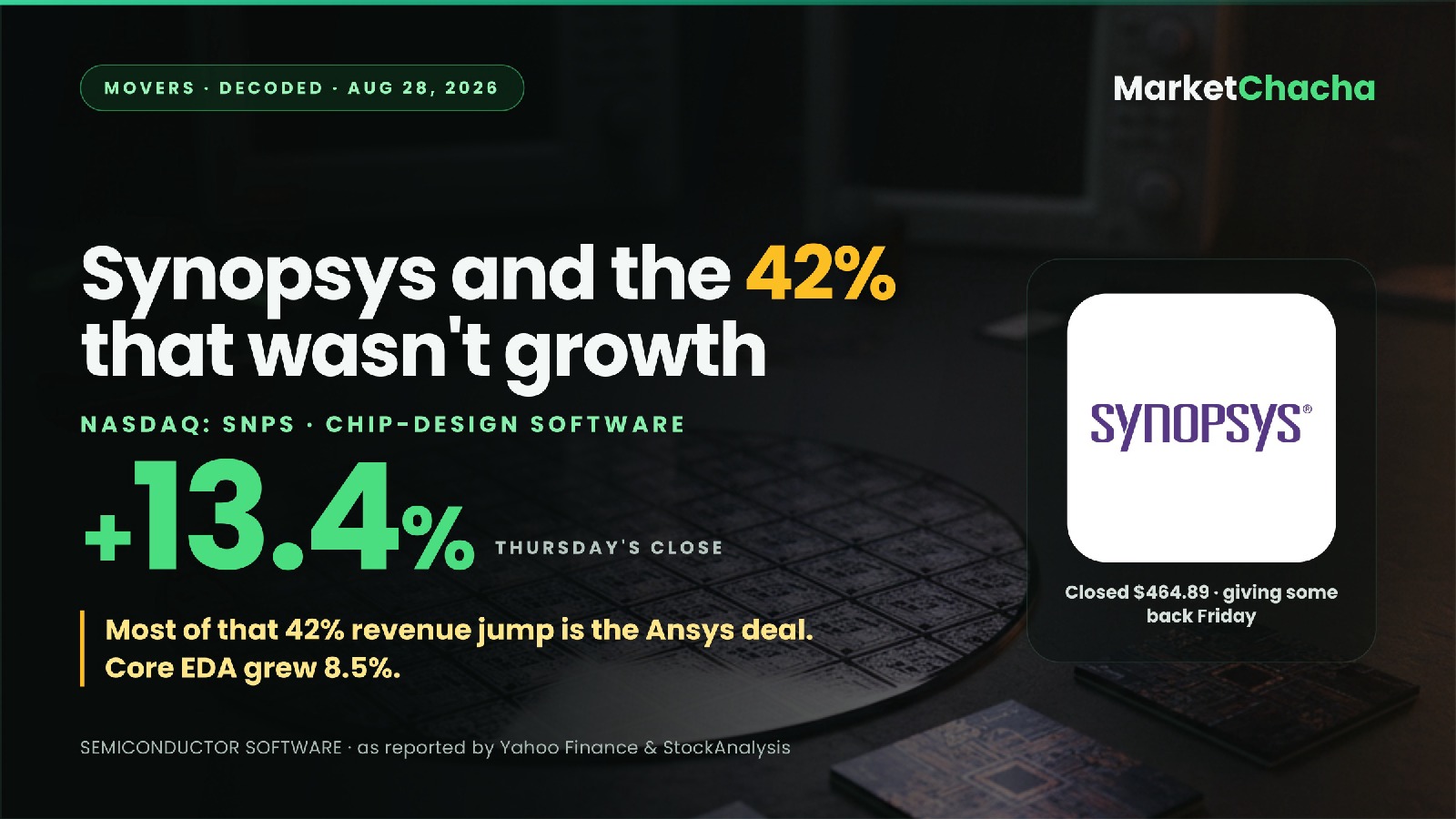
Synopsys makes the software chip companies use to design chips. It just posted a 42% revenue jump, the stock ripped 13.4%, and today it's giving some back. That 42% is worth pulling apart — most of it isn't growth.
What happened
Results landed after Wednesday's bell. The first reaction was a shrug: shares slipped about 4% after hours, per Quartz. Thursday reversed it completely — Synopsys closed at $464.89, up 13.39% from a $410.00 prior close on about 4.07 million shares, as reported by Yahoo Finance. Friday it's cooling: $448.08, down 3.62%, as reported by StockAnalysis around 10:09 am ET.
Why it moved
The beat and the raise were both real. Revenue $2.48 billion, up 42% year on year. Adjusted EPS $3.91 against a $3.67 consensus; GAAP EPS $2.84, up 89%. Full-year revenue guidance went to $9.69–9.74 billion (from $9.625–9.705 billion), adjusted EPS to $15.04–15.10 (from $14.72–14.80). Q4 adjusted EPS guidance of $4.10–4.16 beats the $4.00 street number. Backlog is $10.9 billion.
Now the part the headline hides. Synopsys closed its $35 billion purchase of Ansys — a simulation-software company — on 17 July 2025. Its fiscal Q3 last year ended right around that date, so the comparison quarter had almost no Ansys in it. This one has a full quarter: Ansys alone contributed $711 million. Strip that out and the underlying business grew nothing like 42%. Core EDA — the tools that actually lay out silicon — grew 8.5%. Design IP grew 11% to $474 million.
That's also why it's fading today. 8.5% is single-digit growth in exactly the segment that should be the direct AI-silicon beneficiary — if AI were causing a design boom, that's the line where it should shout. The company also flagged restructuring charges of $425–500 million.
Is it expensive?
Market cap $85.87 billion. Trailing P/E 82.43, which looks brutal. Forward P/E 27.54. That gap is the most useful thing here: a $35bn acquisition gets written down through years of amortisation of acquired intangibles, crushing reported GAAP profit without touching the cash. You can see it — free cash flow was $746 million in the quarter and over $2.1 billion year to date, more than three times reported GAAP profit. The trailing 82x is largely an accounting artefact; the forward 27.5x is the number that means something.
Against the obvious alternative, Cadence Design Systems: market cap $94.45 billion, trailing P/E 69.09, forward P/E 40.49, revenue $5.84 billion TTM growing 14.7%. Read that twice — Cadence is worth more than Synopsys on roughly 60% of the revenue, at a much higher forward multiple. Synopsys is the cheaper multiple with the messier books. Neither is cheap outright; a high-20s forward multiple still assumes years of compounding.
The business
Three things. Core EDA — design and verification software, plus hardware-assisted verification, which had a record quarter. Design IP, $474 million at a 26.5% adjusted operating margin: pre-built circuit blocks customers license instead of building from scratch. And Ansys, $711 million, physics simulation for cars, aircraft and medical devices — well beyond chips. That third piece is why "Synopsys is an AI stock" is only about two-thirds true.
Who it touches
- Cadence (CDNS) — the other half of the EDA duopoly. Synopsys' 8.5% core growth is a live datapoint on whether the design boom is as broad as Cadence's 40x forward multiple assumes.
- Every fabless designer — Nvidia, AMD, Qualcomm, Broadcom, the hyperscalers' in-house silicon teams. EDA is a toll booth: you can't tape out a modern chip without these licences, so it scales with design complexity, not chip volumes.
- India — Synopsys says roughly 20% of the world's chip-design experts are based here, across seven India locations. India's design-services and semiconductor-mission push sits on dollar-priced EDA licences, so this duopoly's pricing power is a domestic input cost.
What would flip it
The bull case needs design complexity to rise faster than customer budgets. The risk is the reverse: if AI silicon design consolidates around a handful of very large buyers, a duopoly supplier's pricing power gets tested at renewal, and 8.5% becomes the trend rather than a soft quarter. Watch the core EDA line next quarter, not headline revenue — the headline stops flattering from Q4, once Ansys sits on both sides of the comparison.
One thing to carry away: when a company buys a business the size of Ansys, its growth rate and its P/E both lie for about a year — in opposite directions.
As of 11:45 am ET, Friday 28 August 2026. Sources: Yahoo Finance, StockAnalysis, Benzinga, The Motley Fool, Quartz, Synopsys/PR Newswire. For discussion and education only — not investment advice. Verify before acting.
This article is for educational and informational purposes only. It is not financial advice, investment recommendation, or a solicitation to buy or sell securities. Investing involves significant risks. I am not a SEBI-registered investment advisor. Readers should consult their own financial advisor and conduct their own research before making any investment decisions.
Comments
Join the conversation
Sign in to join the conversation.
Follow replies, add your view, and take part in the discussion.
Sign in to commentLoading comments...