

Cochin Shipyard: what their latest filing actually means
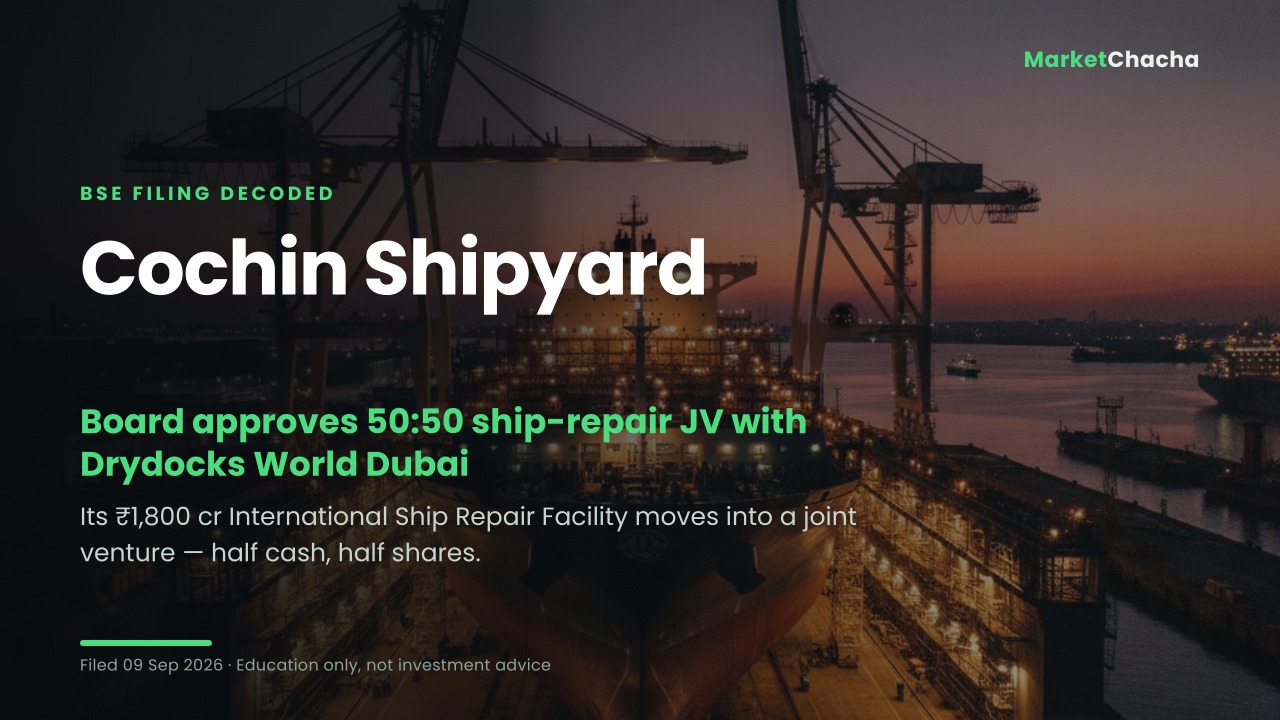
Cochin Shipyard Ltd (CSL) told the exchanges on 9 September 2026 that its board has approved forming a 50:50 joint venture with Drydocks World – Dubai FZCO (DDW), a DP World company. The JV will own and run CSL's International Ship Repair Facility (ISRF) at Willingdon Island, Kochi — a business valued at ₹1,800 crore that CSL will transfer out of the listed company and into the new JV on a slump-sale basis, taking half the money in cash and half in JV shares.
What was announced
- Structure: a new unlisted private limited company registered in Kochi. CSL and DDW hold 50% each.
- What goes in: CSL's ISRF — the dedicated ship-repair yard for dry-docking, maintenance, repair and overhaul of commercial and naval vessels below 130 metres and 6,000 tonnes.
- Price: the ISRF is transferred as a going concern for not less than ₹1,800 crore, based on third-party independent valuations. CSL receives 50% in cash and 50% in JV shares.
- Scale of the asset: ~30 hectares at Willingdon Island leased from Cochin Port Authority for 60 years, built at a cost of ₹970 crore, with a 6,000-tonne ship lift and transfer system, six workstations and ~1,400 metres of berthing. It can repair up to six vessels at once, with annual throughput of up to 82 ships. Commercial operations began 12 August 2024.
- Expansion plan: the JV also envisages adding ten more workstations to the ISRF.
- Who controls it: a five-member board — DDW nominates three directors plus the CEO, CFO and COO; CSL nominates two.
- Still pending: approvals from the Cochin Port Authority, the Government of India (Ministry of Ports, Shipping and Waterways, and DIPAM) and CSL's own shareholders.
- Timeline: the Joint Venture Agreement is proposed to be signed on 11 September 2026; the rest follow once the JV company is incorporated and approvals come through. Implementation is expected before the end of the current financial year.
What this type of filing means
This is a board meeting outcome under Regulation 30 of SEBI's LODR Regulations — the rule that forces a listed company to tell the exchanges about anything price-sensitive, promptly and in a standard format. When a board approves a deal like this, the company must publish the "major terms" the same day, which is why you get a numbered annexure with valuation, shareholding and approvals instead of a vague press note.
Three terms in this filing are worth learning properly:
- Joint venture: two companies each put something in and share ownership. Here CSL contributes an operating asset; DDW contributes capital, four decades of ship-repair expertise and a global customer book. Neither side controls it outright — though note DDW gets three of five board seats and the senior management, so operational control sits with DDW, not CSL.
- Slump sale: a whole business is sold as a single going concern for one lump-sum price, rather than selling the individual land, cranes and equipment item by item. The buyer gets the business running, with its contracts and people, on day one.
- Related-party transaction (RPT): CSL and DDW are not related parties. But because the ISRF is being sold to a company CSL will own 50% of, that transfer itself becomes an RPT — a deal where the company is on both sides of the table. SEBI's answer is not to ban it but to force sunlight: an arm's-length price and a shareholder vote. CSL says it will take that vote under the Companies Act and Regulation 37A.
The 50-50 split of consideration matters too. Taking half in shares rather than all cash means CSL keeps economic exposure to the facility's future earnings instead of simply cashing out — but those earnings will now show up as share of a joint venture, not as CSL's own revenue.
Why it matters / potential impact
Balance sheet: ₹900 crore of cash (half of ₹1,800 crore) is meaningful for a company with a net worth of ₹5,892.83 crore as of 31 March 2026 — the ISRF alone is about 30.55% of CSL's net worth, per the filing. That cash can fund shipbuilding capacity, the new dry dock, or working capital without raising equity or debt.
Revenue optics: here is the nuance a headline will miss. The ISRF generated ₹207.33 crore in FY26 — only about 4.81% of CSL's revenue from operations. So an asset worth ~30% of net worth was contributing under 5% of the top line. That gap is really the whole argument for the deal: the facility is expensive and underutilised, and CSL is buying a partner's expertise and order flow to fill it rather than trying to fill it alone. If it works, the JV's earnings return as CSL's 50% share; if it doesn't, CSL has at least converted a heavy asset into ₹900 crore of cash.
Consolidation: once the ISRF sits in a 50-50 JV, its revenue will very likely stop being consolidated line-by-line into CSL's accounts and instead appear as share of profit from a joint venture. Reported revenue could look slightly smaller even if the underlying business grows. Read future results with that in mind.
Execution risk: nothing is done yet. This needs the port authority, two arms of the central government and shareholders to sign off. CSL is 67.92% government-owned, so the state is both the majority shareholder and, through DIPAM and the shipping ministry, the approving authority. Deals of this shape can slip.
Is it expensive?
Per Screener.in, Cochin Shipyard trades around ₹1,530 a share for a market cap of about ₹40,251 crore, on a P/E of roughly 68 and a price-to-book of about 6.8x. Against FY26 sales of ₹4,308 crore and net profit of ₹643 crore, with ROCE of 14.3% and ROE of 11.2%, that is a rich multiple — you are paying roughly 68 rupees for each rupee of current annual profit from a business earning an 11% return on its equity.
Compare with the obvious listed peer, Mazagon Dock Shipbuilders: market cap about ₹97,495 crore on a P/E near 34, with ROCE of 36% and ROE of 29.2%. Mazagon Dock is more than twice CSL's size, earns roughly three times the return on capital — and trades at half CSL's earnings multiple. That is the honest framing: CSL is the more expensive of the two on earnings despite the weaker returns profile, which tells you the market is pricing in future defence and ship-repair growth rather than today's numbers. Whether that optimism is justified is exactly what deals like this JV will decide. This is context, not a target or a buy/sell call.
The business
Cochin Shipyard is one of India's largest shipbuilding and ship-repair yards, majority-owned by the Government of India (67.92%). It runs on two legs: shipbuilding — defence vessels for the Indian Navy and Coast Guard plus commercial and green vessels — and ship repair, which covers naval refits and commercial dry-docking across its Kochi yards and units elsewhere. The ISRF in this filing is a distinct, newer facility within the repair leg, not the whole company. Its FY26 revenue of ₹207.33 crore against ₹4,308 crore group sales tells you plainly: this deal reshapes one slice of one division, and the shipbuilding order book — where most of CSL's earnings come from — is untouched by it.
Beginner takeaway
A company moving an asset into a joint venture is not the same as selling it, and it is not the same as winning an order. CSL is swapping full ownership of an underused ₹1,800 crore repair facility for ₹900 crore of cash plus half of a business run by an experienced global operator. The thing to watch is not today's price move but whether the approvals actually come through by March, and then whether that facility's utilisation genuinely rises under new management.
FAQ
Does this mean Cochin Shipyard is selling itself? No. It is transferring one facility — the ISRF, about 4.81% of FY26 revenue — into a jointly-owned company, and keeping 50% of it. The shipbuilding business and the rest of the repair business stay entirely within CSL.
Why does CSL give away three of the five board seats if it owns half? Ownership and management control are separate things in a JV, and partners often trade one for the other. CSL keeps 50% of the economics while DDW takes operating control and supplies the management team — which is consistent with the stated rationale of importing global ship-repair practices and turnaround times.
Will my CSL shares change in number or value because of this? Your shareholding does not change — no new CSL shares are being issued and none are cancelled. The shares being issued at face value or an independent valuer's price are shares in the new JV company, issued to CSL and DDW, not to public shareholders.
Is the deal certain to happen? No. The filing states it still needs approvals from the Cochin Port Authority, the Ministry of Ports, Shipping and Waterways, DIPAM and CSL's shareholders. The Joint Venture Agreement is only proposed to be signed on 11 September 2026, and full implementation is targeted before the end of this financial year.
As of 9 September 2026. Source: official BSE/NSE filing — read it directly here. We summarise filings for education and may make errors, so always verify against the official document. Educational content only — not investment advice, not a buy/sell recommendation.
This article is for educational and informational purposes only. It is not financial advice, investment recommendation, or a solicitation to buy or sell securities. Investing involves significant risks. I am not a SEBI-registered investment advisor. Readers should consult their own financial advisor and conduct their own research before making any investment decisions.
Comments
Join the conversation
Sign in to join the conversation.
Follow replies, add your view, and take part in the discussion.
Sign in to commentLoading comments...