

Bank of England holds at 3.75% — but 3 of 9 voted to hike, and the Bank now sees inflation above 4%
The numbers
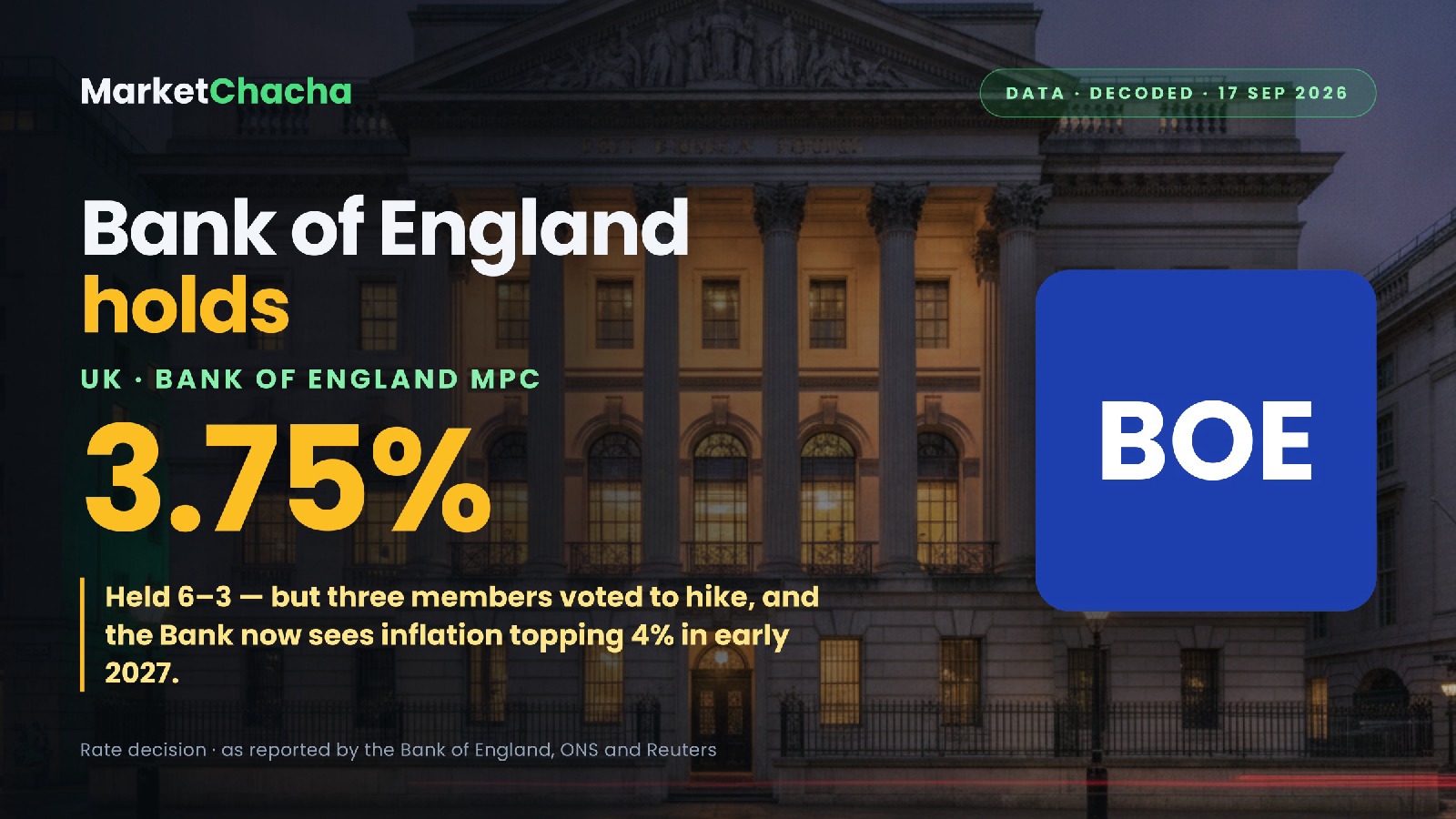
The Bank of England left Bank Rate at 3.75% on Thursday — but the vote was 6–3, with chief economist Huw Pill, Megan Greene and Catherine Mann all voting to raise it to 4.00% immediately, as reported by Reuters and Euronews. A third of the committee now wants a hike.
The print that set this up: UK CPI inflation rose to 3.1% in August from 2.9% in July, per the Office for National Statistics. Underneath, core CPI was unchanged at 2.6% and services inflation unchanged at 3.4%. Goods did the work, jumping to 2.7% from 2.2%, with motor fuel up 23.0% year-on-year and petrol at 161.3p a litre — the highest since November 2022. Food inflation was just 1.3%.
The Bank also lifted its own forecast: inflation now peaks slightly above 4% in early 2027, against a previous path of about 3.2% in late 2026. Separately the MPC voted unanimously to run its gilt pile — £488bn, down from a £895bn peak in February 2022 — to zero by 2034, roughly £46bn a year, with active sales paused for six months.
What it means
Here's what the headline hides. An energy shock and a wage-price spiral look identical on a CPI chart and are completely different problems. Brent is up 36% since the July report at about $106 a barrel, and UK wholesale gas is up 78% to 207 pence per therm — the Middle East conflict showing up at the pump. A one-off jump in fuel lifts the price level; it drops out of the annual rate twelve months later by itself. Hiking into it tightens after the damage is done.
That's the six. Core and services standing still is their evidence that pay deals haven't caught the fever. The three dissenters aren't arguing about today's print — they're arguing about "second-round effects", the moment workers and firms start writing 4% into wages and contracts. Then the shock stops being temporary. Governor Andrew Bailey sat on the fence: "the longer this volatility persists, the bigger the impact it will have on inflation, and the more likely it is we will need to raise Bank Rate."
Note what this is not: a cut. A year ago the debate was how fast rates come down. Now the only live question is up — a day after the Fed hiked to 3.75%–4.00%.
Who it touches
- Indian IT. The UK and Europe are a big slice of the order book at TCS, Infosys, HCLTech and Wipro. Higher-for-longer UK rates mean tighter client budgets, and the pound slipping about half a cent on the decision trims what UK billings convert to in rupees.
- UK-facing manufacturers. Tata Motors sells JLR into a market where two-year mortgage rates sit roughly 95 basis points above pre-conflict levels, per the Bank. Car finance gets dearer alongside the mortgage.
- Bond investors. Selling gilts to zero by 2034 adds paper to a world that just watched the US 10-year cross 5%. Yields fell on the day — the hold read dovish — but the supply plan is a long-dated headwind.
- India's import bill. The same $106 Brent driving UK petrol to a four-year high lands on it too.
What to watch
Two dates. The Bank of Japan decides on 18 September — the last major central bank near the floor, and the one whose move says most about whether this is a global turn. Then the BoE's November meeting, with a full forecast round and a press conference; economists quoted after the decision see that as the realistic window. Before it, September UK CPI tells you whether services inflation finally budged off 3.4%. If it does, 6–3 gets a lot closer.
Full schedule: MarketChacha calendar
As of 6:45 PM IST, 17 September 2026. Sources: ONS Consumer price inflation, August 2026, Bank of England, Reuters via Business Recorder, Euronews. For discussion and education only — not investment advice. Verify before acting.
This article is for educational and informational purposes only. It is not financial advice, investment recommendation, or a solicitation to buy or sell securities. Investing involves significant risks. I am not a SEBI-registered investment advisor. Readers should consult their own financial advisor and conduct their own research before making any investment decisions.
Comments
Join the conversation
Sign in to join the conversation.
Follow replies, add your view, and take part in the discussion.
Sign in to commentLoading comments...