

ICICI Bank: what their latest filing actually means
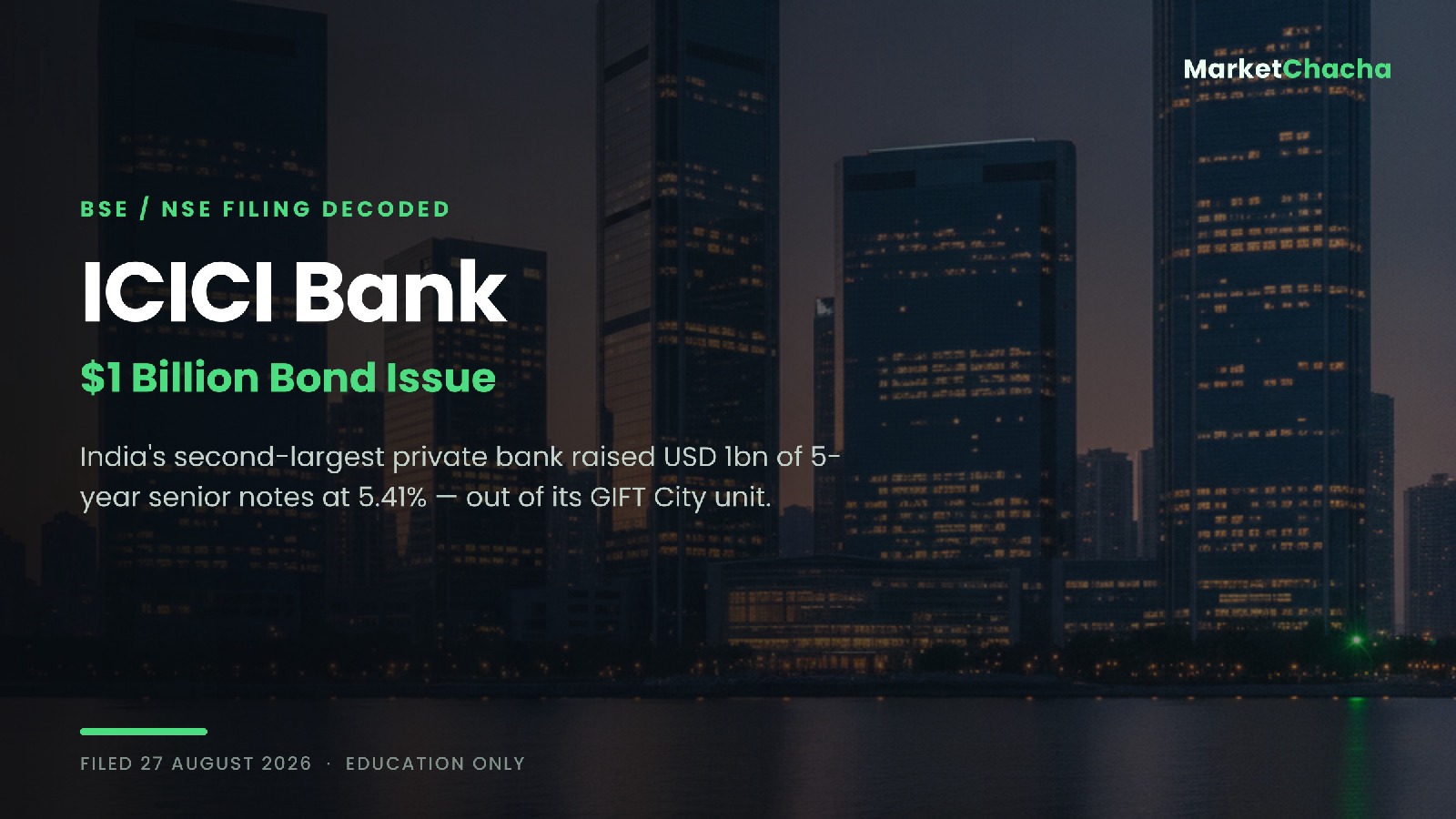
ICICI Bank told the exchanges on 27 August 2026 that it has completed a USD 1 billion bond sale — five-year senior unsecured notes, issued through its GIFT City IFSC Banking Unit under an existing USD 7.5 billion borrowing programme. In plain terms: the bank borrowed roughly ₹9,570 crore from overseas investors, and this filing is the confirmation that the money has landed.
What was announced
- Size: USD 1 billion (about ₹9,570 crore at the RBI reference rate of ₹95.73/USD published for 24 August 2026).
- Instrument: Senior Unsecured Fixed Rate Notes — i.e. plain vanilla bonds, not equity. No new shares are being created.
- Coupon and tenor: priced on 24 August at 5.41% per annum, five-year money maturing in 2031, with interest paid twice a year.
- Issued by: the bank's IFSC Banking Unit — its branch inside GIFT City, Gujarat.
- Programme: drawn under ICICI Bank's existing USD 7.5 billion Global Medium Term Note (GMTN) Programme.
- Ratings on the notes: BBB from S&P Global Ratings and Baa3 from Moody's — both investment grade, sitting roughly at India's sovereign rating level.
- Where they trade: listed on the Global Securities Market of India INX (IFSC), the Debt Securities Market of NSE IFSC, and the Singapore Exchange (SGX-ST).
What this type of filing means
This is a Regulation 30 disclosure — the SEBI rule that forces a listed company to tell the exchanges about any event a reasonable investor would want to know. Fundraising is on that list, so a completed bond issue gets filed.
A few pieces of jargon worth decoding, because they show up constantly in Indian bank filings:
- Senior unsecured notes. "Senior" means these lenders sit near the front of the queue if things ever go wrong — ahead of subordinated bondholders and well ahead of shareholders. "Unsecured" means no specific asset is pledged as collateral; you are lending against the bank's overall credit quality. For a strong bank, that is normal and cheaper to arrange than secured debt.
- GMTN Programme. Think of it as a pre-approved borrowing shelf. Instead of doing the full legal and disclosure work every time it wants dollars, the bank sets up a USD 7.5 billion umbrella once, then draws tranches from it whenever markets look attractive. This USD 1 billion is one such draw — it does not mean the bank just raised USD 7.5 billion.
- IFSC Banking Unit. GIFT City is India's offshore financial zone. A bank branch there is treated broadly like a foreign branch for regulatory and tax purposes, which makes it a natural place to raise and lend foreign currency without routing everything through Singapore, Dubai or London.
- Fixed rate. The 5.41% is locked for the full five years. The bank knows its exact cost of this money until 2031, regardless of what global rates do next.
Crucially, this is debt, not equity. There is no dilution here — existing shareholders' ownership percentage is untouched. That is the single biggest difference between this and a QIP or preferential allotment, which do dilute you.
Why it matters / potential impact
It is funding, not distress. Banks are in the business of borrowing and lending; raising wholesale money is routine plumbing, not a warning sign. The relevant question is never "why are they borrowing" but "at what price, and what will they do with it".
The price is the story. 5.41% for five-year dollar money, at investment grade, from an Indian issuer, is a reasonably tight level. It tells you global investors are comfortable with ICICI Bank's credit and were willing to fund a full billion in one go. If the coupon had come in materially wider, that would have been the interesting signal.
What dollars are for. Foreign-currency funding generally supports foreign-currency lending — trade finance, export credit, dollar loans to Indian corporates with overseas operations, and the bank's own IFSC and international book. Matching dollar liabilities against dollar assets is how a bank avoids taking a naked currency bet. Investors should not assume this money funds domestic rupee loans; that is normally deposit-funded.
Margin effect is modest. ₹9,570 crore sounds enormous in isolation, but ICICI Bank's balance sheet runs into lakhs of crores. A single tranche at a known fixed cost is unlikely to move reported net interest margin in any visible way. Treat it as balance-sheet maintenance, not a earnings catalyst.
The GIFT City angle is the quiet trend. More Indian financial institutions routing international borrowing through IFSC units rather than offshore centres is a structural shift worth watching over years, not days.
Is it expensive?
On the numbers as reported by Tickertape, ICICI Bank trades at a P/E of about 18.8 and a price-to-book of roughly 2.68, on a market capitalisation of about ₹10.19 lakh crore at a share price of ₹1,443. For banks, price-to-book is usually the more meaningful of the two, because a bank's book value is close to the real economic value of its loan assets.
Against peers, that is the richer end of the large private banks:
- HDFC Bank — market cap about ₹11.20 lakh crore, P/E about 14.7, P/B about 1.84.
- Axis Bank — P/E about 14.7, P/B about 1.80.
So ICICI Bank is the second-largest of the group by market value but carries a clear valuation premium — roughly 45% more book value multiple than HDFC Bank. Historically the market has paid up for ICICI on the strength of its return ratios and asset quality; whether that premium is deserved today is a judgement about future earnings, not something this bond filing answers either way. A funding announcement like this has essentially no bearing on the valuation multiple. This is framing, not a target and not a recommendation.
The business
ICICI Bank is India's second-largest private sector bank by market capitalisation. The core of it is straightforward commercial banking — taking deposits and lending — split across retail (home loans, vehicle loans, personal loans, credit cards), business and SME banking, wholesale/corporate banking, and treasury. Around that sits a group of well-known subsidiaries: ICICI Prudential Life Insurance, ICICI Lombard General Insurance, ICICI Prudential AMC and ICICI Securities, plus overseas branches and the GIFT City IFSC unit that issued these notes.
For this filing, the relevant point is scope: the borrowing sits in the bank's own international/treasury operations, not in any of the insurance or asset-management arms. It affects how the bank funds one slice of its book — it is not a group-wide event.
Beginner takeaway
When a bank you own announces it has "raised" money, check one thing first: debt or equity? Debt like these notes costs the bank interest but leaves your shareholding untouched. Equity — a QIP, rights issue or preferential allotment — creates new shares and shrinks your slice of the company.
This one is debt, at a known 5.41% for five years, under a facility the bank already had in place. It is the financial equivalent of a well-run business drawing on a pre-arranged credit line at a good rate: worth noting, rarely worth reacting to.
FAQ
Does this dilute my ICICI Bank shares? No. These are bonds, not shares. The number of shares outstanding is unchanged, so your ownership percentage is unaffected.
Is ICICI Bank in trouble if it needs to borrow USD 1 billion? No — borrowing is what banks do for a living. They fund themselves with deposits and wholesale debt, then lend at a higher rate. A large, cheaply-priced issue that investors happily absorbed is a sign of confidence, not stress.
What does "BBB / Baa3" actually mean? Both are the lowest rungs of investment grade at S&P and Moody's respectively. It means the notes are considered reasonably safe but not top-tier — which is typical, since an Indian company is generally rated around or below India's own sovereign rating.
Can a retail investor in India buy these notes? Not practically. They are dollar-denominated institutional bonds listed on India INX, NSE IFSC and Singapore's exchange, with large minimum ticket sizes and offshore settlement — they are aimed at institutions, not individuals.
As of 28 August 2026. Source: official BSE/NSE filing — read it directly here. Pricing details (coupon and tenor) as reported by Sahi from the bank's 24 August 2026 pricing announcement; valuation figures as reported by Tickertape. We summarise filings for education and may make errors, so always verify against the official document. Educational content only — not investment advice, not a buy/sell recommendation.
This article is for educational and informational purposes only. It is not financial advice, investment recommendation, or a solicitation to buy or sell securities. Investing involves significant risks. I am not a SEBI-registered investment advisor. Readers should consult their own financial advisor and conduct their own research before making any investment decisions.
Comments
Join the conversation
Sign in to join the conversation.
Follow replies, add your view, and take part in the discussion.
Sign in to commentLoading comments...