

Why did Dexcom (DXCM) jump ~11% today?
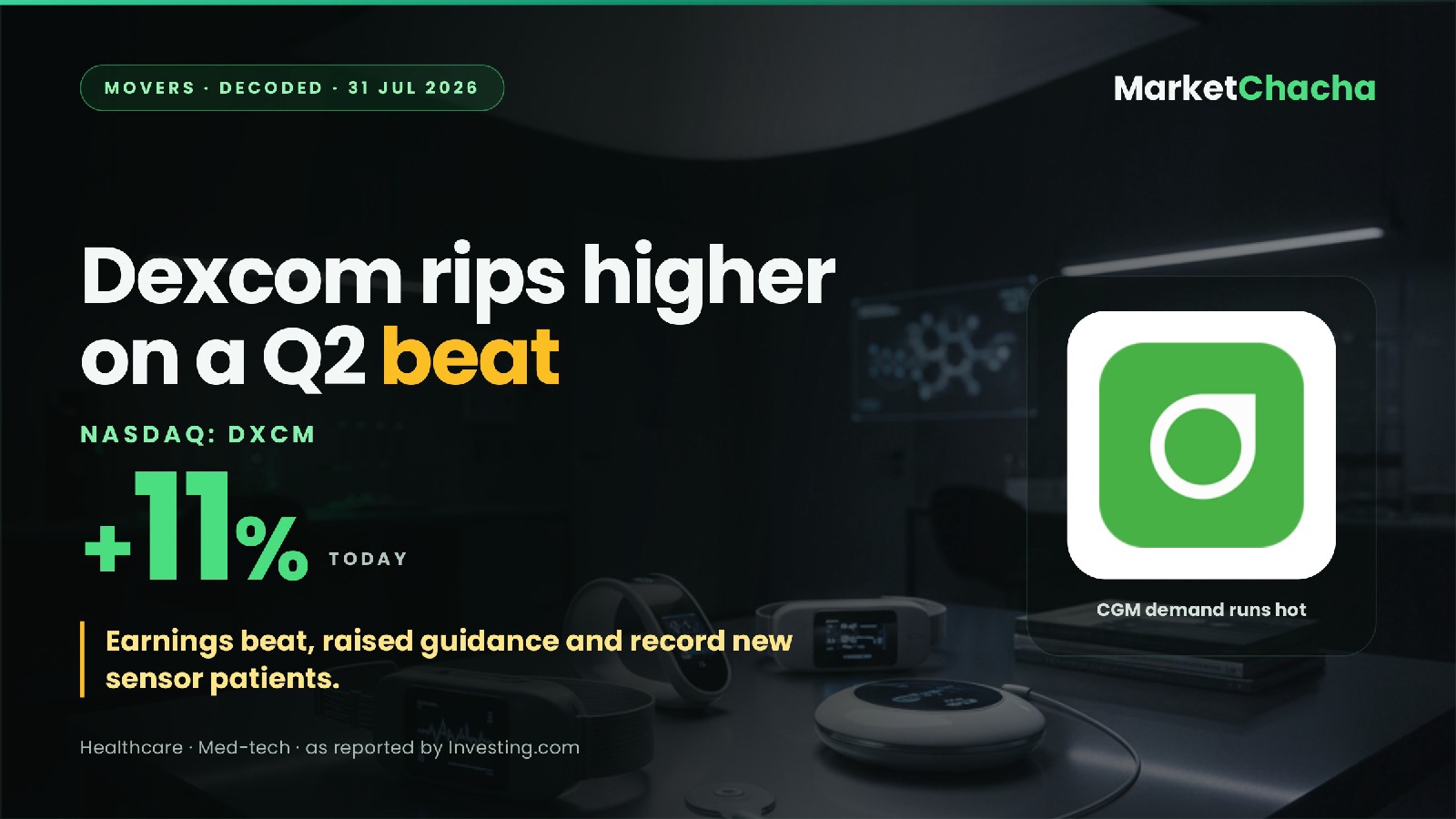
Dexcom (NASDAQ: DXCM) jumped ~11% on Friday, one of its sharpest one-day moves in a while, after the continuous-glucose-monitor maker posted a clean Q2 beat late Thursday and nudged up its full-year outlook. This is the same stock the market punished two years ago on fears that weight-loss drugs would kill demand — so the size of the pop matters.
What happened
Q2 revenue came in at $1.31 billion, up 13% year-on-year and ahead of the roughly $1.29bn Wall Street pencilled in. US sales rose 11% to $933 million; international jumped 19% to $375 million. Adjusted earnings were $0.70 a share versus the $0.61 expected — a real beat, not a rounding error. Margins improved too: gross margin went to 64.1% from 60.1% a year earlier, and net income climbed 46% to $269 million.
Why it moved
Three separate things did the work. First, the beat itself. Second, Dexcom raised full-year revenue guidance to $5.18–$5.25 billion and lifted its operating-margin target — a company that beats and raises gets rewarded twice. Third, and the biggest deal for the growth story: new-patient starts held near a record, and Dexcom said it now has sensor coverage across the four largest US pharmacy-benefit managers, opening the door to more than 7 million type-2 diabetics who don't use insulin — a group CGMs historically couldn't reach.
The business
Dexcom makes wearable patches that read your blood sugar every few minutes and beam it to your phone — no finger pricks. The core customers are type-1 and insulin-using type-2 diabetics (the flagship G7 sensor). It also sells Stelo, an over-the-counter version aimed at prediabetics and people on GLP-1 weight-loss drugs. So today's catalyst isn't one product — it's the whole razor-and-blade model of recurring sensor sales getting bigger.
The GLP-1 twist
Here's the part the headline skips. In 2024 the market dumped Dexcom on the theory that Ozempic-style drugs would shrink the diabetic population and gut sensor demand. Dexcom has flipped that: it's pitching GLP-1 users as new biosensor customers through Stelo, and its own CONNECT trial showed the largest blood-sugar (A1c) improvement in the GLP-1 cohort. The feared headwind is now being sold as a tailwind.
Is it expensive?
Dexcom trades around a P/E of ~30 on a market cap near $27 billion. That's not cheap — it prices in years of double-digit growth, so any stumble stings. For contrast, rival Abbott (ABT) — whose FreeStyle Libre is Dexcom's main competitor — is a ~$170bn giant on a forward P/E near 15x, because CGMs are just one slice of Abbott's sprawling health empire. You pay up for Dexcom because it's a focused, faster-growing pure-play; you pay less for Abbott because its growth is diluted across many businesses.
Who it touches
- Abbott (ABT): the direct Libre rival — a booming Dexcom quarter reads as the whole CGM category expanding, which can lift both.
- Insulet (PODD) & Tandem (TNDM): insulin-pump makers whose devices pair with Dexcom sensors; a healthier category helps them too.
- Novo Nordisk & Eli Lilly: the GLP-1 makers once cast as the threat, now a feeder of fresh Stelo users.
- Medtronic (MDT): the third CGM player, under more pressure to keep pace.
What to watch
The one thing that could flip the story is Medicare. Dexcom has submitted its CONNECT data to CMS to win coverage for those 7 million-plus non-insulin type-2 patients, with a decision expected by end-2026 and its base case assuming coverage starts around mid-2027. A yes unlocks the big new market; a no or a delay takes the air out of the growth thesis. That, and whether Abbott keeps gaining share in doctor surveys, are the two things that decide where this goes next.
As of midday US trading, 31 Jul 2026 (ET). Sources: Investing.com, MassDevice, Yahoo Finance. For discussion and education only — not investment advice. Verify before acting.
This article is for educational and informational purposes only. It is not financial advice, investment recommendation, or a solicitation to buy or sell securities. Investing involves significant risks. I am not a SEBI-registered investment advisor. Readers should consult their own financial advisor and conduct their own research before making any investment decisions.
Comments
Join the conversation
Sign in to join the conversation.
Follow replies, add your view, and take part in the discussion.
Sign in to commentLoading comments...