

State Bank of India: what their latest filing actually means
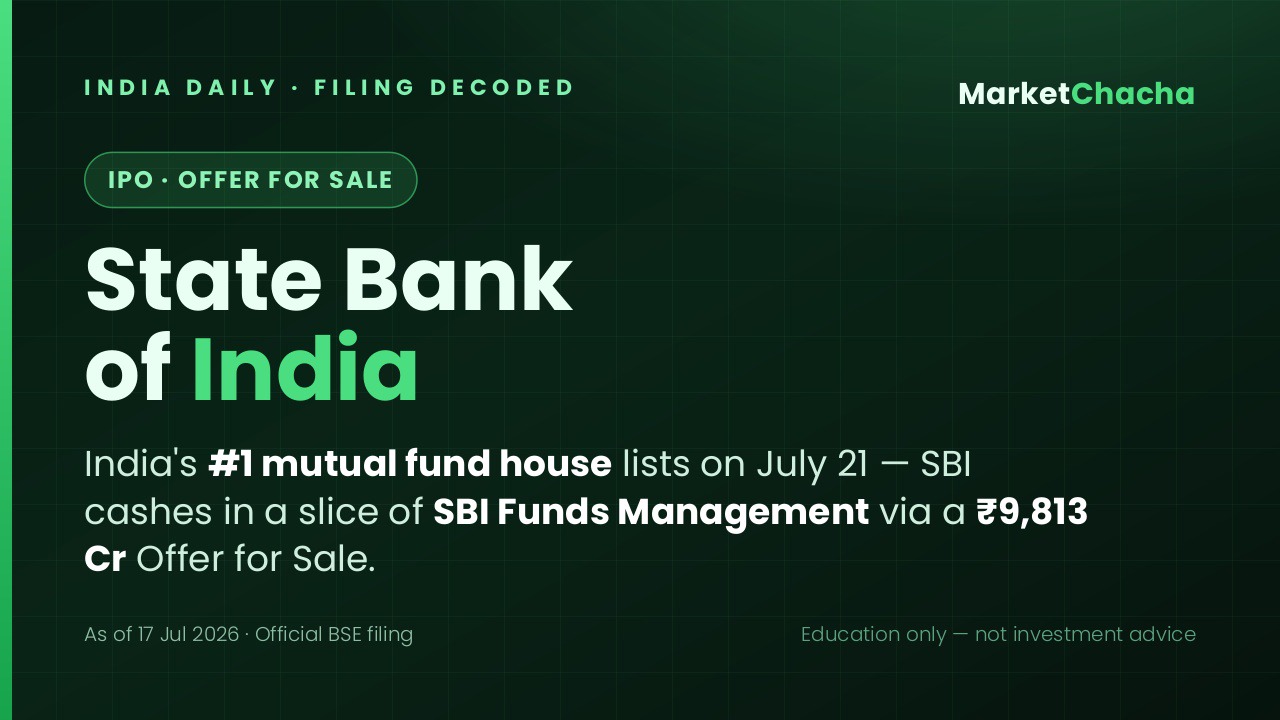
State Bank of India has told the exchanges (a Regulation 30 disclosure) that the IPO of its mutual-fund arm, SBI Funds Management Limited — the company behind SBI Mutual Fund, India's largest fund house — has closed. The roughly ₹9,813 crore issue is entirely an Offer for Sale (OFS), meaning SBI and its French partner Amundi are selling part of their existing shares; shares were allotted today and are expected to list around 21 July 2026.
What was announced
SBI updated the market on the IPO of SBI Funds Management (the parent of SBI Mutual Fund):
- Issue size: about ₹9,813 crore, priced up to ₹574 per share (band ₹545–₹574). It was trimmed from an originally planned ~₹11,693 crore after the company raised roughly ₹1,880 crore in a pre-IPO placement.
- Structure: 100% Offer for Sale — no new shares are created. SBI and Amundi (France) are the sellers.
- Timeline: subscription 14–16 July, allotment 17 July, and listing on BSE/NSE expected around 21 July 2026.
- The asset: SBI Funds Management is India's No. 1 asset manager with about 15.4% market share and quarterly average AUM of roughly ₹12.5 lakh crore.
What this type of filing means
When a listed parent lists one of its subsidiaries, it files a Regulation 30 "material event" update so every shareholder learns of it at the same time. Two ideas make sense of it:
- Offer for Sale (OFS): the shares on sale are existing ones held by current owners. The money flows to the sellers (here SBI and Amundi), not into the AMC. That is the opposite of a "fresh issue," where a company creates new shares and keeps the cash itself.
- Value unlocking: a fast-growing, high-margin business can sit "hidden" inside a large parent's accounts. Listing it puts a live market price on that one piece, so the market can value it on its own merits.
Why it matters / potential impact
- SBI keeps control, banks some cash: SBI stays the majority owner of the AMC (it is only trimming its stake), so it still rides the AMC's future growth while pocketing cash and booking a gain on the shares it sold.
- No dilution for SBI shareholders: SBI itself is not issuing new shares here, so the number of SBI shares you hold does not change.
- A price tag on a crown jewel: asset management is an asset-light, annuity-like, high-margin business that public markets usually value richly. A separately listed price makes the AMC's worth visible instead of buried inside the bank.
Is it expensive?
Two lenses — the stock you would actually hold (SBI) and the asset being listed (the AMC).
- State Bank of India: around ₹1,031 a share (16 July), a P/E of roughly 12, market cap near ₹9.5 lakh crore, and P/B about 1.6. For India's largest bank that is fair-to-reasonable, not stretched.
- Versus peers: private-sector leader HDFC Bank trades richer at roughly 18x earnings (market cap ~₹15 lakh crore), while cheaper PSU peers such as Bank of Baroda sit nearer 6–7x. SBI's ~12x lands in between.
- Why the AMC angle matters: listed fund managers like HDFC AMC and Nippon Life India AMC typically command far higher P/E multiples than banks — one reason surfacing the AMC separately can highlight value that was sitting quietly inside SBI.
None of this is a target or a buy/sell call — just the yardsticks.
The business
SBI is India's largest bank, spanning retail and personal banking, corporate and wholesale lending, and treasury. Around it sits a group of well-known subsidiaries — SBI Life (life insurance), SBI Cards (credit cards), SBI General (general insurance) and SBI Funds Management (the AMC in this filing). Important: this event touches only the mutual-fund arm, not the core bank — SBI's lending, deposits and branch business are unaffected.
Beginner takeaway
SBI is floating part of India's biggest mutual-fund company on the stock market. Because it is an Offer for Sale, the cash goes to SBI and Amundi — not to the fund company — and SBI stays firmly in control. For SBI shareholders it is a small cash inflow plus a clear, public valuation for a prized asset, not a change to the bank's day-to-day business.
FAQ
What exactly is an "Offer for Sale"? It is when existing shareholders sell some of the shares they already own to the public. The company itself gets no new money — the sellers do.
Does SBI receive the whole ₹9,813 crore? No — only its share of it. The proceeds are split between the sellers, SBI and Amundi, in proportion to the shares each sold; the AMC receives nothing from an OFS.
What is QAAUM? Quarterly Average Assets Under Management — the average pool of investors' money the fund house managed over the quarter. SBI MF's ~₹12.5 lakh crore makes it India's largest.
The grey-market premium looked positive — does that guarantee listing gains? No. Grey-market premium (GMP) is an unofficial, unregulated indicator that shifts daily and is often wrong. It is not a promise of how the share will list or trade.
As of 17 July 2026. Filing dated 16 July 2026. Source: official BSE filing by State Bank of India — read it directly here. We summarise filings for education and may make errors, so always verify against the official document. Educational content only — not investment advice, not a buy/sell recommendation.
This article is for educational and informational purposes only. It is not financial advice, investment recommendation, or a solicitation to buy or sell securities. Investing involves significant risks. I am not a SEBI-registered investment advisor. Readers should consult their own financial advisor and conduct their own research before making any investment decisions.
Comments
Join the conversation
Sign in to join the conversation.
Follow replies, add your view, and take part in the discussion.
Sign in to commentLoading comments...