

Super Micro (SMCI): the full file — the numbers, the owners, and what the filings actually show
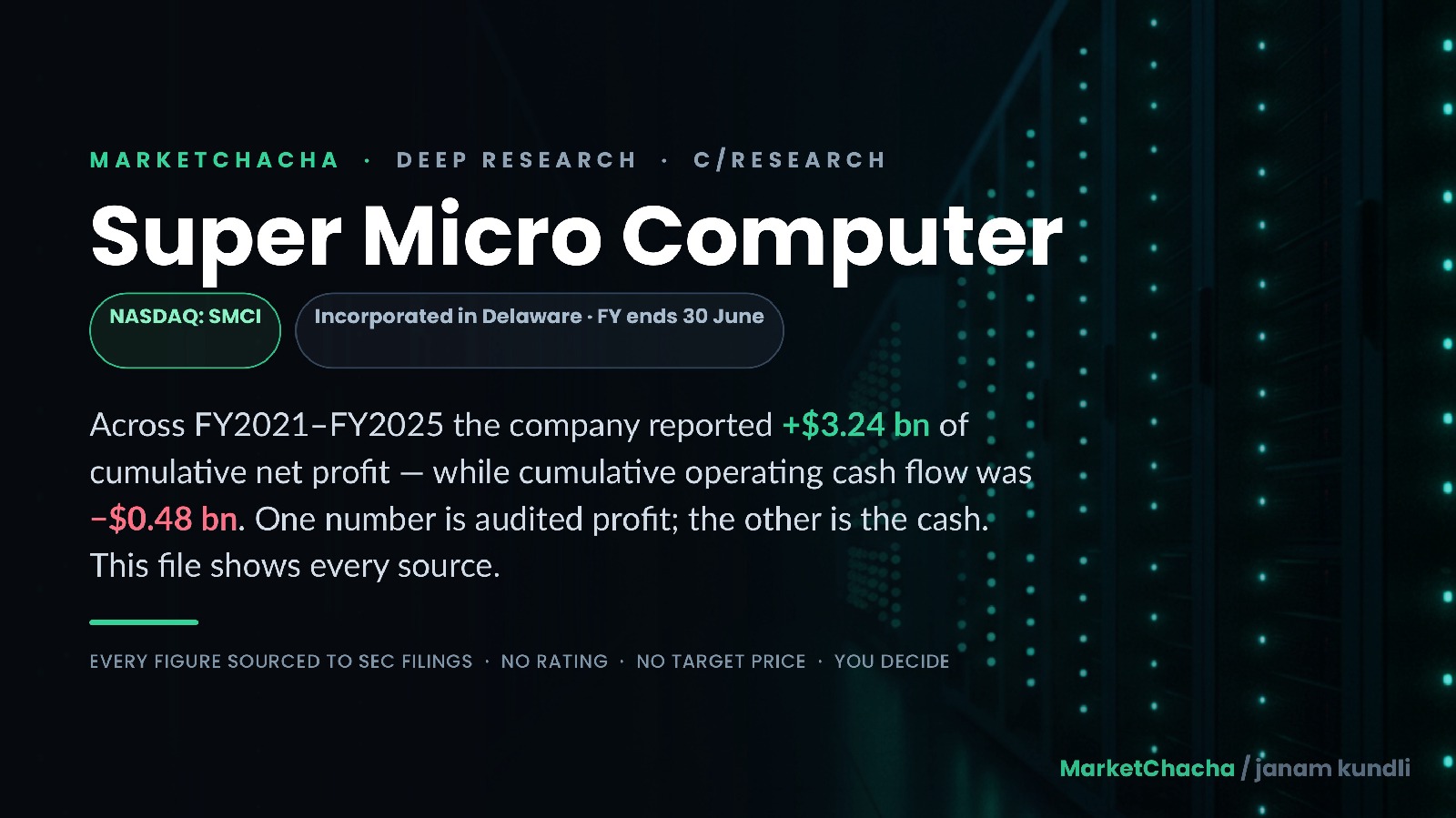
Super Micro Computer designs and builds server and storage systems — the racks of computers inside data centres that increasingly run AI workloads on Nvidia and AMD chips. It makes money by assembling those systems from components (a rising share now high-value GPUs) and selling them to cloud, enterprise and AI customers at very high volume on thin hardware margins.
The record shows a company that grew revenue more than six-fold in four years and reported over $3.2 billion of cumulative profit across five years — yet produced negative cumulative operating cash flow over those same five years. In 2024 its newly-appointed auditor resigned, a short-seller published allegations, and the DOJ and SEC sent subpoenas; an independent board committee then reviewed the accounts and found no evidence of misconduct. Each statement is a documented fact, sourced below. We draw no conclusion — we lay them out so you can.
Origin — the company's birth certificate
Per its own filings, the company "was incorporated in California in September 1993 and subsequently reincorporated in Delaware in March 2007" [S1]. It was founded by Charles Liang (still Chairman, President & CEO) and his spouse Sara Liu (co-founder and director), and keeps its headquarters at 980 Rock Avenue, San Jose, California. It listed on Nasdaq as SMCI in 2007. Three decades on, the two founders still jointly own 13.4% — this is, plainly, a founder-controlled business.
The business — what they actually sell
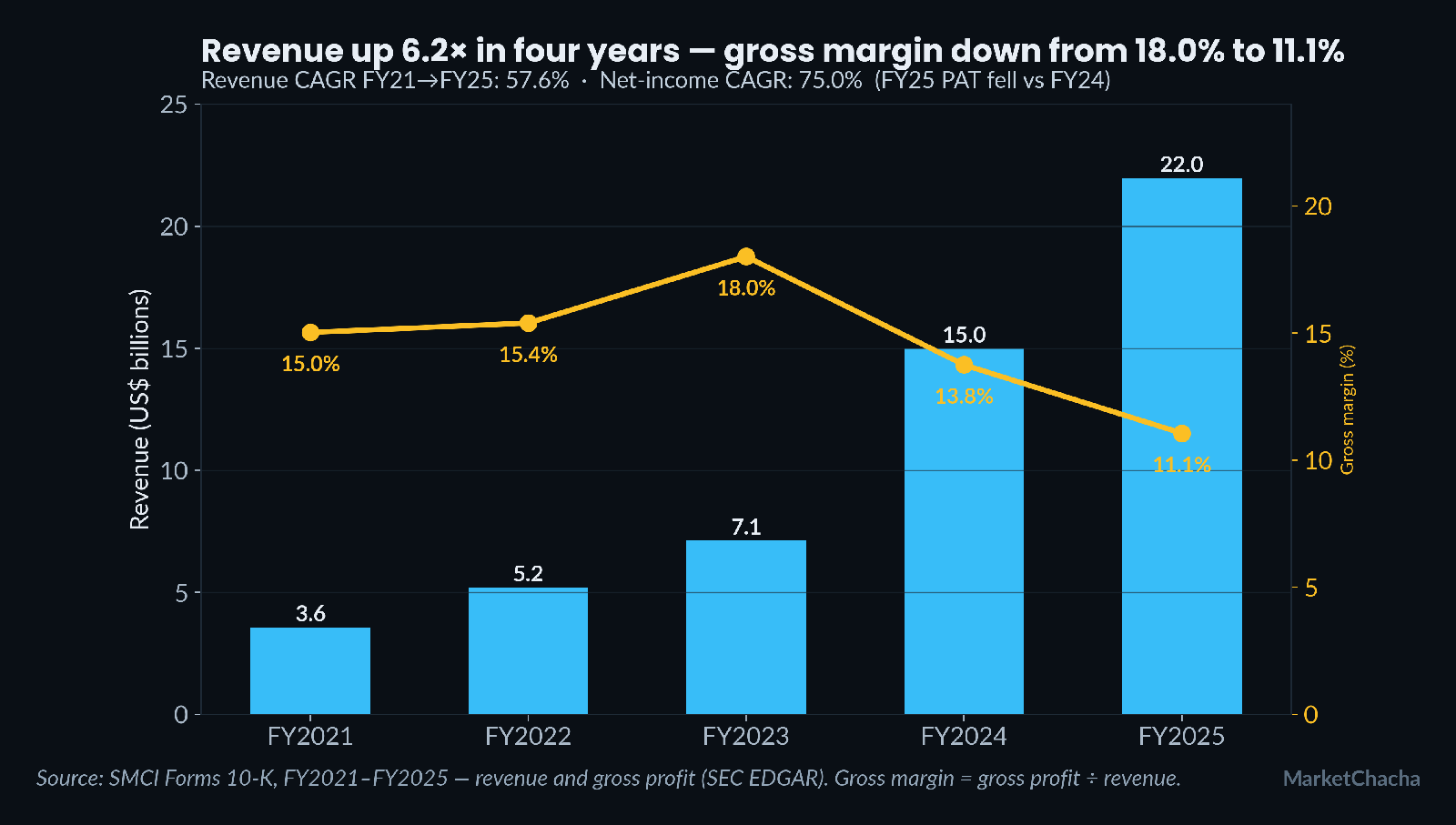
Super Micro reports as one operating segment: "high-performance server solutions based upon an innovative, modular and open-standard architecture" [S1, Note 15]. In practice: complete servers, storage, GPU/accelerated-compute systems, motherboards, plus the racks, liquid cooling and management software around them. Revenue is overwhelmingly hardware, so gross margin is thin and — as shown below — has been falling as the mix shifts toward large GPU-cluster orders.
Who actually buys from them
This is disclosed, and it changed sharply. The FY2025 10-K states "Four customers each accounted for 10% or more of our net sales in fiscal year 2025," that one customer did so in FY2024, and that "No customer accounted for 10% or more of our net sales in fiscal year 2023" [S1]. In two years the base went from no 10%-plus customer to four — a fast concentration into a handful of buyers, typical of the AI build-out. The company does not name them, so their identity is not disclosed. Sales outside the U.S. were 40.6% of net sales in FY2025 (32.0% in FY2024) [S1].
Where it is actually made — plants & supply chain
As of 30 June 2025 the company owned ~3,157,000 sq ft and leased ~1,539,000 sq ft of office and manufacturing space [S1, Item 2]. R&D and much assembly run in San Jose, California and in Taiwan (including the "Bade" facility, financed partly by Taiwanese CTBC bank loans); a new Malaysia facility was added in FY2025. A structural feature: part of the supply chain runs through related parties — Taiwan-based Ablecom and Compuware, long-standing suppliers connected to the founders and a board member (see below). The names of GPU/component suppliers are not disclosed at line-item level.
Five years of numbers
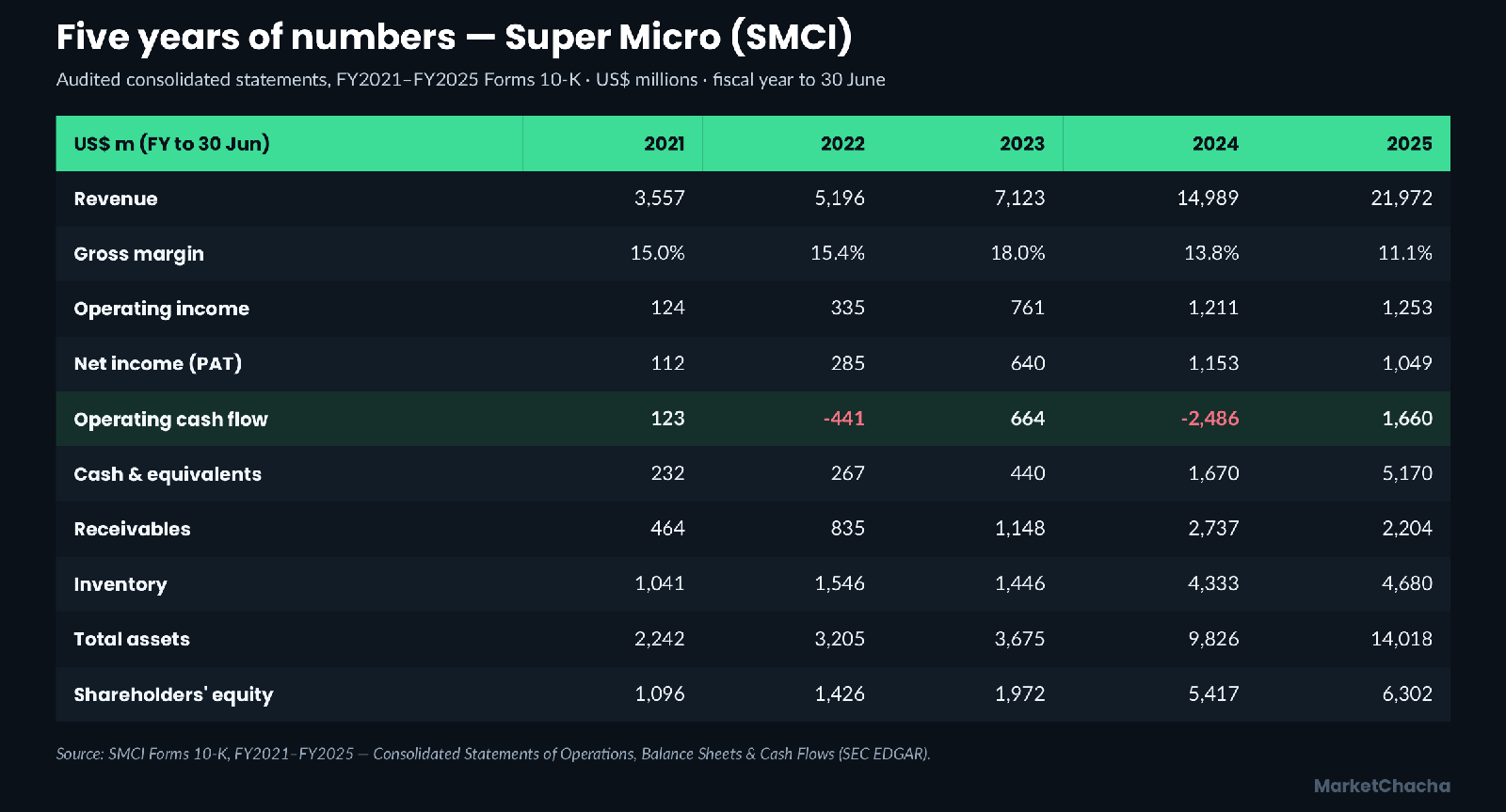
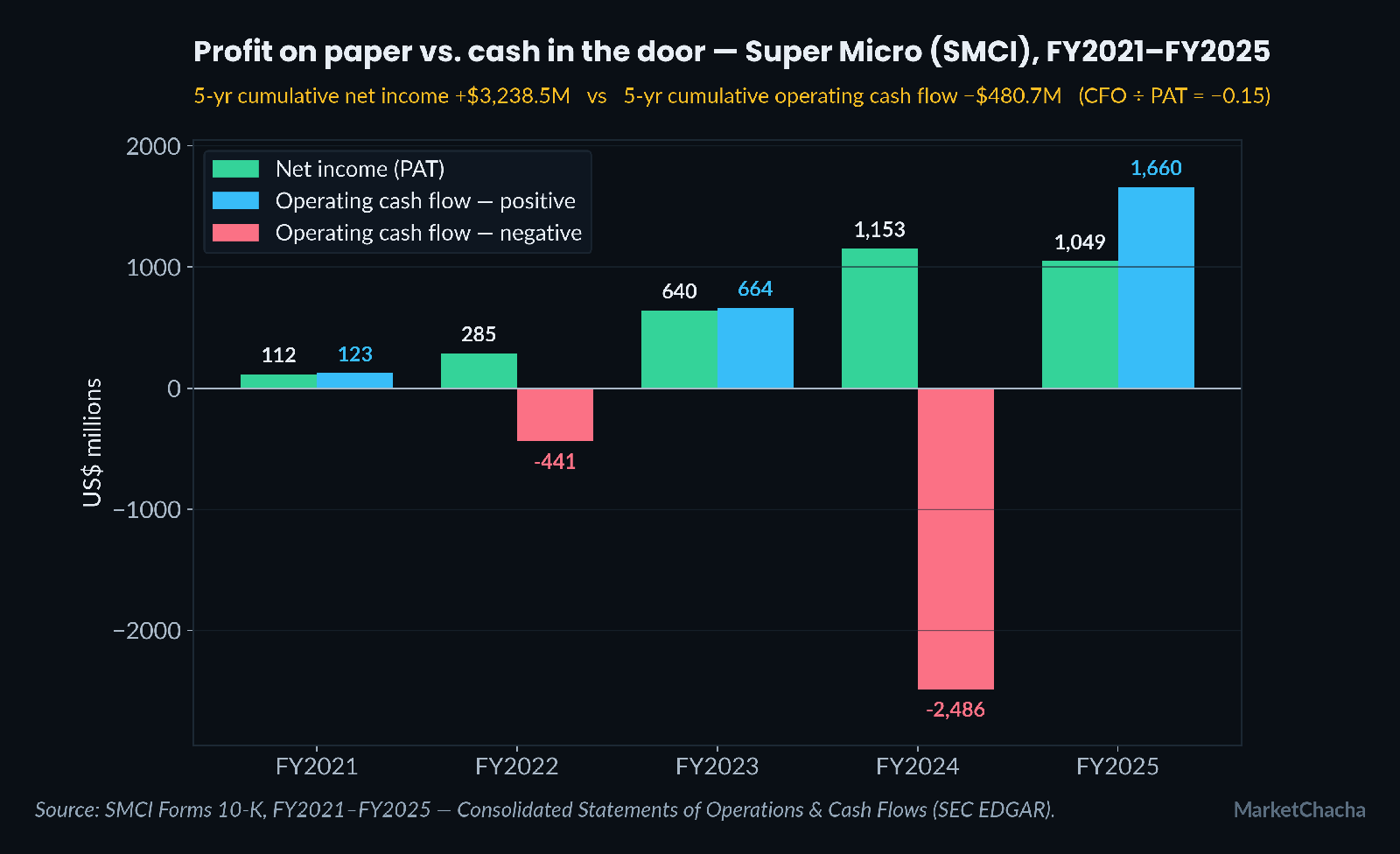
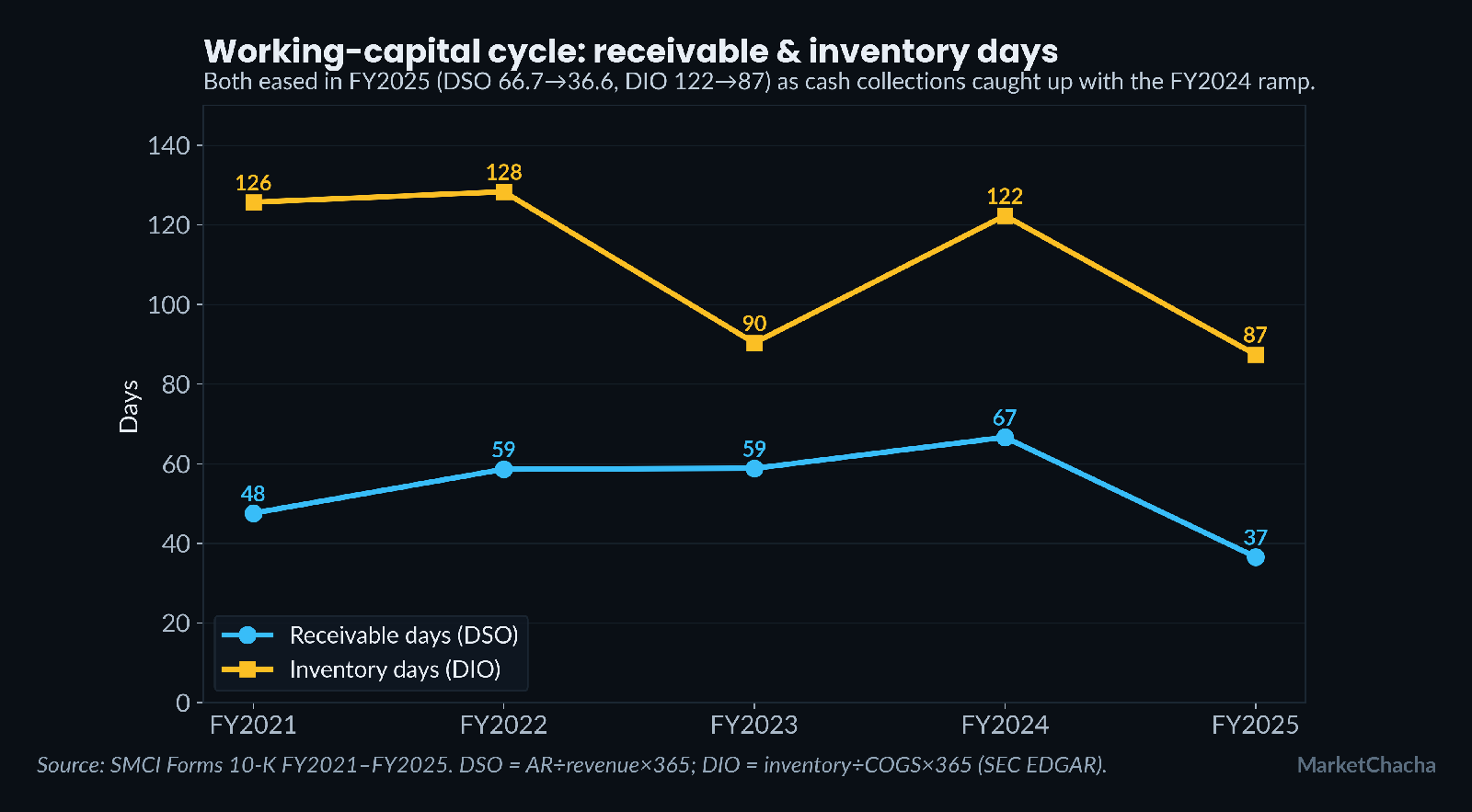
Revenue compounded at 57.6% a year and net income at 75.0% from FY2021 to FY2025 — though FY2025 net income ($1,049m) was actually lower than FY2024's ($1,153m) despite 47% more revenue, because gross margin fell. Over five years cumulative net income was +$3,238.5m and cumulative operating cash flow -$480.7m. One chart captures it.
The latest year, decoded
FY2025 (to 30 June 2025) was filed on time on 28 August 2025 [S1] — itself notable after the prior year's delays. Revenue was $21.97bn (up 47%), but gross margin fell to 11.1% from 13.8%, so operating income barely rose ($1.25bn) and net income declined to $1.05bn. The offset for cash-watchers: operating cash flow swung from -$2.49bn in FY2024 to +$1.66bn in FY2025, and cash rose to $5.17bn — aided by $3.0bn of new convertible notes. The margin slide and the cash-flow swing are the two lines to keep watching.
Who owns it — and where those owners are registered
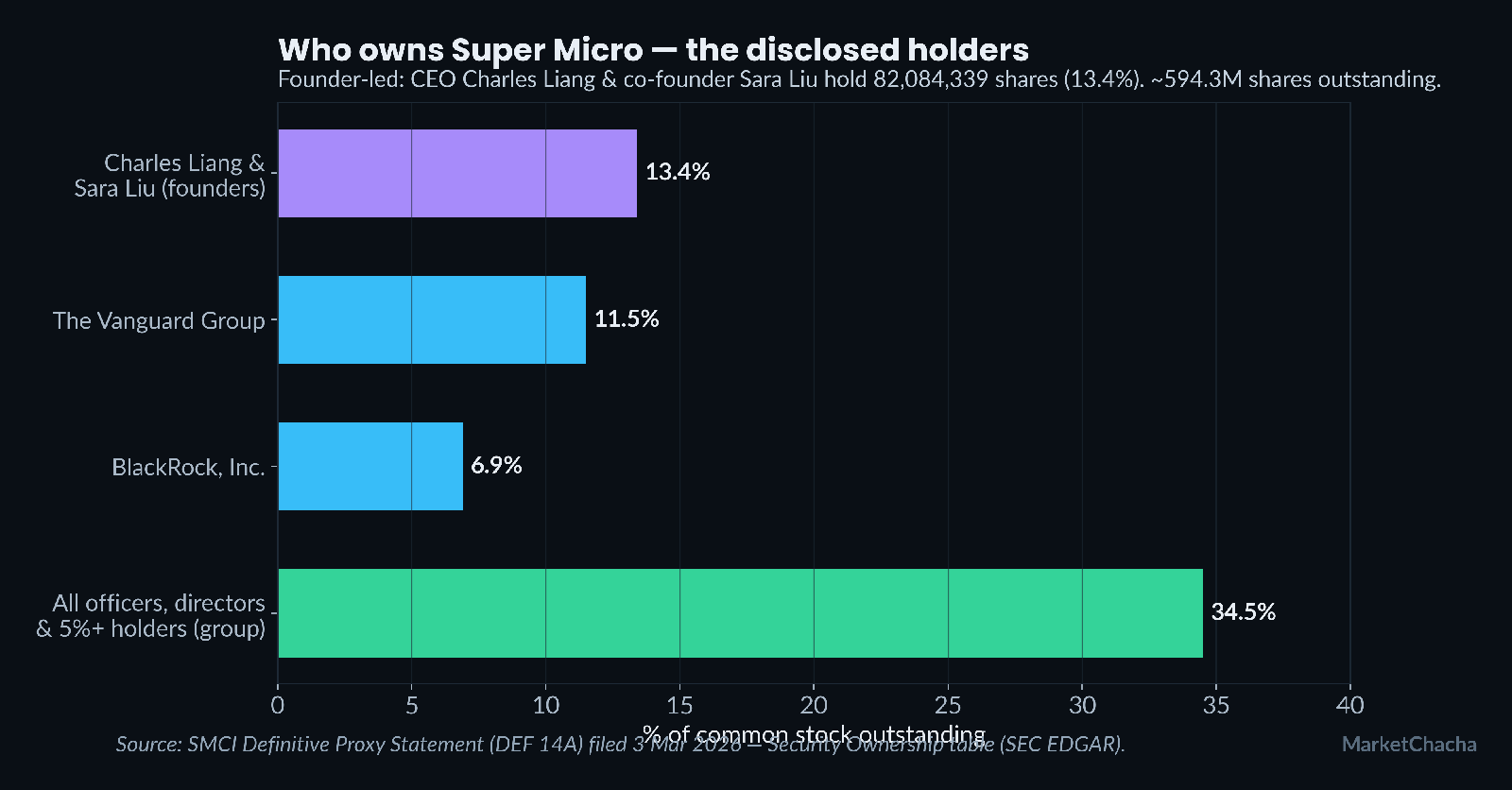
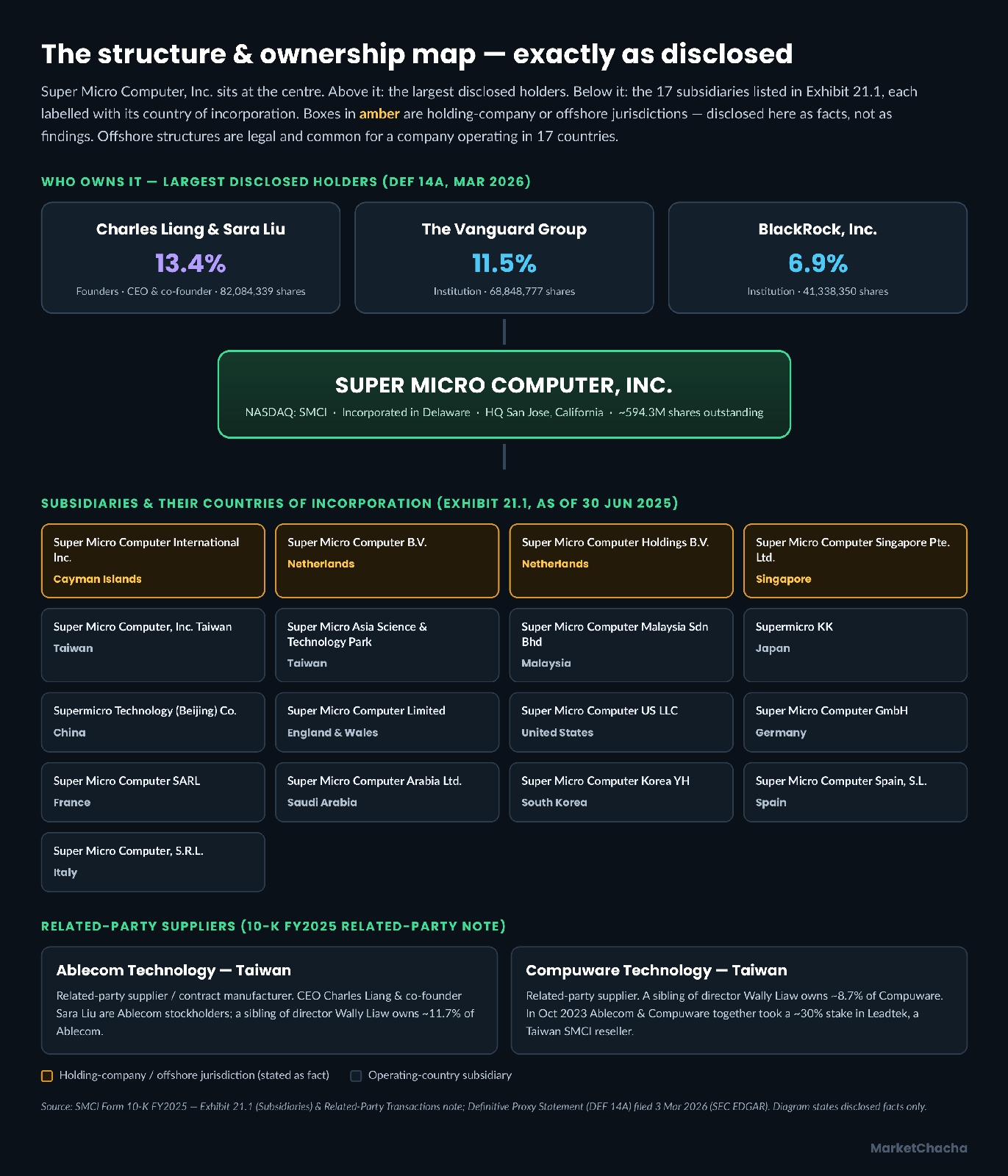
Per the proxy filed 3 March 2026 [S2], founders Charles Liang & Sara Liu hold 82,084,339 shares, or 13.4%. The largest external holders are index managers: Vanguard 11.5% (68,848,777 shares) and BlackRock 6.9% (41,338,350 shares). Officers, directors and 5%+ holders together are 34.5%. There are ~594.3m shares outstanding (31 July 2025), reflecting a 10-for-1 split effective 30 September 2024.
On the corporate side, Exhibit 21.1 to the FY2025 10-K lists 17 subsidiaries with countries of incorporation [S1]. Most are ordinary operating entities (Taiwan, Malaysia, Japan, China, Germany, France, UK, Saudi Arabia, South Korea, Spain, Italy, a US LLC). Four sit in jurisdictions commonly used for holding/offshore structures: Super Micro Computer International Inc. (Cayman Islands), two Netherlands B.V. entities, and Super Micro Computer Singapore Pte. Ltd. (Singapore). Stated plainly: such structures are legal and common for a business operating in seventeen countries, typically for tax, treasury and regional holding. They are named because naming the jurisdiction is the honest way to describe the structure — not as any suggestion of impropriety.
Capital history — every time they raised money
The recent record is heavily convertible-debt and split-driven. In two fiscal years the company issued ~$1.7bn of 2029 notes (FY2024), $700m of 2.25% 2028 notes (Feb 2025) and $2.3bn of 2030 notes (June 2025, incl. a $300m over-allotment) — about $4.7bn of convertible principal [S1]. Convertibles raise cash cheaply now but can dilute holders later if the stock reaches the conversion price. On equity, a ten-for-one forward split took effect 30 September 2024, with authorised shares raised from 100m to 1bn [S1]. Further back, the 2018 episode (below) saw the shares suspended from Nasdaq trading.
Who runs it, and the wider web
Charles Liang is Chairman/President/CEO; Sara Liu is co-founder and director. The auditor is now BDO USA, P.C., appointed 18 November 2024 [S4], replacing Ernst & Young. The "wider web" the filings flag is the Taiwan related-party supply chain. Per the FY2025 related-party note [S1]: Liang and Liu are stockholders of Ablecom; a sibling of director Wally Liaw owns ~11.7% of Ablecom and 8.7% of Compuware; Ablecom's CEO is Steve Liang, Charles Liang's brother. The note also discloses that in October 2018 Charles Liang personally borrowed ~$12.9m from Chien-Tsun Chang, the spouse of Steve Liang — unsecured, no maturity — to repay margin loans on his SMCI shares called after the 2018 Nasdaq suspension; ~$16.8m was outstanding at 30 June 2025. In October 2023 Ablecom and Compuware together took a ~30% interest in Leadtek, a Taiwan graphics-card firm that is also an authorised SMCI reseller. Related-party manufacturing and lending are legal and disclosed precisely so investors can weigh them; we state them and stop.
The regulatory and surveillance record
This is the densest part, and it cuts both ways.
2020 SEC settlement. In August 2020 the SEC charged Super Micro and former CFO Howard Hideshima over accounting for FY2014–2017 — the order described prematurely recognised revenue (incl. on goods sent to warehouses but not delivered, and goods shipped before customer authorisation) and understated expenses. The company paid a $17.5m civil penalty and CEO Charles Liang reimbursed the company $2,122,000 under Sarbanes-Oxley §304, without admitting or denying findings [S5]. This followed the company's suspension from Nasdaq trading in August 2018 and later relisting.
2024 auditor resignation. Ernst & Young — engaged only in March 2023 for the FY2024 audit — resigned on 24 October 2024, before issuing any report. Its letter stated it was "resigning due to information that has recently come to our attention which has led us to no longer be able to rely on management's and the Audit Committee's representations," citing questions about COSO Principle 1 (integrity/ethical values) and Principle 2 (independent board oversight) [S3]. That is the auditor's stated position, quoted from the filing.
The Special Committee's response. An independent Special Committee (advised by Cooley LLP and forensic accountants Secretariat Advisors) announced on 2 December 2024 that its review found "no evidence of misconduct" by management or board, expected no restatement, and concluded EY's stated conclusions "were not supported by the facts examined in the Review" [S6]. BDO USA was appointed 18 November 2024 [S4] and audited the delayed FY2024 and the FY2025 statements.
Nasdaq compliance & subpoenas. After Nasdaq notices, the company filed its delayed FY2024 10-K and FY2025 Q1/Q2 10-Qs by the 25 February 2025 deadline and regained Nasdaq compliance (Rule 5250(c)(1)) [S7]. Its 10-K discloses: "In late 2024, we received subpoenas from the Department of Justice and the Securities and Exchange Commission seeking a variety of documents following the publication of a short seller report in August 2024. We are cooperating… and there have been no charges brought" [S1]. The report referenced was Hindenburg Research's of 27 August 2024, which the company disputed. The FY2025 10-K also states the company has "identified material weaknesses in our internal control over financial reporting" [S1]; BDO nonetheless issued opinions on the FY2024 and FY2025 statements.
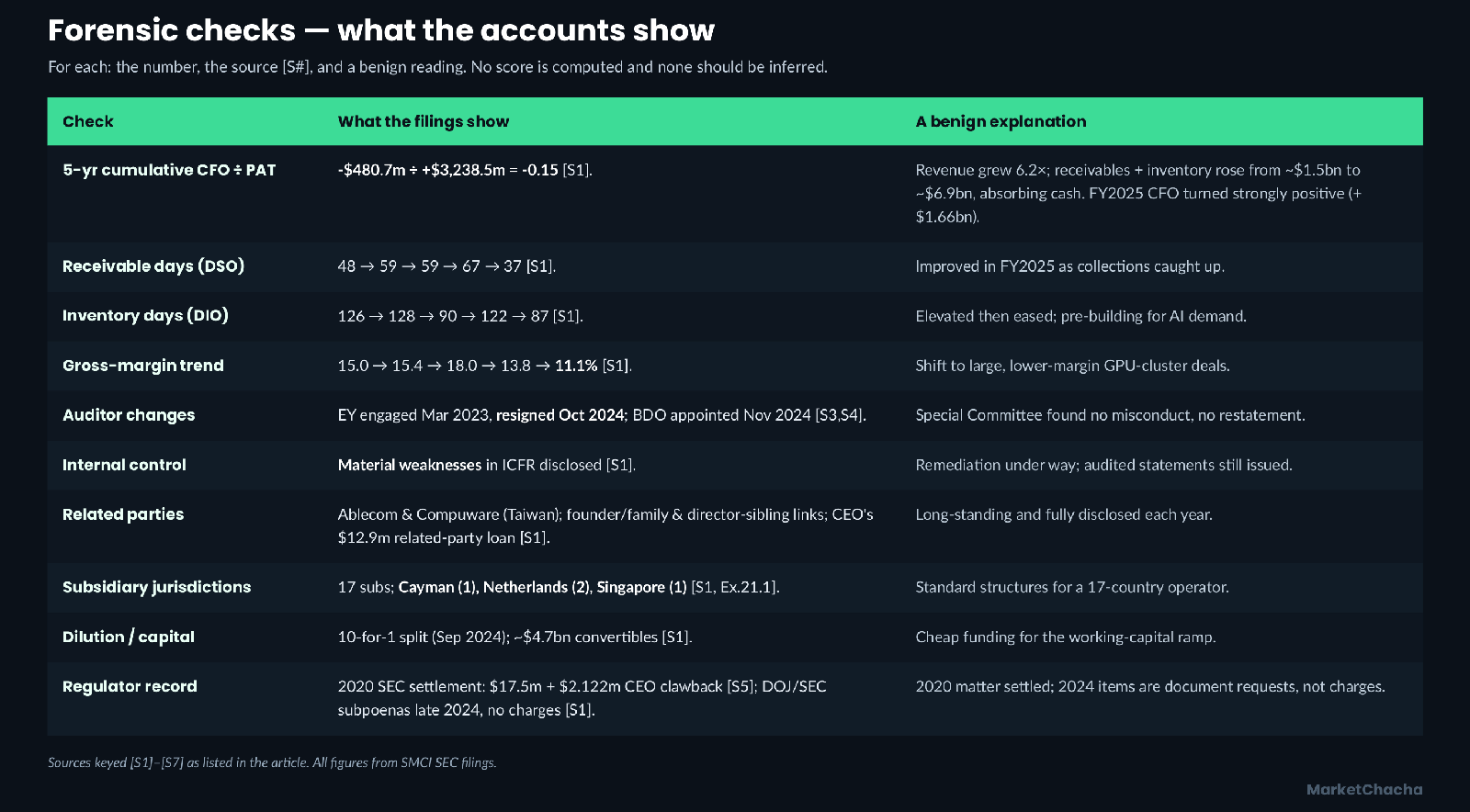
Forensic checks — what the accounts show
What we could not verify
Several things are simply not disclosed, itself part of the file: the names of the four 10%-plus FY2025 customers; the exact FY2025 dollar value of Ablecom/Compuware purchases as a share of cost of goods (read the related-party note directly [S1]); the outcome of the DOJ/SEC document requests; the specifics and completion of the material-weakness remediation; and named component/GPU suppliers and single-source dependencies. We did not compute "other income as % of PBT" or the implied interest rate on debt to a standard we would cite, because those line items were not cleanly isolable from the flattened filing — read them from the audited statements. Where we could not stand behind a number, we left it out rather than estimate it.
What would change the picture
Concrete things to watch: the next BDO audit report and whether the material weaknesses are declared remediated; the gross-margin line (has the slide to 11.1% stopped?); whether operating cash flow stays positive or reverts as inventory rebuilds; the next proxy/13F filings for founder, Vanguard and BlackRock changes; receivables and inventory each quarter; any development in the DOJ/SEC requests; and the related-party note. As market context only (not from the filings), SMCI recently traded around $28–29 with a market cap near $19.9 billion, a trailing P/E near 16× (FY2025 EPS ≈ $1.76 on ~594m shares) and ~3.2× book — comparable against listed peers Dell (DELL) and HPE. Per the company's own five-year performance graph, $100 invested in June 2020 was worth $1,725.70 by June 2025 (~77% annualised), after peaking at $2,884.86 at the FY2024 mark — a ~40% fall from that peak [S1].
Sources
- S1 — Form 10-K, FY ended 30 June 2025 (filed 28 Aug 2025); Business, Risk Factors, Properties, Related-Party note, Note 15, Exhibit 21.1: 10-K · Exhibit 21.1
- S2 — DEF 14A proxy, filed 3 Mar 2026 (Security Ownership): DEF 14A
- S3 — 8-K (Item 4.01), 30 Oct 2024 — EY resignation letter: 8-K
- S4 — 8-K (Item 4.01), 20 Nov 2024 — appointment of BDO USA: 8-K
- S5 — SEC Press Release 2020-190 (25 Aug 2020): SEC
- S6 — 8-K/press release, 2 Dec 2024 — Special Committee review complete: 8-K
- S7 — Company announcement, 25–26 Feb 2025 — regained Nasdaq compliance: IR
FAQ
Did Super Micro actually make a profit over five years? Yes — audited net income was positive every year FY2021–FY2025, totalling ~$3.24bn. Separately, cumulative operating cash flow was negative (~-$0.48bn), because fast growth tied up cash in receivables and inventory. Both are true at once [S1].
Why did Ernst & Young resign? Its 24 Oct 2024 letter said it could no longer rely on management's and the Audit Committee's representations and raised COSO-framework governance questions. The company's Special Committee later said it found no evidence of misconduct and that EY's conclusions were not supported by the facts; no restatement was made [S3, S6].
Is the stock under regulatory action now? The FY2025 10-K discloses DOJ and SEC document subpoenas received in late 2024 after an August 2024 short-seller report, that it is cooperating, and that "there have been no charges brought." A separate SEC matter was settled in 2020 for $17.5m plus a $2.122m CEO clawback [S1, S5].
Who are the biggest owners? Founders Charles Liang and Sara Liu (13.4%), Vanguard (11.5%) and BlackRock (6.9%), per the March 2026 proxy [S2].
Does MarketChacha rate the stock? No — no buy/sell/hold, no target price, no rating. Only sourced facts, so you can decide for yourself.
Independent research for education and discussion only. Not investment advice, not a recommendation, and not a rating — we issue no buy/sell calls and no target prices. Every figure is sourced from the primary documents linked above; figures can be restated and we can make mistakes, so always verify against the original. Nothing here alleges wrongdoing by any company or individual: where a fact raises a question we state the fact, cite it, and give the benign explanation alongside. Offshore holding structures, pledging and preferential allotments are all legal and common — they are disclosed here as facts, not as accusations.
This article is for educational and informational purposes only. It is not financial advice, investment recommendation, or a solicitation to buy or sell securities. Investing involves significant risks. I am not a SEBI-registered investment advisor. Readers should consult their own financial advisor and conduct their own research before making any investment decisions.
Comments
Join the conversation
Sign in to join the conversation.
Follow replies, add your view, and take part in the discussion.
Sign in to commentLoading comments...