

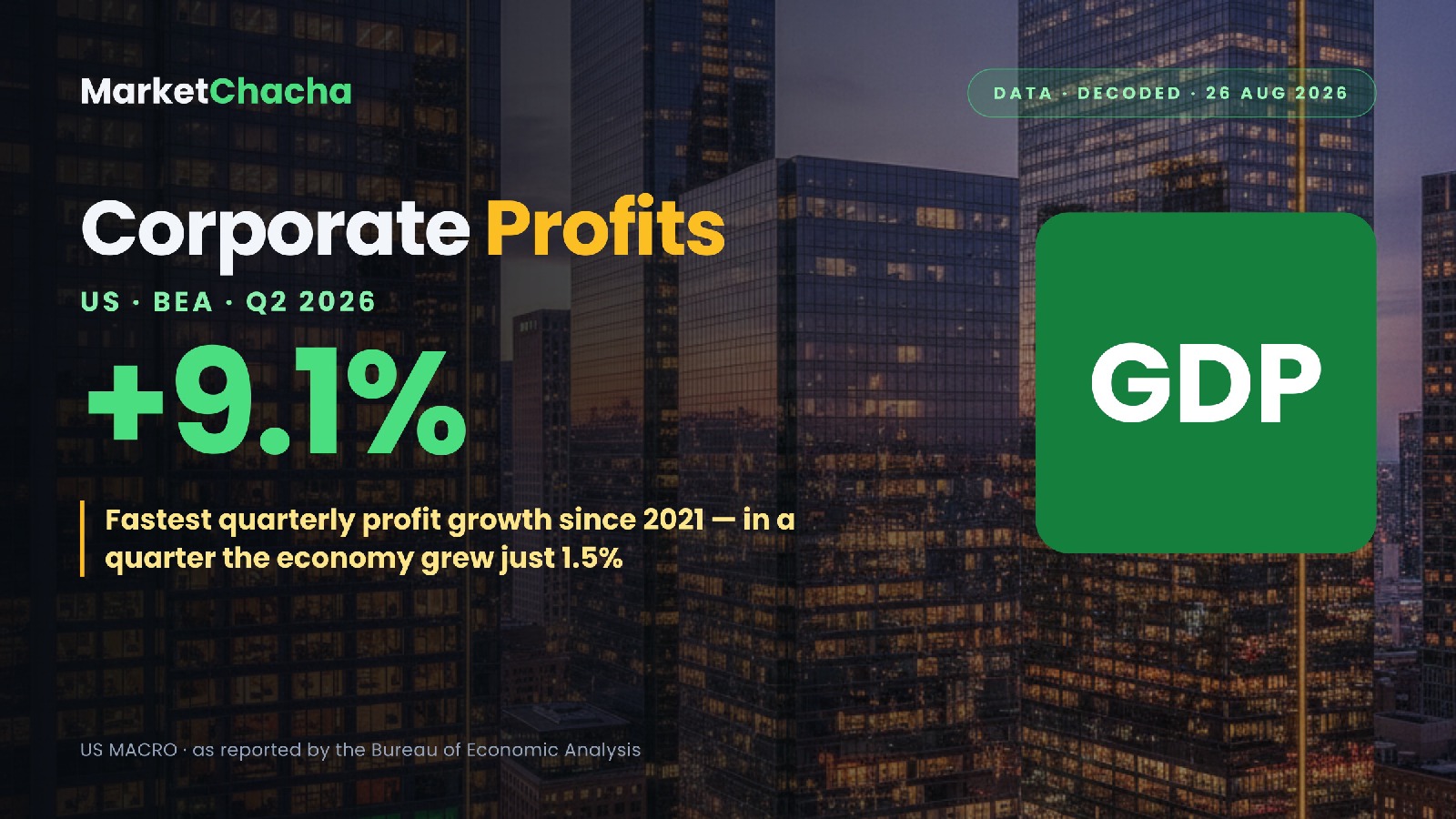
US corporate profits jumped 9.1% in a quarter the economy grew 1.5% — where the gap actually came from
The GDP headline this morning was a non-event: 1.5%, exactly where the advance estimate left it, exactly what economists penciled in. So most desks moved on. Buried in the same release was the number that only shows up in the second estimate — corporate profits — and it did something the GDP line gave no hint of.
The numbers
Per the Bureau of Economic Analysis release for Q2 2026, profits from current production rose $400.9 billion in the second quarter, against an increase of $74.4 billion in Q1. In percentage terms Haver Analytics puts that at +9.1% quarter-on-quarter, the fastest quarterly advance since Q2 2021, after +1.7% in Q1. Over four quarters, profits are up 22.8% — the strongest stretch since Q4 2021.
The split: domestic profits +9.9%, a fifth straight quarterly rise. Foreign profits +3.5%, rebounding from −10.4% in Q1.
Meanwhile real GDP was confirmed at 1.5% annualised, down from 2.1% in Q1. Consumer spending was revised up to +3.4% annualised, beating the 3.2% median. Real final sales to private domestic purchasers came in at +4.2%, revised up 0.3 points. Government spending fell.
What it means
Start with the trap, because nearly every headline walks into it. The 1.5% GDP figure is real — inflation stripped out — and annualised. The 9.1% profits figure is nominal and not annualised. They're different units. Putting them side by side and calling it a nine-to-one gap is arithmetic nonsense.
Now the part that survives the correction. Nominal growth is real growth plus prices, and the price side of this release was hot: BEA revised the gross domestic purchases price index to 5.8%, the PCE price index inside GDP to 5.3%, and the core version to 3.6% — each nudged up from the advance read. Even once you put profits and output on the same nominal footing, profits grew faster than the economy they came from. That's margin expansion: companies didn't sell dramatically more, they kept more of what they sold.
Which connects to the other BEA release that landed at the same minute. Core PCE inflation held at 3.3% for July and the headline ran at 3.7%, hotter than the 3.6% consensus. The price pressure that keeps the Fed cautious is the same price pressure showing up as record profit growth. One release, two readings of it.
Who it touches
- Index-level earnings expectations — national-accounts profits and reported S&P earnings track each other loosely, but a 22.8% four-quarter run is a different backdrop than the flat-margin story many models assumed.
- The Fed's hawks — firms passing costs through without losing volume is evidence pricing power is intact. That argues against inflation falling on its own.
- Domestic vs multinational exposure — the strength was domestic (+9.9%). Foreign profits only clawed back part of a −10.4% quarter, so the dollar is still doing damage abroad.
- Wage-share watchers — profits accelerating while real consumer spending was essentially flat in July is the labour-vs-capital split that shows up in policy debates well before it shows up in markets.
What to watch
The Fed chair's Jackson Hole keynote on 28 August is the first chance to hear whether persistent pricing power changes the committee's read. Then 11 September for August CPI and 16 September for the FOMC decision and projections. If margins are still expanding into Q3 while volume growth stays near 1.5%, the "inflation is cooling on its own" case gets harder to make.
As of 26 Aug 2026, 4:45 pm ET. Sources: Bureau of Economic Analysis, Haver Analytics, BEA Personal Income & Outlays. For discussion and education only — not investment advice. Verify before acting.
This article is for educational and informational purposes only. It is not financial advice, investment recommendation, or a solicitation to buy or sell securities. Investing involves significant risks. I am not a SEBI-registered investment advisor. Readers should consult their own financial advisor and conduct their own research before making any investment decisions.
Comments
Join the conversation
Sign in to join the conversation.
Follow replies, add your view, and take part in the discussion.
Sign in to commentLoading comments...