

US wholesale prices decoded: PPI hits 5.4% — the hottest print of 2026, and diesel did the damage
The numbers
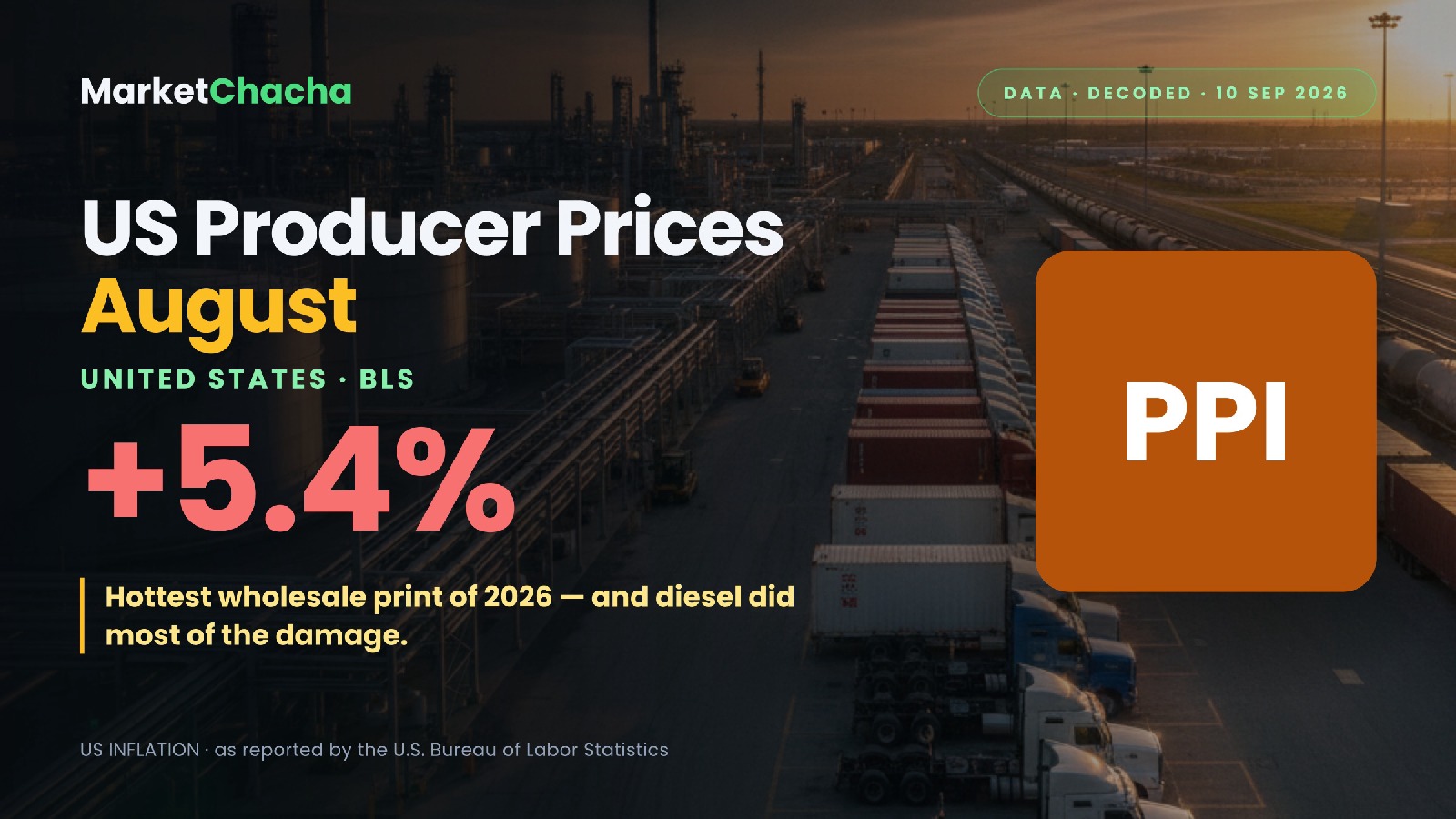
US producer prices — what factories, farms and freight yards charge before anything reaches a shop shelf — rose 0.4% in August, exactly what economists penciled in. The annual rate is where it stings: 5.4% against a 5.3% forecast, up from 4.8% in July (itself revised up from 4.7%). That's the hottest 12-month wholesale reading of 2026, per the BLS release out at 8:30 am ET this morning.
Strip out food and energy and it reads calmer. Core PPI rose 0.2% on the month — below the 0.3% expected — and 4.6% over the year. The narrower cut the Fed leans on, excluding food, energy and trade services, rose 0.3% MoM and 4.7% YoY.
The internals do the explaining:
- Final-demand goods +1.1%, a hard reversal from −0.4% in July
- Final-demand services +0.1%
- Energy +4.2%, with diesel alone up 24.1%
- Food +0.1%; goods excluding food and energy +0.4%
- Transportation and warehousing +2.3%; trade services −0.2%
Same 8:30 slot, weekly jobless claims landed at 206,000 versus 205,000 expected, with continuing claims at 1.774 million. No labour-market crack to offset the inflation read.
What it means
More than three-quarters of the goods jump came from energy. WTI crude pushed above $100 for the first time since May as the Iran conflict dragged on, and diesel is where an oil spike hits the real economy first — every truck, train and delivery van burns it.
Here's the bit the headline hides. PPI excluding food, energy and trade services is the slice that feeds directly into PCE, the gauge the Fed actually targets. That measure sitting at 4.7% is the uncomfortable number — not the 5.4% splash.
And the 2.3% jump in transportation and warehousing is fuel already leaking out of the tank and into services pricing. That's the second-round effect central bankers lose sleep over: an energy shock stops being a one-off the moment it shows up in what everyone charges to move a box.
The counterweight: domestic pressure isn't accelerating. Core undershot at 0.2%. Trade services — effectively retailer and wholesaler margins — actually fell 0.2%. Firms are absorbing some of this rather than passing it on. That is a cost shock arriving from outside, not an economy running hot from within.
Who it touches
- Fed odds: the FOMC meets 16 September with the funds rate at 3.50–3.75%, held for five straight meetings. Futures had already moved to roughly 56–64% odds of a 25 bps hike; a hot headline gives the doves nothing to work with.
- Bond yields: long-dated Treasuries have been tracking crude more than data lately. A 5.4% wholesale print reinforces that direction.
- Freight, logistics and airlines: diesel +24.1% is a direct margin hit for anyone who moves goods, and a fuel-surcharge fight with customers.
- Consumer goods makers: goods ex-food-and-energy at +0.4% means input costs are climbing beyond just fuel.
- India: a hawkish Fed usually means a firmer dollar — which pressures the rupee, raises the bar for FII inflows into Indian equities, and complicates the RBI's own path. Indian refiners and oil marketers sit on the other side of the same crude move.
What to watch
US CPI for August lands tomorrow, 11 September, 8:30 am ET; the previous headline was 3.4%. If consumer prices confirm the energy pass-through, the 16 September Fed decision stops being a coin flip. If CPI stays contained while PPI runs hot, that gap is companies eating the cost — and it shows up in margins next quarter instead.
As of 9:15 am ET / 6:45 pm IST, 10 September 2026. Sources: U.S. Bureau of Labor Statistics, investingLive, ActionForex, FXStreet, Trading Economics. For discussion and education only — not investment advice. Verify before acting.
This article is for educational and informational purposes only. It is not financial advice, investment recommendation, or a solicitation to buy or sell securities. Investing involves significant risks. I am not a SEBI-registered investment advisor. Readers should consult their own financial advisor and conduct their own research before making any investment decisions.
Comments
Join the conversation
Sign in to join the conversation.
Follow replies, add your view, and take part in the discussion.
Sign in to commentLoading comments...