

Kirloskar Oil Engines: what their latest filing actually means
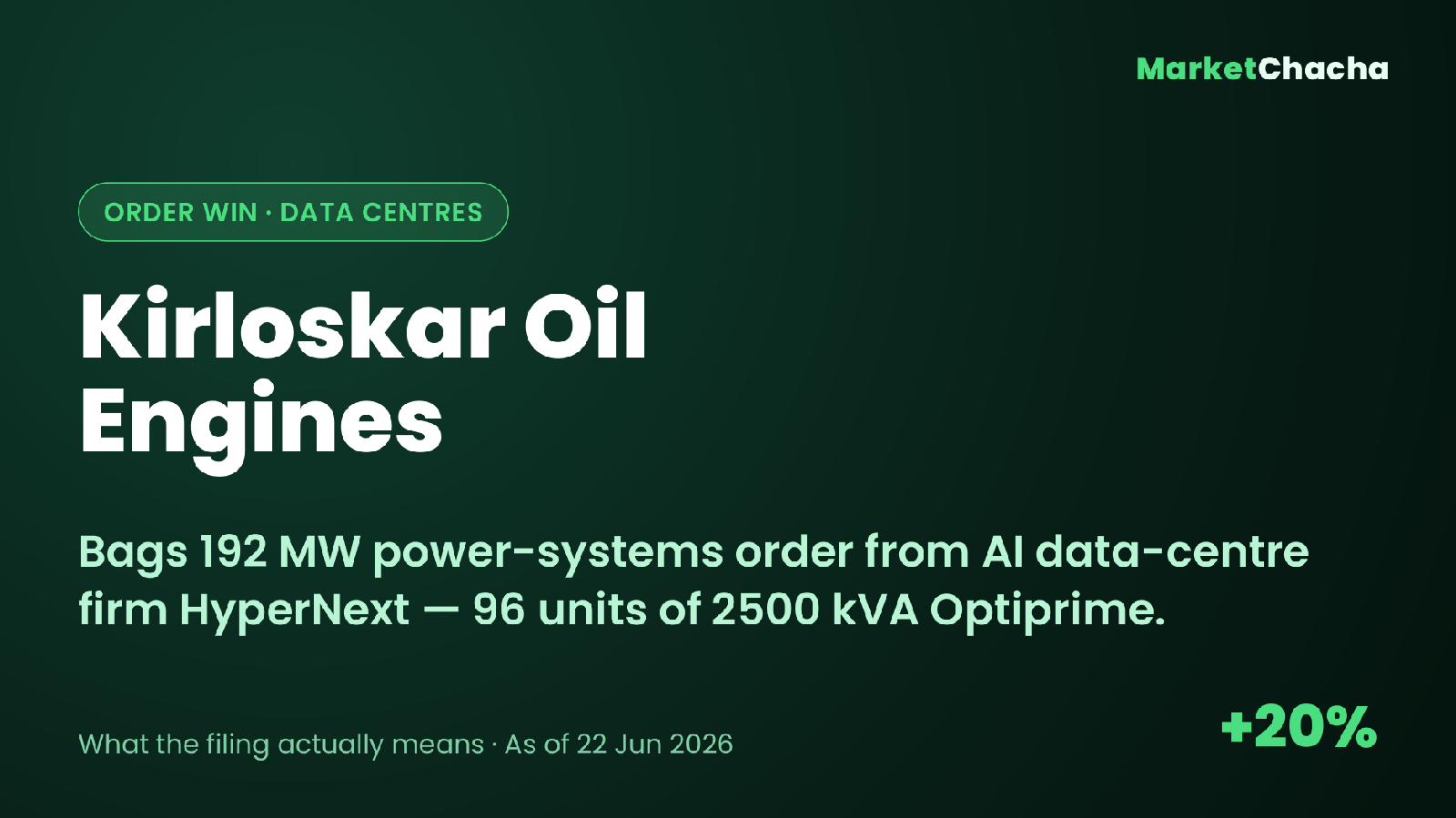
Kirloskar Oil Engines (KOEL) told the exchanges, in a filing after market hours on Friday, 19 June 2026, that it has won a large order to supply 192 MW of power systems (96 units of its 2500 kVA Optiprime™ Dual Core gensets) to HyperNext, a company that builds AI-focused data centres. The stock re-opened on Monday and locked in a 20% upper circuit at a record high as the market digested the news.
What was announced
This is an order-win intimation made under Regulation 30 of SEBI's listing rules. KOEL will supply 96 units of its 2500 kVA Optiprime Dual Core power systems — adding up to roughly 192 megawatts of standby power capacity — to HyperNext for large-scale, hyperscale data centres in India. KOEL describes it as one of the largest single deployments of high-capacity standby power for data centres in the country. The company did not disclose the rupee value of the order in the available filing, so treat any number you see floating around as an estimate, not an official figure.
What this type of filing means
An "order win" or "contract" intimation is a company telling the exchange that a customer has placed a firm order. Under SEBI rules, a listed company must disclose material orders so all investors learn about them at the same time. A few things to keep in mind when you read one:
- An order is revenue over time, not cash today. KOEL recognises the money only as it manufactures and delivers the units, often spread across several quarters.
- Watch for the value and the timeline. A filing that states the order size in rupees and a delivery period is more useful than one that only describes the scope. Here, the capacity (192 MW) is given but the rupee value is not.
- "Won" is not "completed." Execution, input costs and any cancellation risk still sit ahead of the company.
Why it matters / potential impact
India's data-centre build-out — supercharged by AI computing demand — needs enormous amounts of reliable backup power, and that is exactly what diesel/gas gensets provide. A marquee order from an AI data-centre operator does two things for KOEL: it adds visible future revenue to the order book, and it validates KOEL's newer high-capacity Optiprime platform against global genset brands in a fast-growing, premium segment. If data-centre orders keep coming, this could shift KOEL's mix toward higher-value power solutions. The flip side: a single order, however large, is a small slice of a diversified engine company, the rupee value is undisclosed, and a 20% one-day pop already prices in a lot of optimism. None of this is a price prediction — just the levers to watch.
Is it expensive?
After the jump, KOEL's market capitalisation is roughly ₹34,700 crore and it trades at a P/E of about 63x (per Screener.in / Moneycontrol). That is a rich valuation in absolute terms — you are paying up for a growth and re-rating story, not for cheapness. For context, its larger listed peer Cummins India (also a gensets and engines major) is a roughly ₹1,55,000 crore company trading at a P/E near 68x. So both names in this engines/power-systems space carry premium multiples right now; KOEL is the much smaller (about 4-5x smaller) of the two. Rich multiples mean the market already expects strong growth — if execution disappoints, expensive stocks can de-rate quickly. This is framing, not a buy or sell call.
The business
Kirloskar Oil Engines, part of the 75-year-old Kirloskar group, makes internal-combustion engines, gensets and integrated power solutions. It serves data centres, infrastructure and real estate, defence, marine and railways, with distribution across India, the Middle East, Africa and the Americas. Importantly, data-centre power is just one of several end-markets — so this order strengthens one growth vertical rather than transforming the whole company overnight.
Beginner takeaway
KOEL won a big contract to supply backup power systems for AI data centres, and the stock hit a 20% upper circuit on the news. An order win adds to future revenue but is earned over time, not booked instantly — and the stock is already richly valued, so a lot of good news is in the price. Treat the move as a signal to understand the business, not a reason to chase.
FAQ
What is an "upper circuit"? It is the maximum percentage a stock is allowed to rise in a single session before trading in it is paused. Hitting a 20% upper circuit means buyers vastly outnumbered sellers at that ceiling.
Why did the stock jump on Monday if the order was filed Friday? The filing came after Friday's market close, and the weekend kept markets shut, so Monday was the first session for investors to react — a common pattern for weekend or after-hours filings.
How much is the order worth? The capacity is 192 MW (96 units of 2500 kVA), but KOEL did not disclose the rupee value in the available filing. Be cautious about unofficial figures.
Does a 20% jump mean I should buy? No. A price move tells you about sentiment, not about whether the stock is a good long-term holding. The valuation here is already rich, and this is educational content, not advice.
As of 22 June 2026 (filing dated 19 June 2026). Source: official BSE/NSE filing — read it directly here. We summarise filings for education and may make errors, so always verify against the official document. Educational content only — not investment advice, not a buy/sell recommendation.
This article is for educational and informational purposes only. It is not financial advice, investment recommendation, or a solicitation to buy or sell securities. Investing involves significant risks. I am not a SEBI-registered investment advisor. Readers should consult their own financial advisor and conduct their own research before making any investment decisions.
Comments
Join the conversation
Sign in to join the conversation.
Follow replies, add your view, and take part in the discussion.
Sign in to commentLoading comments...