

Intel (INTC): the full file — the numbers, the owners, and what the filings actually show
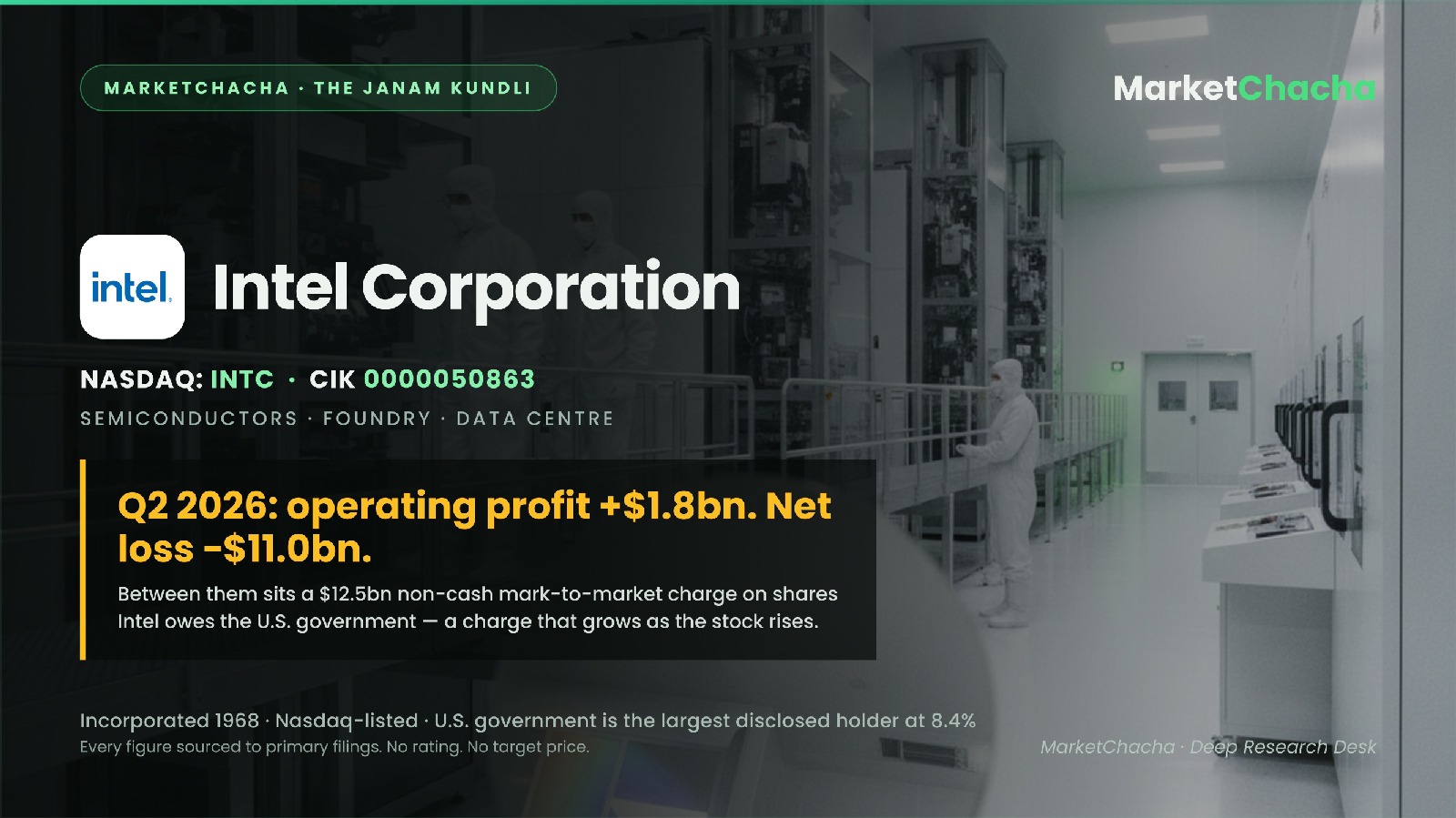
Intel designs and sells x86 processors for PCs and data centres, and it owns the fabs that make most of them — a combination almost no other large chip company still runs. It earns money two ways that the accounts keep strictly apart: Intel Products sells chips to customers, and Intel Foundry manufactures wafers, overwhelmingly for Intel Products itself.
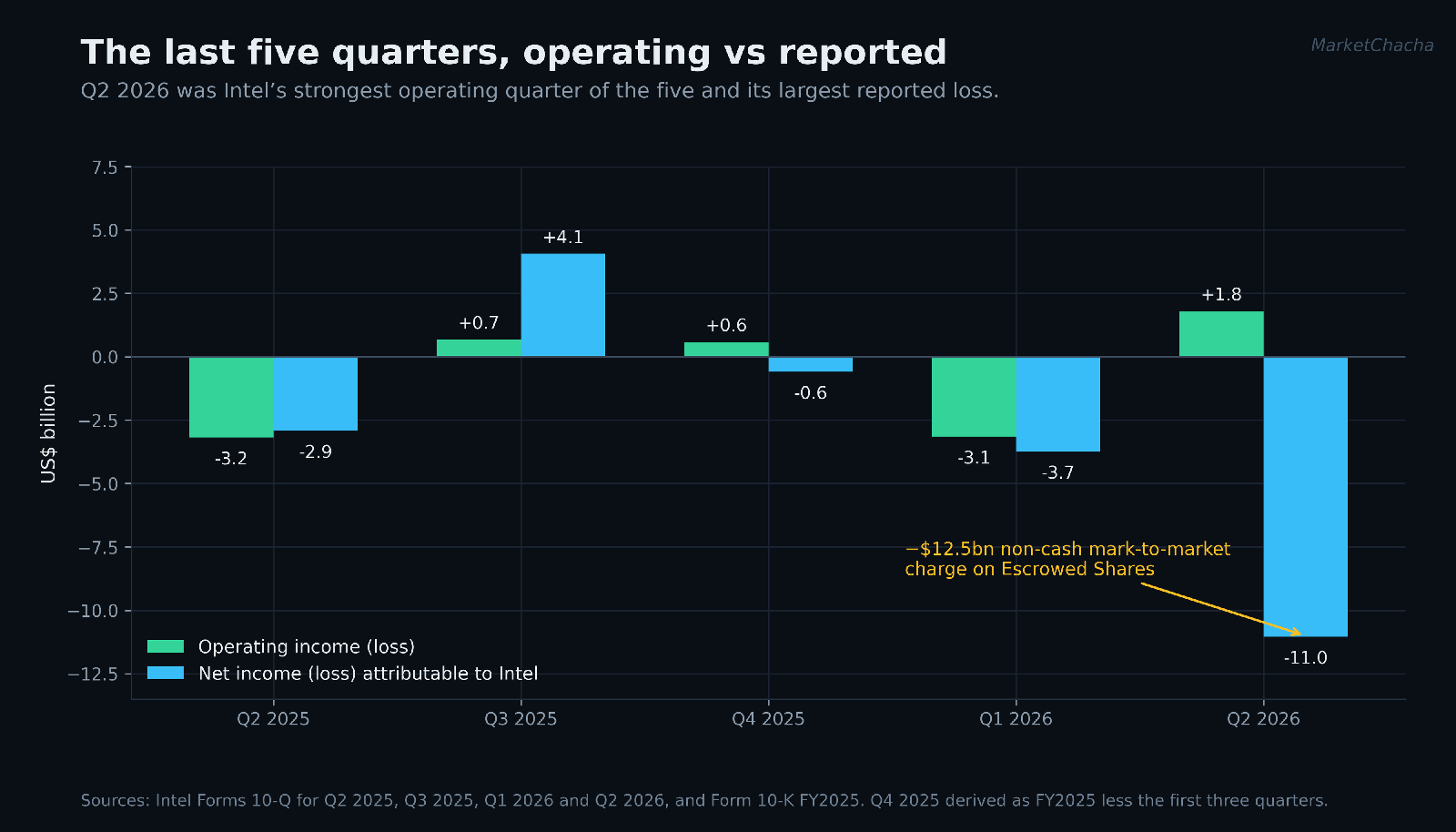
One line from the June 2026 quarter frames the whole file. Intel reported operating income of +$1,796 million — its best operating quarter in more than two years — and, in the same three months, a net loss attributable to Intel of $11,033 million, the largest quarterly loss in its history. The bridge between the two is a single non-cash line: a $12,529 million mark-to-market charge on shares Intel has promised to the U.S. government, a charge that gets bigger as Intel's own share price rises. Everything below is what the filings say, with the arithmetic shown.
Origin — the company's birth certificate
Intel was founded on 18 July 1968 by Robert Noyce and Gordon Moore, both of whom had helped start Fairchild Semiconductor in 1957. The initial incorporation paperwork carried the name N.M. Electronics; the founders bought the "Intel" name shortly afterwards, a contraction of "integrated electronics". Operations began on 1 August 1968 in a conference room in the old Union Carbide building on Middlefield Road in Mountain View, California, per Intel's own corporate history.
The SEC filer record puts the current registrant in Delaware, SIC code 3674 (Semiconductors and Related Devices), Commission File Number 000-06217, CIK 0000050863, with a fiscal year that ends on the last Saturday of December. Principal executive offices are at 2200 Mission College Boulevard, Santa Clara, California. The 2026 proxy adds a detail worth recording: Ernst & Young has been the auditor since Intel was incorporated in 1968 — a 58-year engagement, and one of the longest continuous auditor relationships in the S&P 500.
The stock trades on the Nasdaq Global Select Market as INTC. As at 16 January 2026 there were approximately 87,000 registered holders of record, with a substantially larger number holding in street name. There is no dual-class structure, no poison pill, and no controlling family or promoter group.
The business — what they actually sell
FY2025 revenue of $52,853 million splits into three reported segments plus a residual. The figures below are before intersegment eliminations, and are taken from Note 3 of the FY2025 10-K.
| Segment (FY2025) | Revenue $m | Operating income (loss) $m | Margin |
|---|---|---|---|
| Client Computing Group (CCG) | 32,228 | +9,317 | 28.9% |
| Data Center and AI (DCAI) | 16,919 | +3,422 | 20.2% |
| Total Intel Products | 49,147 | +12,739 | 25.9% |
| Intel Foundry | 17,826 | −10,318 | −57.9% |
| All Other (incl. Mobileye) | 3,563 | +264 | 7.4% |
| Corporate unallocated | — | −5,518 | — |
| Intersegment eliminations | (17,683) | +619 | — |
| Consolidated | 52,853 | −2,214 | −4.2% |
The single most checkable fact in that table is buried in the segment note's text rather than its numbers. Of Intel Foundry's $17,826 million of FY2025 segment revenue, third-party foundry and assembly-and-test revenue from external customers totalled $307 million — 1.7%. It was $159 million in 2024 and $547 million in 2023. In the June 2026 quarter external foundry revenue was $293 million, against $22 million a year earlier, so the number is now growing quickly off a small base. Foundry's revenue is, almost entirely, Intel selling wafers to itself at internal transfer prices which the filing says are "intended to approximate market pricing".
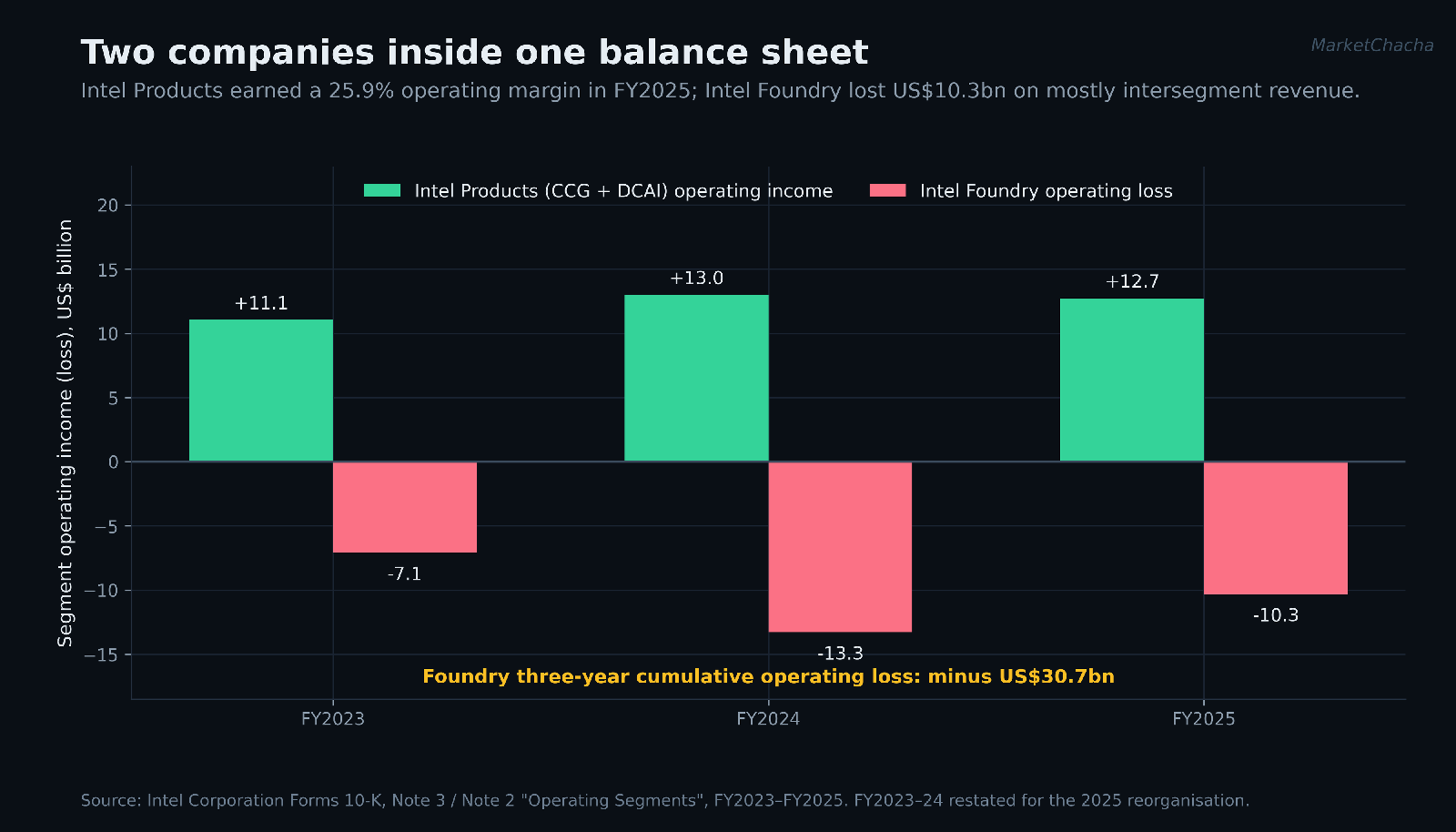
Read together, the accounts describe a highly profitable fabless chip company bolted to a foundry that has lost $30,692 million cumulatively over three years (−$7,083m in FY2023, −$13,291m in FY2024, −$10,318m in FY2025). The benign reading is explicit in the strategy and in the risk factors: leading-edge fabs cost tens of billions before they earn anything, the losses are the cost of building capacity for Intel 18A and Intel 14A, and the FY2025 loss is already $3.0bn narrower than FY2024's. The 10-K also states the other side plainly — that Intel may pause or discontinue Intel 14A if it cannot secure a significant external customer for it.
Who actually buys from them
Unlike most Indian issuers, U.S. registrants must disclose customer concentration, and Intel does. From Note 3:
| Share of consolidated net revenue | FY2025 | FY2024 | FY2023 |
|---|---|---|---|
| Customer A | 19% | 19% | 19% |
| Customer B | 12% | 14% | 11% |
| Customer C | 12% | 12% | 10% |
| Top three combined | 43% | 45% | 40% |
The three are not named in the filing — that is permitted, and it is a disclosure gap the reader should register rather than fill in. Concentration has been stable at roughly two-fifths of revenue for three years. The 10-K also notes that customers order on purchase orders and "can typically cancel, change or delay product purchase commitments with little or no notice … and without penalty".
Revenue by billing location tells a second concentration story: United States $15,757m, China $12,694m, Singapore $9,535m, Taiwan $7,672m, other regions $7,195m. China is 24% of billings, and the 2026 proxy carries a stockholder proposal (Proposal 6) requesting a report on the risks of that exposure — a fact about the proxy, not a judgement about the exposure.
Where it is actually made — plants & supply chain
Item 2 of the 10-K reports 65 million square feet of major facilities: 37 million in the United States and 28 million elsewhere; 60 million owned and 5 million leased. Intel says the majority of that footprint supports Intel Foundry.
The named manufacturing entities in Exhibit 21.1 and the notes place production in Arizona (Arizona Fab LLC, and the Arizona SCIP joint arrangement), Ireland (Fab 34, held through the Ireland SCIP structure), Israel (four separate Israeli entities), China (Dalian and Chengdu), Vietnam, Malaysia and Costa Rica. Operating and capital costs are incurred materially in the Israeli shekel, Malaysian ringgit, euro and yen, per Item 7A.
What is not disclosed: Intel does not publish a plant-by-plant capacity table, does not name a single supplier of tools or materials, does not quantify single-source dependencies, and does not identify how much of its own product it buys from external foundries. The 10-K discusses external foundry usage as a strategy and as a risk, but puts no number on it. A reader who wants to know what share of Intel-branded silicon is made by someone else cannot get that from the filings.
Five years of numbers
| US$ million | FY2021 | FY2022 | FY2023 | FY2024 | FY2025 |
|---|---|---|---|---|---|
| Net revenue | 79,024 | 63,054 | 54,228 | 53,101 | 52,853 |
| Gross margin | 55.4% | 42.6% | 40.0% | 32.7% | 34.8% |
| Operating margin | 24.6% | 3.7% | 0.2% | −22.0% | −4.2% |
| Net income attributable to Intel | 19,868 | 8,014 | 1,689 | −18,756 | −267 |
| Cash from operations | 29,456 | 15,433 | 11,471 | 8,288 | 9,697 |
| Total capital expenditure | 18,733 | 24,844 | 25,750 | 25,122 | 17,672 |
| Free cash flow | +10,723 | −9,411 | −14,279 | −16,834 | −7,975 |
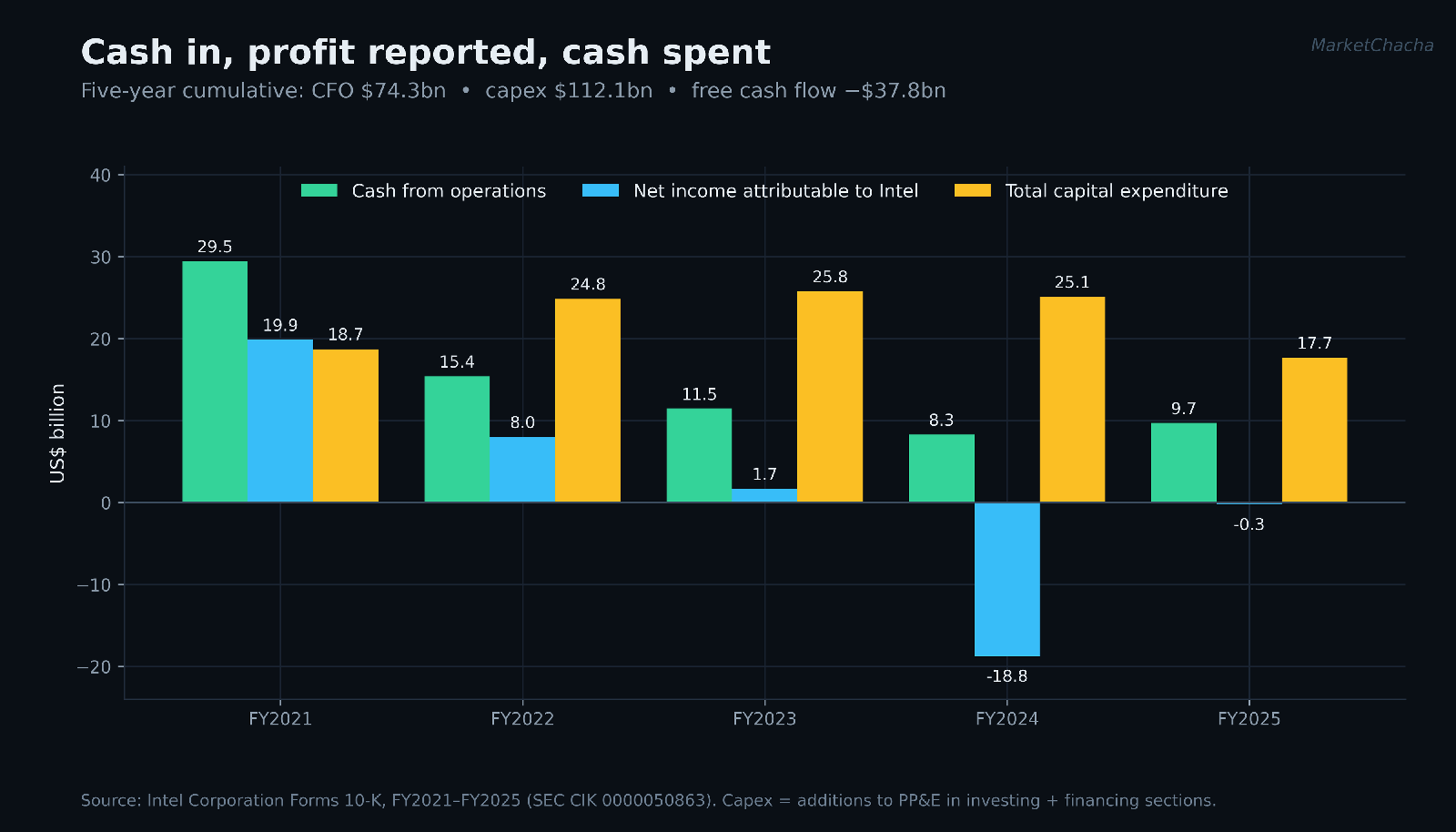
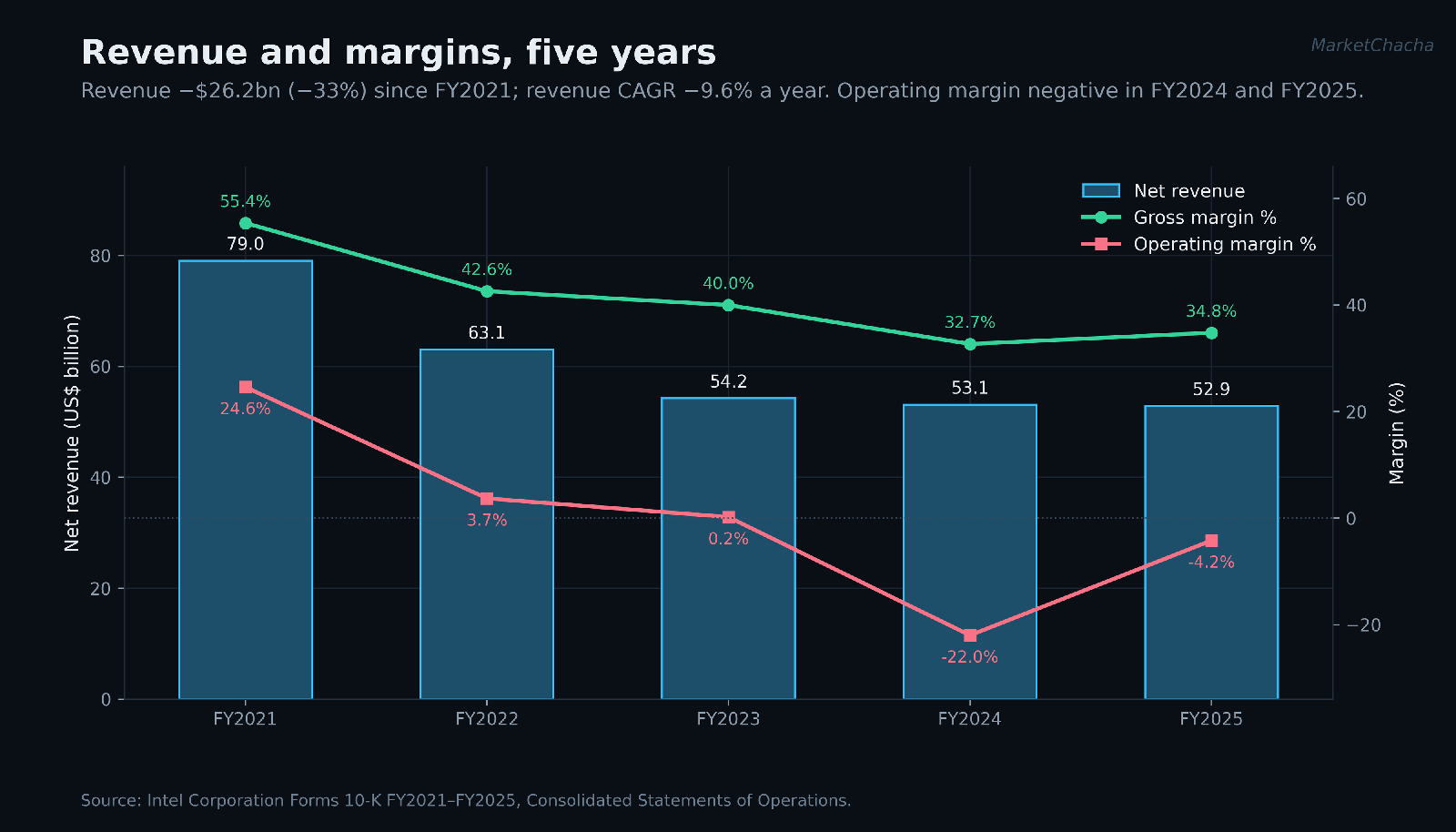
Revenue fell $26,171 million (−33%) across the four years from FY2021 to FY2025, a compound rate of −9.6% a year. Cumulative cash from operations was $74,345m; cumulative capital expenditure was $112,121m; cumulative free cash flow was −$37,776m. Capex here adds the "additions to property, plant and equipment" line that Intel reports inside financing activities (equipment bought on extended payment terms) to the one in investing activities — $3,026m and $1,178m in FY2025 and FY2024 respectively.
On shareholder return, the 10-K's own performance table is the cleanest source. $100 invested in Intel at the close of FY2020, with dividends reinvested, was worth $85 at the end of FY2025 — a cumulative −15%, or −3.2% a year. The same $100 in the PHLX Semiconductor Index was worth $277 (+177%, +22.6% a year); in the S&P 500, $201.
Income statement, FY2025 vs FY2024
| US$ million | FY2025 | FY2024 | Change $m | Change % |
|---|---|---|---|---|
| Net revenue | 52,853 | 53,101 | −248 | −0.5% |
| Cost of sales | 34,478 | 35,756 | −1,278 | −3.6% |
| Gross profit | 18,375 | 17,345 | +1,030 | +5.9% |
| Research and development | 13,774 | 16,546 | −2,772 | −16.8% |
| Marketing, general and administrative | 4,624 | 5,507 | −883 | −16.0% |
| Restructuring and other charges | 2,191 | 6,970 | −4,779 | −68.6% |
| Operating income (loss) | −2,214 | −11,678 | +9,464 | +81.0% |
| Gains on equity investments, net | 514 | 242 | +272 | +112.4% |
| Interest and other, net | 3,257 | 226 | +3,031 | +1,341% |
| Income (loss) before taxes | 1,557 | −11,210 | +12,767 | n.m. |
| Provision for taxes | 1,531 | 8,023 | −6,492 | −80.9% |
| Net income (loss) | 26 | −19,233 | +19,259 | n.m. |
| Less: non-controlling interests | 293 | −477 | +770 | n.m. |
| Net income (loss) attributable to Intel | −267 | −18,756 | +18,489 | +98.6% |
| Diluted EPS | −$0.06 | −$4.38 | +$4.32 | — |
Balance sheet, FY2025 vs FY2024
| US$ million | FY2025 | FY2024 | Change $m | Change % |
|---|---|---|---|---|
| Cash and cash equivalents | 14,265 | 8,249 | +6,016 | +72.9% |
| Short-term investments | 23,151 | 13,813 | +9,338 | +67.6% |
| Accounts receivable, net | 3,839 | 3,478 | +361 | +10.4% |
| Inventories | 11,618 | 12,198 | −580 | −4.8% |
| Property, plant and equipment, net | 105,414 | 107,919 | −2,505 | −2.3% |
| Equity investments | 8,512 | 5,383 | +3,129 | +58.1% |
| Total assets | 211,429 | 196,485 | +14,944 | +7.6% |
| Accounts payable | 9,882 | 12,556 | −2,674 | −21.3% |
| Short-term debt | 2,499 | 3,729 | −1,230 | −33.0% |
| Long-term debt | 44,086 | 46,282 | −2,196 | −4.7% |
| Total Intel stockholders' equity | 114,281 | 99,270 | +15,011 | +15.1% |
| Non-controlling interests | 12,079 | 5,762 | +6,317 | +109.6% |
| Retained earnings | 48,983 | 49,032 | −49 | −0.1% |
Four lines moved by more than 40%: cash (+72.9%), short-term investments (+67.6%), equity investments (+58.1%, chiefly the $3.2bn retained 49% stake in Altera) and non-controlling interests (+109.6%, from SCIP partner contributions and the Mobileye minority rising from 12% to 20%).
Cash flow, FY2025 vs FY2024
| US$ million | FY2025 | FY2024 | Change |
|---|---|---|---|
| Cash from operating activities | 9,697 | 8,288 | +1,409 |
| Cash used in investing activities | −14,821 | −18,256 | +3,435 |
| Cash from financing activities | +11,587 | +11,138 | +449 |
| Free cash flow (CFO less total capex) | −7,975 | −16,834 | +8,859 |
The material variances. Revenue was flat; the entire $9,464m improvement in operating loss came from cost lines — R&D down $2,772m, MG&A down $883m and restructuring charges down $4,779m — plus $1,030m of gross profit. The FY2025 restructuring plan reduced Intel's core workforce by approximately 15% by the end of the year. Financing inflows are almost entirely external capital: $12,706m attributed to common stock, warrants and Escrowed Shares issued, plus $5,108m of SCIP partner contributions, against zero dividends paid (the dividend was $1,599m in FY2024 and $3,088m in FY2023) and no buybacks since Q1 2021.
Earnings quality. This is the line that matters. Operating loss was −$2,214m. Profit before tax was +$1,557m. The entire $3,771m gap is non-operating — $514m of equity-investment gains and $3,257m of "interest and other, net", which itself contains a $5.6 billion pre-tax gain on the Altera divestiture (of which roughly $2.1bn was a non-cash remeasurement of the retained 49% stake to fair value). Strip the divestiture out and FY2025 is a pre-tax loss. None of the reported pre-tax profit is core operating profit. A $1,531m tax charge on that $1,557m of pre-tax income then took the result back to roughly zero.
The latest quarter, decoded
| US$ million | Q2 FY26 | Q1 FY26 | QoQ | Q2 FY25 | YoY |
|---|---|---|---|---|---|
| Net revenue | 16,128 | 13,577 | +18.8% | 12,859 | +25.4% |
| Cost of sales | 9,619 | 8,230 | +16.9% | 9,317 | +3.2% |
| Gross profit | 6,509 | 5,347 | +21.7% | 3,542 | +83.8% |
| Gross margin | 40.4% | 39.4% | +1.0 pt | 27.5% | +12.9 pt |
| Research and development | 3,368 | 3,375 | −0.2% | 3,684 | −8.6% |
| Restructuring and other | 170 | 4,070 | −95.8% | 1,890 | −91.0% |
| Operating income (loss) | +1,796 | −3,136 | n.m. | −3,176 | n.m. |
| Interest and other, net | −12,576 | −738 | n.m. | −95 | n.m. |
| Loss before taxes | −10,819 | −3,946 | n.m. | −2,769 | n.m. |
| Tax | 29 | 335 | −91.3% | 255 | −88.6% |
| Net loss attributable to Intel | −11,033 | −3,728 | n.m. | −2,918 | n.m. |
| Diluted EPS | −$2.16 | −$0.73 | — | −$0.67 | — |
Operationally the quarter was the strongest in the series. Revenue rose 25.4% year on year, gross margin expanded 12.9 percentage points to 40.4%, and DCAI revenue rose from $3,939m to $6,262m (+59%) with segment operating income up from $633m to $2,474m. Intel Products earned $4,817m of operating income on $15,139m of revenue — a 31.8% margin. Intel Foundry still lost $2,089m, an improvement from $3,168m a year earlier.
The reported loss comes from one place. The Q2 note breaks "interest and other, net" into interest income $334m, interest expense −$321m, other −$60m, and "Gain (loss) on mark-to-market of Escrowed Shares" of −$12,529m. Intel owes the U.S. government shares at a fixed $20.00 reference; that obligation is accounted for as a derivative liability, so the higher Intel's stock goes, the larger the loss it must book. The liability stood at $15.6 billion at 27 June 2026, against $2.7 billion at 27 December 2025. It is entirely non-cash: the cash flow statement adds the $13,619m six-month charge straight back, and cash from operations for the half was +$8,102m against +$2,863m a year earlier.
Two other quality points in the half. Restructuring and other charges of $4,240m for the six months included $3,967m of asset impairment charges, almost all in Q1; over the same period recorded goodwill in the Mobileye reporting unit fell from $8.2bn to $4.3bn, and the 10-Q discloses that a higher discount rate would have produced roughly $682m of additional Mobileye goodwill impairment in Q1 2026. And the $14.2bn paid to Apollo in April 2026 to reacquire the 49% Ireland SCIP interest did not pass through the income statement at all: $13.5bn of it was recorded as a reduction of capital in excess of par value.
Who owns it — and where those owners are registered
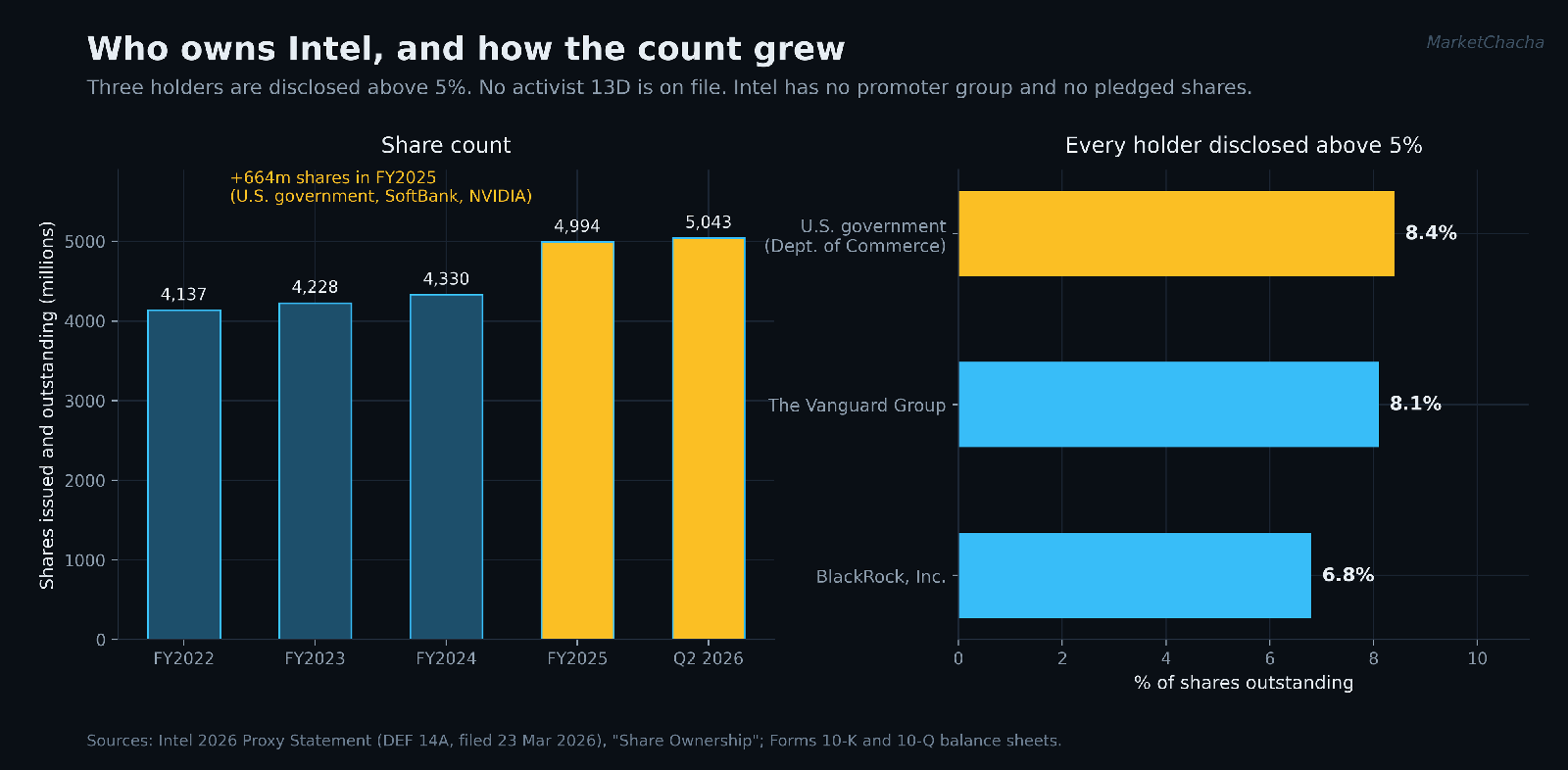
Intel has no promoter, no pledged shares and no controlling shareholder. The 2026 proxy discloses exactly three holders above 5%:
| Holder | Shares | % outstanding | Basis |
|---|---|---|---|
| U.S. government (Dept. of Commerce) | 433,323,000 | 8.4% | Company stock registry, as at 20 Mar 2026 |
| The Vanguard Group, Inc. | 404,520,480 | 8.1% | Schedule 13G/A filed 30 Jan 2026 |
| BlackRock, Inc. | 341,067,967 | 6.8% | Schedule 13G/A filed 25 Jan 2024 |
The government holding assumes full release of 149,438,785 escrowed shares and excludes the warrants described below. No Schedule 13D has been filed on Intel in the recent record — there is no activist position on file.
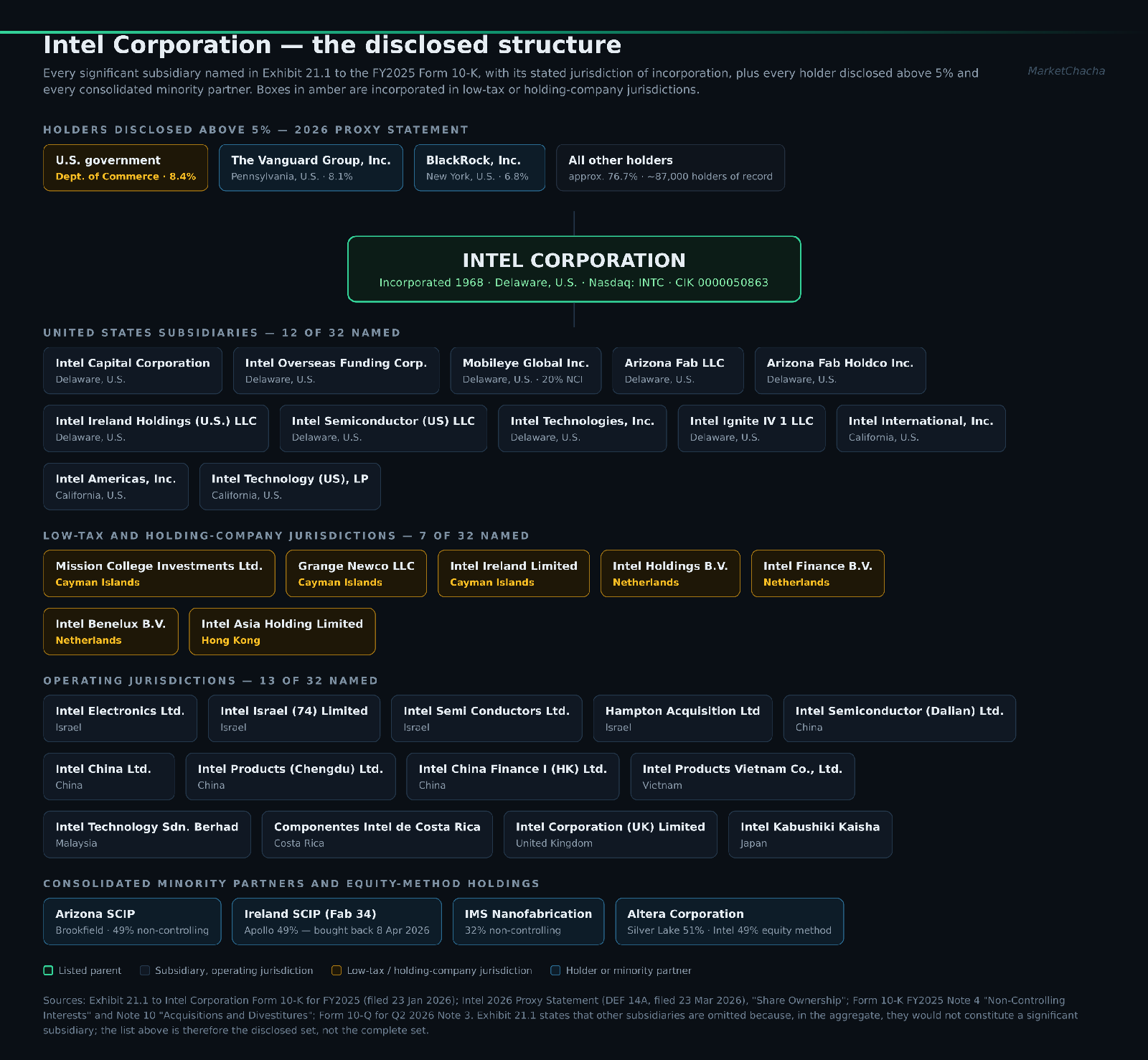
Jurisdictions. Exhibit 21.1 to the FY2025 10-K names 32 significant subsidiaries. Twelve are incorporated in Delaware or California. Seven are incorporated in low-tax or holding-company jurisdictions: Mission College Investments Ltd., Grange Newco LLC and — despite its name — Intel Ireland Limited are all incorporated in the Cayman Islands; Intel Holdings B.V., Intel Finance B.V. and Intel Benelux B.V. in the Netherlands; and Intel Asia Holding Limited in Hong Kong. Holding and financing companies in these jurisdictions are legal, entirely standard for multinationals of this size, and disclosed here because the jurisdiction of a financing entity determines which tax and creditor regime governs it. The exhibit also states that other subsidiaries are omitted because in the aggregate they would not be a significant subsidiary — so this is the disclosed set, not the complete set. Intel does not publish a full subsidiary list.
Insider dealing. Across every Form 4 filed since 1 September 2025, open-market purchases by officers and directors totalled 111,145 shares for about $10.25 million and open-market sales totalled 81,280 shares for about $7.47 million — net buying. The largest single transaction is CEO Lip-Bu Tan's purchase of 105,263 shares at $95.00 on 11 August 2026, the same price as the public offering that priced the day before. Sales in the period: April Miller Boise (Chief Legal Officer) 20,000 shares at $49.05 in February 2026 and 40,256 at $99.53 in May 2026; Naga Chandrasekaran (Intel Foundry) 21,024 shares at $118.28 in June 2026. The proxy states that all Section 16(a) reports were filed on time for FY2025.
Capital history — every time they raised money
Intel financed itself from operations for most of five decades. Since August 2025 it has raised equity four times in twelve months, and the share count is the clearest record of it.
| Event | Date | Shares | Price | Proceeds / consideration |
|---|---|---|---|---|
| U.S. government — issued at closing | 27 Aug 2025 | 275,000,000 | — | Part of $5.7bn accelerated CHIPS disbursement |
| U.S. government — into escrow | 27 Aug 2025 | 159,000,000 | $20.00 reference | Released against $3.2bn Secure Enclave disbursements |
| U.S. government — warrants | 27 Aug 2025 | up to 241,000,000 | $20.00 strike | Exercisable only if Intel ceases to own ≥51% of Foundry |
| SoftBank Group private placement | completed 26 Sep 2025 | 87,000,000 | $23.00 | $2.0bn cash |
| NVIDIA private placement | completed 26 Dec 2025 | 215,000,000 | $23.28 | $5.0bn cash |
| Public follow-on offering | priced 10 Aug 2026 | 210,526,315 + 31,578,947 greenshoe | $95.00 | ≈$23.0bn gross |
Shares issued and outstanding went 4,137m (FY2022) → 4,228m → 4,330m → 4,994m (FY2025, +15.3% in one year) → 5,043m at 27 June 2026. Adding the August 2026 offering's 242,105,262 shares takes the count to roughly 5,285m, about 28% above the FY2022 level. Existing holders were diluted; the offsetting fact, equally verifiable, is that the money came in at $95.00 — more than four times the $20.00–$23.28 prices of the 2025 issuances. Intel bought back no stock in FY2025; $7.2bn of the $110bn authorisation remains unused, and the last repurchase was in Q1 2021.
On debt: in Q2 2026 Intel issued $6.5bn of senior notes (4.65% due 2031, 5.00% due 2033, 5.30% due 2036, 6.13% due 2056 and 6.20% due 2066) and drew and repaid a $6.5bn 364-day term loan priced at 4.79% in connection with the Apollo buyback.
Who runs it, and the wider web
Chair of the Board: Frank D. Yeary, independent. CEO and director: Lip-Bu Tan, formerly CEO of Cadence Design Systems. CFO: David A. Zinsner, who also sits on the boards of Albertsons Companies, Mobileye Global and Altera Corporation — the latter two being Intel affiliates. Eleven directors stood for election in 2026, including Steve Sanghi (CEO of Microchip Technology), Barbara G. Novick (co-founder of BlackRock), James J. Goetz (Sequoia Capital), Eric Meurice (former CEO of ASML), Stacy J. Smith (Executive Chairman of Kioxia), Gregory D. Smith (former CFO of Boeing), Craig H. Barratt, Andrea J. Goldsmith, Alyssa H. Henry and Dion J. Weisler.
Auditor: Ernst & Young LLP, San Jose, auditor since 1968. Its report dated 22 January 2026 is unqualified, with no going-concern paragraph, and a separate unqualified opinion that internal control over financial reporting was effective at 27 December 2025. Item 9 of the 10-K — changes in and disagreements with accountants — reads "None", and no Form 8-K reporting Item 4.01 has been filed since at least January 2024. FY2025 EY fees were $27,499,700, of which $27,042,700 (98.3%) was audit fees — a non-audit ratio that is about as clean as large-cap disclosure gets.
Officer change. On 24 April 2026 Scott Gawel, Corporate Vice President and Chief Accounting Officer, resigned as principal accounting officer, effective immediately, "to pursue another career opportunity"; CFO David Zinsner assumed the principal accounting officer role in addition to being principal financial officer. That is the filing's own language. Chief accounting officers move on routinely and the stated reason is a new job. It is recorded here because the two roles are now held by one person, which removes a layer of separation between the officer who prepares the numbers and the officer who certifies them — and because the change happened in the same quarter as a $3,967m impairment charge.
Related-party transactions. The proxy discloses a single item of substance: a family member of an executive is employed by Intel and was compensated approximately $274,500 in FY2025, on terms the company says are consistent with those for similarly situated employees. Against $52.9bn of revenue this rounds to zero. CEO compensation for FY2025 was $92,990,900, of which $746,200 was salary and $89.2m was stock and option awards granted on appointment.
The regulatory and surveillance record
- Credit rating. The 10-K states directly: "In August 2025, a major credit rating agency downgraded our corporate credit rating from BBB+ to BBB, citing execution risks tied to our technology roadmap and foundry strategy, delayed deleveraging and weaker than expected demand." The filing does not name the agency. BBB remains investment grade.
- European Commission. Intel carries an accrued liability of $311 million, including revaluation effects and accrued interest, for an EC-imposed fine originating in the 2009 Article 102 abuse-of-dominance decision.
- VLSI litigation. Accrued liabilities of $1.0 billion related to litigation involving VLSI at 27 December 2025. Intel states that, excluding the VLSI claims, management believes the ultimate outcome of its proceedings will not materially harm its financial position.
- U.S. government agreement risk. The 10-K's own risk factors state that branches of the U.S. government "could determine in the future that all or a portion of the transactions were unauthorized, void or voidable", that only the Department of Commerce is contractually bound, and that enforcement against a government counterparty "is inherently uncertain". The company also flags that converting grants into equity means it will no longer benefit from the reduced operating costs that grant funding would have provided.
- No auditor resignation, no qualified opinion, no restatement disclosed in the five years reviewed. No SEC enforcement action naming Intel was found in the primary record we searched.
- Stockholder proposals on the 2026 ballot requested reports on China-exposure risk and on human-rights due diligence, and an enduring policy separating the Chair and CEO roles. These are proposals by shareholders, not findings against the company.
Forensic checks — what the accounts show
| Check | What we found | Source | A benign explanation |
|---|---|---|---|
| 5-year cumulative CFO ÷ PAT | CFO $74,345m; net income attributable to Intel $10,548m; ratio 7.0× | 10-K FY2021–FY2025 | The ratio is high, not low — profit is not being overstated relative to cash. It is distorted by the FY2024 loss shrinking the denominator, and by $49,636m of depreciation over the five years. The meaningful version for a capital-intensive business is CFO ÷ capex: 0.66×, i.e. five-year free cash flow of −$37.8bn. |
| Yield on cash | Interest income $1,007m on average cash plus short-term investments of $29,739m = 3.4% | 10-K FY2025, income statement and balance sheets | Consistent with short-dated U.S. dollar money-market and Treasury rates. The cash is real and is earning a market return. |
| Implied interest rate on debt | Cash interest paid net of capitalised interest $1,106m on average total debt $48,298m = 2.3% | 10-K FY2025 cash flow statement and balance sheets | Low because much of the stock is legacy fixed-rate debt issued at 2020–21 coupons, and because Intel capitalises interest on construction ($542m in H1 2026 alone). New 2026 issues price at 4.65%–6.20%, so the average rate will rise as old paper matures. |
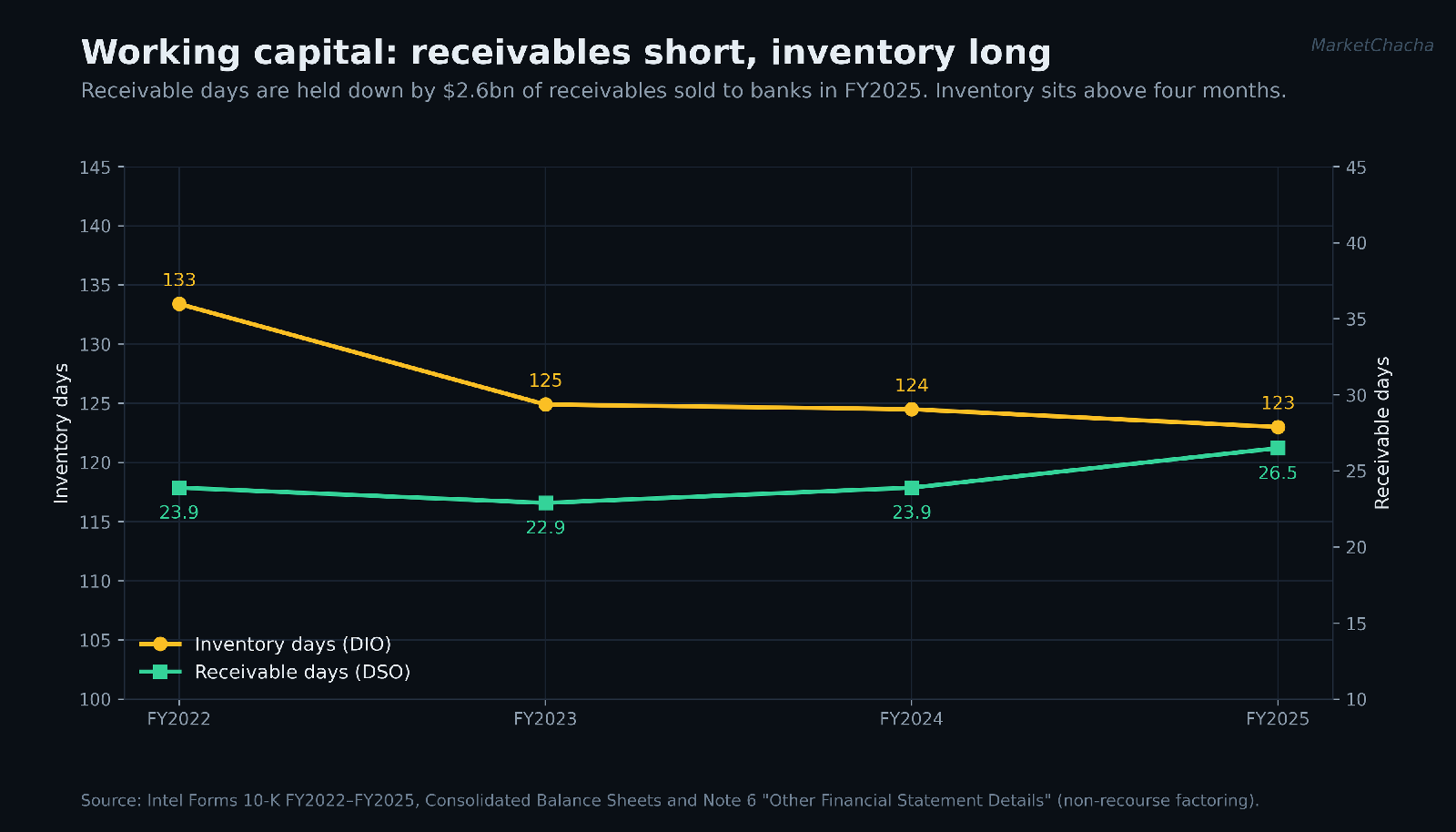
| Receivable days | 23.9 → 22.9 → 23.9 → 26.5 (FY2022–FY2025) | 10-K balance sheets; Note 6 | Very short and stable. The important caveat is disclosed: Intel sold $2.6bn of receivables non-recourse to banks in FY2025 ($2.3bn FY2024, $2.0bn FY2023) and books the proceeds in operating cash flow. Reported DSO is therefore lower than underlying collection terms. |
| Inventory days | 133 → 125 → 124 → 123 | 10-K balance sheets | Above four months, but flat and falling slightly. Work in process is $7,840m of the $11,618m total — leading-edge wafer cycle times run to months, so a high figure is structural for an integrated manufacturer. |
| Related-party transactions | One disclosed item of approximately $274,500 — under 0.001% of revenue | 2026 proxy, Independence and Related Party Transactions | Nothing to explain. This is a clean result. |
| Insider net activity | Buys $10.25m vs sales $7.47m since Sep 2025 — net buying. CEO bought 105,263 shares at $95.00 on 11 Aug 2026 | Forms 4, Sep 2025 – Aug 2026 | Straightforward. Executives bought into their own offering. The sales were by two officers at $49–$118 and are small relative to holdings. |
| Auditor | Ernst & Young since 1968. Unqualified opinion on FY2025 accounts and on ICFR. No Item 4.01 8-K on file. Audit fees 98.3% of total fees | 10-K FY2025 auditor's reports; 2026 proxy | No red flag on independence or scope. The counter-consideration, which the audit committee addresses in the proxy, is that a 58-year tenure is very long; partner rotation is mandated by PCAOB rules. |
| Subsidiaries and jurisdictions | 32 named; 12 U.S.; 7 in the Cayman Islands, Netherlands or Hong Kong; 13 in operating countries | Exhibit 21.1 to FY2025 10-K | Financing and holding structures in these jurisdictions are legal and universal among multinationals. Disclosed because the exhibit itself states that non-significant subsidiaries are omitted — the full group is larger than the list. |
| Dilution | Shares 4,330m → 4,994m in FY2025 (+15.3%), 5,043m at Q2 FY26, and roughly 5,285m after the August 2026 offering | 10-K and 10-Q balance sheets; 8-K of 12 Aug 2026 | The dilution funded a fab build-out that operating cash flow could not. The 2026 tranche was priced at $95.00, roughly four times the 2025 issuance prices, so recent dilution came at a far higher valuation. |
| Non-operating income as % of pre-tax profit | FY2025 pre-tax profit $1,557m against an operating loss of −$2,214m. All of it, and more, is non-operating — including a $5.6bn Altera divestiture gain | 10-K FY2025 income statement and MD&A | The gain is real, audited and cash-backed ($4.8bn received in Q3 2025). It is simply not repeatable, and FY2025 is a pre-tax loss without it. |
| Capex vs depreciation | FY2025 capex $17,672m against depreciation $10,757m = 1.64×. Asset turnover 0.26× (0.27× in FY2024) | 10-K FY2025 cash flow statement and Note 6 | Still investing well ahead of the replacement rate, which is what a fab build requires. Construction in progress fell from $50,418m to $34,543m as assets entered service — depreciation will keep rising. |
Valuation arithmetic, shown rather than judged. At $95.80 on 4 September 2026, Intel had no trailing P/E because it is loss-making. Book value per share at 27 June 2026 was $87,542m ÷ 5,043m shares = $17.36, giving a price-to-book of 5.5×; adding roughly $23bn of offering proceeds and 242m shares gives a pro-forma book value of about $20.92 and a P/B of about 4.6×. A named listed peer, Advanced Micro Devices, closed the same day at $477.57 on a trailing P/E of 121.9. These are inputs, not conclusions.
What we could not verify
- The identity of Customers A, B and C (43% of revenue). Not disclosed, and not required to be.
- Named suppliers, single-source dependencies and external-foundry share. Discussed qualitatively in Item 1 and Item 1A; no figures given.
- Which agency issued the August 2025 BBB+ to BBB downgrade. The 10-K says "a major credit rating agency" without naming it, and we did not locate a current primary rating publication to confirm the present rating from any agency.
- Segment balance sheets. Intel states it does not maintain them and its CODM does not receive segment asset data, so return on capital for Intel Foundry cannot be computed from the filings.
- Depreciation by segment. The filings say it is "impracticable" to allocate, because Foundry depreciation flows through overhead into inventory.
- A complete subsidiary list. Exhibit 21.1 covers only significant subsidiaries.
- Institutional 13F detail. We used the proxy's own 5%-holder table, which is a primary disclosure; we did not reconcile it to individual 13F filings for the September 2026 quarter, which were not yet due.
- Post-quarter operating results. The August 2026 offering and the CEO's purchase are documented, but no financial statements after 27 June 2026 exist yet.
What would change the picture
- Intel Foundry's external revenue line in the next segment note. It went $22m → $293m year on year in Q2. Whether it keeps compounding is the single most informative number Intel publishes.
- Whether a significant external customer signs for Intel 14A. The 10-K states the programme may be paused or discontinued without one.
- The Escrowed Shares derivative liability ($15.6bn at 27 June 2026). It moves with the share price and will keep distorting reported earnings in both directions until the 143m remaining escrowed shares are released.
- Free cash flow. Negative for four consecutive years. FY2026 capex guidance and the next two cash flow statements will show whether $23bn of new equity is funding a return to positive FCF or another build cycle.
- The principal accounting officer role. Whether Intel appoints a new CAO or leaves both certifications with the CFO.
- The next auditor's report (due late January 2027) — specifically its critical audit matters, and whether the Escrowed Shares valuation becomes one.
- Mobileye goodwill, now $4.3bn after the Q1 2026 impairment, and the disclosed sensitivity to the discount rate.
Sources
- Intel Corporation, Form 10-K for the fiscal year ended 27 December 2025 (filed 23 January 2026) — income statement, balance sheet, cash flow statement, Note 3 Operating Segments, Note 4 Non-Controlling Interests, Note 6 Other Financial Statement Details, Note 10 Acquisitions and Divestitures, Legal Proceedings, Properties, Stock Performance Graph, auditor's reports.
- Exhibit 21.1 to the FY2025 Form 10-K — Subsidiaries of the Registrant (32 entities with jurisdictions of incorporation).
- Intel Corporation, Form 10-Q for the quarter ended 27 June 2026 (filed 24 July 2026) — Q2 and H1 statements, Note 2 Operating Segments, Note 3 Non-Controlling Interests, Note 4 Earnings (Loss) Per Share and Stockholders' Equity, Note 11 Borrowings, Note 12 Fair Value.
- Intel Corporation, Form 10-Q for the quarter ended 28 March 2026 (filed 24 April 2026).
- Intel Corporation, Form 10-Q for the quarter ended 27 September 2025 (filed 6 November 2025).
- Intel Corporation, Form 10-K for the fiscal year ended 28 December 2024 (filed 31 January 2025).
- Intel Corporation, 2026 Proxy Statement (DEF 14A) (filed 23 March 2026) — Share Ownership, Director Biographies, Auditor Fees, Summary Compensation Table, Independence and Related Party Transactions, Delinquent Section 16(a) Reports, stockholder proposals.
- Intel Corporation, Form 8-K dated 10 August 2026 (filed 12 August 2026) — underwriting agreement for 210,526,315 shares at $95.00 plus a 31,578,947-share option exercised in full.
- Intel Corporation, Form 8-K dated 24 April 2026 — Item 5.02, resignation of the Chief Accounting Officer.
- Form 4 for Lip-Bu Tan, filed 14 August 2026 — purchase of 105,263 shares at $95.00 on 11 August 2026.
- SEC XBRL company facts, CIK 0000050863 — machine-readable five-year financial series used for the CAGR and ratio calculations.
- EDGAR filing index for Intel Corporation — used to confirm the absence of any Form 8-K Item 4.01 and of any Schedule 13D.
- Intel Corporation, "Intel's Founding" — founding date, founders and the N.M. Electronics name.
- Market data for INTC and for AMD, as at the close of 4 September 2026 — used only for the share price, market capitalisation and the peer P/E.
FAQ
Why did Intel report an $11 billion loss in a quarter when it made an operating profit? Because of a $12,529 million non-cash mark-to-market charge on the Escrowed Shares it owes the U.S. government. Those shares are accounted for as a derivative liability referenced to $20.00, so when Intel's share price rises, the cost of settling the obligation rises and a loss is booked. The charge is added straight back in the cash flow statement; operating cash flow for the half was positive $8,102 million.
How much of Intel does the U.S. government own? 433,323,000 shares, or 8.4% of shares outstanding as at 20 March 2026 per the 2026 proxy, assuming full release of the 149,438,785 shares still in escrow. The government also holds warrants over up to 241 million shares at $20.00, which become exercisable only if Intel ceases to own at least 51% of its foundry business.
Is Intel Foundry making money? No. It reported an operating loss of $10,318 million in FY2025, $13,291 million in FY2024 and $7,083 million in FY2023 — $30.7 billion cumulatively. Only $307 million of its FY2025 segment revenue came from external customers; the rest was sales to Intel Products.
Does Intel still pay a dividend? Not since 2024. Dividends paid were $3,088 million in FY2023, $1,599 million in FY2024 and zero in FY2025. No shares have been repurchased since the first quarter of 2021.
Has the auditor ever qualified Intel's accounts? Not in the period reviewed. Ernst & Young has audited Intel since 1968 and issued an unqualified opinion on the FY2025 financial statements and a separate unqualified opinion on internal control over financial reporting. No Form 8-K reporting an auditor change has been filed since at least January 2024.
How much has Intel diluted its shareholders? Shares outstanding went from 4,137 million at the end of FY2022 to 5,043 million at 27 June 2026, and to roughly 5,285 million after the August 2026 offering — about 28%. The FY2025 tranches were priced between $20.00 and $23.28; the August 2026 offering was priced at $95.00.
Independent research for education and discussion only. Not investment advice, not a recommendation, and not a rating — we issue no buy/sell calls and no target prices. Every figure is sourced from the primary documents linked above; figures can be restated and we can make mistakes, so always verify against the original. Nothing here alleges wrongdoing by any company or individual: where a fact raises a question we state the fact, cite it, and give the benign explanation alongside. Offshore holding structures, pledging and preferential allotments are all legal and common — they are disclosed here as facts, not as accusations.
This article is for educational and informational purposes only. It is not financial advice, investment recommendation, or a solicitation to buy or sell securities. Investing involves significant risks. I am not a SEBI-registered investment advisor. Readers should consult their own financial advisor and conduct their own research before making any investment decisions.
Comments
Join the conversation
Sign in to join the conversation.
Follow replies, add your view, and take part in the discussion.
Sign in to commentLoading comments...