

Route Mobile: what their latest filing actually means
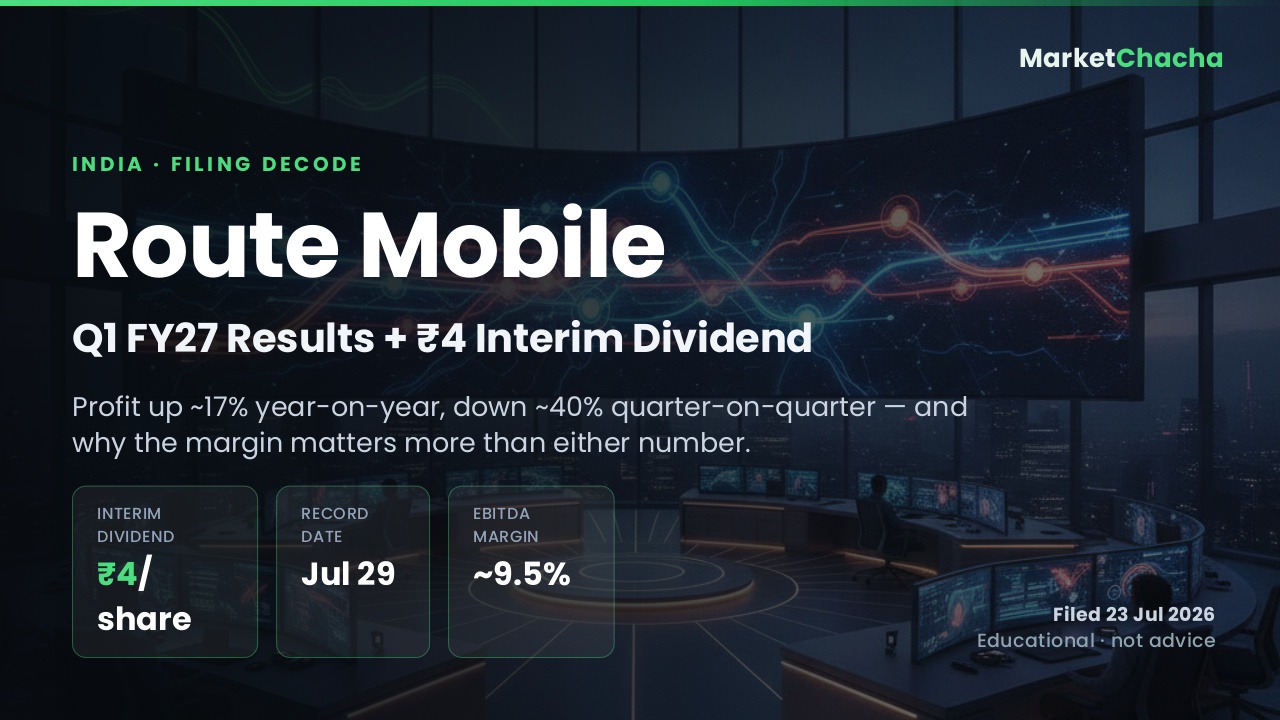
Route Mobile reported its April–June quarter (Q1 FY27) results on 23 July 2026 and, alongside them, its board declared a first interim dividend of ₹4 per share for the year, with a record date of 29 July 2026. Profit rose versus the same quarter last year but fell sharply versus the previous quarter — and the stock slipped about 2.9% the next day.
What was announced
Two things landed in the same filing:
- Q1 FY27 results (consolidated): Revenue from operations of about ₹1,151 crore, up ~9.6% versus Q1 last year. Net profit of about ₹68.6 crore, up ~16.6% versus the ₹58.8 crore of Q1 FY26 — but down ~40% versus the ₹114 crore booked in the immediately preceding quarter (Q4 FY26). Profit before tax rose ~19.5% year-on-year to about ₹91 crore.
- First interim dividend of ₹4 per share for FY27, with a record date of 29 July 2026. Route Mobile paid ₹3 as its first interim dividend a year ago, so this is a step up.
One number to keep an eye on: adjusted EBITDA margin dipped to about 9.5%, from ~11% a year earlier — meaning revenue grew but the slice of it kept as operating profit got thinner.
What this type of filing means
A quarterly results filing is the mandatory scorecard every listed company files with the exchanges four times a year. An interim dividend is a cash payout the board declares during the year (a "final" dividend is proposed after year-end and needs shareholder approval at the AGM; an interim one is decided by the board and paid straightaway).
The record date is the cut-off that decides who gets paid. You must be a registered shareholder as of that date to receive the ₹4. Because Indian stocks settle on a T+1 basis, you generally need to own the share on the record date, which means buying before the stock goes "ex-dividend." After the ex-date the price typically drops by roughly the dividend amount, because that cash is about to leave the company — so a dividend is not free money, it is your own capital handed back to you.
Why it matters / potential impact
The headline tension is "profit up 16% or down 40%?" — and the answer is both, depending on what you compare to. Versus the same quarter last year (the cleaner, like-for-like read for a business with seasonal patterns), profit grew. Versus the previous quarter, it fell — but that prior quarter was an unusually strong one, so a step-down was always likely. For an operating read, the year-on-year comparison is the more apples-to-apples one.
The margin dip matters more than the profit optics. Route Mobile is a high-volume, thin-margin business: it earns a small spread on billions of messages, and a chunk of every rupee of revenue is a pass-through cost paid to telecom operators. When telco termination charges rise or the message mix shifts toward lower-margin routes, EBITDA margin compresses even as revenue grows. That is the single most important thing to watch in this company's results, quarter after quarter.
None of this is a price call. It simply explains why a "profit up year-on-year" quarter can still see the stock ease: the market was weighing the sequential dip and the softer margin, not just the year-on-year headline.
Is it expensive?
Route Mobile trades at a P/E of roughly 15x with a market capitalisation of about ₹3,700 crore — squarely a small-cap. That is not a demanding multiple; it sits below the broader software/IT-services peer median (mid-20s P/E). But the right yardstick is its closest listed rival, Tanla Platforms, which does much the same CPaaS messaging business and trades even cheaper at about 13x, on a larger ~₹6,600 crore market cap.
So the honest framing is: fair-to-cheap on paper, but cheap for a reason. The whole CPaaS group is valued more like a low-margin telecom reseller than a high-margin software company, because the business is competitive, volume-driven and exposed to rising operator charges. A low P/E here reflects those structural realities, not a bargain waiting to be discovered. This is framing only, not a recommendation.
The business
Route Mobile is a CPaaS company — Communications Platform as a Service. In plain terms, it is the plumbing that lets banks, e-commerce apps and other businesses send you OTPs, transaction alerts, WhatsApp messages, RCS, voice calls and emails at massive scale. It makes money on the volume of "application-to-person" (A2P) messages routed through its platform, plus newer offerings in WhatsApp Business, RCS and anti-fraud/verification tools. Since 2023 it has been majority-owned by Proximus, the Belgian telecom group, which folded Route Mobile into its global digital-communications arm. So this filing affects essentially the entire company — messaging is the business, not one small division of a conglomerate.
Beginner takeaway
Route Mobile grew revenue and grew profit versus a year ago, and is handing shareholders ₹4 per share — modestly positive on the face of it. The two things worth understanding are that "profit down 40%" was a quarter-on-quarter optical dip against a strong prior quarter, and that the real health metric for a messaging business is its margin, which softened this quarter. A dividend is nice, but it is your own money returned, not a signal that the stock is cheap.
FAQ
If I buy Route Mobile today, do I get the ₹4 dividend? Only if you are a registered shareholder as of the 29 July 2026 record date, which means buying before the stock trades ex-dividend. Buy after the ex-date and the seller keeps the dividend.
Why did the stock fall if profit went up? Profit rose year-on-year but fell versus the previous quarter, and operating margin slipped — the market focused on those, plus the stock had already run into the result. A dividend announcement rarely offsets a soft margin read.
What is CPaaS in one line? It is the behind-the-scenes service that sends business messages — OTPs, alerts, WhatsApp texts — on behalf of companies, charged by volume.
Is a low P/E a buy signal here? Not on its own. Route Mobile's peers trade at similar low multiples because CPaaS is a thin-margin, competitive business; a cheap multiple reflects that structure rather than a mispricing. Always look at why the multiple is low.
As of 24 July 2026. Source: official BSE/NSE filing — read it directly here. We summarise filings for education and may make errors, so always verify against the official document. Educational content only — not investment advice, not a buy/sell recommendation.
This article is for educational and informational purposes only. It is not financial advice, investment recommendation, or a solicitation to buy or sell securities. Investing involves significant risks. I am not a SEBI-registered investment advisor. Readers should consult their own financial advisor and conduct their own research before making any investment decisions.
Comments
Join the conversation
Sign in to join the conversation.
Follow replies, add your view, and take part in the discussion.
Sign in to commentLoading comments...