

American Airlines beat Q2 — so why did it fall ~8% today?
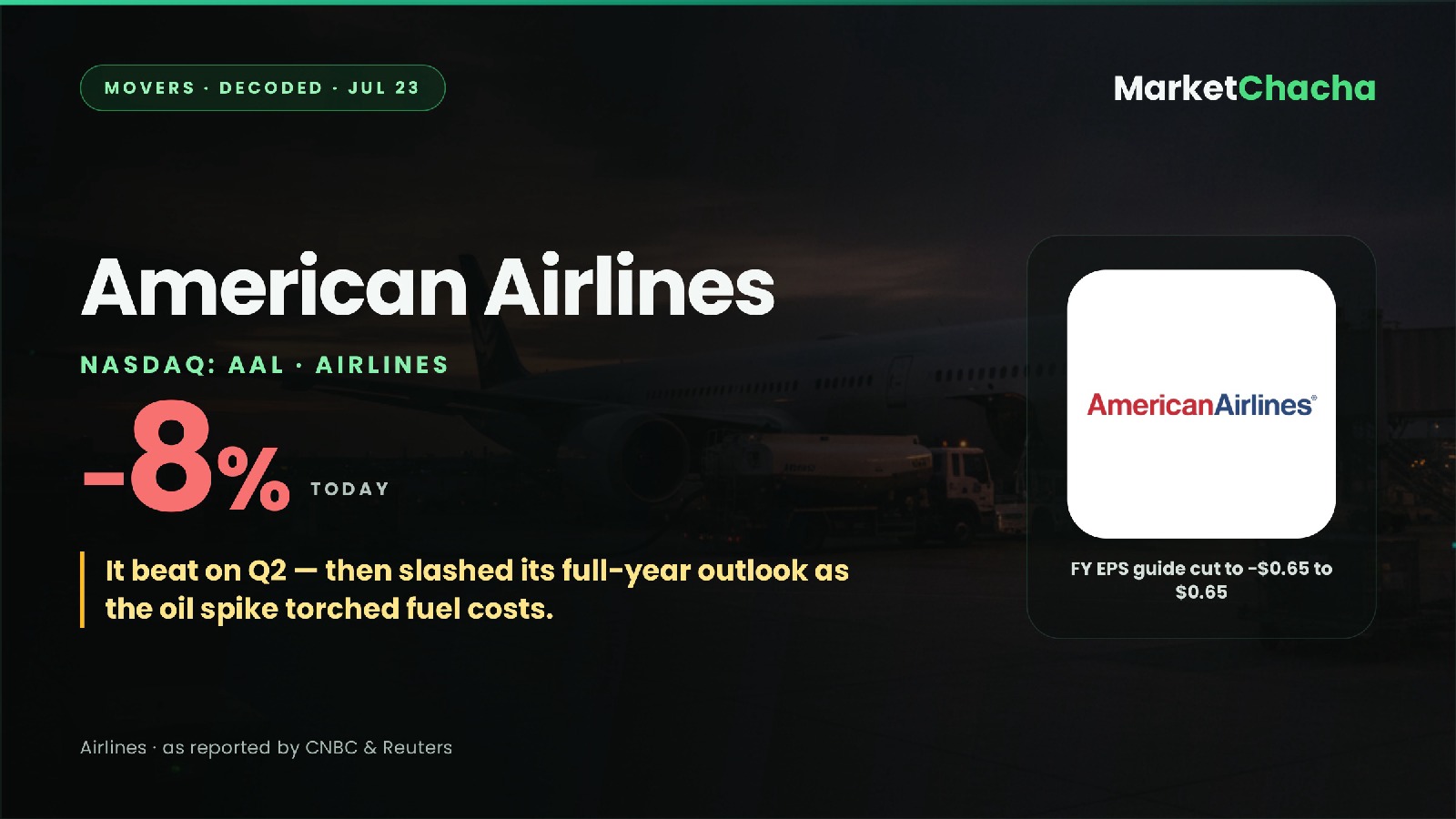
American Airlines (NASDAQ: AAL) fell about 8% on Thursday — one of the S&P 500's worst performers on a red day — and the strange part is that the quarter it just reported was good. This is a clean example of a stock beating the past and getting punished for the future.
What happened
For Q2, American posted record revenue of $16.74 billion, up 16.3% year-on-year, and adjusted EPS of $0.15 versus the ~$0.03 Wall Street expected — a five-fold beat on profit. On the numbers alone, it was a strong print. Then management opened the hood on the rest of the year, and that's where the stock broke.
Why it moved
American slashed its full-year 2026 adjusted EPS guidance to a range of a $0.65 loss to a $0.65 profit, against a consensus of roughly $0.35 in earnings. For the current quarter it guided to an adjusted loss of $0.10 to $0.70 a share, versus the +$0.28 the street had penciled in. The single biggest culprit is jet fuel: Q2 fuel expense jumped more than $2.2 billion, up about 83%, and the airline now models roughly $3.75 a gallon for Q3 based on the forward fuel curve as of July 21. That curve is being pushed up by the very oil spike moving the whole market today, with Brent back near $100. In short, the beat was history; the fuel bill is the future.
Is it expensive?
On the surface American looks dirt cheap — around a $10.3 billion market cap and low-single-digit multiples of prior earnings targets. But a P/E is close to meaningless when guidance now spans a possible loss; the market isn't valuing earnings here, it's staring at the balance sheet. American carries about $34.7 billion of total debt and an adjusted net-debt-to-capital ratio near 119% — versus roughly 68% for a basket of smaller carriers. Its trailing net margin is barely above 1%. Compare that to the other two legacy majors: Delta (DAL) runs a ~7.4% net margin and guides to $6.50–$7.50 full-year EPS, and United (UAL) just lifted its guide to $9–$11. American is guiding to roughly breakeven. It's "cheap" precisely because it's the most leveraged, thinnest-margin of the big three — so an identical fuel shock hits its bottom line first and hardest.
The business
American's revenue sits on four legs: passenger flying (its mainline fleet plus the American Eagle regional network), cargo, its AAdvantage loyalty program — the largest airline loyalty scheme in the US — and ancillary fees. Today's problem isn't demand: revenue hit a record. It's that fuel is the one big cost an airline can't quickly control, and with so little profit cushion, a spike flows almost straight to the loss line.
Who it touches
- Indian carriers: the same crude spike lands on IndiGo (InterGlobe Aviation) and SpiceJet, where ATF (jet fuel) is roughly 30–40% of operating cost — so a $100 Brent squeezes their margins the same way.
- India's macro: the country imports ~88% of its crude, so pricier oil widens the import bill, pressures the rupee, and lifts fuel-linked inflation.
- US peers: Delta, United and Southwest (LUV) face the identical fuel curve, but fatter margins let them absorb it — which is why American, not the group, is today's story.
What to watch
The entire guidance cut rests on that $3.75-a-gallon fuel assumption, which rests on Brent staying near $100. If the Middle East supply scare eases and crude drifts back toward $80, the math flips and today's cut starts to look conservative — the shares could rebound quickly. If the Red Sea and Hormuz stay hot and oil climbs further, the cut may not be deep enough. For American specifically, thin margins and heavy debt mean the stock will keep trading like a leveraged bet on the oil price.
As of ~12:40 pm ET, Jul 23, 2026. Sources: CNBC, Yahoo Finance / Zacks, American Airlines 8-K. For discussion and education only — not investment advice. Verify before acting.
This article is for educational and informational purposes only. It is not financial advice, investment recommendation, or a solicitation to buy or sell securities. Investing involves significant risks. I am not a SEBI-registered investment advisor. Readers should consult their own financial advisor and conduct their own research before making any investment decisions.
Comments
Join the conversation
Sign in to join the conversation.
Follow replies, add your view, and take part in the discussion.
Sign in to commentLoading comments...