

JSW Steel: what their latest filing actually means
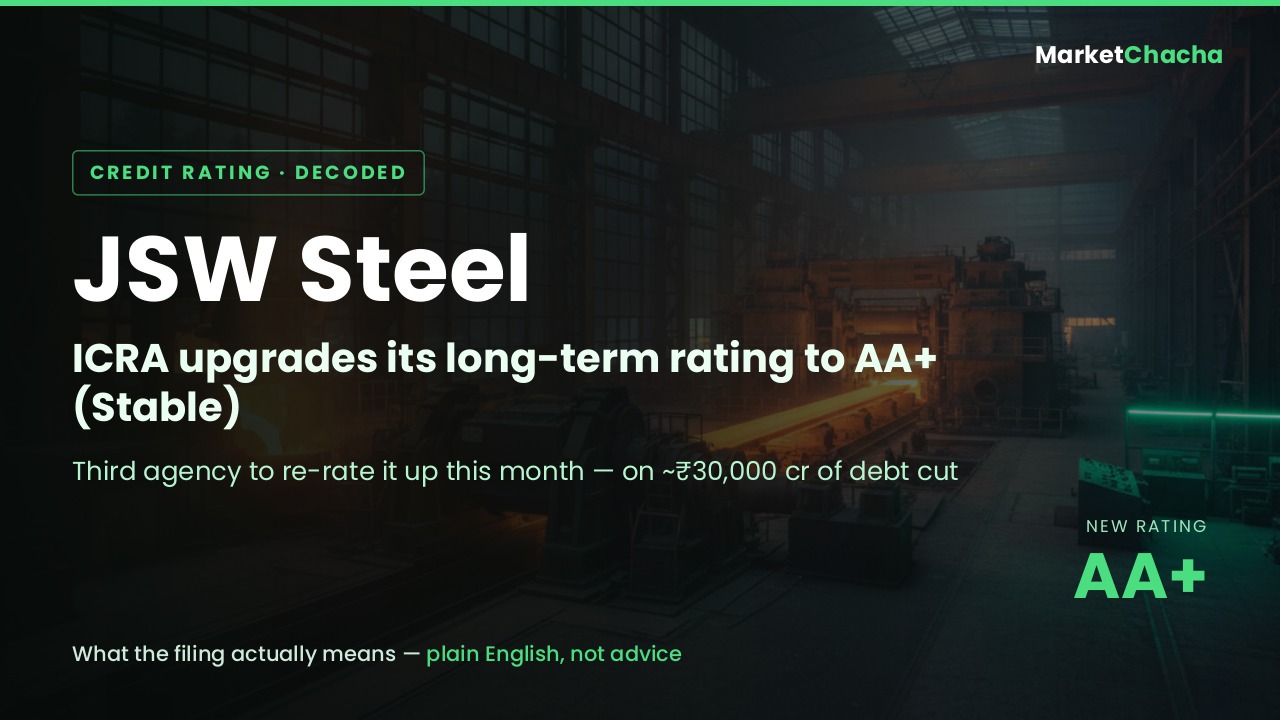
JSW Steel has told the exchanges that rating agency ICRA upgraded its long-term credit rating one notch to [ICRA]AA+ with a “Stable” outlook (from [ICRA]AA earlier). In plain terms: a credit-rating agency now judges India’s largest steelmaker to be a slightly safer borrower than it did before. This is not a results announcement or an order win — it’s a verdict on the strength of the company’s balance sheet.
What was announced
In a filing dated July 30, 2026, JSW Steel disclosed that ICRA upgraded its long-term rating to [ICRA]AA+ (Stable). This is the latest in a cluster of upgrades the company has received through July 2026 — CARE Ratings moved it to CARE AA+ (Stable) earlier in the month, and global agency Fitch upgraded its international rating to BB+ with a Positive outlook. When three separate agencies re-rate a company upward in the same window, it usually points to one clear underlying change — here, a much stronger balance sheet.
The trigger is JSW Steel’s big deleveraging move: it transferred the Bhushan Power & Steel (BPSL) business into a 50:50 joint venture with Japan’s JFE Steel. The cash that came in from that deal is being used to pay down debt — agencies note roughly ₹30,000 crore of net-debt reduction, with a further tranche expected. Net leverage has fallen to around 1.5x.
What this type of filing means
A credit rating is a report card on how likely a company is to repay its borrowings on time. It is about debt safety, not the share price. In India the long-term scale runs (best to worst): AAA → AA+ → AA → AA- → A… and downward. Moving from AA to AA+ is one rung up — closer to the top-tier AAA.
- The letters = how safe the debt is. AAA is the safest; each notch down means slightly more risk.
- “Stable” outlook = the agency does not expect the rating to change in either direction over the next 12–24 months. (A “Positive” outlook, like Fitch’s, hints the next move could be another upgrade.)
- Who cares = mainly lenders and bondholders. A better rating means the company can usually borrow more cheaply, because it is seen as less likely to default.
Why it matters / potential impact
For a capital-heavy business like steel — which constantly borrows to build and run giant plants — the cost of debt is a real profit lever. A one-notch upgrade can shave the interest rate on future borrowings and refinancing, which flows straight to the bottom line over time. It also widens the pool of investors who can buy its bonds (many funds have minimum-rating rules).
Just as important is the signal: the upgrade validates that the BPSL-into-JFE-JV deal did what management said it would — bring in cash and cut debt. Lower leverage gives JSW more room to fund its expansion toward its 62-million-tonne capacity goal without straining the balance sheet. What it does not do is directly change earnings this quarter or guarantee the stock goes up — a rating speaks to debt safety, not to steel prices, which remain the biggest swing factor for profits.
Is it expensive?
As of around July 30, 2026, JSW Steel trades near ₹1,277 a share, for a market cap of roughly ₹3.1 lakh crore — making it one of India’s most valuable metal companies. Its P/E is not a reliable yardstick here: reported figures swing from the low teens to 40x+ depending on the source, because steel earnings are highly cyclical (profits balloon when steel prices are high and collapse when they fall), which distorts the ratio. A steadier gauge for cyclicals is price-to-book (P/B), and JSW trades around 3–3.4x book value.
Compared with its closest large peer Tata Steel (market cap broadly similar; P/B roughly 1.4x), JSW Steel is clearly the premium-priced name in Indian steel — the market pays up for its scale, higher plant utilisation and reputation for efficiency. Honest framing: on assets, this is not a cheap stock; you are paying a rich multiple relative to the sector, and the upgrade improves the debt picture, not the valuation. None of this is a target price or a buy/sell call.
The business
JSW Steel is India’s largest steelmaker by capacity and the flagship of the JSW Group. It makes both flat products (hot- and cold-rolled coils, galvanised and coated steel) and long products (TMT bars, wire rods) that go into autos, appliances, construction and infrastructure. It runs large integrated plants in India (led by Vijayanagar in Karnataka) plus overseas operations in the US and Europe. Because it is a fairly focused steel play — not a sprawling conglomerate — a balance-sheet event like this upgrade affects essentially the whole company, not just one slice.
Beginner takeaway
A credit-rating upgrade is good news about how safely a company can carry its debt, and it usually lowers future borrowing costs — but it is not the same as a jump in profits or a signal to buy. Here it confirms JSW Steel meaningfully cut its debt after the BPSL–JFE deal. Treat it as a sign of a healthier balance sheet, then judge the stock on its own cyclical earnings and its rich valuation.
FAQ
Does a higher credit rating mean the share price will go up? Not necessarily. A rating measures debt safety for lenders, not equity upside. It can help sentiment and lower borrowing costs, but the stock still moves mainly on steel prices and earnings.
What’s the difference between AA and AA+? AA+ is one notch higher (safer) than AA on the long-term scale, sitting just below the top rung, AAA. The “+” is a fine-grained step within the AA band.
Why did three agencies upgrade JSW around the same time? They were all reacting to the same event — the company transferring its BPSL business into a JV with JFE Steel and using the cash to slash net debt by roughly ₹30,000 crore, cutting leverage to about 1.5x.
What does “Stable outlook” mean? The agency doesn’t expect to change the rating up or down over the next year or two. A “Positive” outlook would suggest the next move is more likely to be another upgrade.
As of July 31, 2026. Filing dated July 30, 2026. Source: official BSE/NSE filing — read it directly here. We summarise filings for education and may make errors, so always verify against the official document. Educational content only — not investment advice, not a buy/sell recommendation.
This article is for educational and informational purposes only. It is not financial advice, investment recommendation, or a solicitation to buy or sell securities. Investing involves significant risks. I am not a SEBI-registered investment advisor. Readers should consult their own financial advisor and conduct their own research before making any investment decisions.
Comments
Join the conversation
Sign in to join the conversation.
Follow replies, add your view, and take part in the discussion.
Sign in to commentLoading comments...