

MOIL: what their latest filing actually means
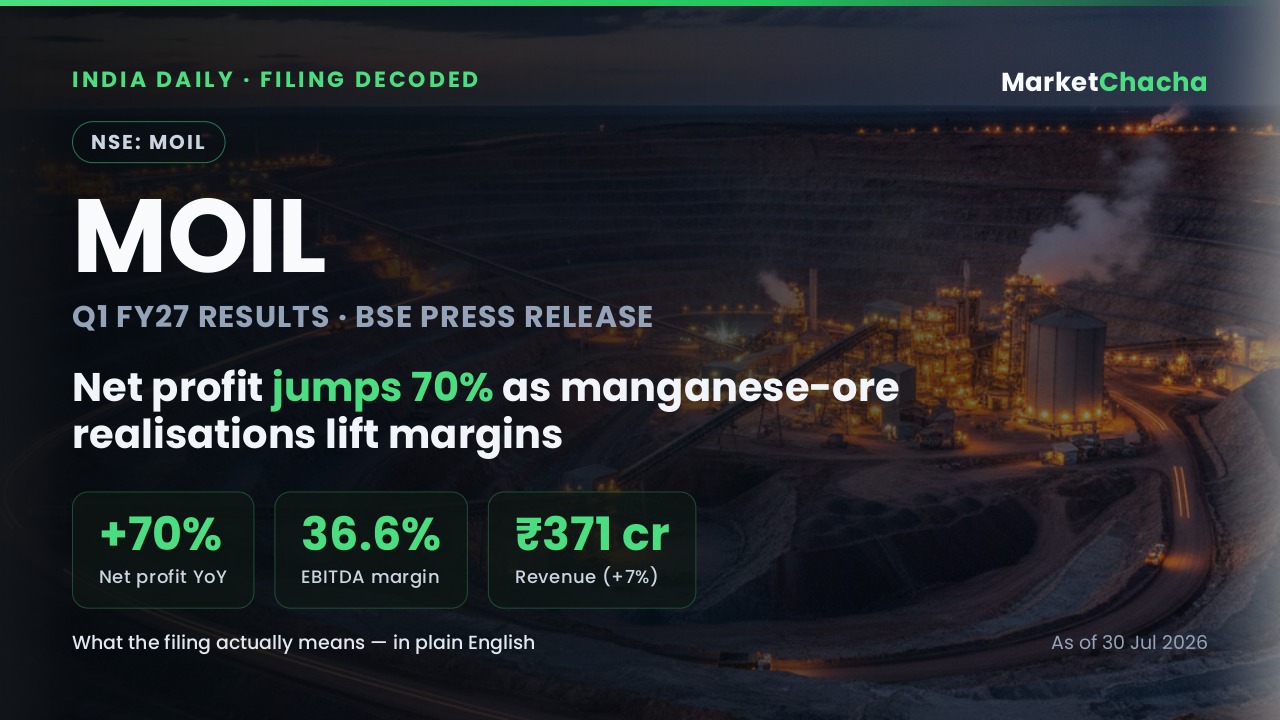
MOIL Ltd — India's largest manganese-ore miner — released its Q1 FY27 results (quarter ended 30 June 2026), reporting a 70% jump in net profit to ₹87.62 crore. Revenue rose only ~7%, so the real story is a sharp expansion in margins, and the stock reacted with a roughly 8% pop.
What was announced
MOIL filed its unaudited results for the June 2026 quarter along with a press release. The headline numbers:
- Net profit: ₹87.62 crore, up ~70% from ₹51.51 crore a year earlier.
- Revenue from operations: ₹370.88 crore, up ~7% from ₹348.06 crore.
- EBITDA: ~₹136 crore vs ~₹79 crore — with the EBITDA margin jumping to 36.6% from 22.6%.
- Volumes: manganese-ore production ~5.08 lakh tonnes (+1% YoY) and sales ~3.69 lakh tonnes (+4% YoY).
Notice the mismatch: sales volume barely moved, revenue rose single-digits, yet profit rose 70%. That gap is the whole point of this filing.
What this type of filing means
This is a quarterly results announcement (plus an explanatory press release). Every listed Indian company must report audited or unaudited financials each quarter to the exchanges. A press release alongside the results is the company's own plain-language summary — useful, but always cross-check it against the actual financial statement, because a company naturally frames its own numbers favourably.
One concept worth internalising here: profit growth and revenue growth are not the same thing. Profit can jump far faster than sales when margins expand — and for a commodity miner, margins swing mostly with the price it gets per tonne (its realisation), not with how much it digs up.
Why it matters / potential impact
Because volumes were nearly flat, MOIL's 70% profit surge was driven largely by higher manganese-ore realisations and operating leverage — when selling prices rise but mining costs are relatively fixed, almost every extra rupee of price drops through to profit. That is exactly why the EBITDA margin nearly doubled.
The flip side of that same coin is the risk: what commodity prices give, they can take away. A miner that just posted a great quarter on strong ore prices can post a weak one if those prices soften, even with identical output. So the quality question for a reader is not "how big was the profit jump" but "how durable are the ore prices behind it". No price prediction here — just the mechanism to watch.
Is it expensive?
MOIL trades at a P/E of roughly 21 with a market capitalisation of about ₹5,700 crore. It is almost debt-free and has kept a healthy dividend payout (~37%), but its longer-term sales growth has been modest. So the valuation is best described as fair — neither a bargain nor obviously cheap — for a cyclical, dividend-paying PSU miner whose earnings swing with ore prices.
For context, its closest listed peer Sandur Manganese & Iron Ores trades at a lower P/E of ~15 despite a larger market cap (~₹10,000 crore) — though Sandur is more diversified (iron ore, ferroalloys, coke) while MOIL is a fairly pure manganese-ore play. In other words, the market leader here is pricier on earnings than its main peer, something a value-minded reader would want to weigh. This is framing, not a recommendation.
The business
MOIL is a Miniratna PSU under the Ministry of Steel and the largest producer of manganese ore in India, running around ten mines concentrated in the Balaghat belt of Madhya Pradesh and Maharashtra. Manganese ore is an essential input for steelmaking — it goes into ferro-manganese and silico-manganese alloys used to harden steel — so MOIL's fortunes are tied closely to steel demand and manganese prices. It also operates ferroalloy plants and some wind-power capacity, but ore mining is the dominant segment. That means this result reflects the whole company, not just one small division.
Beginner takeaway
A 70% profit jump sounds spectacular, but here it came from better ore prices on flat volumes, not from selling much more. For commodity companies, learn to separate a price-led quarter from a growth-led one — the first can reverse quickly, the second tends to be sturdier. Strong quarter, but read it as a snapshot of today's manganese prices, not a promise.
FAQ
Why did profit rise 70% when sales rose only 7%? Because margins expanded: manganese-ore realisations rose while mining costs stayed relatively fixed, so a bigger share of each rupee of revenue became profit (operating leverage).
What does MOIL actually sell? Manganese ore, a raw material used to make the ferro-manganese and silico-manganese alloys that go into steel. It also makes ferroalloys and a little wind power.
Is a 70% jump a reason the stock "should" go up? The market already reacted (~8% on the day). Results are one input, not a signal to buy or sell — and commodity-driven profits can be lumpy quarter to quarter.
Why compare it to Sandur Manganese? Sandur is the closest listed manganese-ore peer, so its valuation gives a rough yardstick — here MOIL looks a touch pricier on P/E, though the two aren't identical businesses.
As of 30 July 2026 (filing dated 29 July 2026). Source: official BSE filing — read it directly here. We summarise filings for education and may make errors, so always verify against the official document. Educational content only — not investment advice, not a buy/sell recommendation.
This article is for educational and informational purposes only. It is not financial advice, investment recommendation, or a solicitation to buy or sell securities. Investing involves significant risks. I am not a SEBI-registered investment advisor. Readers should consult their own financial advisor and conduct their own research before making any investment decisions.
Comments
Join the conversation
Sign in to join the conversation.
Follow replies, add your view, and take part in the discussion.
Sign in to commentLoading comments...