

Adani Green: what their latest filing actually means
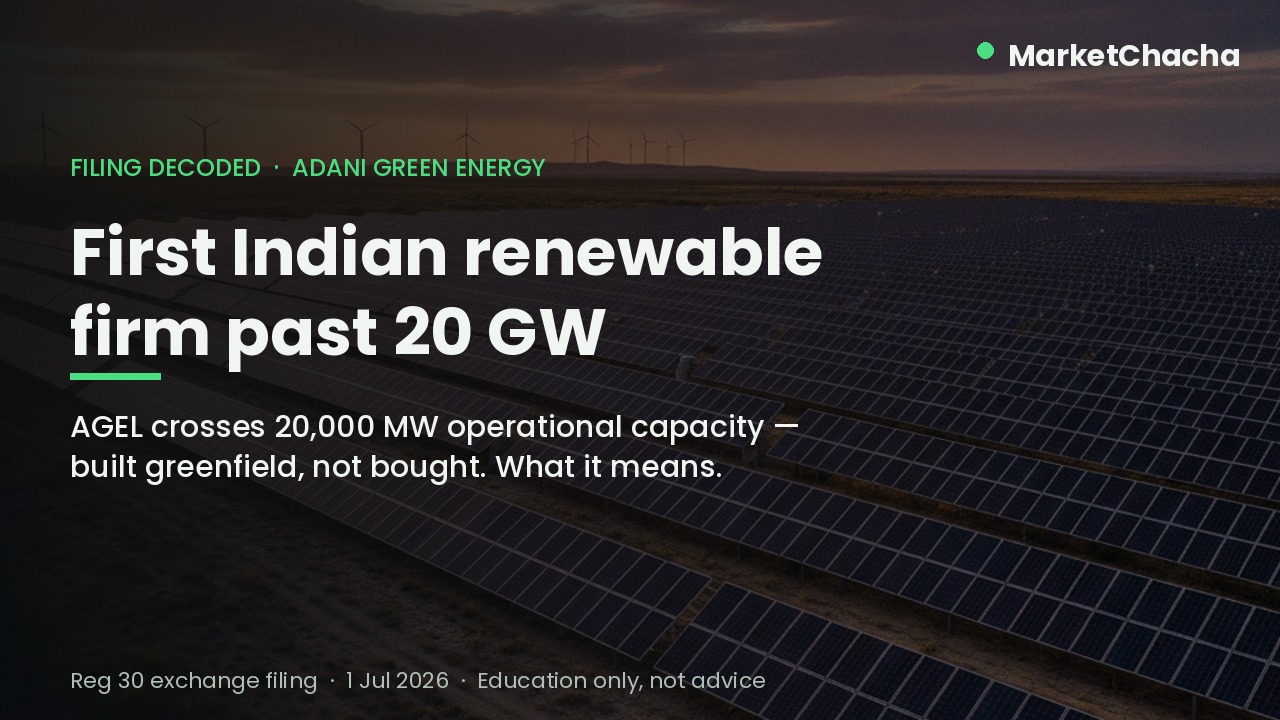
Adani Green Energy (AGEL) filed a Regulation 30 press release plus an "operationalization of projects" intimation telling the exchanges it has crossed 20 GW (20,000 MW) of operational renewable capacity — becoming the first Indian renewable company to get there, and doing it almost entirely by building new plants rather than buying existing ones.
What was announced
AGEL's total operational green-power capacity has reached roughly 19,986 MW (about 20 GW) after it commissioned a 150 MW solar plant at Khavda, Gujarat (power flowed from 28 June 2026). The mix is about 14.2 GW solar, 2.7 GW wind and 3.3 GW wind-solar hybrid. The company says it added ~5,051 MW in FY26 — its highest-ever annual addition — and generates over 52 billion units of clean electricity a year, close to 3% of India's electricity consumption. Its stated targets are 50 GW of renewables and 50 GWh of battery storage by 2030.
What this type of filing means
This is a Regulation 30 disclosure — SEBI's rule that a listed company must promptly tell the exchange about any event a reasonable investor would consider important. Two flavours showed up here: a press release (the company's own framing of the news) and an "operationalization of projects" intimation (a factual note that specific capacity is now live and generating). The key word is operational. Renewable developers report capacity in three buckets: operational (built and generating revenue today), under construction, and contracted / awarded (won but not yet built). Only operational MW actually earn money right now — so a jump in operational capacity is more meaningful than a headline about projects merely "won."
Why it matters / potential impact
For an independent power producer, capacity is the engine of revenue. More operational MW means more electricity sold under long-term power-purchase agreements, which tends to lift revenue and operating profit (EBITDA) in coming quarters. The filing also stresses that the growth is greenfield — built from scratch — rather than acquired, which management frames as cheaper, cleaner growth. The caution: building at this pace is capital-hungry, and AGEL already carries high debt, so execution and funding costs matter as much as the capacity headline. A milestone press release like this is about operational momentum and narrative; it is not a quarterly earnings result, and it says nothing directly about profit or debt for the period.
Is it expensive?
On reported figures (Screener/Tickertape, around 29 June 2026) Adani Green trades near a P/E of ~152, a market cap of about ₹2.51 lakh crore and a P/B of ~8.4. That is a rich, priced-for-growth valuation — the market is paying today for capacity expected years out. For context, fellow pure-play NTPC Green Energy is similarly or even more expensive (P/E reported in the ~160–200 range, market cap ~₹85,000–90,000 cr), while the more diversified, integrated utility Tata Power trades far cheaper at a P/E of ~35 on a ~₹1.28 lakh crore market cap. So AGEL sits with other high-multiple renewable pure-plays, not with traditional utilities. High multiples leave little room for disappointment — this is context, not a target or a buy/sell call.
The business
Adani Green Energy is a pure-play renewable independent power producer within the Adani group. It develops, owns and operates large solar, wind and hybrid plants — its flagship being the giant Khavda site in Gujarat — and sells the electricity mostly under long-term contracts to distribution utilities. Because it is renewables-only, a capacity milestone like this affects essentially the whole company, not just one division.
Beginner takeaway
Adani Green just became India's first renewable company with 20 GW of live capacity — a genuine operational milestone that shows scale and execution. But "big capacity" and "cheap stock" are different questions: the shares are priced very richly versus most utilities, and this filing is a progress update, not a profit statement. Judge the milestone on its merits and check the earnings and debt separately.
FAQ
What does "operational capacity" actually mean? It's the megawatts of plants that are built and generating electricity right now — the capacity that earns revenue today, as opposed to projects still under construction or only awarded on paper.
Does crossing 20 GW mean profits will jump? Not automatically. More operational capacity generally supports higher revenue and EBITDA over time, but actual profit also depends on tariffs, costs and — importantly for AGEL — interest on its large debt. This filing doesn't report profit.
Why is "greenfield" highlighted? Greenfield means the capacity was built new rather than bought from someone else. Management uses it to argue the growth is organic and cost-efficient, versus growing by acquisition.
Is a high P/E a reason to avoid the stock? A high P/E isn't automatically good or bad — it signals the market expects strong future growth, which raises the risk if that growth slows. It's one input among many, not a verdict.
As of 1 July 2026. Source: official BSE filing — read it directly here. We summarise filings for education and may make errors, so always verify against the official document. Educational content only — not investment advice, not a buy/sell recommendation.
This article is for educational and informational purposes only. It is not financial advice, investment recommendation, or a solicitation to buy or sell securities. Investing involves significant risks. I am not a SEBI-registered investment advisor. Readers should consult their own financial advisor and conduct their own research before making any investment decisions.
Comments
Join the conversation
Sign in to join the conversation.
Follow replies, add your view, and take part in the discussion.
Sign in to commentLoading comments...