

Yatharth Hospital preferential issue: ₹3,150 crore from Advent for 24.87% — what it means
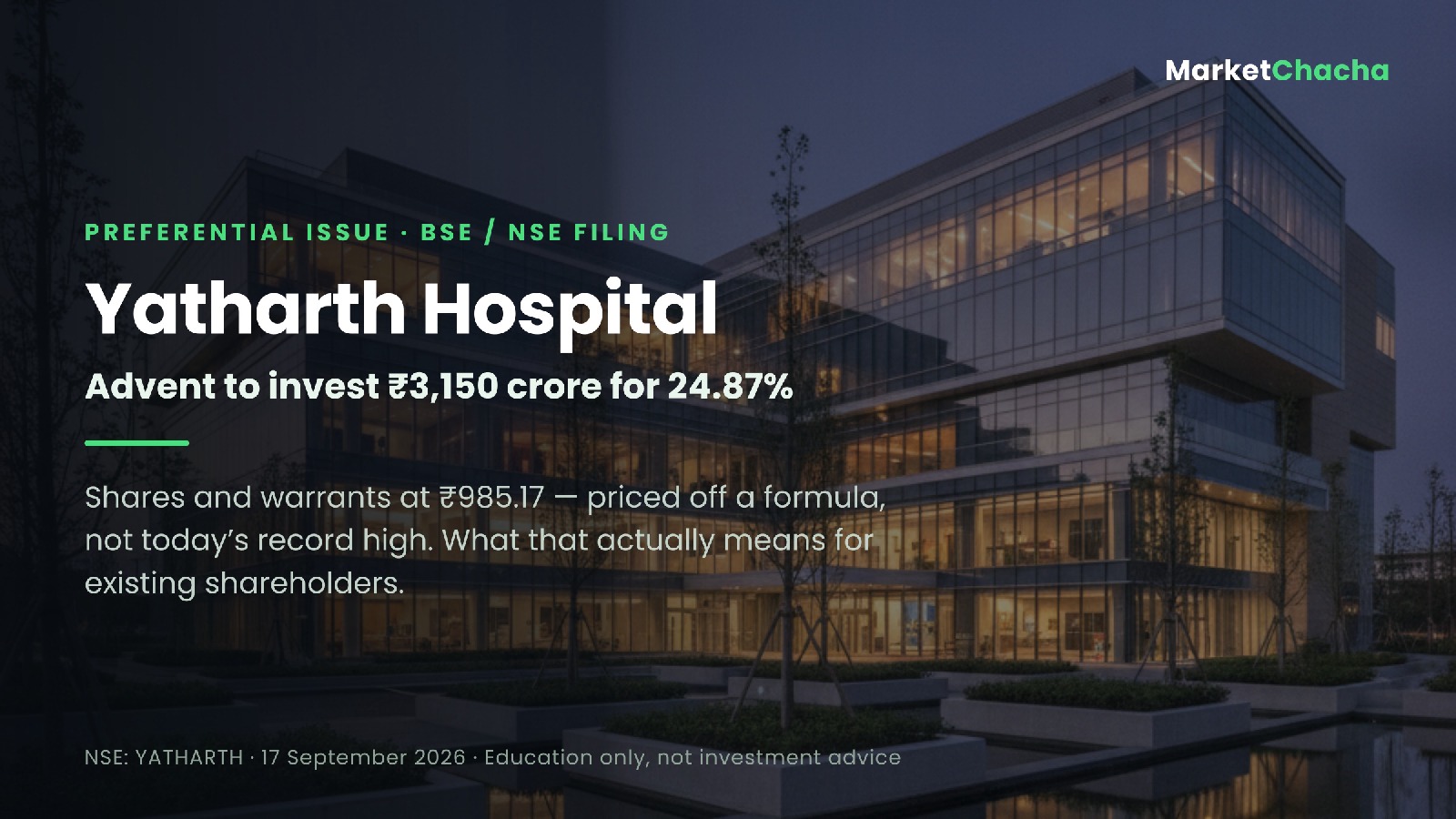
Yatharth Hospital & Trauma Care Services told the exchanges this morning that its board approved a preferential issue — new shares and warrants sold privately to one named buyer — raising up to ₹3,150 crore from Rasmalai Limited, a Cyprus-incorporated vehicle of private equity firm Advent International, for up to 24.87% of the company on a fully diluted basis. The stock rose about 8% to a record ₹1,065.05 on roughly three times normal volume.
What was announced
- 1,30,26,516 equity shares at ₹985.17 — ₹1,283.33 crore, paid in full at allotment.
- 1,89,47,664 warrants at the same price — ₹1,866.67 crore, of which 25% (₹246.29) is paid upfront and 75% (₹738.88) only on exercise into a share.
- Together, up to 3,19,74,180 shares. Advent held nothing before and will be classified as a public shareholder.
- The SEBI "relevant date" was 15 September 2026, giving a floor price of ₹984.70. The board set ₹985.17 — 47 paise above it.
- Also approved: authorised capital up from ₹115 crore to ₹150 crore, restated Articles granting the investor special rights, and an EGM on 15 October 2026 to put it all to shareholders.
- The filing states there is no change in control; the Tyagi promoter family remains the largest shareholder.
What this type of filing means
A preferential issue is the company printing new shares for one named buyer — unlike a QIP, offered to a pool of institutions, or a rights issue, offered to every existing holder. Because one party buys in without competition, SEBI wraps it in rules: the price cannot fall below a formula-derived floor keyed to a "relevant date", and shareholders must approve by special resolution. That is why ₹985.17 sits below the record high — a formula output, not a negotiated discount.
The warrants are the part most readers misprice. A warrant is an option, not a commitment: Advent pays 25% now and decides later whether to pay the rest. So of the ₹3,150 crore headline, roughly ₹1,750 crore actually lands at closing (₹1,283 crore of shares plus ₹467 crore of deposits); the other ~₹1,400 crore arrives only on exercise. The same structure appeared at HFCL and Raymond.
Why it matters
This is primary capital — it goes onto the balance sheet, not to an exiting shareholder. Hospitals are capital-hungry: every bed is built, equipped and staffed years before it earns. Against a market capitalisation near ₹9,411 crore, ₹3,150 crore is roughly a third of the company's value.
The offset is dilution: your slice of future profit shrinks by up to 24.87%, and the trade only works if the new capital earns more than the stake cost. Two governance items deserve a read before the EGM — the investor's special rights under Regulation 31B, and an "upside share arrangement" under Regulation 26(6) under which, if Advent exits above an agreed return, promoter Dr. Ajay Tyagi receives an agreed share of its profit (a term needing public shareholder approval). Note also that 24.87% sits just under the 25% threshold that triggers a mandatory open offer under SEBI's takeover rules.
Valuation, as reported
Screener.in reports Yatharth at a P/E of 52.0, price-to-book 5.28, market cap ₹9,411 crore, on TTM sales of ₹1,334 crore and net profit of ₹174 crore, with ROCE 12.4% and ROE 10.4%. Peer Max Healthcare — about ten times larger at ₹1,00,051 crore — trades at a P/E of 66.8 and P/B 9.28, with ROCE and ROE both 14.7%. Yatharth has been listed only since 2023, so there is no five-year multiple range to quote; its 52-week range is ₹538 to ₹1,025. See the day's other movers.
The business
Founded in 2008, Yatharth runs nine multi-speciality hospitals in North India with roughly 2,800 operational beds and announced capacity of about 3,250. It is effectively a single-segment operator — hospital services — so this capital affects the whole company, not one division.
Beginner takeaway
A board approving a preferential issue is a decision, not a completed transaction: the 15 October EGM, regulatory clearances and closing conditions still stand between the announcement and the money. Read the headline as two numbers — what arrives at closing, and what depends on warrants being exercised.
FAQ
Why pay ₹985 when the share trades above ₹1,050? SEBI's formula uses a volume-weighted average ending on a "relevant date" — here 15 September — producing a floor of ₹984.70. The board priced just above it: rule-driven, not a favour.
Does Advent now control Yatharth? No. The filing states there is no change in control, the promoter family remains the largest shareholder, and Advent is classified as a public shareholder.
What if the warrants are never exercised? Advent forfeits the 25% paid upfront, the company keeps it, and those shares are never issued — so actual dilution would be less than 24.87%. The fully diluted figure is a maximum, not a certainty.
As of 17 September 2026. Source: official BSE/NSE filing — read it directly here. We summarise filings for education and may make errors, so always verify against the official document. Educational content only — not investment advice, not a buy/sell recommendation.
This article is for educational and informational purposes only. It is not financial advice, investment recommendation, or a solicitation to buy or sell securities. Investing involves significant risks. I am not a SEBI-registered investment advisor. Readers should consult their own financial advisor and conduct their own research before making any investment decisions.
Comments
Join the conversation
Sign in to join the conversation.
Follow replies, add your view, and take part in the discussion.
Sign in to commentLoading comments...