

Why did SpaceX (SPCX) just fall below its IPO price for the first time?
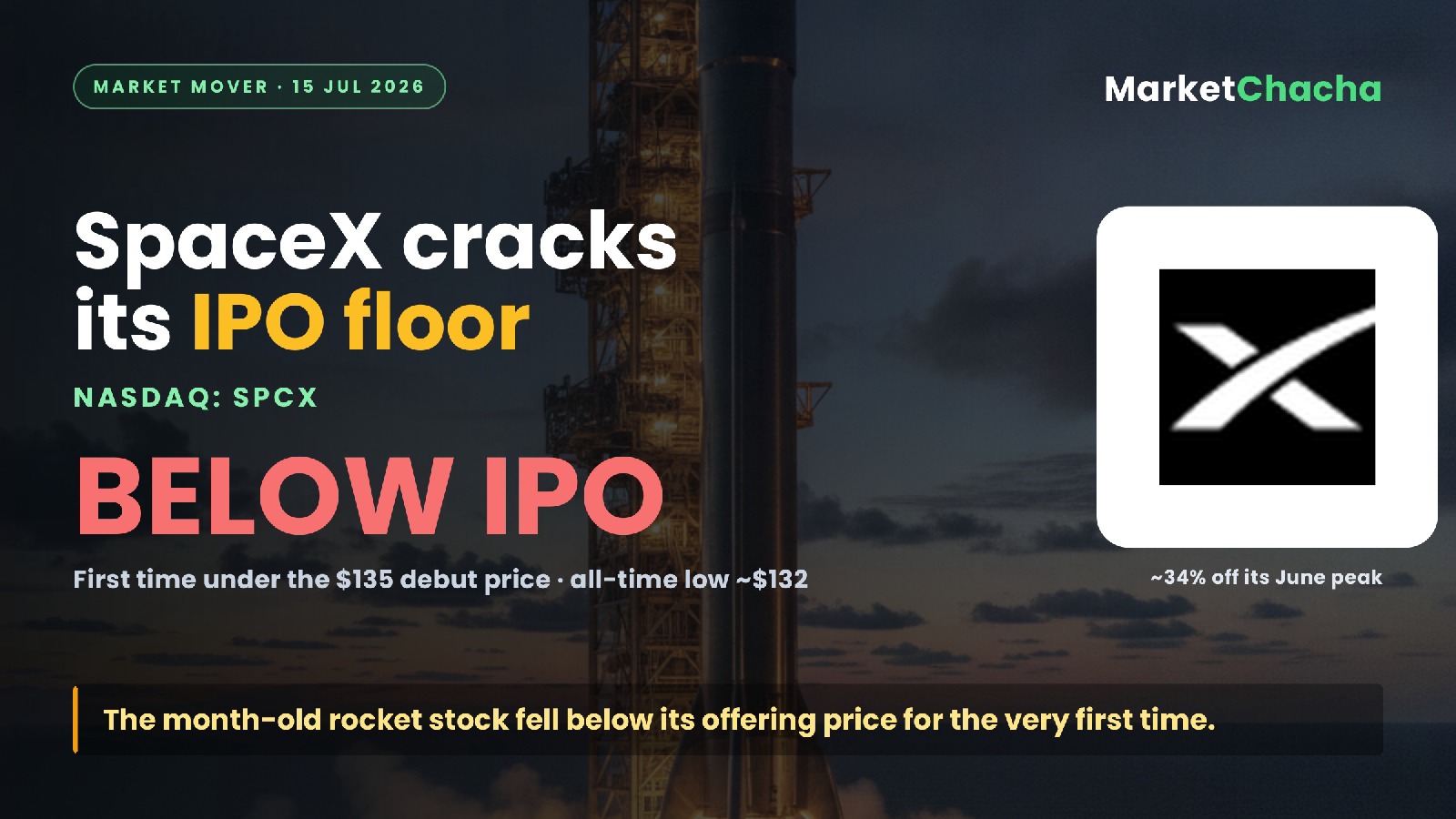
SpaceX (Nasdaq: SPCX) just did something it had never done before: it traded below its $135 IPO price. Shares fell as much as ~2.9% on Wednesday to an all-time low near $132, barely a month after the biggest listing in history — a record ~$86bn IPO that briefly made Elon Musk the world’s first trillionaire. From its mid-June high of $225.64 (when it was worth more than Microsoft or Amazon), the stock is now down roughly 34%.
Why it’s sliding
The debut ran on pure hype, and reality is catching up. Three things bit at once: the valuation looks stretched for a company still deep in the red (a reported net loss of ~$4.9bn in 2025 and ~$4.3bn in Q1 2026); a China wake-up call — state-owned CASC launched a reusable Long March 10B rocket and landed it at sea, narrowing SpaceX’s biggest edge (cheap, reusable boosters); and a Starship stumble in May, when the Super Heavy booster took heat damage at stage separation and was lost. Put together, the new-IPO “honeymoon” snapped.
The ripple: a wobble in the sector’s poster child pressures the whole space-and-satellite trade — think Rocket Lab (RKLB), Intuitive Machines (LUNR) and AST SpaceMobile (ASTS) — and the China-reusability headline is a quiet read-through for defense and launch names.
The one thing that flips it: a clean, fully successful next Starship flight (or a blockbuster Starlink number) could reignite the story fast — more than 80% of analysts covering the stock still carry buy-equivalent ratings, so sentiment is one good launch away from turning.
As of ~2:05 pm ET / 11:35 pm IST, Wed 15 Jul 2026. Sources: Bloomberg, CNBC, Yahoo Finance. For discussion and education only — not investment advice. Verify before acting.
This article is for educational and informational purposes only. It is not financial advice, investment recommendation, or a solicitation to buy or sell securities. Investing involves significant risks. I am not a SEBI-registered investment advisor. Readers should consult their own financial advisor and conduct their own research before making any investment decisions.
Comments
Join the conversation
Sign in to join the conversation.
Follow replies, add your view, and take part in the discussion.
Sign in to commentLoading comments...