

TVS Motor: what their latest filing actually means
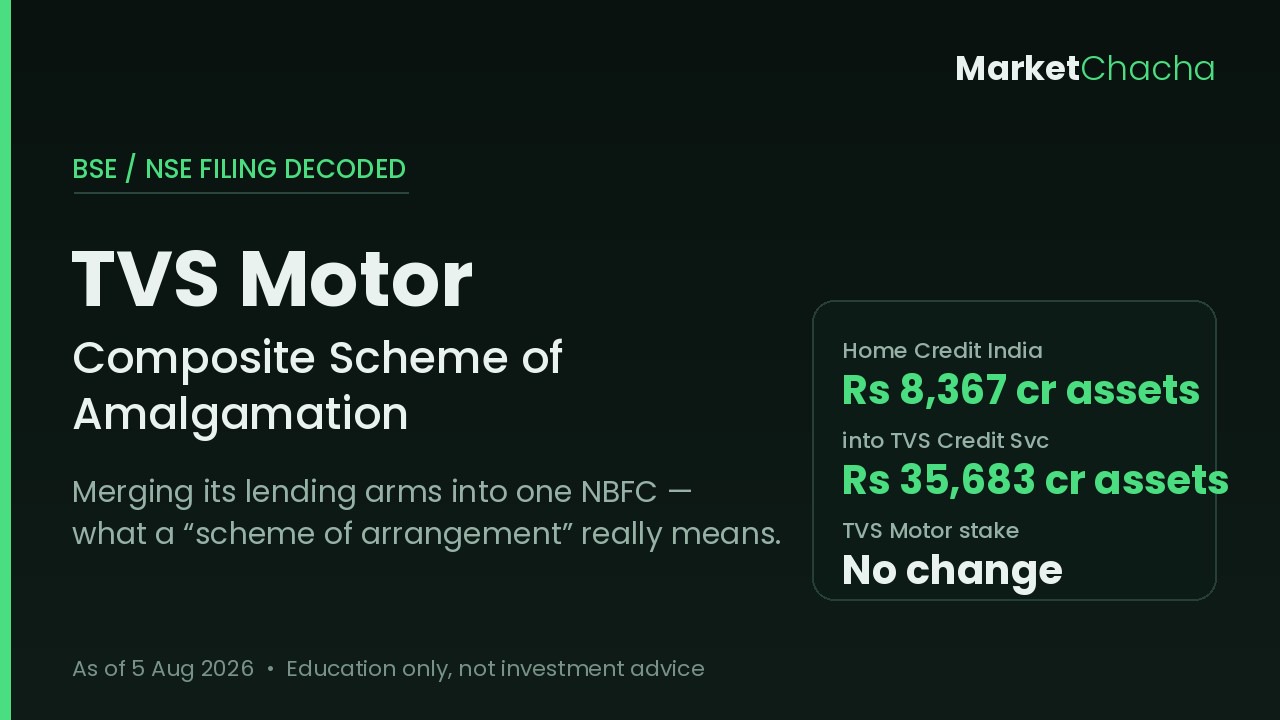
TVS Motor Company has told the exchanges that its lending subsidiaries are being merged together. On 5 August 2026, the boards approved a composite scheme of amalgamation that folds the group's newly-acquired Home Credit India Finance (and a couple of small group companies) into TVS Credit Services — the group's main non-banking finance company (NBFC). It is a group-restructuring filing, not a new order or a results update.
What was announced
TVS Motor said it was informed by its subsidiaries — TVS Credit Services Limited and TVS Housing Finance Private Limited — that all the relevant company boards have approved a scheme to consolidate four entities into one lending business. It is a two-step merger under Sections 230–232 of the Companies Act, 2013:
- Step 1: STPL Trading and Services (a group holding company; total assets ~Rs 387 cr) merges into Home Credit India Finance — the retail-lending NBFC the TVS group acquired, with total assets of ~Rs 8,367 cr, net worth ~Rs 2,958 cr and income of ~Rs 620 cr for the June 2026 quarter.
- Step 2: Home Credit India Finance, plus the dormant TVS Housing Finance, then merge into TVS Credit Services — the flagship NBFC with total assets of ~Rs 35,683 cr, net worth ~Rs 6,273 cr and income of ~Rs 1,918 cr for the June quarter.
The swap ratios were set by an independent registered valuer (Bansi S Mehta Valuers LLP), with a fairness opinion from JM Financial. The stated rationale is simple: the companies are all under common ownership, so the group wants to simplify its structure and consolidate its NBFCs into one entity, in line with RBI's directions, to cut duplicate costs and use capital more efficiently. The scheme still needs approvals from the RBI, the Competition Commission (CCI), SEBI, the stock exchanges, the National Company Law Tribunal (NCLT) and shareholders/creditors — so it will take several months to complete.
What this type of filing means
A scheme of arrangement (here, a "composite scheme of amalgamation") is the legal, court-supervised process an Indian group uses to merge, demerge or restructure companies. "Composite" just means several mergers are bundled into one scheme. "Amalgamation" means two or more companies combine into one — the transferor companies dissolve and their assets, liabilities and businesses move into the transferee company. Shareholders of the disappearing companies get shares of the surviving company in a fixed ratio (that is what the "155.79 shares for every 200 shares" language in the filing is). Because it can affect creditors and minority holders, it is not something a board can just do — it needs a registered valuer, a merchant-banker fairness opinion, and finally NCLT (a tribunal) approval. When you see this from a listed company, the key question is always: is the listed company itself changing, or is it just tidying up subsidiaries underneath it?
Why it matters / potential impact
The most important line in this filing is the honest one TVS Motor itself flagged: TVS Motor Company is NOT a party to the scheme, and there is no change to TVS Motor's own shareholding pattern. The merger happens one level down, among the group's finance companies. So this is not an event that changes TVS Motor's auto business, its share count, or its reported auto profits directly.
What it does do is clean up the lending arm. The TVS group acquired Home Credit's India business; this scheme legally absorbs that acquisition into TVS Credit Services, creating a single, larger NBFC instead of several overlapping ones. For the group that can mean lower compliance and administrative cost, a simpler capital structure, and a cleaner entity — which matters because a larger, consolidated TVS Credit Services is easier to fund, scale, and potentially list on its own someday. For a TVS Motor shareholder, the effect is indirect: TVS Motor owns a majority of TVS Credit Services, so a healthier, simpler finance subsidiary feeds through to the group's value over time, but there is no immediate change to earnings and no reason on this filing alone to expect a sharp move in the stock.
Is it expensive?
TVS Motor is a large-cap, with a market capitalisation of roughly Rs 2.07 lakh crore and a share price near Rs 4,300 (close to its 52-week high of ~Rs 4,325, well above the 52-week low of ~Rs 2,755). Its P/E is high — roughly 57x to 68x depending on the source (trailing earnings), and its price-to-book is around 19–21x. On any normal yardstick that is a rich, premium valuation, not a cheap one. For context among two-wheeler peers: Bajaj Auto trades around 32x earnings, Hero MotoCorp around 17x, and Eicher Motors (Royal Enfield) around 38x. So TVS Motor carries the most expensive multiple of the major listed two-wheeler makers — the market is paying up for its faster growth, its exports and its EV (electric two-wheeler) ambitions. A rich multiple leaves less room for disappointment; this is framing, not a target or a buy/sell view.
The business
TVS Motor is one of India's largest two-wheeler and three-wheeler manufacturers, known for motorcycles (Apache, Raider), scooters (Jupiter, the iQube electric scooter), mopeds (XL100) and three-wheelers, with a growing export franchise and a European arm (Norton, and the e-bike brands it has acquired). Sitting alongside the vehicle business is the group's financial-services arm — TVS Credit Services — which finances vehicle purchases, consumer durables and small businesses. This filing affects only that finance arm, not the vehicle-making business.
Beginner takeaway
This is a "housekeeping" corporate action, not a growth trigger: TVS is merging its lending companies (including the acquired Home Credit India) into one NBFC to simplify the group. TVS Motor itself is not part of the merger and its shareholding does not change, so don't read it as a direct catalyst for the stock. It is a useful reminder that a lot of exchange filings are structure clean-ups happening below the listed company, and it is worth checking whether the listed company is actually a party before assuming any impact.
FAQ
Does this change how many TVS Motor shares I own or their value directly? No. TVS Motor is not a party to the scheme and its shareholding pattern does not change. The share-swap ratios in the filing apply to the unlisted subsidiaries, not to TVS Motor's listed shares.
What is an NBFC, and why merge them? An NBFC (Non-Banking Financial Company) is an RBI-registered lender that gives loans but can't take deposits like a bank. The group runs more than one, so merging them into TVS Credit Services removes duplication, cuts compliance cost, and lines up with RBI's push for groups to consolidate their finance companies.
Is the merger final now? No — only the boards have approved it. It still needs the RBI, the Competition Commission, SEBI, the stock exchanges, the NCLT and shareholders/creditors to sign off, which typically takes several months to over a year.
What was Home Credit India doing here? Home Credit's India retail-lending business was acquired by the TVS group; this scheme legally absorbs it into TVS Credit Services so the group has one consolidated consumer-and-vehicle finance company instead of separate ones.
As of 5 August 2026. The filing was made to BSE/NSE on 5 August 2026 (intimation received by the company at 3:01 PM IST). Source: official BSE filing — read it directly here. We summarise filings for education and may make errors, so always verify against the official document. Educational content only — not investment advice, not a buy/sell recommendation.
This article is for educational and informational purposes only. It is not financial advice, investment recommendation, or a solicitation to buy or sell securities. Investing involves significant risks. I am not a SEBI-registered investment advisor. Readers should consult their own financial advisor and conduct their own research before making any investment decisions.
Comments
Join the conversation
Sign in to join the conversation.
Follow replies, add your view, and take part in the discussion.
Sign in to commentLoading comments...