

Fed holds at 3.75% — but three officials wanted a HIKE, not a cut. Here's what flipped.
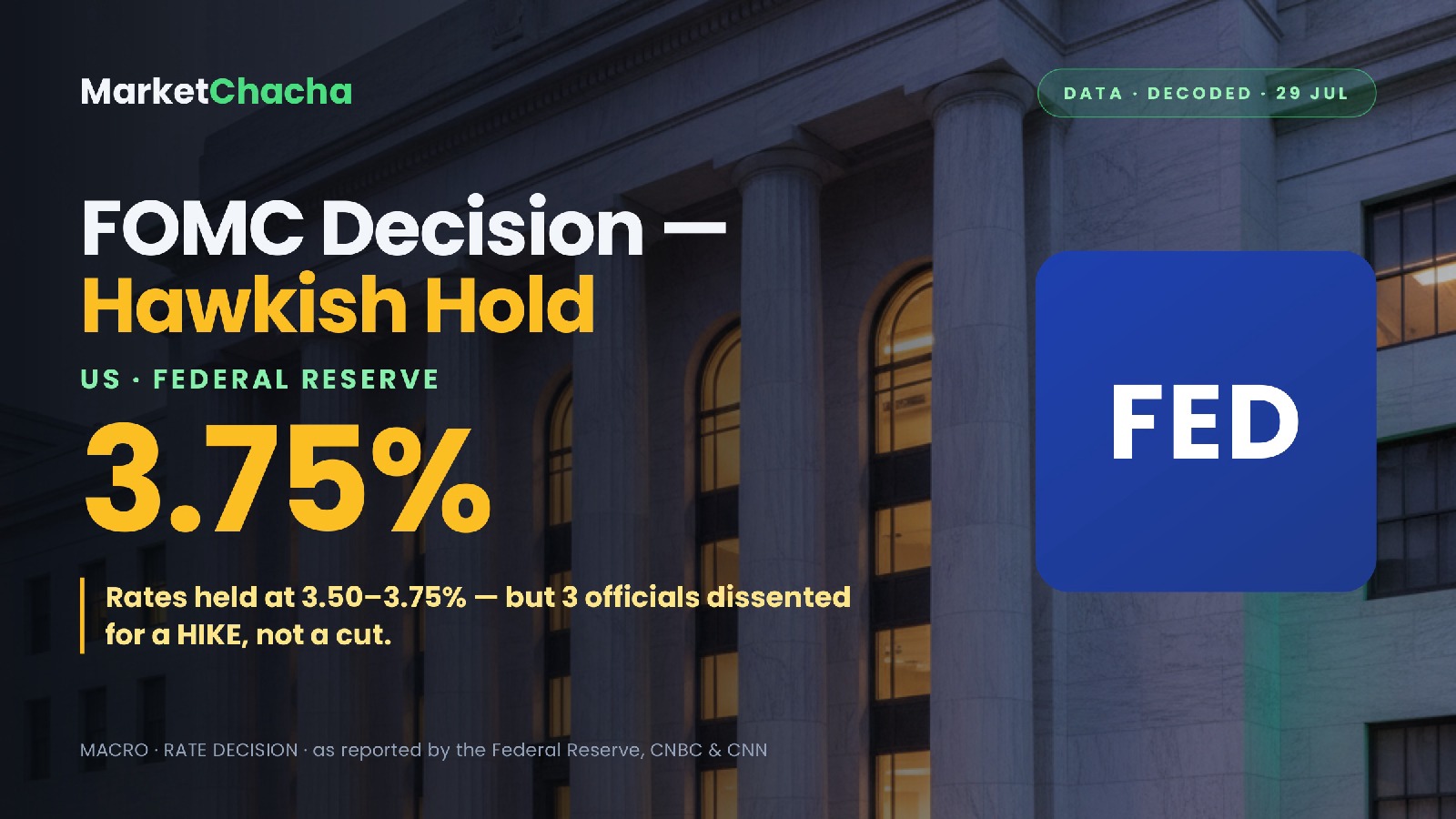
The Fed did the boring thing — and it was anything but. It left rates untouched, yet three of its own officials voted to raise them. When dissenters push for higher rates instead of lower ones, that's the tell worth reading.
The numbers
The Federal Open Market Committee held its benchmark federal funds rate at 3.50%–3.75%, unchanged, per the Fed's statement. The vote was 9–3. All three dissenters — Cleveland's Beth Hammack, Minneapolis's Neel Kashkari and Dallas's Lorie Logan — preferred a 25-basis-point hike, as reported by Reuters and CNBC. It's the first time since September 2016 that three policymakers dissented in the same direction. This was Chair Kevin Warsh's second meeting, and he again stripped forward guidance out of the statement.
What it means
Here's the part most headlines skip: when Fed officials dissent, they usually want cuts — cheaper money. This time all three wanted the opposite. The reason is inflation. It's run above the Fed's 2% target for more than five years, and the May CPI print came in at 4.2% year-on-year as energy costs jumped on Middle East tension, per the reporting. Governor Christopher Waller framed the balance of risks as tilted "more toward high inflation than labour-market weakness."
So this is a hawkish hold: the Fed stood still, but the internal pull is toward a hike, not a cut. And "forward guidance" — the Fed's old habit of hinting where rates head next — is gone under Warsh. Less hand-holding means markets trade each data print live, which means sharper moves around every number.
Who it touches
- Bonds & the dollar: Treasury yields climbed and the dollar firmed during Warsh's press conference as traders priced "higher for longer," per market reporting — the yield curve steepened.
- Growth & tech stocks: higher long-term yields shrink the present value of future profits, so the priciest growth names feel it first.
- India & other emerging markets: a stronger dollar and higher US yields pressure the rupee and can pull foreign money out of Indian equities — and they narrow the RBI's own room to cut.
- Rate-sensitive corners (US housing, autos, regional banks): a hold-not-cut keeps borrowing costs elevated.
What to watch
The story flips on inflation, and the next test is fast. US PCE inflation — the Fed's preferred gauge — lands July 30, followed by US CPI on Aug 12. Then Warsh takes the stage at the Jackson Hole symposium on Aug 28, his biggest platform yet to signal intent. Cooler prints and the hawkish dissents fade; hotter ones and a 2026 hike moves from tail-risk to the table.
As of 4:07 PM ET, Jul 29. Sources: Federal Reserve, CNBC, CNN Business. For discussion and education only — not investment advice. Verify before acting.
This article is for educational and informational purposes only. It is not financial advice, investment recommendation, or a solicitation to buy or sell securities. Investing involves significant risks. I am not a SEBI-registered investment advisor. Readers should consult their own financial advisor and conduct their own research before making any investment decisions.
Comments
Join the conversation
Sign in to join the conversation.
Follow replies, add your view, and take part in the discussion.
Sign in to commentLoading comments...