

Oracle 8-K: Larry Ellison cancels his 50M-share sale plan — what it means
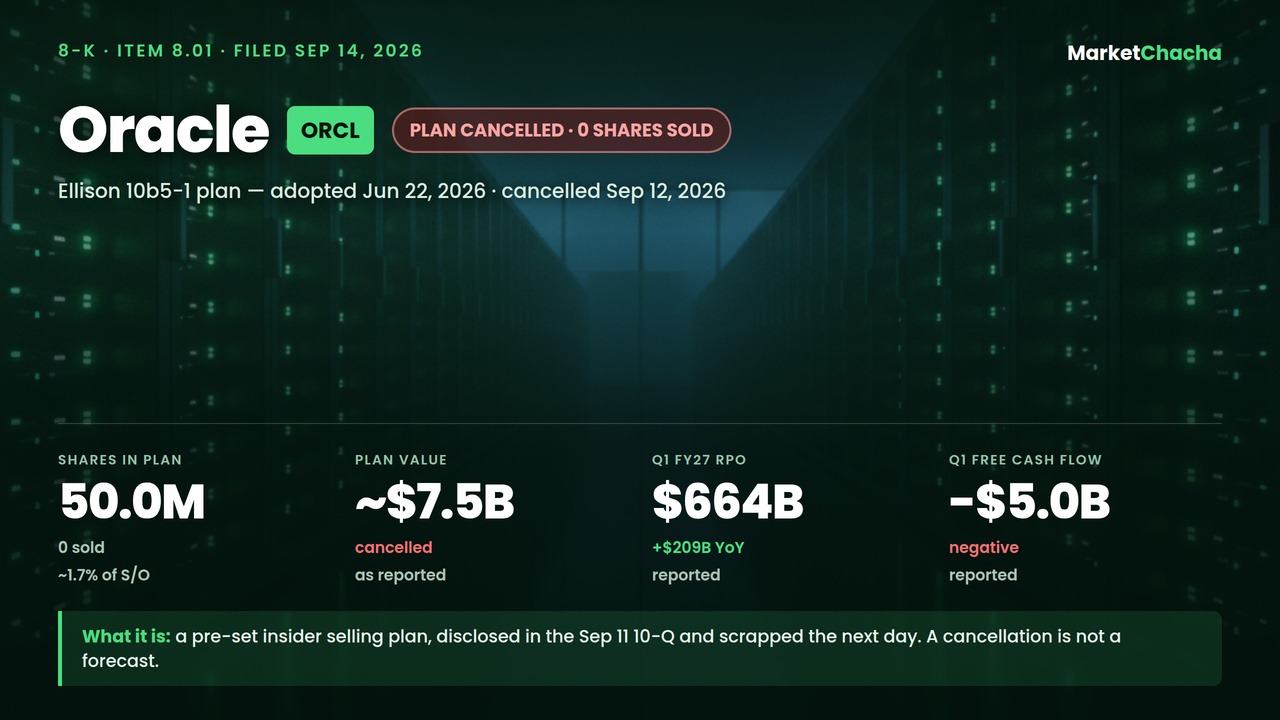
Oracle filed an 8-K this morning under Item 8.01 disclosing that Larry Ellison — Executive Chair of the Board and Chief Technology Officer — has cancelled the Rule 10b5-1 plan under which he could have sold Oracle stock. The filing states that no Oracle stock was sold under the plan before it was terminated, and the attached press release adds that he "has no other plans to sell any of his Oracle stock."
The timeline is the story
- June 22, 2026 — Ellison adopted the plan, "adopted and precleared in accordance with Oracle's Insider Trading Policy" per the 10-Q.
- Up to 50 million shares — the ceiling. Against 3,023,736,000 shares outstanding at September 7, that is roughly 1.7% of the company; press reports valued it near $7.5 billion.
- September 11, 2026 — the plan became public for the first time, in Item 5 of Oracle's quarterly 10-Q. It was scheduled to run until October 24, 2026.
- September 12, 2026 — he cancelled it. Oracle gave no reason.
The plan sat in place nearly three months, was disclosed once, and was scrapped the next day. Nothing was sold.
What a Rule 10b5-1 plan is
Insiders know things the public does not, so trading on their own judgment is legally fraught. Rule 10b5-1 offers a safe harbour: commit in advance — while not holding material non-public information — to a written schedule of trades, hand control to a broker, and the later sales are presumed not to be insider trading. Post-2022 SEC amendments added cooling-off periods and, via Item 408 of Regulation S-K, require companies to disclose in each 10-Q or 10-K when a Section 16 officer or director adopts, modifies or terminates a plan.
That rule is why this became news at all: the adoption was never separately announced, it simply surfaced in a routine quarterly filing. The cancellation got its own 8-K — Item 8.01 is the voluntary "other events" bucket, not a mandated disclosure.
Why it matters
The honest reading is narrow. A cancelled plan tells you an insider chose not to sell on a pre-set schedule; it is not a forecast, and such plans are routinely used for diversification, tax and estate planning rather than as a view on the business. Nothing was sold, so there is no transaction to interpret — only an intention formed, disclosed and withdrawn.
What makes it worth reading is the balance sheet behind it. In Q1 FY27, reported September 10, Oracle posted revenue of $19.3 billion (+30%), cloud revenue of $11.6 billion (+62%) with infrastructure up 121% to $7.4 billion, non-GAAP EPS of $1.92 (+30%), and remaining performance obligations of $664 billion — up $209 billion year on year.
The same release shows operating cash flow of $23 billion against free cash flow of negative $5 billion: the datacenter buildout is consuming more than the business generates. Oracle sold $20 billion of stock through an at-the-market programme in the quarter, carried $125.0 billion of senior notes and other long-term borrowings at August 31, ran no buybacks despite $6.3 billion of authorisation left, and guided to capex that moved its suppliers' shares. When growth is funded with debt and fresh equity, the founder's selling intentions get read closely — context, not a conclusion.
Beginner takeaway
Insider-sale headlines are usually less informative than they look, because most large sales run through plans set months earlier. The useful habit is to check three things in the filing: when the plan was adopted, how many shares it covered, and whether anything was actually sold — here, June 22, 50 million, and none. Compare that with an insider buying on the open market, where an executive puts personal cash at risk.
FAQ
Does cancelling the plan mean Ellison thinks the stock is cheap? Oracle gave no reason, and the filing offers none. Cancellation is consistent with many explanations, including changed personal plans, and should not be read as a company forecast.
Did he sell any shares first? No. Both the 8-K and the press release state that no Oracle stock was sold under the plan before it was terminated.
Why did nobody know until September? Adoption is disclosed in the next quarterly report under Item 408 of Regulation S-K, not immediately. This plan was adopted June 22 and first appeared in the 10-Q filed September 11.
Can he start a new plan later? Yes, subject to the cooling-off period and Oracle's insider trading policy. Any future plan would appear in a subsequent quarterly filing, and actual sales in Section 16 Form 4 filings.
As of September 14, 2026. Source: official SEC filing — read it directly here. We summarise filings for education and may make errors, so always verify against the official document. Educational content only — not investment advice, not a buy/sell recommendation.
This article is for educational and informational purposes only. It is not financial advice, investment recommendation, or a solicitation to buy or sell securities. Investing involves significant risks. I am not a SEBI-registered investment advisor. Readers should consult their own financial advisor and conduct their own research before making any investment decisions.
Comments
Join the conversation
Sign in to join the conversation.
Follow replies, add your view, and take part in the discussion.
Sign in to commentLoading comments...