

Paytm — One97 Communications (PAYTM): the full file — the numbers, the owners, and what the filings actually show
One97 Communications Ltd, which owns and runs the Paytm brand, makes money by processing payments for merchants (subscriptions on QR codes, soundboxes and card machines, plus a margin on payment volumes) and by distributing other companies' financial products — chiefly loans, for which it earns a fee and, on part of the book, a trail linked to a Default Loss Guarantee. It also has smaller broking, insurance-distribution and commerce lines. Here is what the record shows, top to bottom, from incorporation to the quarter just gone — the numbers, the owners, the regulators, and every primary document behind them.
Origin — the company's birth certificate
One97 Communications was incorporated in 2000. It began as a mobile value-added-services and telecom-billing business, and the Paytm wallet was launched in 2010. It grew on the back of large venture rounds from Chinese affiliate Ant Group (via Alibaba), Japan's SoftBank, and early backer SAIF Partners (now Elevation Capital). Its founder, chairman, managing director and CEO is Vijay Shekhar Sharma.
One structural fact stands out at the outset, and it is unusual for an Indian listed company: in its offer documents One97 declared itself a professionally-managed company with no identifiable promoter. That means there is no "promoter" category in its shareholding pattern at all — and therefore no promoter pledge to disclose. It is a genuine finding, not an omission, and it shapes everything that follows about ownership and control.
The business — what they actually sell
Paytm reports three broad revenue streams: payment services (merchant subscriptions for soundboxes/QR/card machines and net payment margins), financial services distribution (loans sourced for lender partners, plus insurance and wealth), and marketing/commerce & cloud. In the June-2026 quarter the company said merchant subscriptions were at record highs and that financial-services revenue had grown on the back of merchant loans and the trail from its Default Loss Guarantee portfolio. Crucially, Paytm is a distributor of credit, not primarily a lender off its own balance sheet — the loans sit with partner banks and NBFCs, and Paytm earns fees and, on a portion, a guarantee-linked trail.
Who actually buys from them
Paytm's "customers" are two-sided: tens of millions of small merchants who pay for devices and services, and consumers who transact and, in some cases, borrow. Its lending revenue, however, depends on a concentrated set of lender partners (banks and NBFCs) who actually fund the loans; if partners pull back — as several did around the 2024 regulatory episode — distribution revenue falls quickly. The company does not disclose a single dominant customer in the way a manufacturer would; the dependency to watch is on lending partners and on regulatory permissions, not on one buyer.
Where it is actually "made" — the platform and its dependencies
There is no factory here; the "plant" is software, a payments network, and a large field/sales operation deploying devices. The dependencies that matter are regulatory licences and partners: an online payment-aggregator authorisation (held through subsidiary Paytm Payments Services Ltd), UPI participation via sponsor banks, and lending tie-ups. The single largest disclosed dependency risk in the company's recent history was its associate Paytm Payments Bank, on which the RBI acted in 2024 (covered below). Beyond that, Paytm is overwhelmingly an India-domestic operation.
Five years of numbers
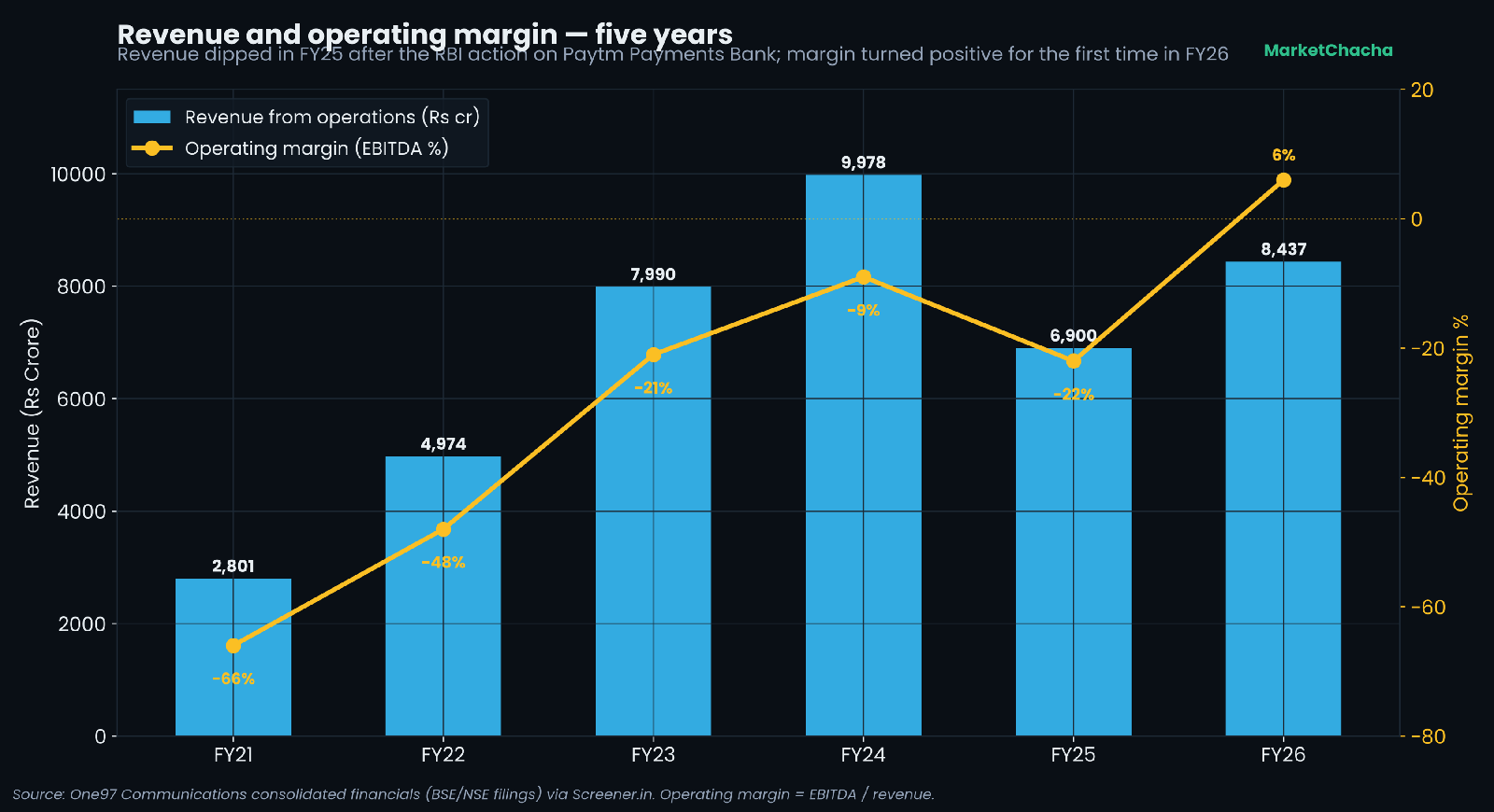
The table below is the consolidated record (₹ crore, financial year ending 31 March). It captures the arc: heavy losses through FY22–FY24, a revenue dip in FY25 after the Payments Bank action, and the first profitable year in FY26.
| ₹ cr (consolidated) | FY22 | FY23 | FY24 | FY25 | FY26 |
|---|---|---|---|---|---|
| Revenue from operations | 4,974 | 7,990 | 9,978 | 6,900 | 8,437 |
| Operating profit (EBITDA) | -2,384 | -1,644 | -943 | -1,506 | 500 |
| Operating margin | -48% | -21% | -9% | -22% | 6% |
| Other income | 288 | 410 | 314 | 1,550 | 668 |
| Depreciation | 247 | 485 | 736 | 673 | 568 |
| Profit before tax | -2,385 | -1,743 | -1,390 | -645 | 582 |
| Net profit (PAT) | -2,396 | -1,776 | -1,422 | -663 | 552 |
| EPS (₹) | -36.90 | -28.02 | -22.30 | -10.33 | 8.64 |
| Cash from operations (CFO) | -1,236 | 416 | 651 | -121 | -743 |
Revenue compounded at roughly 25% a year over five years (FY21 revenue was ₹2,801 cr). The FY25 dip to ₹6,900 cr followed the RBI's action on Paytm Payments Bank and a pull-back in loan distribution. FY26 revenue recovered to ₹8,437 cr and, for the first time, operating profit and net profit were both positive.
Income statement — FY26 vs FY25
| ₹ cr | FY25 | FY26 | Change | % |
|---|---|---|---|---|
| Revenue from operations | 6,900 | 8,437 | +1,537 | +22.3% |
| Operating profit (EBITDA) | -1,506 | 500 | +2,006 | to positive |
| Other income | 1,550 | 668 | -882 | -56.9% |
| Finance cost | 17 | 18 | +1 | +5.9% |
| Depreciation & amortisation | 673 | 568 | -105 | -15.6% |
| Profit before tax | -645 | 582 | +1,227 | to positive |
| Net profit (PAT) | -663 | 552 | +1,215 | to positive |
| EPS (₹) | -10.33 | 8.64 | — | to positive |
The turnaround is real, but its quality deserves a plain reading. FY26 operating profit (EBITDA) was ₹500 cr — genuinely positive for the first time. However, depreciation of ₹568 cr slightly exceeded that EBITDA, so at the operating (EBIT) level the year was roughly break-even; the reported profit before tax of ₹582 cr was carried over the line by other income of ₹668 cr (treasury income on a large cash and investment pile, and gains). In other words, strip out non-operating income and FY26 pre-tax profit would have been about -₹86 cr. That is not a red mark — the cash pile and the interest it earns are real — but it is the honest characterisation of the maiden annual profit. The encouraging signal is in the trajectory: by the latest quarter (below), operating profit already exceeds other income.
Balance sheet — FY26 vs FY25
| ₹ cr | FY25 | FY26 | Change | % |
|---|---|---|---|---|
| Net worth (equity + reserves) | 15,027 | 16,026 | +999 | +6.6% |
| Borrowings | 160 | 194 | +34 | +21.3% |
| Other liabilities | 6,261 | 7,695 | +1,434 | +22.9% |
| Investments | 4,172 | 4,501 | +329 | +7.9% |
| Total assets | 21,448 | 23,915 | +2,467 | +11.5% |
The company is essentially debt-free: borrowings of ₹194 cr against net worth of ₹16,026 cr, and those borrowings are largely lease liabilities. Book value is roughly ₹250 a share. The balance sheet's strength is the cash-and-investments cushion built from the 2021 IPO and subsequent asset sales.
Cash flow — FY26 vs FY25
| ₹ cr | FY25 | FY26 |
|---|---|---|
| Cash from operations (CFO) | -121 | -743 |
| Cash from investing (CFI) | -2,031 | +1,719 |
| Cash from financing (CFF) | -53 | -50 |
| Free cash flow | -438 | -1,211 |
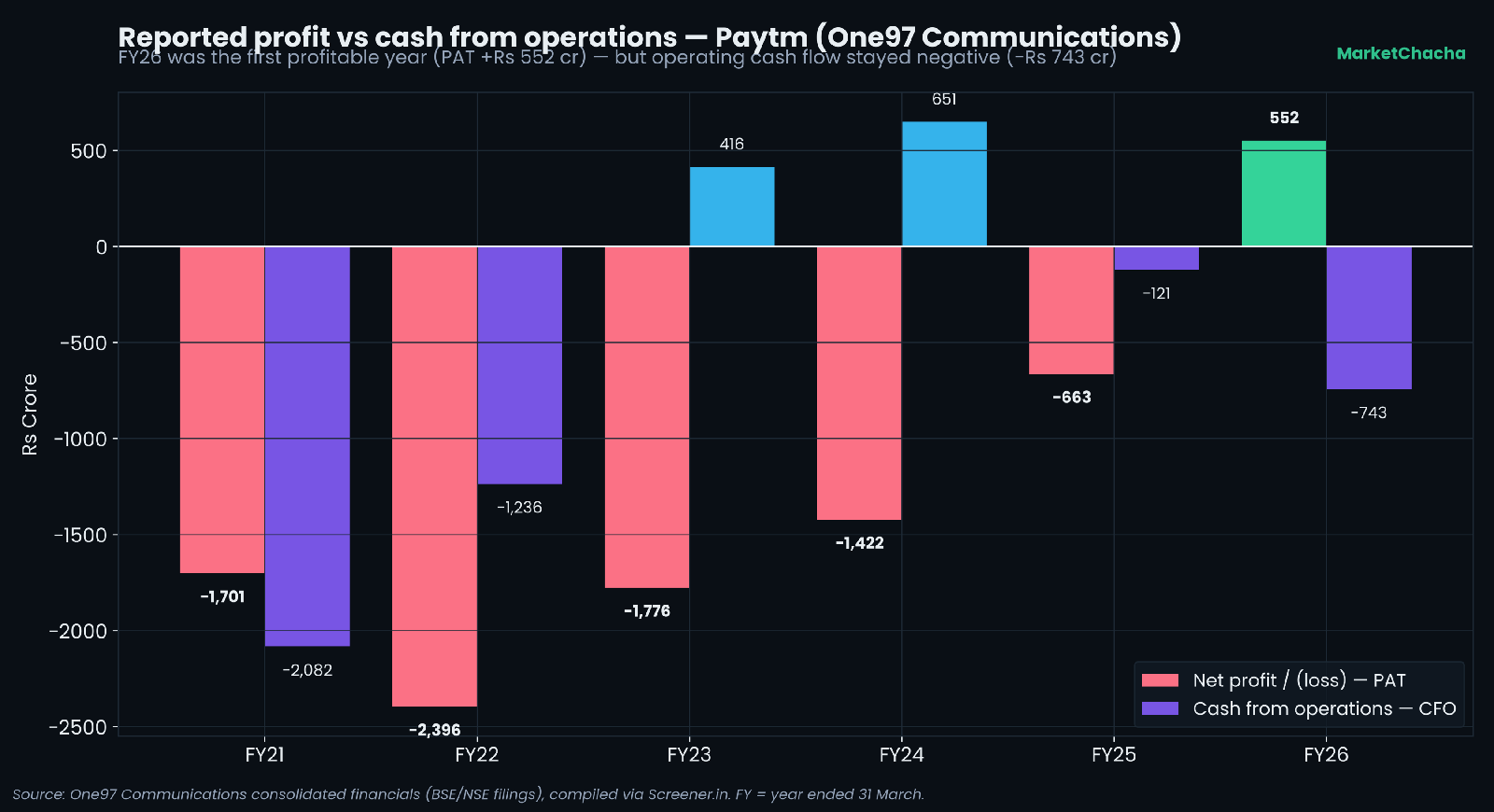
This is the single most important thing to watch, and the chart below makes it visible: FY26 was profitable on the P&L (+₹552 cr) yet operating cash flow was negative (-₹743 cr). Profit and cash diverged. The benign, and probably correct, explanation is two-fold: (a) a chunk of the reported profit is non-cash / non-operating other income; and (b) a growing financial-services and Default-Loss-Guarantee book ties up working capital (guarantee deposits, receivables from lending partners) that flows through operating cash. Neither is evidence of anything improper — but until CFO turns positive alongside PAT, the profit has not yet become cash, and that is a fact worth stating.
The latest quarter, decoded
For the quarter ended June 2026 (Q1 FY27), against the prior quarter (QoQ) and the year-ago quarter (YoY):
| ₹ cr | Q1 FY26 (Jun-25) | Q4 FY26 (Mar-26) | Q1 FY27 (Jun-26) | QoQ | YoY |
|---|---|---|---|---|---|
| Revenue | 1,918 | 2,264 | 2,448 | +8.1% | +27.6% |
| Operating profit (EBITDA) | 72 | 132 | 203 | +53.8% | +181.9% |
| Other income | 224 | 199 | 182 | -8.5% | -18.8% |
| Profit before tax | 126 | 194 | 247 | +27.3% | +96.0% |
| Net profit (PAT) | 123 | 183 | 220 | +20.2% | +78.9% |
| EPS (₹) | 1.93 | 2.87 | 3.44 | — | — |
The decode: revenue up 28% YoY, and the earnings quality improved, which is the more telling point. A year earlier (Jun-25) the reported PAT of ₹123 cr sat entirely on other income of ₹224 cr — strip that out and pre-tax profit would have been roughly -₹98 cr. In the latest quarter, operating profit of ₹203 cr exceeded other income of ₹182 cr; ex-other-income pre-tax profit was about +₹65 cr. So the core business now stands on its own without treasury income — a genuine change from twelve months earlier. One neutral flag: the tax rate rose to about 11% (from ~2%), consistent with a company that is becoming sustainably profitable and beginning to recognise tax.
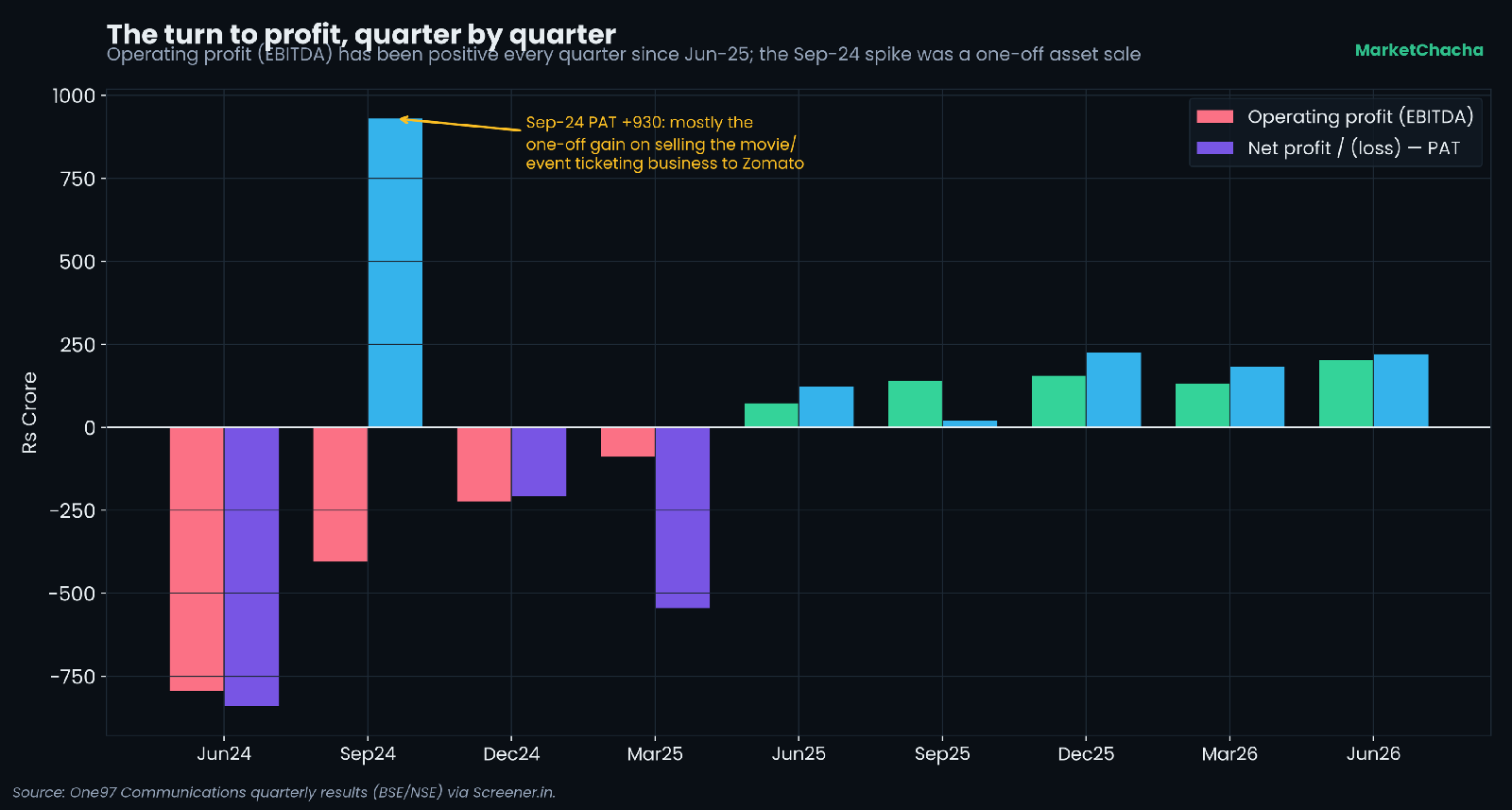
Note the Sep-2024 spike in the chart above: that quarter's ₹930 cr profit was mostly a one-off gain on the sale of the movie/event-ticketing business to Zomato — not operating performance. The clean signal is that operating profit (EBITDA) has been positive every quarter since June 2025.
Who owns it — and where those owners are registered
Because there is no promoter, ownership is the whole story here — and it has shifted dramatically. Over ten quarters, foreign holding fell from about 60% (Mar-24) to about 48% (Jun-26), while domestic institutions rose from about 7% to about 25%. Public/retail holding eased to about 27%. At the same time the number of shareholders fell from roughly 12.3 lakh (Mar-24) to about 7.8 lakh (Jun-26) — a drop of more than a third. In plain terms: the big early foreign backers have been selling down, Indian mutual funds have been buying, and the retail base has shrunk.
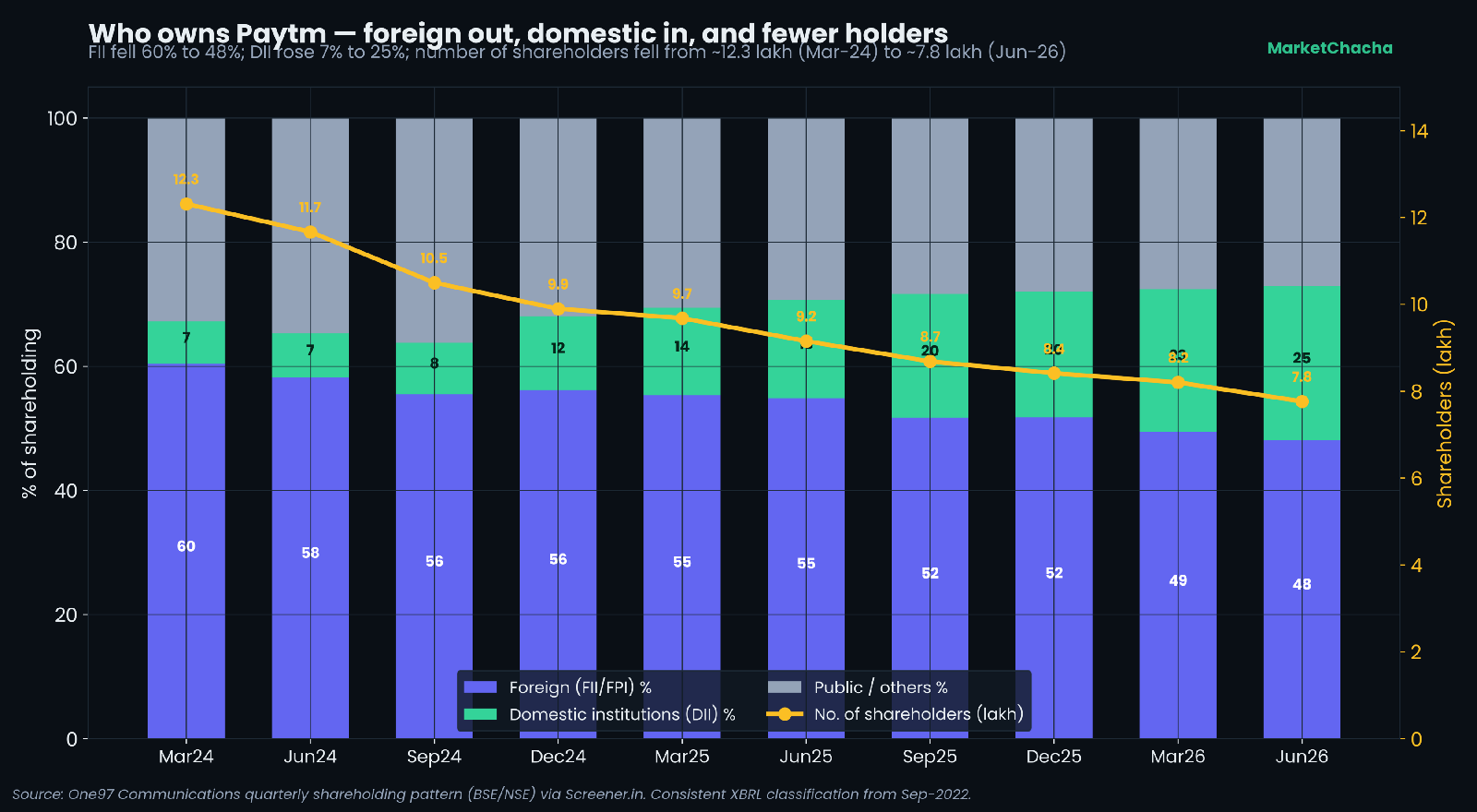
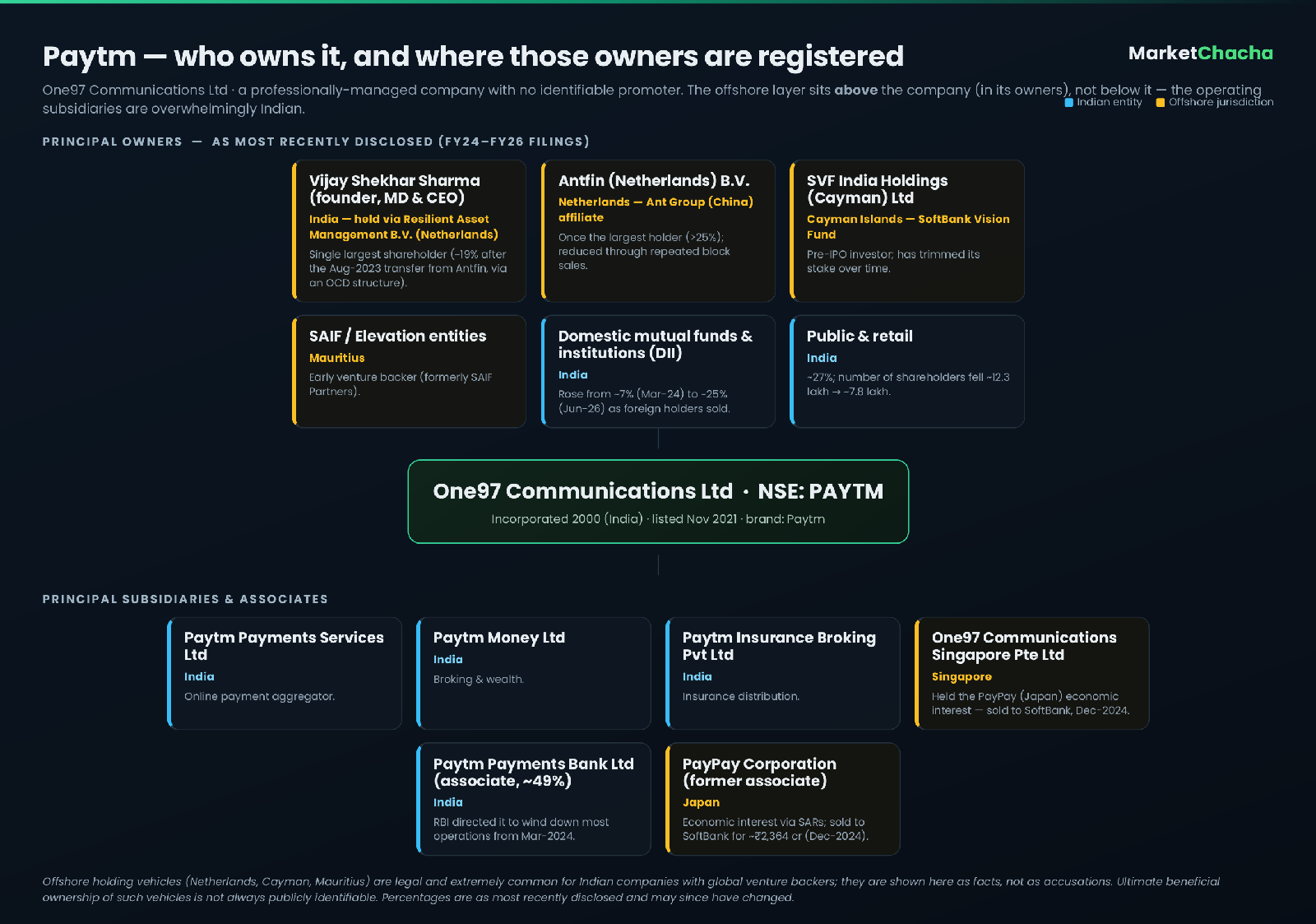
Now the jurisdictions — the part an Indian "kundli" should name plainly. The principal owners, as most recently disclosed, and where each vehicle is registered:
- Vijay Shekhar Sharma (founder/CEO) — the single largest shareholder (about 19% after 2023), held through a Netherlands entity, Resilient Asset Management B.V. In August 2023 he acquired a 10.30% stake from Antfin without paying cash, via an optionally-convertible-debenture structure that let Antfin retain the economic value; the deal moved One97 from majority-foreign to majority-Indian ownership on paper.
- Antfin (Netherlands) B.V. — the Ant Group (China) affiliate, registered in the Netherlands. Once the largest holder at over 25%, reduced through repeated block sales.
- SVF India Holdings (Cayman) Ltd — the SoftBank Vision Fund vehicle, registered in the Cayman Islands.
- SAIF / Elevation entities — early venture backer, registered in Mauritius.
- Domestic mutual funds and public/retail — Indian, and now a rising share of the register.
The neutral context, stated once: Mauritius, the Netherlands, Singapore and the Cayman Islands are among the most common domiciles for foreign investment into India, for tax-treaty and fund-structuring reasons; an offshore holding vehicle is legal and extremely common. It is named here because the ultimate beneficial owner of such vehicles is not always publicly identifiable. Note the important asymmetry, shown in the structure map below: the offshore layer sits above One97 (in who owns it), not below it — the operating subsidiaries are overwhelmingly Indian. A largely domestic operating structure with a globally-domiciled cap table is itself a verified finding, not a red flag.
Capital history — every time they raised or returned money
The defining event is the IPO of November 2021: a price band of ₹2,080–2,150 and a total issue of about ₹18,300 crore (a fresh issue of ~₹8,300 cr plus an offer-for-sale of ~₹10,000 cr) — India's largest IPO at the time. The listing was poor: the shares debuted at ₹1,950 and closed the first day at ₹1,564, about 27% below the ₹2,150 issue price. The stock later fell to roughly ₹310 in late 2022. As of 6 August 2026 it traded around ₹1,447 — meaning that, nearly five years on, it remains about a third below its IPO price, even after a strong recent run (roughly +35% over the past year).
Other capital actions on record: a share buyback approved in December 2022 of up to ₹850 crore via the open market at a maximum price of ₹810 per share — an unusual move for a recently-listed, then loss-making company, and one that drew market comment at the time. There have been no bonus or dividend payouts (the board explicitly declined a proposed bonus issue in 2026). Employee stock options have been a large and recurring expense, and are the subject of the SEBI matter below. We did not find preferential allotments to related parties at a discount — consistent with the no-promoter structure.
Who runs it, and the wider web
Vijay Shekhar Sharma is chairman, managing director and CEO. The statutory auditor is S.R. Batliboi & Associates LLP (part of the EY network), appointed after Price Waterhouse completed its term; reported audit opinions have been unmodified. The company's principal subsidiaries — Paytm Payments Services Ltd (payment aggregator), Paytm Money (broking/wealth), and Paytm Insurance Broking — are Indian. Its most notable offshore subsidiary was One97 Communications Singapore Pte Ltd, which held the economic interest in Japan's PayPay; that interest was sold to SoftBank in December 2024 for about ₹2,364 crore. Its once-central associate, Paytm Payments Bank (India, ~49% held), is the subject of the regulatory record below.
The regulatory and surveillance record
This is high-signal and entirely factual. Every item below is a public record with a primary source; none of it is an allegation by us.
- RBI action on Paytm Payments Bank (associate). On 31 January 2024 the RBI directed Paytm Payments Bank to stop accepting fresh deposits, top-ups and credit transactions in customer accounts, wallets and FASTags after a cut-off date (later set at 15 March 2024), citing "persistent non-compliances and material supervisory concerns." This followed an earlier RBI direction in March 2022 barring the bank from onboarding new customers. This action was the direct cause of the FY25 revenue dip.
- FIU-IND penalty. In March 2024, the Financial Intelligence Unit-India imposed a penalty of ₹5.49 crore on Paytm Payments Bank for contraventions under the Prevention of Money Laundering Act. Separately, the RBI had levied a penalty of about ₹5.39 crore on the bank in October 2023 for a range of norm violations.
- SEBI ESOP matter — settled. SEBI issued show-cause notices to the company and to Vijay Shekhar Sharma and Ajay Shekhar Sharma over ESOPs granted to the founder in FY22, questioning whether he ought to have been classified as a promoter at the time (SEBI's case referenced his declassification as a non-promoter shortly before the IPO filing; promoters cannot receive ESOPs). The matter was settled in 2025: the founder agreed to forgo 21 million ESOPs, pay ₹1.11 crore, and accept a three-year bar on receiving ESOPs from listed companies; Ajay Shekhar Sharma forfeited 22.2 million ESOPs, paid ₹57.11 lakh, and disgorged ₹35.86 lakh. A settlement is a resolution without admission of guilt.
- Enforcement Directorate notice — allegation stage. In March 2025 the ED was reported to have issued a show-cause notice under FEMA alleging contraventions of about ₹611 crore connected to past acquisitions, of which about ₹245 crore was attributed to One97 and the balance to acquired entities (Little Internet and Nearbuy). This is a notice/allegation, not an established finding; such matters can be contested or compounded, and often relate to the mechanics of historical foreign investment in acquired subsidiaries.
- Exchange surveillance. As of this writing, PAYTM is a derivatives-eligible large-cap and we did not find it on the exchanges' ASM or GSM surveillance lists.
Forensic checks — what the accounts show
| Check | What we found | A benign explanation |
|---|---|---|
| Profit vs cash (CFO vs PAT) | FY26 PAT +₹552 cr but CFO -₹743 cr; the two have diverged. | Part of profit is non-cash other income; a growing loan-distribution/DLG book ties up working capital. |
| Other income as % of PBT | FY26: ₹668 cr on PBT of ₹582 cr = ~115%. Ex-other-income PBT ≈ -₹86 cr. | Genuine treasury income on a real ~₹4,500 cr investment pile; the latest quarter's core already stands without it. |
| Debt & implied rate | Borrowings ₹194 cr; finance cost ₹18 cr ⇒ ~9–10% implied. Essentially debt-free. | Borrowings are largely lease liabilities; nothing unusual. |
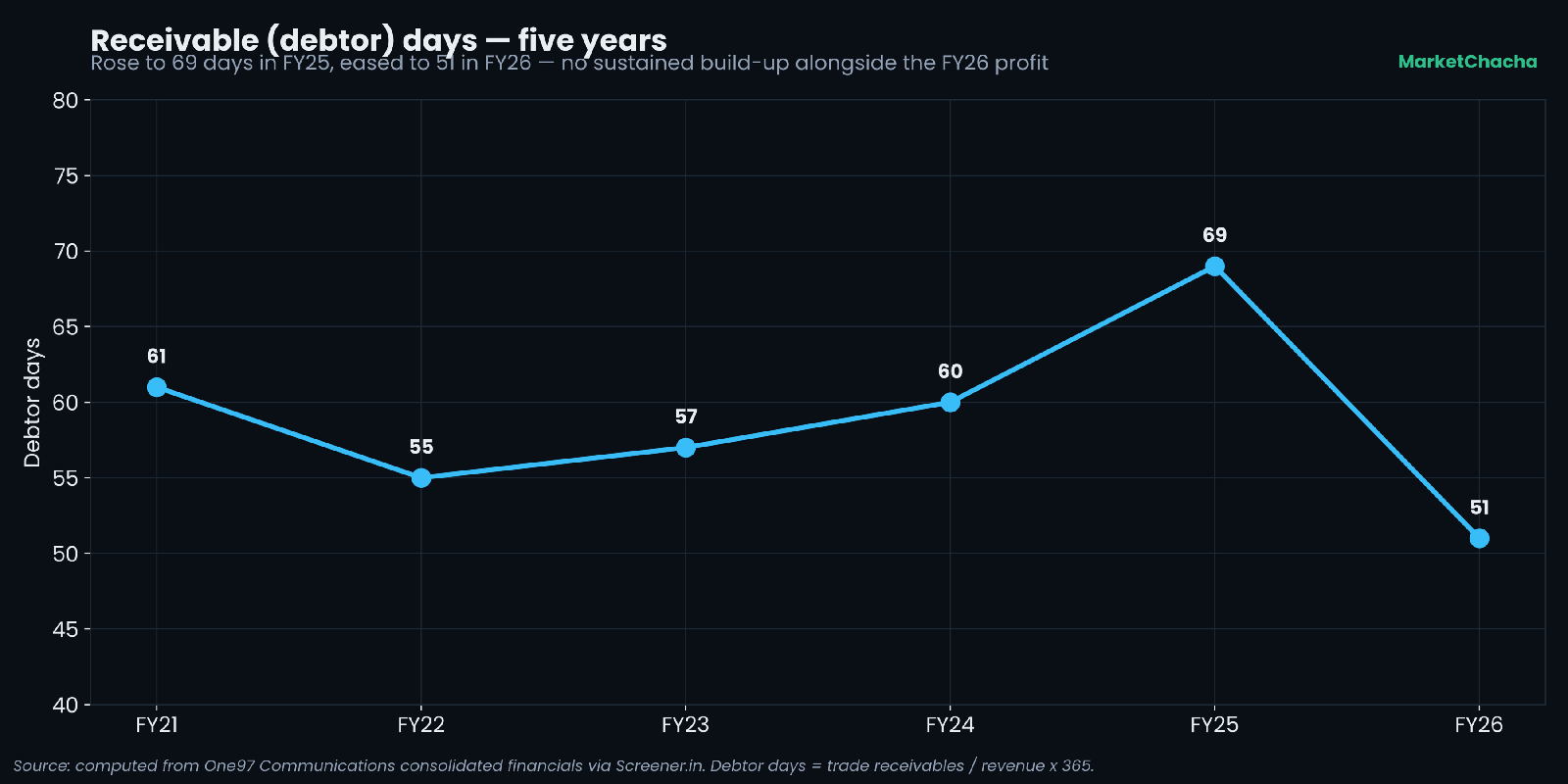
| Receivable (debtor) days | 60 (FY24) → 69 (FY25) → 51 (FY26). | No sustained build-up alongside the FY26 profit; eased in FY26. |
| Promoter holding / pledge | No promoter classification, so no promoter pledge exists. | Professionally-managed, no-promoter structure disclosed since the IPO. |
| Auditor | S.R. Batliboi & Associates LLP (EY network), after Price Waterhouse's term; opinions unmodified. | A routine end-of-term rotation. |
| Subsidiaries & jurisdictions | Operating subsidiaries overwhelmingly Indian; offshore layer is in ownership (Netherlands/Cayman/Mauritius). | A common structure for a globally-funded Indian company. |
| Dilution / capital returns | IPO fresh issue ~₹8,300 cr (2021); ₹850 cr buyback (2022); heavy ESOP expense; 43.2m ESOPs forfeited in the SEBI settlement. | ESOP-heavy pay is typical for new-age tech; the buyback returned cash to holders. |
What we could not verify
We relied on secondary confirmation for the exact wording of the FY25 audit opinion and did not read every note of the full annual report line by line. We present the category-level shareholding trend and shareholder count from the exchange filings as the hard numbers; the precise June-2026 percentage held by each individual foreign vehicle was not separately re-verified beyond those totals, so the named holders and their approximate stakes are flagged "as most recently disclosed" and may since have changed. Related-party transaction amounts were not separately quantified here. The ED matter is at the notice stage and its outcome is unknown. On valuation multiples we cite the widely-published figures (P/E ~114, P/B ~5.7 at ₹1,447) as computed by data aggregators, not as our own recommendation.
What would change the picture
Concrete, checkable things to watch next: whether operating cash flow turns positive alongside profit (the key gap today); whether profit continues to stand without other income, as it began to in Q1 FY27; the next shareholding pattern — does foreign selling continue and does the shareholder count keep falling; the trajectory of the financial-services/DLG book and its effect on working capital; the resolution of the ED FEMA notice; any change in auditor or audit opinion; and whether the stock's valuation multiple is sustained by the new earnings base.
Sources
- One97 Communications — consolidated financials, quarterly results, shareholding pattern (BSE/NSE filings), compiled via Screener.in: https://www.screener.in/company/PAYTM/consolidated/
- Paytm Q1 FY26 results blog (turned profitable, ₹123 cr PAT): https://paytm.com/blog/investor-relations/paytm-turns-profitable-with-rs123cr-pat-in-q1fy26/
- Paytm Q1 FY27 earnings release (Jun-26 quarter): https://paytm.com/document/ir/financial-results/Paytm_Earning-Release_Q1-FY-2027.pdf
- Annual report FY2025 (BSE): https://www.bseindia.com/xml-data/corpfiling/AttachHis/dad7b019-c2c8-40e1-88b9-d2fb7ce2b73a.pdf
- Paytm IPO — price band and issue details (Business Standard): https://www.business-standard.com/article/markets/paytm-ipo-price-band-set-at-rs-2-080-2-150-subscription-to-open-on-nov-8-121102800743_1.html
- Paytm IPO listing-day performance (CNBC): https://www.cnbc.com/2021/11/18/india-paytm-makes-stock-market-debut.html
- Buyback December 2022 (₹850 cr at ₹810/share): https://www.business-standard.com/article/companies/paytm-announces-rs-850-cr-share-buyback-via-open-market-at-rs-810-per-share-122121301234_1.html
- RBI direction on Paytm Payments Bank (press release): https://www.rbi.org.in/Scripts/BS_PressReleaseDisplay.aspx?prid=57224
- SEBI ESOP show-cause and settlement (Outlook Business): https://www.outlookbusiness.com/corporate/vijay-shekhar-sharma-brother-settle-with-sebi-no-esops-from-listed-companies-for-3-years
- SEBI ESOP show-cause notice (Business Standard): https://www.business-standard.com/markets/news/paytm-receives-notice-from-sebi-on-esops-granted-to-vijay-shekhar-sharma-124071901133_1.html
- ED FEMA notice (~₹611 cr) — Business Today: https://www.businesstoday.in/latest/corporate/story/paytm-parent-company-under-ed-lens-for-rs611-crore-fema-breach-tied-to-subsidiary-deals-466391-2025-03-01
- FIU-IND ₹5.49 cr PMLA penalty / RBI ₹5.39 cr penalty (Business Standard): https://www.business-standard.com/companies/news/rbi-slaps-rs-5-39-crore-penalty-on-paytm-pb-for-violating-series-of-norms-123101201150_1.html
- Antfin → Resilient Asset Management (Netherlands) 10.3% transfer, 2023 (Business Today): https://www.businesstoday.in/latest/corporate/story/vijay-shekhar-sharma-used-his-netherlands-based-firm-to-buy-antfins-stake-in-paytm-all-you-need-to-know-393061-2023-08-07
- PayPay (Japan) stake sale to SoftBank, Dec-2024 (Business Standard): https://www.business-standard.com/companies/news/paytm-to-sell-japan-s-paypay-stake-to-softbank-for-250-mn-to-boost-capital-124120600638_1.html
- Zomato acquires Paytm's entertainment/ticketing business for ₹2,048 cr (TechCrunch): https://techcrunch.com/2024/08/21/zomato-buys-paytms-entertainment-ticket-business-for-244-million
- Auditor appointment (EY / S.R. Batliboi) — Outlook: https://startup.outlookindia.com/sector/fintech/paytm-s-parent-one97-communications-approves-appointment-of-ey-as-new-auditor-news-7944
- DRHP / prospectus (no identifiable promoter) — SEBI: https://www.sebi.gov.in/filings/public-issues/nov-2021/one97-communications-limited-prospectus_53936.html
FAQ
Is One97 Communications the same as Paytm? Yes. One97 Communications Ltd is the listed company (NSE: PAYTM, BSE: 543396); Paytm is the brand it owns and operates.
Does Paytm have a promoter? No. It is classified as a professionally-managed company with no identifiable promoter. The founder, Vijay Shekhar Sharma, is the largest single shareholder and the CEO, but there is no promoter category — and therefore no promoter pledge.
Is the company profitable now? FY26 (year to March 2026) was its first profitable year, with net profit of ₹552 crore, and the June-2026 quarter reported ₹220 crore. Note that the full-year FY26 profit still leaned on other (treasury) income, though the latest quarter's core operations were profitable without it, and operating cash flow was negative in FY26.
Why did revenue fall in FY25? The RBI's January-2024 action winding down Paytm Payments Bank, together with a pull-back in loan distribution, cut revenue from ₹9,978 cr (FY24) to ₹6,900 cr (FY25).
Who are the biggest foreign owners and where are they registered? Historically Antfin (Ant Group, registered in the Netherlands), SoftBank's SVF vehicle (Cayman Islands) and SAIF/Elevation (Mauritius); the founder holds through a Netherlands entity. Foreign holding has fallen from ~60% to ~48% as Indian institutions bought in.
Is the stock above its IPO price? No. It was issued at ₹2,150 in November 2021 and traded around ₹1,447 in early August 2026 — roughly a third below the IPO price, despite a strong recent recovery.
Independent research for education and discussion only. Not investment advice, not a recommendation, and not a rating — we issue no buy/sell calls and no target prices. Every figure is sourced from the primary documents linked above; figures can be restated and we can make mistakes, so always verify against the original. Nothing here alleges wrongdoing by any company or individual: where a fact raises a question we state the fact, cite it, and give the benign explanation alongside. Offshore holding structures, pledging and preferential allotments are all legal and common — they are disclosed here as facts, not as accusations.
This article is for educational and informational purposes only. It is not financial advice, investment recommendation, or a solicitation to buy or sell securities. Investing involves significant risks. I am not a SEBI-registered investment advisor. Readers should consult their own financial advisor and conduct their own research before making any investment decisions.
Comments
Join the conversation
Sign in to join the conversation.
Follow replies, add your view, and take part in the discussion.
Sign in to commentLoading comments...