

Hindustan Aeronautics (HAL): what their latest dividend filing actually means
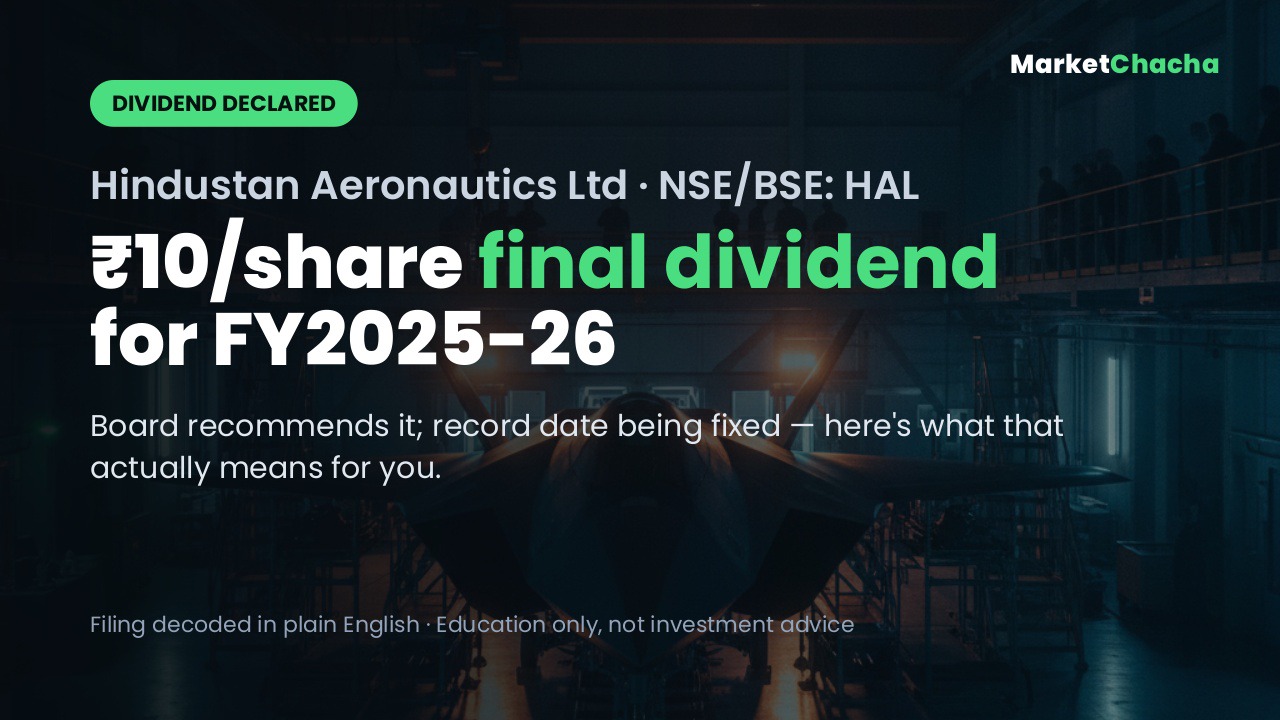
Hindustan Aeronautics Ltd (HAL) — India's state-owned fighter-jet and helicopter maker — told the exchanges that its board has recommended a final dividend of ₹10 per share for FY2025-26, and in a companion filing said it is fixing the record date that decides who actually receives it. It's a corporate-action filing, not a results or order-win surprise.
What was announced
Two linked filings landed on the BSE on 29 June 2026. In the first, HAL's board met and recommended a final dividend of ₹10 per equity share (face value ₹5, so this works out to a 200% dividend on face value) for the year ended March 2026. In the second, the board moved to fix the record date — the cut-off day used to decide which shareholders are on the register and therefore eligible for the payout. A board recommendation is still subject to shareholder approval at the AGM before it is finally declared and paid.
What this type of filing means
A final dividend is a slice of the year's profit a company chooses to pay back to shareholders, proposed after the full-year accounts are done. Two words matter here:
- Recommended — the board proposes the amount, but it isn't final until shareholders vote it through at the Annual General Meeting (AGM).
- Record date — the single day the company looks at its share register. If your name is there at the end of that day, you get the dividend; if you buy too late, the seller gets it. On exchanges this is tied to the ex-dividend date (usually the same day or one day before), from which the stock trades "without" the upcoming dividend.
So this filing is HAL telling everyone how much it plans to pay and setting up the machinery for who gets it.
Why it matters / potential impact
For a profitable, cash-rich public-sector defence company, a final dividend is routine capital return, not a strategic shift. ₹10 a share on a stock trading around ₹4,300 is a tiny direct yield (roughly 0.2% from this single payment), so the real signal is qualitative: the board is comfortable enough with cash flows and its order book to keep returning money to shareholders — and the government, which is the majority owner, receives the bulk of it. It does not change HAL's earnings, margins or balance sheet in any meaningful way; a dividend is cash leaving the company, so book value ticks down slightly on the record date. No demand, contract or guidance information is contained in this filing.
Is it expensive?
HAL trades at a P/E of around 32 with a market capitalisation near ₹2.9 lakh crore (share price roughly ₹4,300–4,370 in late June 2026). For a defence manufacturer with a multi-year order book that's a full but not extreme valuation by Indian standards. For context, fellow defence PSU Bharat Electronics (BEL) trades richer at a P/E of about 49 on a similar ~₹2.9–3.0 lakh crore market cap — so on an earnings-multiple basis HAL is the cheaper of the two large listed defence names, though the two aren't identical businesses (BEL makes defence electronics and systems; HAL makes the aircraft and platforms). "Cheaper than BEL" is a relative observation, not a recommendation.
The business
HAL is India's flagship aerospace and defence public-sector company. Its work spans designing, building, repairing and upgrading military aircraft and helicopters (think Tejas fighters, Dhruv/Prachand helicopters), aero-engines, avionics and accessories, and a large, sticky repair, overhaul and spares business for the Indian armed forces. Revenue is dominated by orders from the Ministry of Defence, which gives it a deep order backlog but also ties its fortunes to government procurement cycles. A dividend filing like this affects the whole company's cash — it isn't tied to any one platform or division.
Beginner takeaway
HAL is handing shareholders ₹10 per share as a final dividend for last year, and is now setting the record date that decides who qualifies. If you own (or buy before the ex-dividend date) you're eligible; the amount is small relative to the share price, so treat it as a sign of steady capital return rather than a reason the stock should jump.
FAQ
If I buy HAL today, will I get this ₹10 dividend? Only if you own the shares before the ex-dividend date, which sits just before the record date HAL is fixing. Buy on or after the ex-date and the previous holder keeps the dividend.
Is a "recommended" dividend guaranteed? Not quite — the board proposes it, but it becomes final only after shareholders approve it at the AGM. For a healthy company this is usually a formality, but it isn't paid until then.
Why is ₹10 called a "200% dividend"? Indian companies quote dividends as a percentage of face value, not market price. HAL's face value is ₹5, so ₹10 is 200% of face value — it sounds large but is only about 0.2% of the ~₹4,300 market price.
Does the dividend make the stock cheaper? On the ex-dividend date the share price typically drops by roughly the dividend amount, because that cash has left the company. So you don't get "free" money — you receive cash and the share adjusts.
As of 29 June 2026. Source: official BSE filing — read it directly here. We summarise filings for education and may make errors, so always verify against the official document. Educational content only — not investment advice, not a buy/sell recommendation.
This article is for educational and informational purposes only. It is not financial advice, investment recommendation, or a solicitation to buy or sell securities. Investing involves significant risks. I am not a SEBI-registered investment advisor. Readers should consult their own financial advisor and conduct their own research before making any investment decisions.
Comments
Join the conversation
Sign in to join the conversation.
Follow replies, add your view, and take part in the discussion.
Sign in to commentLoading comments...