

General Motors just filed an 8-K: what it means
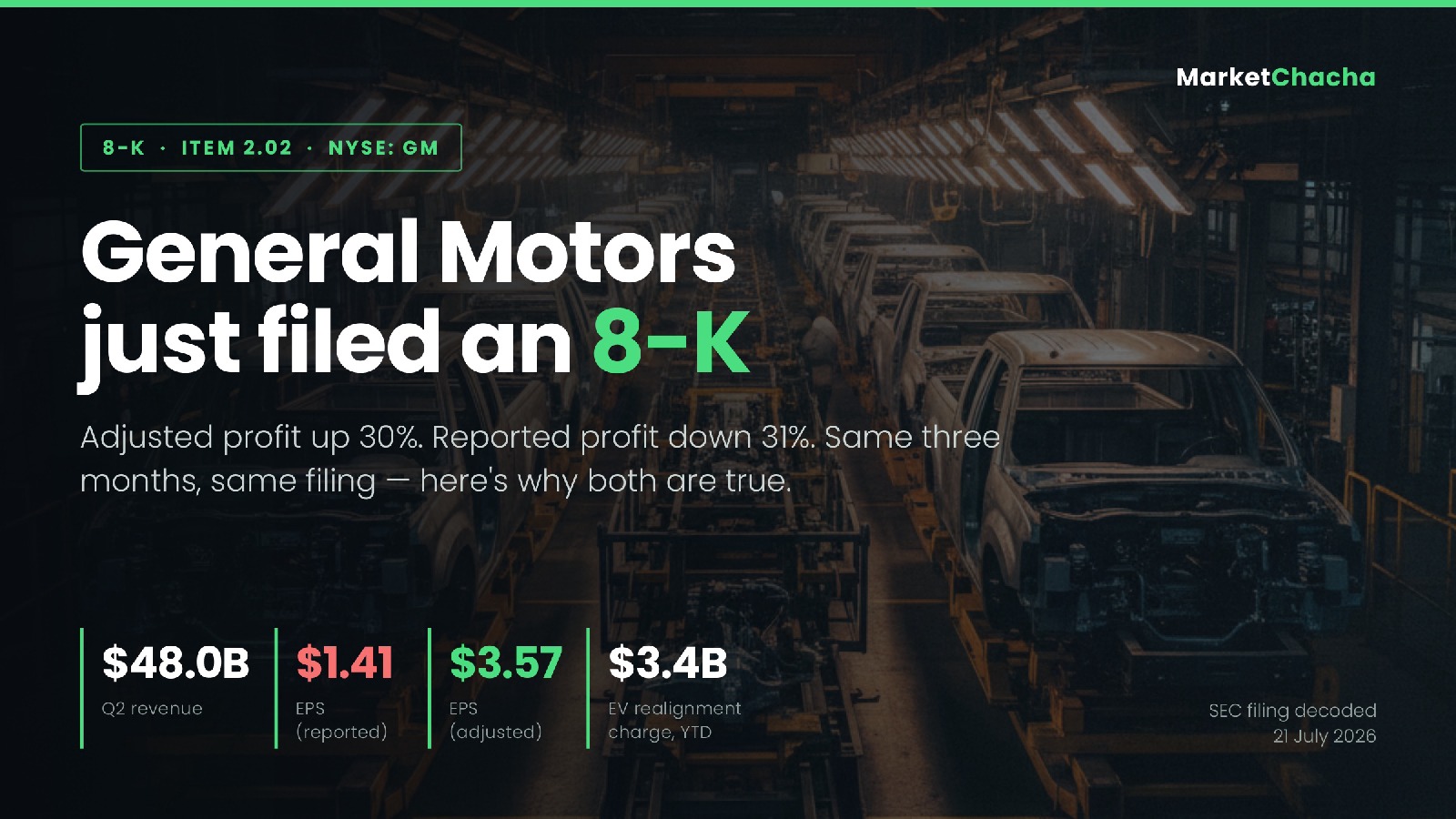
General Motors filed an 8-K with the SEC before the US market opened on 21 July 2026, attaching its second-quarter results. In the same document the company raised its full-year adjusted profit guidance and cut its full-year reported profit guidance — and both of those are honest descriptions of the same business.
What was filed
The filing is a Form 8-K carrying Item 2.02 (Results of Operations and Financial Condition) and Item 9.01 (Exhibits). The attached press release covers the three months to 30 June 2026. The headline numbers:
- Revenue: $48.0 billion, up 1.9% from $47.1 billion a year earlier.
- Net income attributable to stockholders: $1.31 billion, down 31.1% from $1.90 billion.
- EBIT-adjusted: $3.94 billion, up 29.8% — an 8.2% adjusted margin versus 6.4%.
- Earnings per share: $1.41 reported, $3.57 adjusted. Reported EPS fell 26%; adjusted EPS rose 41%.
- Adjusted automotive free cash flow: $5.03 billion for the quarter, up from $2.83 billion.
- A quarterly dividend of $0.18 per share was declared, payable 17 September 2026 to holders of record on 4 September 2026.
The gap between the two profit figures is one line item. GM excluded $2.46 billion of adjustments from the quarter, of which $2.28 billion was "EV strategic realignment" — the cost of shrinking its planned electric-vehicle capacity and manufacturing footprint, including its Ultium battery joint venture. Year to date those realignment charges total roughly $3.36 billion.
Guidance moved in two directions at once. Full-year EBIT-adjusted guidance went up, to $14.0–16.0 billion from $13.5–15.5 billion, and adjusted EPS guidance to $12.00–14.00 from $11.50–13.50. Full-year reported net income guidance went down, to $8.4–9.8 billion from $9.9–11.4 billion, and reported EPS to $8.98–10.98 from $10.62–12.62. The reason is arithmetic: GM now expects $3.5 billion of adjustments for the year instead of $1.0 billion, so more real cost sits below the adjusted line.
What this filing type means
A Form 8-K is the SEC's "something happened" filing. Unlike the 10-Q and 10-K, which arrive on a fixed quarterly and annual schedule, an 8-K is event-driven: a company files one within four business days of a triggering event, and the specific Item number tells you which event.
- Item 2.02 — results of operations. This is how earnings press releases legally reach the market. Every US-listed company's quarterly numbers land here first.
- Item 1.01 — a material definitive agreement (a big contract, supply deal or credit facility).
- Item 5.02 — a director or senior officer arriving, leaving, or being removed.
- Item 9.01 — the exhibits attached, which is where the actual press release lives.
One nuance worth knowing: material furnished under Item 2.02 is technically furnished rather than filed, which changes its liability treatment under the securities laws. Practically, it is still the primary-source document, and it reaches you at the same moment it reaches every analyst.
Why it matters
The adjusted-versus-reported gap is the whole story. "Adjusted" figures strip out items management considers outside core operations. That is a legitimate and widely used practice — but it is management deciding what counts as core. Here, GM is excluding the cost of unwinding a strategy it publicly committed to a few years ago. The EV pullback charges are real money: GM has said roughly $4.5 billion of the expected $7.2 billion realignment cost has been paid in cash so far this year. Cash that leaves the business is cash that leaves the business, whether or not it appears in the adjusted number.
The underlying automotive business genuinely improved. GM North America's adjusted margin rose from 6.1% to 8.6% and its adjusted profit jumped 43% to $3.45 billion. Reporting around the release points to steady vehicle transaction prices, lower warranty costs and narrower losses on electric vehicles. That improvement is not an accounting artifact.
Two softer spots sit inside the same tables. GM's US market share slipped to 16.6% from 17.4% a year ago, and fleet sales — typically the lower-margin channel, covering rental companies, governments and corporate buyers — rose to 22.3% of total vehicle sales from 17.8%. Selling a larger share of your volume into the less profitable channel while share slips is a mix worth watching in future quarters. In China, GM's share eased to 6.6% and restructuring charges continued.
Buybacks are quietly flattering the per-share numbers. Diluted share count fell from 976 million to 910 million year on year, with $2.8 billion spent on repurchases in the first half. A smaller denominator lifts EPS even when total profit does not move. Whenever you see EPS growing faster than net income, check the share count.
Beginner takeaway
When a company reports two very different profit numbers for the same quarter, neither one is a lie — but they answer different questions. Reported (GAAP) profit asks "what actually happened to the money this quarter, including the messy parts." Adjusted profit asks "what would the ongoing business have earned without the one-offs." Read both, and pay particular attention to whether the "one-offs" keep reappearing quarter after quarter. A charge that shows up for the fourth consecutive quarter is arguably not a one-off at all.
FAQ
Why would GM raise guidance and cut guidance in the same press release? Because they are guiding on two different measures. The adjusted forecast went up because the core car business is performing better; the reported forecast went down because GM now expects a larger pile of EV-realignment charges to sit inside the year's results.
Is "EBIT-adjusted" a real accounting standard? No. EBIT-adjusted is a non-GAAP measure that each company defines for itself, which is why GM must reconcile it back to net income inside the filing. Two companies can calculate it differently, so it is not reliably comparable across firms.
What does "EV strategic realignment" actually mean? It is the cost of scaling back electric-vehicle plans — writing down the value of battery and assembly capacity that will no longer be used as originally intended, plus related exit costs. GM has been booking these charges since it flagged a large realignment in January 2026.
Where can I read the numbers myself? Every figure above is in the press release attached as Exhibit 99.1 to the 8-K, free on EDGAR. Reading the primary document takes about fifteen minutes and is the single best habit a new investor can build.
As of 21 July 2026. Source: official SEC filing — read it directly here. We summarise filings for education and may make errors, so always verify against the official document. Educational content only — not investment advice, not a buy/sell recommendation.
This article is for educational and informational purposes only. It is not financial advice, investment recommendation, or a solicitation to buy or sell securities. Investing involves significant risks. I am not a SEBI-registered investment advisor. Readers should consult their own financial advisor and conduct their own research before making any investment decisions.
Comments
Join the conversation
Sign in to join the conversation.
Follow replies, add your view, and take part in the discussion.
Sign in to commentLoading comments...