

Why did Nubank (NU) pop ~11% — its first billion-dollar quarter?
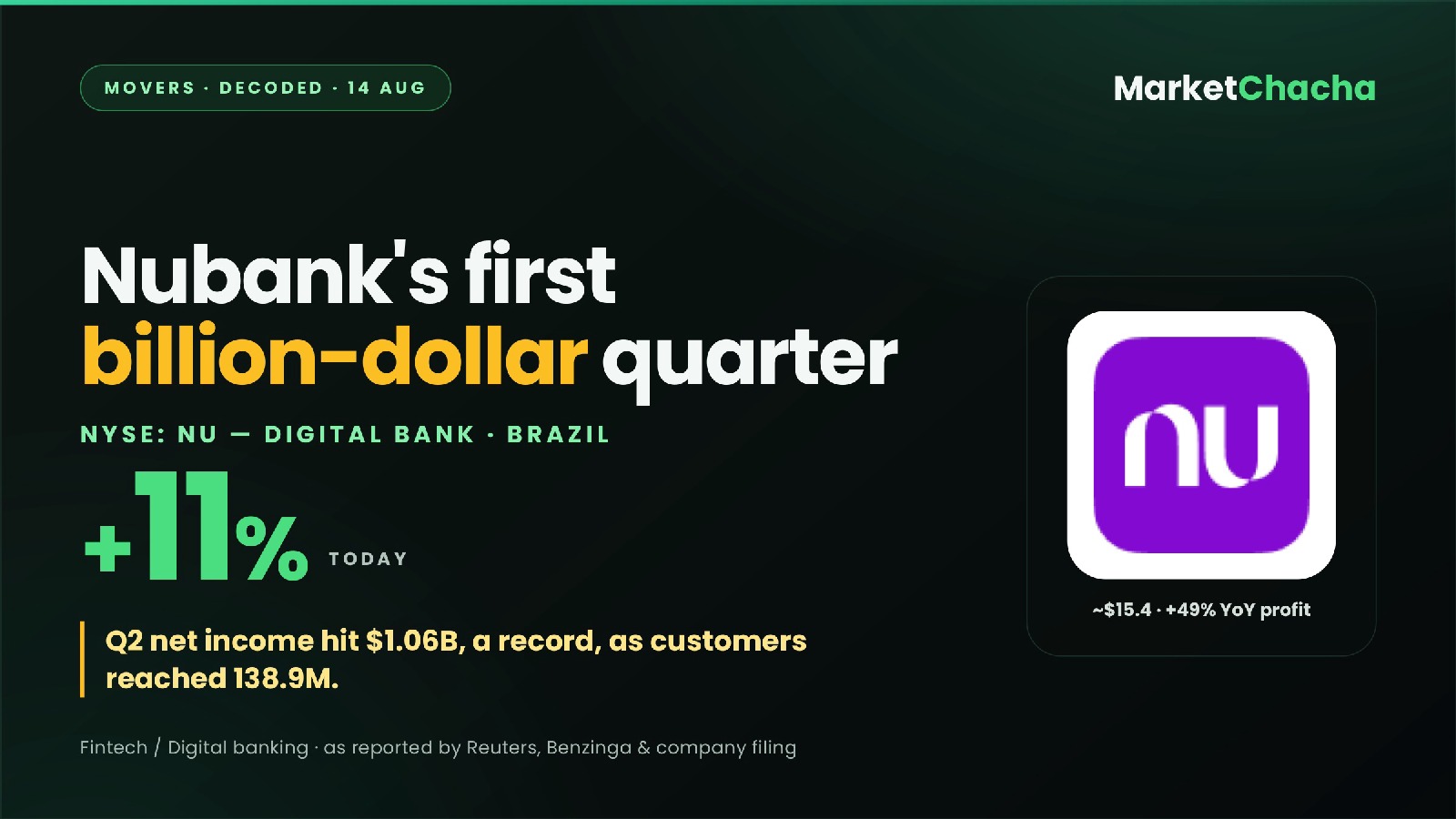
Nu Holdings (NYSE: NU) — the parent of Brazil's digital bank Nubank — jumped around 11% to roughly $15.4 on Friday (Yahoo Finance), the day after it posted the first billion-dollar profit quarter in its history. This isn't a story about one hot number. It's a bank that started as a purple credit card app in São Paulo now minting the kind of profit that used to belong only to the incumbents it set out to disrupt.
What happened
Late Thursday, Nubank reported second-quarter results. Net income hit $1.06 billion, a record and up 49% year-on-year — its first ever quarter above a billion dollars (StockTitan, company 6-K filing). Revenue rose 39% to $5.88 billion and gross profit climbed 43% to $2.44 billion (Reuters via MarketScreener). Return on equity ran at a fat 33% — a level most large banks can only dream about.
Why it moved
Two things landed at once and both were specific, not vibes. First, more customers: Nubank reached 138.9 million customers, up 13% YoY, with an unusually high 83.5% activity rate (the share who actually use it monthly). Second, more money per customer: average revenue per active customer (ARPAC) rose to $17.1, and the risk-adjusted net interest margin — roughly what it earns on lending after expected loan losses — widened to 12.4% as the cost of credit fell versus the prior quarter. Growing the user base and squeezing more profit from each user at the same time is exactly what the market pays up for.
The business
Nubank isn't a single-product app. It runs a full digital bank across Brazil, Mexico and Colombia: credit cards, deposit accounts, personal loans, investments, insurance and a shopping marketplace. Brazil is the profit engine; Mexico and Colombia are the growth options still being built out. That matters for reading today's number — this was strength across the core deposit-and-lending machine (deposits $45.3B, total credit portfolio $39.4B), not one lucky product line.
Is it expensive?
Nubank carries a market cap of about $65.5 billion and trades near a P/E of ~21 (Investing.com). For a plain old bank that would be rich — traditional lenders trade around 11–12x earnings. But Nubank is growing profit ~50% a year, so a low-20s multiple is the market treating it as a fintech, not a bank. For context, US neobank peer SoFi trades far pricier, at a forward P/E in the high-20s to ~30 (GuruFocus). So NU sits in an odd sweet spot: pricey next to old banks, but cheaper than the other marquee fintech growth name. Worth knowing: Berkshire Hathaway, an early backer, fully exited its stake between late 2024 and early 2025 — so this is no longer a "Buffett owns it" trade. No target or call here — just the honest frame.
Who it touches
- Brazilian incumbents — Itaú, Bradesco and Santander Brasil are the share donors as Nubank keeps pulling accounts and lending.
- LATAM fintech peers — MercadoLibre's Mercado Pago and other regional challengers get benchmarked against these margins.
- US fintech sentiment — a clean neobank profit print tends to lift the read-across to names like SoFi.
The one risk that flips it
Credit. Nubank's whole model rests on lending to a fast-growing, largely emerging-market customer base. If Brazil's economy or interest-rate backdrop turns and loan losses climb, that juicy 12.4% risk-adjusted margin can compress quickly — and a stock priced for 50% profit growth has little room for a stumble. That, plus BRL currency swings on the reported dollar numbers, is what to watch next quarter.
As of ~12:45 PM ET, Aug 14. Sources: Reuters/MarketScreener, StockTitan (company filing), Investing.com. For discussion and education only — not investment advice. Verify before acting.
This article is for educational and informational purposes only. It is not financial advice, investment recommendation, or a solicitation to buy or sell securities. Investing involves significant risks. I am not a SEBI-registered investment advisor. Readers should consult their own financial advisor and conduct their own research before making any investment decisions.
Comments
Join the conversation
Sign in to join the conversation.
Follow replies, add your view, and take part in the discussion.
Sign in to commentLoading comments...