

Larsen & Toubro: what their latest filing actually means
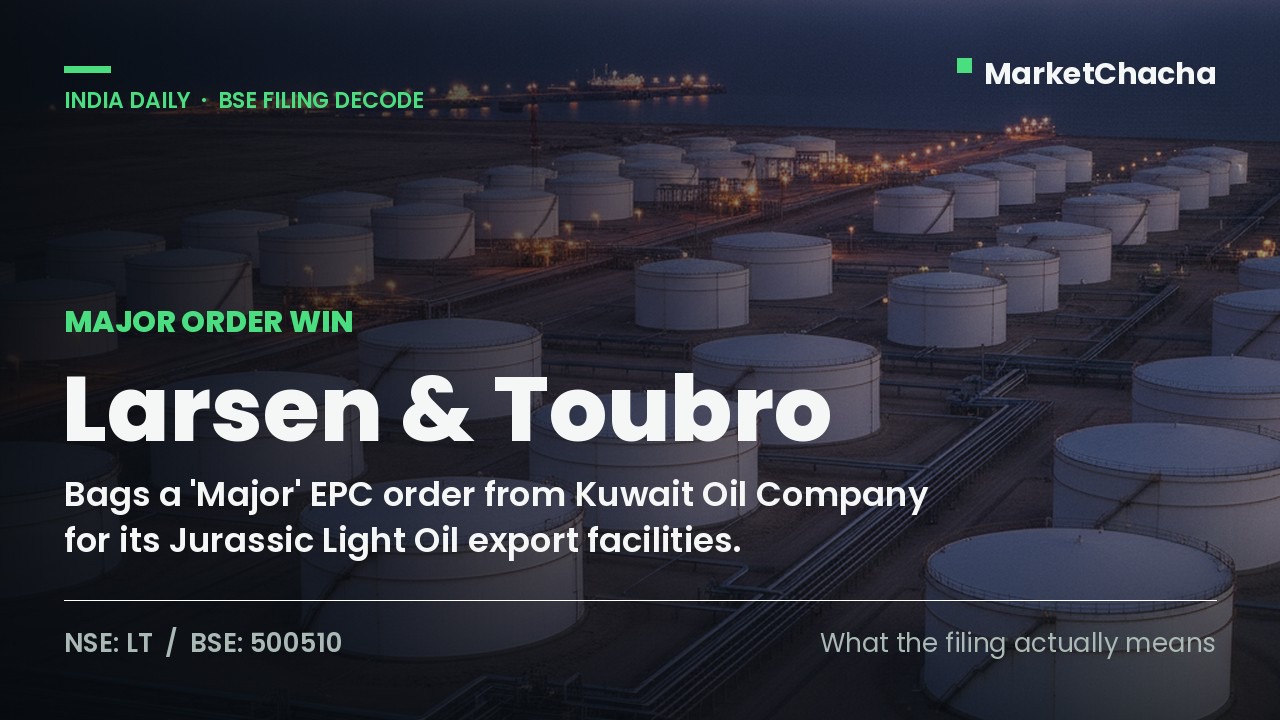
Larsen & Toubro (L&T) told the exchanges on 29 July 2026 that its Energy Hydrocarbon Onshore business has won a "Major" engineering, procurement and construction (EPC) order from Kuwait Oil Company (KOC) to build new crude-oil export facilities in Kuwait. In L&T's own size bands, "Major" means a contract worth between ₹5,000 crore and ₹10,000 crore — a large, high-visibility overseas win, not a routine day-to-day contract.
What was announced
L&T has secured a lump-sum turnkey (LSTK) EPC contract from Kuwait Oil Company for its Jurassic Light Oil (JLO) export facilities and an upgrade of the country's existing crude export network. The headline scope:
- Six new crude-oil storage tanks, each with an operating capacity of ~618,000 barrels.
- New pipelines and associated facilities.
- Comprehensive upgrades to Kuwait's existing crude loading and export network so it can handle higher production volumes.
L&T has classified it as a "Major" order, which under its published bands is ₹5,000–10,000 crore. The company did not disclose the exact rupee value — only the band — which is normal for such filings.
What this type of filing means
This is an order-win disclosure under Regulation 30 of SEBI's listing rules — companies must promptly tell the exchange about events a reasonable investor would consider price-sensitive, and a large contract qualifies. For an EPC company like L&T, an "order win" adds to the order book — the stock of work already contracted but not yet executed. The order book is the single most important forward indicator for a construction/engineering firm because it converts into revenue over the next few years as the project is built. Think of it as the visible pipeline of future sales: more inflows today generally mean better revenue visibility tomorrow.
The "lump-sum turnkey" (LSTK) label matters too. It means L&T has agreed a fixed price to design, procure and build the whole facility and hand it over ready-to-run. The upside is a clean, single-scope contract; the risk is that if steel, labour or execution costs run over budget, L&T — not the client — absorbs the difference. Execution discipline is therefore what turns an LSTK order into actual profit.
Why it matters / potential impact
Three reasons this is a meaningful (not merely cosmetic) win:
- Order-book growth. A ₹5,000–10,000 crore inflow is material even for a company of L&T's size and feeds revenue over the build period.
- Middle-East hydrocarbon capex. Gulf oil producers are investing heavily in export and processing infrastructure. L&T's hydrocarbon arm is a direct beneficiary, and repeat wins from a marquee client like KOC reinforce its international credentials.
- Diversification. An overseas energy order broadens L&T's mix beyond domestic infrastructure, which can smooth out the lumpiness of any single market.
The honest caveat: an order is future revenue, not booked profit. Margins depend on execution over several years, and LSTK contracts carry cost-overrun risk. This is a positive data point on demand and competitiveness — it is not a prediction about the share price.
Is it expensive?
As of late July 2026, L&T trades around ₹3,800 a share, a market capitalisation of roughly ₹5.4 lakh crore, on a trailing P/E of about 25–26x and a P/B near 4x. For a business of its quality, scale and order book, that is a fair-to-moderate valuation rather than a stretched one — and notably cheaper than pure capital-goods peers: Siemens India trades near 56x earnings and ABB India near 53x (both much smaller, at roughly ₹1.1–1.6 lakh crore market cap). L&T's lower multiple reflects its conglomerate mix — lower-margin EPC work sits alongside its IT-services and financial-services arms — so it is valued more like a diversified group than a pure high-margin equipment maker. Honest framing only: this is context, not a target price or a buy/sell call.
The business
L&T is a ~US$32 billion Indian multinational — one of the country's largest engineering and construction groups. It operates across several arms: Infrastructure (roads, metros, buildings, water), Energy (hydrocarbon EPC and power), Hi-Tech Manufacturing (defence, heavy equipment), IT & Technology Services (LTIMindtree, L&T Technology Services), and Financial Services (L&T Finance), plus realty. This particular order sits inside just one slice — the Energy Hydrocarbon Onshore business — so while it's a strong win for that division, it affects only a part of the wider group rather than the whole company.
Beginner takeaway
L&T won a large overseas oil-infrastructure contract, adding ₹5,000–10,000 crore to its future workload. It's good news for demand visibility in its energy business, but it's an order (future revenue), not immediate profit — and the real payoff depends on how well L&T executes the fixed-price contract over the next few years.
FAQ
Does an order win mean L&T has already earned this money? No. An order is contracted future work. It converts into revenue gradually as the project is built, and into profit only if L&T executes within its cost estimates.
Why doesn't L&T give the exact order value? It discloses the size band ("Major" = ₹5,000–10,000 crore) rather than the precise figure — a common practice, sometimes for client-confidentiality reasons. The band is enough to judge materiality.
What is a "lump-sum turnkey" (LSTK) contract? A fixed-price deal where L&T designs, procures and builds the entire facility and hands it over ready to operate. If costs overrun, L&T bears the excess — so execution and cost control decide the final margin.
Is L&T's ~25x P/E cheap or expensive? It's fair-to-moderate for a company of this quality and lower than pure capital-goods peers (Siemens India ~56x, ABB India ~53x), largely because L&T is a diversified conglomerate rather than a single high-margin equipment maker.
As of 29 July 2026. Source: official BSE filing — read it directly here. We summarise filings for education and may make errors, so always verify against the official document. Educational content only — not investment advice, not a buy/sell recommendation.
This article is for educational and informational purposes only. It is not financial advice, investment recommendation, or a solicitation to buy or sell securities. Investing involves significant risks. I am not a SEBI-registered investment advisor. Readers should consult their own financial advisor and conduct their own research before making any investment decisions.
Comments
Join the conversation
Sign in to join the conversation.
Follow replies, add your view, and take part in the discussion.
Sign in to commentLoading comments...