

Alumis crashed 57% on a lupus miss. So why is it up 9% today?
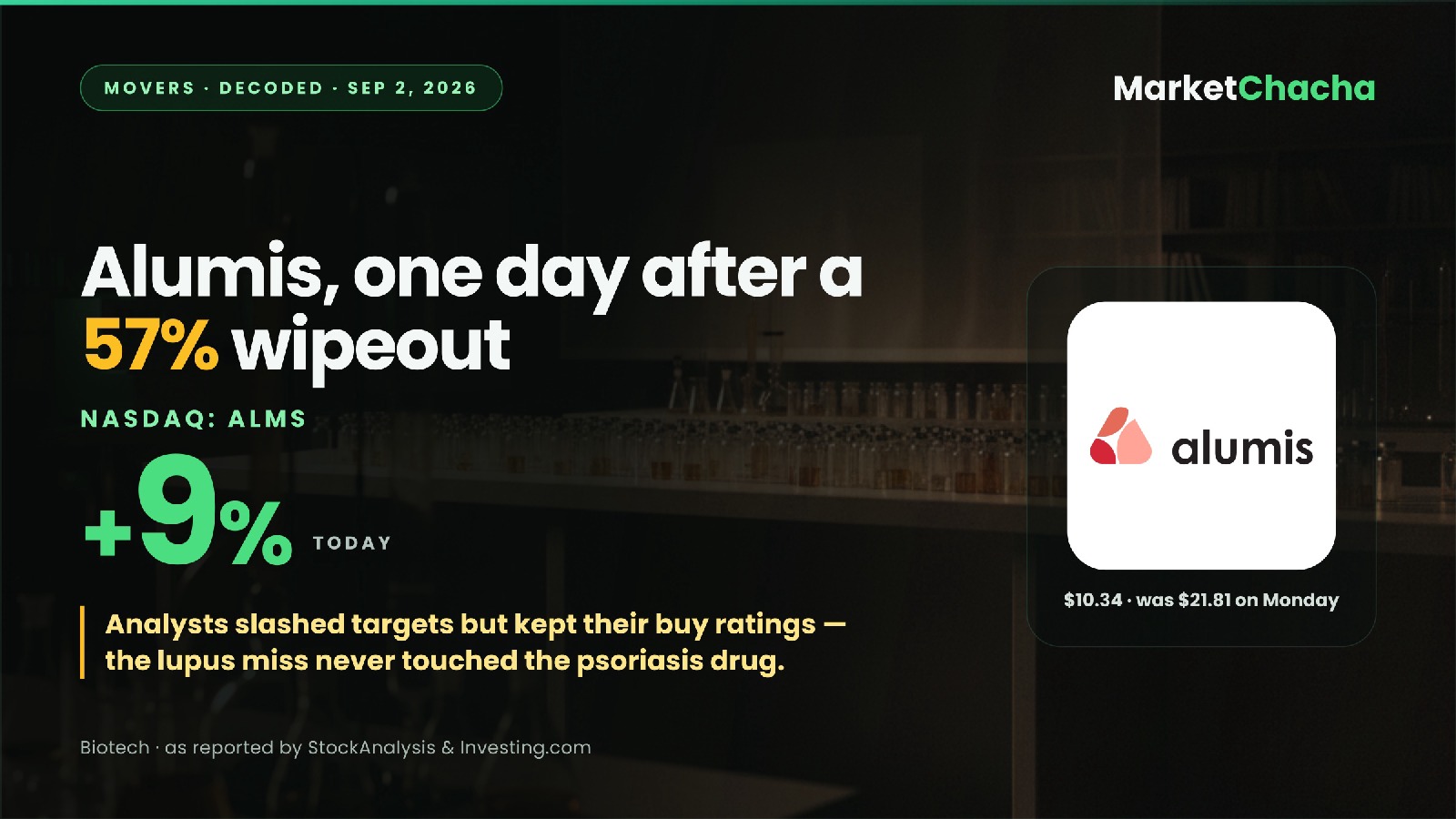
Alumis (NASDAQ: ALMS) is up about 9.2% to $10.34 on roughly 6.25 million shares, as reported by StockAnalysis at 12:39 PM ET. That's the day after it closed down 56.6% at $9.47 on Tuesday — from $21.81 on Monday, per RTTNews. Tuesday's volume was 28.4 million shares. So the market has paid back roughly a sixth of what it took away, and the reason is unusually specific.
What happened Tuesday
At 7:30 AM ET on September 1, Alumis released topline data from LUMUS, a Phase 2b trial of envudeucitinib — an oral TYK2 inhibitor — in moderate-to-severe systemic lupus. The trial enrolled 408 patients across three dose arms plus placebo. It missed its primary endpoint: BICLA response at Week 48. BICLA is a composite score doctors use to judge whether a lupus patient's disease activity actually improved across organ systems, so missing it means the drug didn't beat placebo on the headline measure.
Why it's bouncing today
Three sell-side notes landed today, and they all argue the same thing — the selloff overshot:
- Wells Fargo cut its target from $51 to $25 but kept Overweight. Analyst Derek Archila cut the lupus probability of success from 75% to 35% — and still carries lupus at about $6 a share plus psoriasis at about $13 a share. That's $19 of modelled value against a $10 stock.
- Morgan Stanley cut its target from $39 to $29, also keeping Overweight, and went further: it removed lupus from the model entirely. That indication had been carried at roughly $500 million of risk-adjusted 2040 sales — a 40% probability against $2.5 billion in total.
- HC Wainwright did the opposite of a downgrade: it moved Alumis from Neutral to Buy, while trimming its target from $25 to $15.
Two firms cut their numbers and still said buy. One got more positive because the price fell. That combination is what a 9% bounce looks like.
The part the headline hides: IFNGS
Lupus patients split into two groups — those with a high "interferon gene signature" (IFNGS-high) and those without. Envudeucitinib blocks TYK2, an enzyme that sits inside the interferon signalling pathway, so it should only really work on the IFNGS-high group. In that prespecified subgroup, the drug did deliver, on BICLA and on the secondary measures (CLASI-50, SRI-4, LLDAS). Alumis says IFNGS-high patients are the majority of real-world moderate-to-severe lupus, but were under-represented in LUMUS, diluting the overall result.
That's the company arguing it has a population problem, not a molecule problem. It's also the argument every failed trial makes — which is precisely why the market handed back a sixth of the loss and not the whole thing. Alumis says it will approach regulators about a Phase 3 run only in IFNGS-high patients.
The business
Alumis is clinical-stage with no product revenue, and one molecule carries most of the value:
- Plaque psoriasis — the lead program, and the furthest along. Phase 3 ONWARD1 showed PASI 90 of 68.0% and PASI 100 of 41.0% at Week 24. NDA submission is guided for Q4 2026. This program was not in Tuesday's trial.
- Lupus (SLE) — the one that just missed.
- A-005, a brain-penetrant TYK2 for neuroinflammation; a Phase 2 biomarker trial in Parkinson's is targeted for H1 2027.
- Lonigutamab, on which Alumis booked a $41.8 million impairment inside its $142.2 million Q2 2026 net loss.
Is it expensive?
There is no P/E — Alumis lost $438.96 million over the trailing twelve months, so the ratio doesn't exist. You value it off the balance sheet instead. Market cap is $1.34 billion, cash and short-term investments $502.29 million, total debt $36.4 million, giving an enterprise value of about $872 million. Price-to-book is 2.69 against book value of $3.52 a share (all StockAnalysis). Strip out the cash and the market is paying roughly $870 million for the entire pipeline.
For scale, use the drug it would compete with. Bristol Myers Squibb's Sotyktu — the approved oral TYK2 — did $291 million in worldwide 2025 revenue, up 19% (BMS Q4 2025 release). That's the shape of this market: a useful, growing, few-hundred-million-dollar drug several years post-launch, not a blockbuster. Against that, an $872 million enterprise value is neither a bargain nor obviously silly — it's a wager that the psoriasis NDA lands and the label reads better than Sotyktu's.
Who else this touches
- Bristol Myers Squibb — Sotyktu is the incumbent oral TYK2; an Alumis filing with those PASI numbers is a direct competitive read.
- Johnson & Johnson — Morgan Stanley named Icotyde as the other label envudeucitinib gets measured against.
- Anyone else running TYK2 in lupus — LUMUS is data on the mechanism in that disease, not just on this company. The IFNGS-high signal is a hint about how to enrol the next trial.
The risk that flips it
Roughly $13 of Wells Fargo's $25 sits in psoriasis, so the Q4 2026 NDA is the whole story now. Alumis said its cash funds operations into Q4 2027. A filing delay or a refuse-to-file wouldn't only push out revenue — it would push the company toward raising money against a $10 share price instead of a $22 one, which is a very different amount of dilution. The second risk is regulatory: if the FDA won't accept a subgroup-only pivotal design in IFNGS-high patients, the ~$6 a share Wells Fargo still carries for lupus goes too.
As of 12:39 PM ET, September 2, 2026. Sources: StockAnalysis, Alumis LUMUS topline release, Investing.com (Wells Fargo), Investing.com (Morgan Stanley), Alumis Q2 2026 results, BMS Q4 2025 release, RTTNews. For discussion and education only — not investment advice. Verify before acting.
This article is for educational and informational purposes only. It is not financial advice, investment recommendation, or a solicitation to buy or sell securities. Investing involves significant risks. I am not a SEBI-registered investment advisor. Readers should consult their own financial advisor and conduct their own research before making any investment decisions.
Comments
Join the conversation
Sign in to join the conversation.
Follow replies, add your view, and take part in the discussion.
Sign in to commentLoading comments...