

Mahindra & Mahindra: what their latest filing actually means
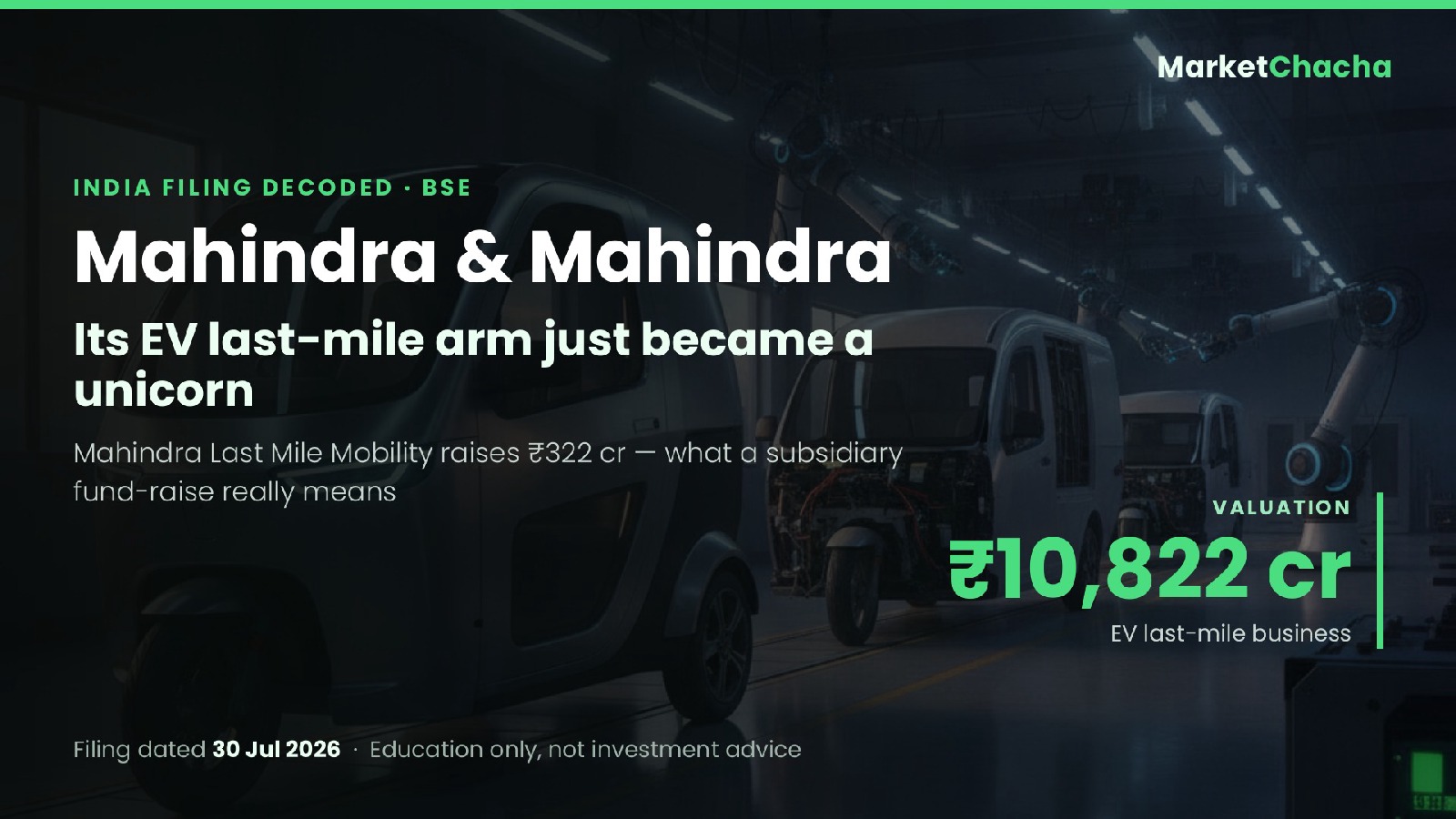
Mahindra & Mahindra (M&M) told the exchanges that its electric last-mile arm, Mahindra Last Mile Mobility Ltd (MLMML), has raised fresh capital — a filing that quietly puts a ₹10,822 crore price tag on M&M's electric three-wheeler business and nudges it toward a stock-market listing.
What was announced
In a disclosure under Regulation 30 dated 30 July 2026, M&M said MLMML raised ₹322 crore in a funding round led by global impact investor Lightrock, with existing backers International Finance Corporation (IFC) and the India-Japan Fund (managed by NIIF) also participating. The round values MLMML at about ₹10,822 crore — crossing the "unicorn" threshold (a private company valued above roughly $1 billion).
- New money raised: about ₹322 crore, going into MLMML (the subsidiary), not into M&M's own accounts.
- Valuation: about ₹10,822 crore for the last-mile EV business.
- Parent stake: M&M's holding in MLMML edges down from 78.11% to 75.79% because new shares were issued to the incoming investors.
- Next step: Management reiterated it aims to list MLMML in the second half of FY27.
What this type of filing means
This is a subsidiary fund-raise disclosure. When a listed parent's unlisted subsidiary sells new shares to outside investors, the parent must tell the exchange because it is price-sensitive information. Two ideas are worth knowing:
- Value unlocking: A separate funding round puts an independent, market-tested price on one slice of a big group. Before this, the EV arm's worth was buried inside M&M; now there is a ₹10,822 crore reference point.
- Dilution at the subsidiary level: Issuing new shares to investors means existing owners (here, the parent M&M) end up holding a slightly smaller percentage — hence 78.11% → 75.79%. The parent did not sell anything; the pie simply got bigger.
Why it matters / potential impact
The raise is small versus M&M's size, so it is not about the ₹322 crore itself. It matters for three reasons: it gives the last-mile EV business growth capital to expand its electric three-wheeler fleet without leaning on the parent; it sets a visible valuation benchmark ahead of a planned IPO, which can help the market appreciate M&M's EV assets that were previously hard to value separately; and it keeps the group on its stated path of building an electric-mobility franchise. The flip side: the money lands in the subsidiary, not the parent, and M&M's stake dips slightly — so the immediate effect on M&M's own reported financials is modest.
Is it expensive?
M&M (the listed parent) trades at a P/E of about 25.6 with a market capitalisation of roughly ₹4.08 lakh crore (as reported by Screener.in / Moneycontrol, 30 July 2026). That is a touch above the broad auto industry average (~21.6) but cheaper than key peers: Maruti Suzuki trades near a P/E of 28 and Tata Motors near 44. For a company that combines India's No.1 tractor business, a strong SUV franchise and stakes in listed group firms, a P/E in the mid-20s reads as fair — neither obviously cheap nor stretched. Note that the ₹10,822 crore figure is the subsidiary's private valuation, not the parent's market value.
The business
Mahindra & Mahindra is a diversified group with three main engines: Automotive (SUVs such as Thar, Scorpio-N and XUV700, plus commercial vehicles), Farm Equipment (the country's largest tractor maker), and a set of group companies across IT, finance and real estate (Tech Mahindra, Mahindra Finance, Mahindra Lifespace). Mahindra Last Mile Mobility is a focused unit that makes electric three-wheelers and small commercial EVs for goods and passenger transport — so this filing affects one high-growth slice of the group, not the whole company.
Beginner takeaway
A big listed company just raised outside money for one of its electric-vehicle units and, in doing so, stamped a ₹10,822 crore value on it. It is a "value-unlocking" step that puts a number on assets that were hidden inside the parent, and it moves that unit closer to its own stock-market listing. It does not put fresh cash into M&M itself and only trims the parent's stake a little.
FAQ
Does this money go to Mahindra & Mahindra? No. The ₹322 crore is raised by the subsidiary, MLMML, and stays on the subsidiary's balance sheet to fund its own growth. The parent's benefit is indirect — a higher, market-tested value on an asset it owns.
What is a "unicorn"? A privately held company valued at over roughly $1 billion. At about ₹10,822 crore (~$1.2 billion), MLMML clears that bar.
Why did M&M's stake fall to 75.79%? New shares were issued to the incoming investors, so the total share count grew. M&M did not sell any of its holding — it simply owns a slightly smaller slice of a now-bigger company.
Is the IPO confirmed? Management has said it intends to list MLMML in the second half of FY27, but IPO plans and timelines can change and depend on approvals and market conditions.
As of 31 July 2026. Filing dated 30 July 2026. Source: official BSE filing — read it directly here. We summarise filings for education and may make errors, so always verify against the official document. Educational content only — not investment advice, not a buy/sell recommendation.
This article is for educational and informational purposes only. It is not financial advice, investment recommendation, or a solicitation to buy or sell securities. Investing involves significant risks. I am not a SEBI-registered investment advisor. Readers should consult their own financial advisor and conduct their own research before making any investment decisions.
Comments
Join the conversation
Sign in to join the conversation.
Follow replies, add your view, and take part in the discussion.
Sign in to commentLoading comments...