

AI Data Center Supply Chain Explained: The 8 Layers and the US Companies Powering the AI Boom (2026)
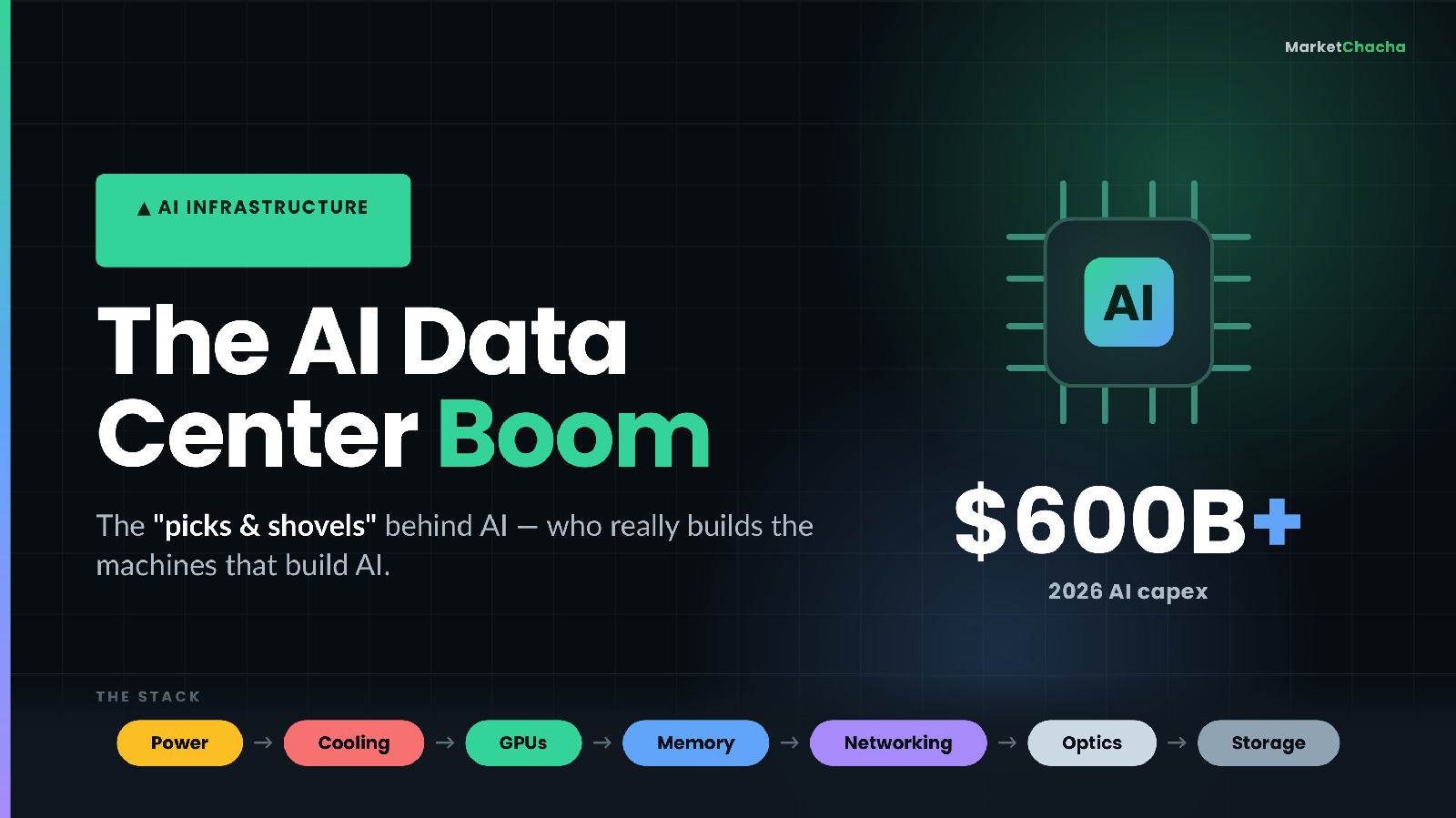
The AI data center supply chain is the full stack of companies that build the physical "AI factories" behind every chatbot, model and inference call — from the chips that compute, to the cables that connect them, to the power and cooling that keep them alive. Investors often call these the "picks and shovels" of artificial intelligence: instead of betting on which AI app wins, you study the suppliers who get paid no matter which app wins. This guide maps the chain layer by layer, names the major US-listed companies in each layer with verified specifications, and explains how a beginner can think about the theme — strictly as education, not a buy or sell recommendation.
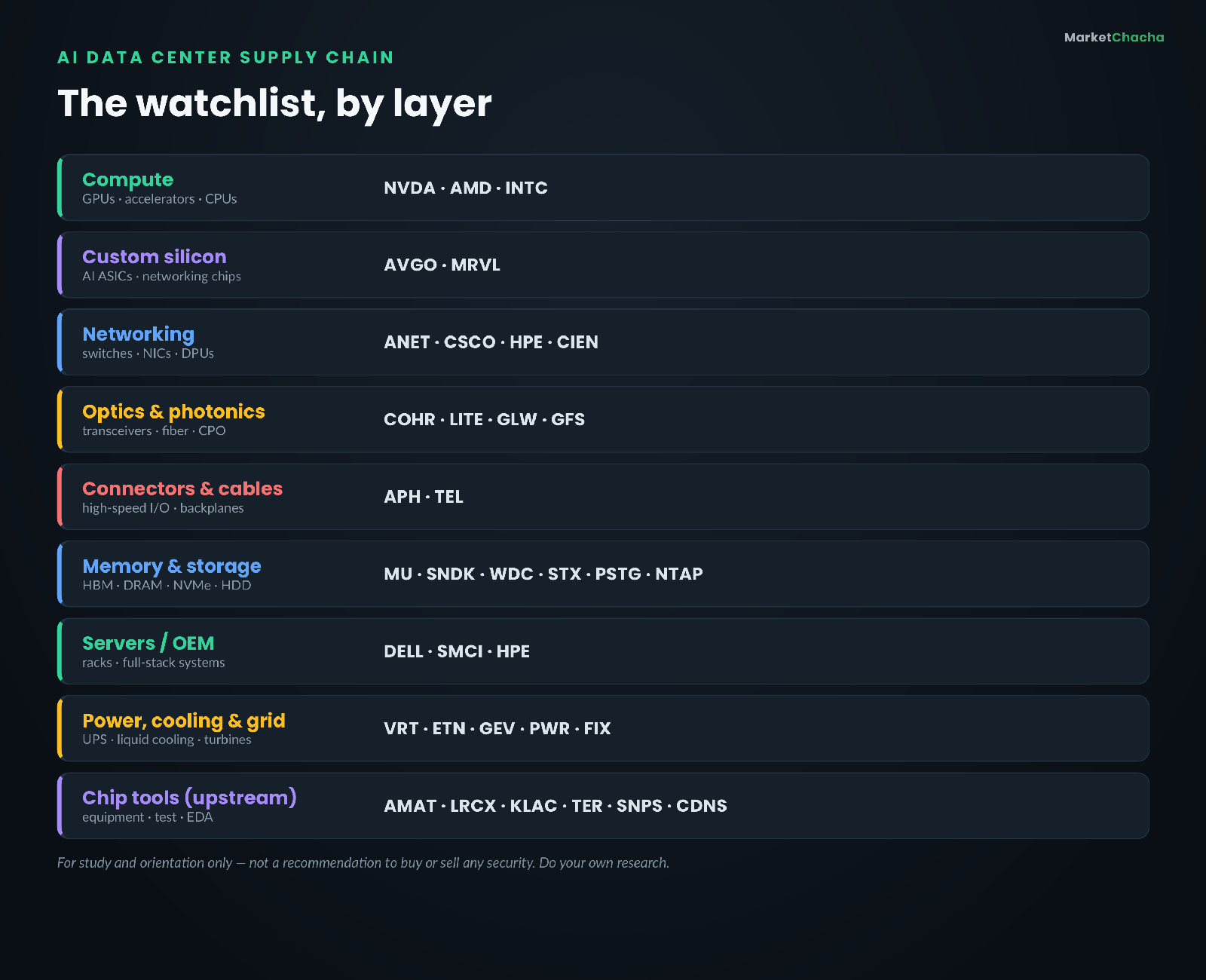
We will walk through eight layers: compute, networking, optics and photonics, connectors and cables, memory and storage, servers, power and cooling, and the upstream equipment that makes all the chips possible.
Why the AI data center theme matters right now
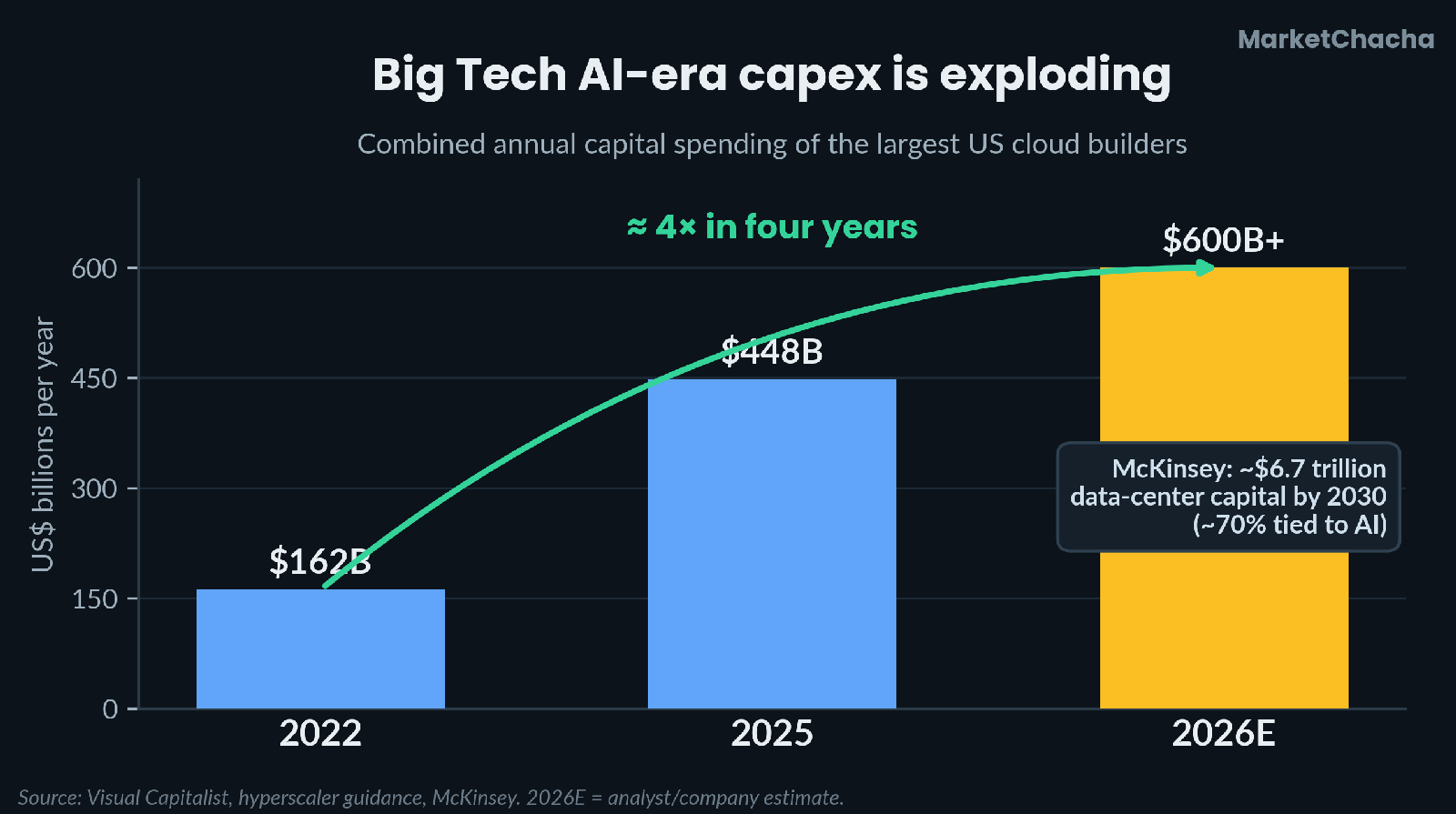
The reason this supply chain gets so much investor attention is the sheer scale of money flowing into it. Big Tech's AI-era capital spending (capex) nearly tripled from about $162 billion in 2022 to roughly $448 billion in 2025, and for 2026 the largest US cloud builders are widely guided to spend in the region of $600 billion or more on AI infrastructure. Looking further out, McKinsey has estimated that the global data center build-out could require around $6.7 trillion of capital by 2030, with roughly 70% tied to AI workloads. The AI data center market itself is projected to grow from about $147 billion in 2025 to over $800 billion by 2033.
For a supplier, that spending is revenue. That is why understanding which company sits in which layer — and how essential that layer is — is the heart of analysing this theme.
Layer 1 — Compute: GPUs, accelerators and CPUs
Compute is the engine room. GPUs and AI accelerators do the heavy parallel maths of training and running models. NVIDIA (NVDA) is the dominant force here; its rack-scale GB200 NVL72 system links 36 Grace CPUs and 72 Blackwell GPUs into a single liquid-cooled unit delivering about 1.44 exaflops of FP4 compute and 13.4 TB of unified GPU memory, drawing up to ~120 kW per rack. AMD (AMD) competes with its Instinct line — the MI355X packs 288 GB of HBM3E memory and 8 TB/s of bandwidth on the CDNA 4 architecture.
Not everything is a GPU. CPUs still orchestrate the system, move data and run general workloads: Intel (INTC) supplies Xeon server processors, and AMD's EPYC CPUs often sit alongside its accelerators. A fast-growing slice is custom AI silicon (ASICs/XPUs) designed for specific cloud customers — Broadcom (AVGO) and Marvell (MRVL) are central here, building bespoke accelerators plus the networking and interconnect chips that tie clusters together.
Layer 2 — Networking: switches, NICs and DPUs
A modern AI cluster is thousands of GPUs that must talk to each other at enormous speed; if the network is slow, expensive GPUs sit idle. This is why networking has become a marquee AI layer. Broadcom (AVGO)'s Tomahawk 5 switch chip delivers 51.2 Tbps of throughput, supporting configurations like 64 ports of 800GbE or 128 of 400GbE. Arista Networks (ANET) builds the systems around such silicon — its 7800R4 AI spine scales to 460 Tbps and up to 576 ports of 800GbE in a single chassis that behaves like one giant lossless switch.
NVIDIA (NVDA) also sells networking — Spectrum-X Ethernet, Quantum InfiniBand, ConnectX SuperNICs and BlueField DPUs — purpose-built for AI fabrics. Cisco (CSCO) contributes its Silicon One chips, routers and Acacia optics; HPE (HPE) brings Juniper and Aruba networking for enterprise AI; and Ciena (CIEN) focuses on the coherent optical links that connect one data center to another.
Layer 3 — Optics and photonics
This is one of the most interesting layers, because as data rates climb to 800G, 1.6T and beyond, copper struggles over distance and light takes over. Coherent (COHR) and Lumentum (LITE) make the optical transceivers and lasers — the modules that convert electrical signals to light and back. Corning (GLW) supplies the fiber and high-density cabling; its optical communications revenue grew about 71% year-on-year on AI demand, and it signed a multi-year deal reported around $6 billion to be a primary fabric supplier for a hyperscaler's next-generation clusters.
Further upstream, GlobalFoundries (GFS) offers silicon-photonics manufacturing for the coming shift to co-packaged optics (CPO), where the optics sit right next to the chip. Marvell (MRVL) is expanding into optical interconnect fabric for AI compute and memory. Several private companies (such as Ayar Labs and Lightmatter) are pushing optical I/O that could connect thousands of GPUs — worth knowing about even though they are not publicly traded.
Layer 4 — Connectors, cables, memory and storage
Inside and between racks, signals travel over high-speed copper and connectors. Amphenol (APH) and TE Connectivity (TEL) supply the high-speed I/O cables, backplane connectors, power connections and even liquid-cooling interfaces that hold an AI system together — unglamorous parts that every rack needs in volume.
Then there is memory and storage, the layer that keeps GPUs fed with data. Micron (MU) makes high-bandwidth memory (HBM3E), server DRAM, and data-center SSDs; its 9650 NVMe drive is a PCIe Gen6 SSD hitting around 28 GB/s sequential reads, designed to stop GPUs from starving for data. SanDisk (SNDK) supplies enterprise NVMe SSDs, while Western Digital (WDC) and Seagate (STX) provide high-capacity hard drives for the vast "warm" and "cold" datasets, logs and backups AI generates. Pure Storage (PSTG) and NetApp (NTAP) sell the flash arrays and AI data platforms that manage all of it.
Layer 5 — Servers and OEM systems
Someone has to assemble chips, memory, networking and cooling into finished, deployable machines. Dell (DELL) and Supermicro (SMCI) are the high-profile AI server builders — Supermicro ships HGX B200/B300 systems and GB200 NVL72 rack-scale clusters, while Dell packages full "AI factory" stacks with compute, storage and networking. HPE (HPE) brings Cray-derived AI supercomputers and full-stack services. Manufacturing specialists like Jabil (JBL) and Flex (FLEX) handle enclosures, assembly and supply-chain work behind the scenes.
Layer 6 — Power, cooling and the grid (the hidden bottleneck)
Many investors fixate on GPUs and forget that an AI rack can draw more than 100 kW — and the binding constraint is increasingly electricity and heat, not chips. Vertiv (VRT) co-developed a complete 7 MW power-and-cooling reference design with NVIDIA for GB200 NVL72 clusters, supporting up to ~132 kW per rack, and is advancing 800 VDC power architectures for the next generation. Eaton (ETN) supplies switchgear, UPS systems and power distribution; GE Vernova (GEV) provides the gas turbines and grid equipment that bring power to the site; Quanta Services (PWR) builds the transmission and grid connections; and Comfort Systems USA (FIX) handles mechanical, electrical and cooling construction, including liquid and immersion cooling. As racks move toward megawatt-class power, this layer is becoming as critical as the silicon.
Layer 7 — Upstream: chip equipment and design tools
None of the chips above exist without the tools that make them. Applied Materials (AMAT), Lam Research (LRCX) and KLA (KLAC) build the wafer-processing, etch/deposition and inspection machines used to manufacture every advanced chip, while Teradyne (TER) supplies the test equipment. On the design side, Synopsys (SNPS) and Cadence (CDNS) make the EDA software engineers use to design AI chips, networking ASICs and photonics. These companies sit far from the data center floor, yet they are foundational to the entire chain.
How a beginner should think about this theme
A few principles help turn this map into sensible study rather than hype-chasing. First, the chain is only as fast as its slowest layer — power, cooling, optics, memory or networking can each become the bottleneck, so no single company "is" the AI trade. Second, most of these firms are cyclical: their revenue rides on hyperscaler capex budgets, which can be cut as quickly as they were raised, so the same spending that drives the boom is also the key risk. Third, valuation matters — a great business bought at an extreme price can still be a poor investment, and many AI suppliers trade at rich multiples. Fourth, diversification within the theme (across layers) behaves very differently from owning one name. The right use of a map like this is to understand the business model and risks of each layer, then do your own deeper research — not to treat any ticker here as a recommendation.
Common mistakes beginners make with AI infrastructure stocks
The first mistake is assuming the supply chain is "just NVIDIA". The compute layer is the most visible, but the networking, optics, memory, power and cooling layers all capture meaningful spend and have their own competitive dynamics. The second is ignoring customer concentration: several suppliers depend heavily on a handful of hyperscaler buyers, so one customer's pause can swing results. The third is confusing a strong product with a strong stock — the market often prices in years of growth already, so good news can still disappoint. The fourth is forgetting cyclicality and lead times: orders, inventory and capex plans move in waves. And the fifth is treating private innovators (in CPO or optical I/O, for example) as if you can buy them — many cannot be owned directly today.
FAQ
What is the AI data center supply chain in simple terms? It is the full set of companies that supply the parts and systems needed to build AI data centers — chips, networking, optics, memory, storage, servers, and power and cooling. Investors study it to understand who benefits from AI spending regardless of which AI app succeeds.
What are "picks and shovels" AI stocks? The phrase refers to companies that sell the tools and infrastructure for the AI boom rather than the AI products themselves — much like selling shovels during a gold rush. It is an analogy for studying suppliers, not a recommendation to buy any of them.
Which layers of the AI supply chain are most often overlooked? Power and cooling, optics and photonics, and high-speed connectors and memory are frequently underappreciated even though an AI cluster cannot run without them. Compute (GPUs) gets the most headlines.
Why is power and cooling such a big deal for AI data centers? Modern AI racks can draw over 100 kW and generate intense heat, so electricity supply and advanced (often liquid) cooling have become major constraints — sometimes more limiting than chip availability itself.
Are AI infrastructure stocks risky? They carry real risks, including dependence on hyperscaler capex budgets, customer concentration, cyclicality and often high valuations. This article is educational and does not assess whether any specific stock is a good investment for you.
How can I research these companies myself? Read each company's investor presentations and annual reports, note which AI layer it serves and how concentrated its customers are, compare it with peers in the same layer, and consider how sensitive its revenue is to data-center capex cycles.
Educational content only — not investment advice, not a buy/sell recommendation, and not a list of stocks to purchase. No guaranteed returns. Company names and tickers are mentioned to illustrate the supply chain, not to endorse them. Figures verified as of June 2026; specifications and deals can change. Sources: Visual Capitalist, McKinsey, Reuters/CNBC, NVIDIA, AMD, Broadcom, Arista, Micron, Vertiv, Corning. Always do your own research.
This article is for educational and informational purposes only. It is not financial advice, investment recommendation, or a solicitation to buy or sell securities. Investing involves significant risks. I am not a SEBI-registered investment advisor. Readers should consult their own financial advisor and conduct their own research before making any investment decisions.
Comments
Join the conversation
Sign in to join the conversation.
Follow replies, add your view, and take part in the discussion.
Sign in to commentLoading comments...