

Why did Dyne Therapeutics (DYN) crash ~23% on a drug it doesn't own?
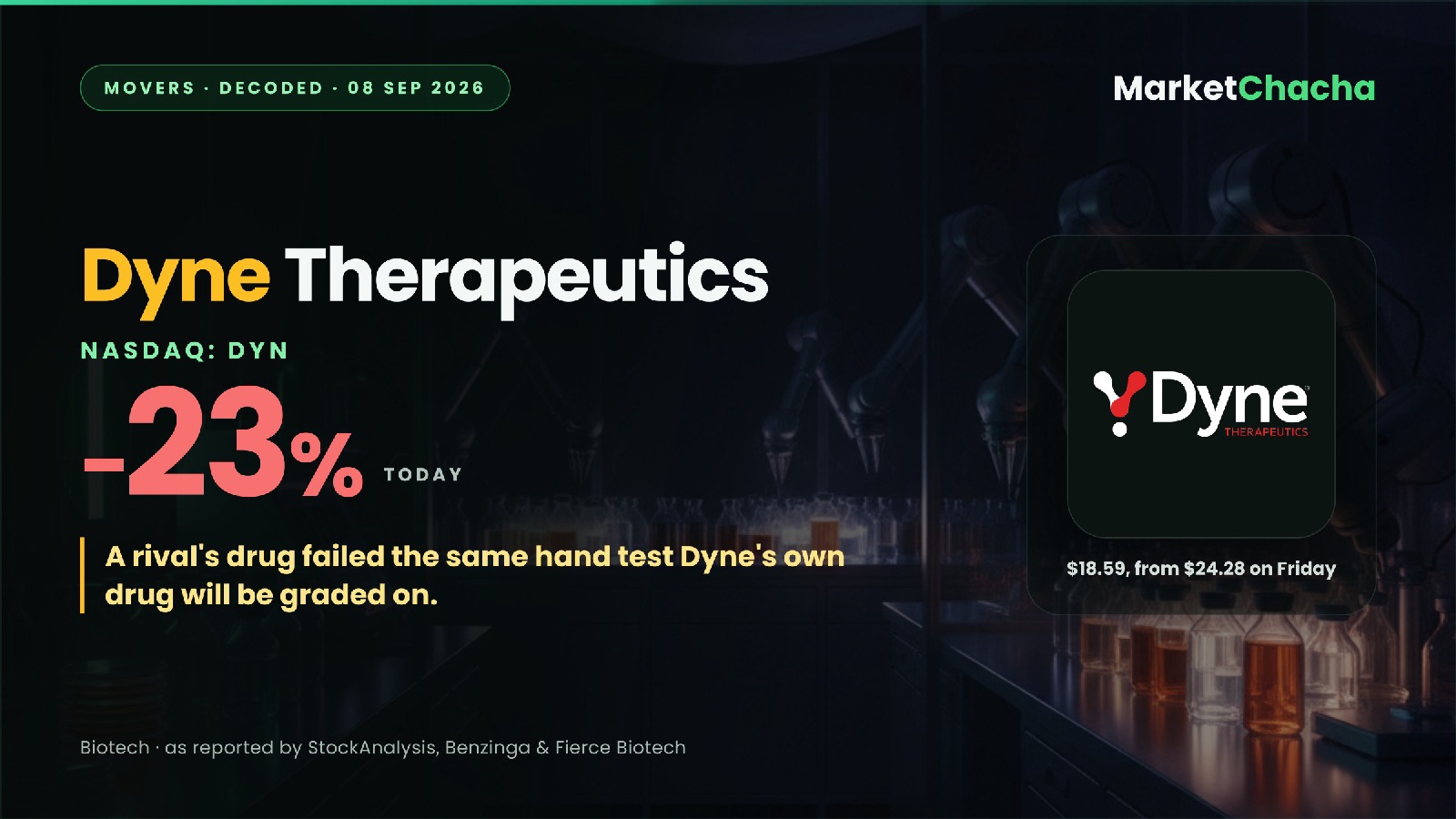
Dyne Therapeutics (NASDAQ: DYN) was down about 23.4% at $18.59 on Tuesday, per StockAnalysis — a $3.47bn company that shed roughly a fifth of its value before lunch. In premarket it was worse: −35.5% at $15.64, against Friday's $24.28 close, per Benzinga.
Here's the odd part. Dyne didn't report anything. No trial, no filing, no guidance. The drug that failed belongs to somebody else.
What happened
Before the open, Novartis said its Phase III HARBOR study of del-desiran missed its primary endpoint. The trial ran 159 patients with myotonic dystrophy type 1 (DM1), giving seven infusions every eight weeks, and the drug did not beat placebo on the measure that mattered, as reported by Fierce Biotech. Novartis said it saw "evidence of clinical activity" in secondary and exploratory analyses and will talk to regulators about next steps.
That drug wasn't cheap. Novartis bought Avidity Biosciences for $12bn — announced October 2025, closed February 2026 — and del-desiran was the centrepiece, per BioSpace. Novartis itself fell about 12.5% premarket to $139.98 from Friday's $159.99, per Fierce Biotech.
Why Dyne got hit
DM1 is caused by a faulty gene that churns out toxic RNA which gums up muscle. Both Novartis and Dyne go after that same toxic RNA. They differ in the delivery truck — how the drug gets inside muscle cells — not in the target.
And here's the thing that actually moved the stock: the yardstick. HARBOR was graded on video hand opening time (vHOT) — literally, how fast a patient can un-clench a fist after squeezing. Dyne's DM1 drug, z-basivarsen, is heading for the same kind of test. So the market didn't just read "a competitor failed." It read "the ruler regulators are using may not budge, even when the drug is doing something to the biology." That's a much scarier sentence if you own Dyne.
Analysts split on it. Stifel kept its rating, but flagged that efficacy between the two drugs may land in a similar place — and Dyne's pivotal cohort is 71 patients, smaller than HARBOR's 159, which makes it harder to prove a difference. Stifel's counter-argument: Dyne's Phase 1/2 vHOT and splicing data were better. Jefferies went further, calling Dyne's construct best-in-class on tissue penetration, per Investing.com.
The business — what today did NOT touch
- z-rostudirsen (Duchenne, DMD) — BLA accepted with Priority Review, FDA decision due 21 January 2027. This is Dyne's nearest shot at actual revenue, and it has nothing to do with DM1 or today's failure.
- z-basivarsen (DM1) — 71 patients enrolled June 2026, topline Q1 2027, filing targeted Q3 2027. This is the piece today's news casts doubt on.
So roughly half the story got hit, and the half with the nearer catalyst didn't.
Is it expensive?
There's no P/E here — Dyne sells nothing and lost $178.6m in Q2 alone ($1.08 a share, wider than the $0.75 loss consensus expected). The honest metric is what you're paying above the bank balance. Against $898.5m of cash and securities at 30 June, a $3.47bn market cap means roughly $2.6bn is pure bet on two drugs that aren't approved yet. Management says that cash funds operations into Q2 2028.
Compare that with Sarepta (SRPT), the obvious listed neighbour: $2.14bn market cap on $1.97bn of trailing revenue, per StockAnalysis — drugs already on shelves, roughly 1x sales, and still lossmaking. Investors are paying more for Dyne's pipeline than for Sarepta's entire commercial business. That can be rational for a company with a January approval date. It is not cheap.
Who else got dragged
- Sarepta (SRPT), −9.8% to $20.29 — it has its own DM1 candidate, SRP-1003, using a different delivery route (αvβ6-integrin, versus Novartis's TfR1), per Investing.com. Same disease, same endpoint problem.
- Novartis — this was its second pipeline miss of the week. The other, pelacarsen in Lp(a), is a separate cholesterol trial with separate read-throughs; it's what dragged Ionis and Amgen, not Dyne.
The one thing that flips it
Dyne's Q1 2027 topline. If z-basivarsen moves vHOT where del-desiran didn't, today's selloff was the market punishing the wrong company. If it also misses, the accelerated-approval path in DM1 narrows sharply and the valuation above rests almost entirely on the January DMD decision. Between now and then, that 21 January 2027 date is the real event.
As of 11:40 am ET, 8 September 2026. Sources: Novartis media release, Fierce Biotech, BioSpace, StockAnalysis, Benzinga, Dyne Q2 2026 results, Investing.com. For discussion and education only — not investment advice. Verify before acting.
This article is for educational and informational purposes only. It is not financial advice, investment recommendation, or a solicitation to buy or sell securities. Investing involves significant risks. I am not a SEBI-registered investment advisor. Readers should consult their own financial advisor and conduct their own research before making any investment decisions.
Comments
Join the conversation
Sign in to join the conversation.
Follow replies, add your view, and take part in the discussion.
Sign in to commentLoading comments...