

JSW Steel: what their latest filing actually means
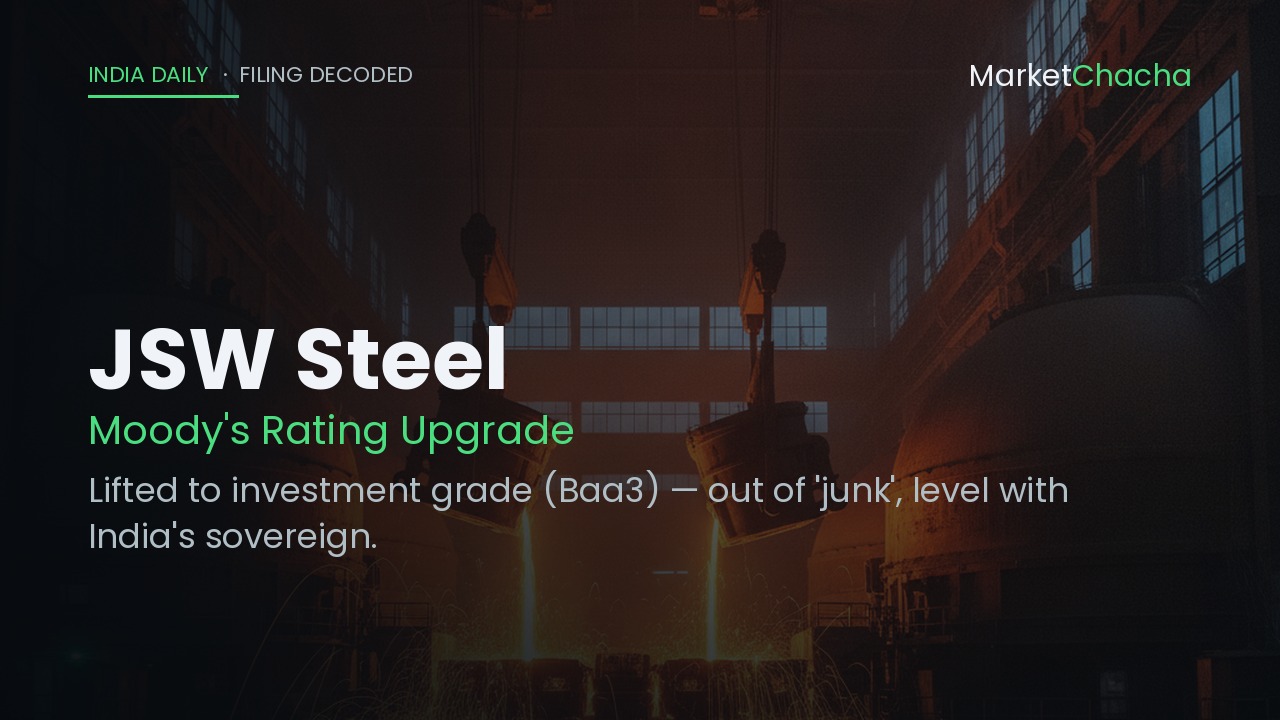
JSW Steel, India's largest steelmaker, told the exchanges that Moody's has upgraded its credit rating to "investment grade" — assigning a Baa3 issuer rating with a stable outlook. In plain terms, JSW Steel has just crossed out of "junk" territory and now sits at the same rating level as the Indian government itself.
What was announced
On 27th July 2026, Moody's Ratings upgraded JSW Steel from Ba1 (with a positive outlook) to Baa3 (stable outlook). The upgrade applied across the board — the corporate family rating, senior unsecured rating, and its US-dollar bonds (including bonds routed through Jefferson County Port Authority and guaranteed by JSW Steel). Baa3 is the lowest rung of "investment grade"; Ba1, its old rating, is the highest rung of "speculative grade." So this move crosses the single most important line on the entire ratings ladder. JSW Steel is now rated at the same level as India's sovereign rating.
What a credit rating filing means
A credit rating is an outside agency's opinion (Moody's, S&P, Fitch are the big three) of how likely a company is to repay its debt. It has nothing to do with the share price directly — it's about the bonds and loans. The ladder splits into two halves:
- Investment grade (Baa3 and above): considered safe enough for conservative lenders — pension funds, insurers, and many global bond funds that are only allowed to hold investment-grade paper.
- Speculative / "junk" grade (Ba1 and below): higher risk, so borrowers pay higher interest.
Crossing from Ba1 to Baa3 is therefore a bigger deal than a one-notch move sounds — it unlocks a whole new pool of lenders. One more concept: the "sovereign ceiling" — a company usually can't be rated above its own country. JSW Steel reaching India's sovereign level means it's now bumping right up against that ceiling.
Why it matters
An investment-grade tag typically means cheaper borrowing (lower interest on future bonds and loans), easier refinancing, and access to a wider global investor base. Moody's cited JSW's deleveraging — a stronger balance sheet driven by recovering profits (EBITDA), cost efficiencies, and debt reduction helped by cash from selling assets into the JSW JFE Kalinga joint venture (roughly ₹294 billion received in March 2026 and ₹79 billion in June 2026). Note what this filing is not: it's not a quarterly profit number and not a new order — it's a verdict on the company's financial strength and debt safety.
Is it expensive?
JSW Steel's market capitalisation is roughly ₹3.04 lakh crore (about $30 billion), making it India's most valuable steelmaker. On valuation, a warning: P/E is a poor tool for steel. Steel is deeply cyclical, so when profits are near a cyclical low the trailing P/E looks very high (around 50×) — not because the stock is "expensive" in the usual sense, but because the denominator (earnings) is temporarily depressed. Analysts lean on EV/EBITDA instead. For a peer frame, Tata Steel trades at a more modest P/E (mid-teens to low-20s depending on the source) with a smaller market cap. The honest read: steel valuations swing with the commodity cycle, so treat any single P/E with caution — this is context, not a buy/sell call.
The business
JSW Steel is an integrated steel producer — it makes both flat products (used in cars, appliances, construction) and long products, from large plants at Vijayanagar, Dolvi and Bhushan Power & Steel, plus overseas operations in the US and Italy. Because a credit-rating upgrade is about the whole company's balance sheet, it affects the entire group's cost of debt, not just one plant or product line.
Beginner takeaway
A rating upgrade is like a company's "credit score" improving. JSW Steel just moved from "risky borrower" to "safe borrower" in the eyes of Moody's, which should make its future borrowing cheaper. It reflects a healthier, less-indebted balance sheet — a quality signal, even though it says nothing directly about next quarter's profit or the share price.
FAQ
Does an upgrade mean the stock will go up? Not necessarily. A rating is about debt safety, not share value. It can help sentiment and lower borrowing costs, but it isn't a price prediction.
What's the difference between Ba1 and Baa3 — they look similar? They're one notch apart, but they sit on opposite sides of the crucial "investment grade" line. Baa3 is the bottom of investment grade; Ba1 is the top of junk. Crossing that line matters more than the small gap suggests.
Why did the rating improve? Mainly deleveraging — JSW cut debt using cash from selling assets into a joint venture, and profits and cost efficiency improved, making its balance sheet safer.
As of 28 July 2026 (filing dated 27 July 2026). Source: official BSE filing — read it directly here. We summarise filings for education and may make errors, so always verify against the official document. Educational content only — not investment advice, not a buy/sell recommendation.
This article is for educational and informational purposes only. It is not financial advice, investment recommendation, or a solicitation to buy or sell securities. Investing involves significant risks. I am not a SEBI-registered investment advisor. Readers should consult their own financial advisor and conduct their own research before making any investment decisions.
Comments
Join the conversation
Sign in to join the conversation.
Follow replies, add your view, and take part in the discussion.
Sign in to commentLoading comments...