

Campbell's cut its dividend 36% and fell ~9% — the reason is a number called 4.3x
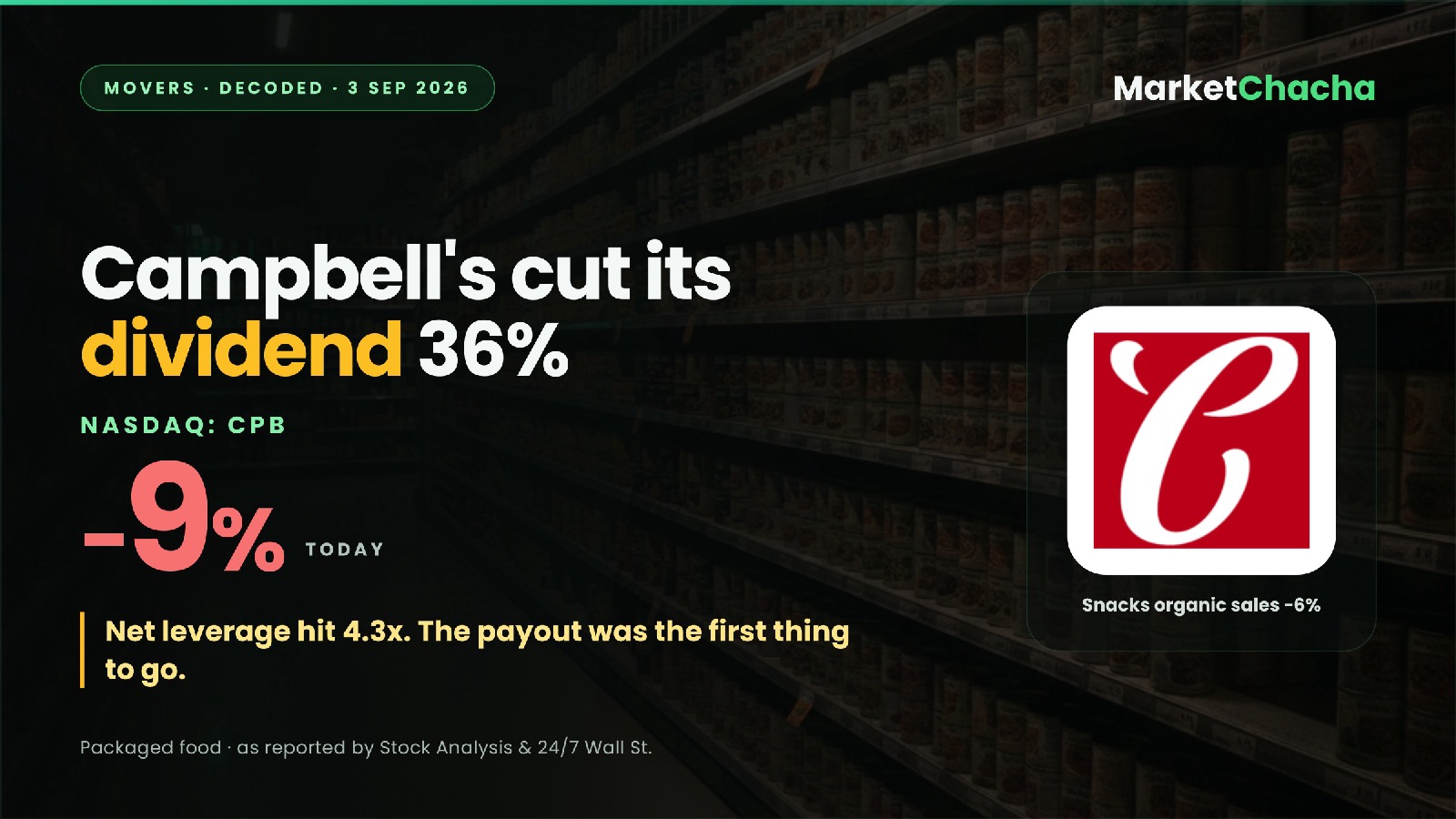
Campbell's is down about 9% to around $21.53, as reported by 24/7 Wall St., after the company reported Q4 FY26 results and cut its quarterly dividend from $0.39 to $0.25 a share — a 36% reduction. That takes the annual payout from $1.56 to $1.00, payable 2 November.
Here's the part the headline hides: this wasn't a cut because the company stopped making money. It's a debt decision.
Why it actually moved
Campbell's net leverage — debt measured against annual profit — finished the year at 4.3x, up from 3.6x a year earlier, per the company's Q4 slides via Investing.com. Management wants that back near 3x. Cutting the dividend frees roughly $170 million a year in cash, and that money is earmarked for paying down debt.
So the payout didn't fall because the soup didn't sell. It fell because leverage climbed while earnings shrank, and the dividend was the biggest discretionary cheque on the books. When leverage rises, a company either grows profit into it or stops sending cash out the door. Campbell's picked the second.
The earnings gave it no choice. Q4 net sales were $2.137 billion, down 8%; adjusted EPS fell 37% to $0.39; gross margin dropped 310 basis points to 27.3%. On a GAAP basis the quarter was a $(0.23) per-share loss.
The business — and which half broke
Campbell's is two companies in one wrapper, and only one of them is struggling:
- Meals & Beverages — soup, sauces, Rao's, Prego, V8. FY26 sales $5.928bn (−4%), operating earnings $943m (−14%). Q4 organic sales actually grew 3%.
- Snacks — Goldfish, Kettle Brand, Cape Cod, Snyder's. FY26 sales $3.816bn (−6%), operating earnings $386m (−28%). Q4 organic sales fell 6%, with dollar consumption down 5.1%.
Soup is fine. Salty snacks are the hole. And the company said so with its accounting: it took a $117 million impairment writing down the value of the Cape Cod and Kettle Brand trademarks — the exact brands whose sales are falling. An impairment is a company admitting on paper that something it bought is worth less than it paid. That's a harder signal than any guidance number.
Is it expensive?
At $21.67 the market cap is about $6.46bn on a trailing P/E of 11.7, per Stock Analysis. That reads cheap for a household-name food company. Look one line down and it isn't: the forward P/E is 13.0, higher than trailing. A forward multiple above the trailing one means the market expects earnings to fall, not rise — and management's own FY27 guidance says adjusted EPS drops 17% to 24%, to $1.65–$1.80. You aren't buying 11.7x. You're buying roughly 12–13x an "E" that's guided to shrink.
Against the obvious alternative, General Mills at $38.97 trades on a forward P/E of 13.2 with a $20.8bn market cap, per Stock Analysis. Campbell's is smaller, more levered and cheaper on trailing numbers — but on forward earnings the two are priced almost identically. The "discount" mostly disappears once you use next year's numbers.
The same trap sits in the yield. Screens still show roughly 7.2%, but that's calculated on the $1.56 dividend that no longer exists. On the new $1.00 rate at today's price it's about 4.6%. Anyone who bought the 7% headline yield this morning owned a number that had already been deleted.
Who else it touches
- General Mills (GIS) fell about 4% to $38.88 and Kraft Heinz (KHC) about 3% to $25.43 — read-across, not their own news. Campbell's named inflation, salty-snack weakness and a multi-year cost reset, and investors repriced whoever else carries that exposure.
- Dividend and income ETFs that screen on yield: a 36% cut can push a name out of index rules that require a maintained or growing payout, which forces mechanical selling separate from any view on the business.
- Private-label suppliers and store brands are the other side of this trade. Every share point that leaves a branded snack bag on price is a point someone's store brand picked up.
What to watch
Campbell's announced a $500 million cost-savings program running to FY2030, with over $100 million targeted in FY27 — though $50 million of that first slice comes from resetting incentive plans, which is a one-time reset of what the company pays its own people, not a durable operating improvement. Watch whether snacks organic sales stop falling; the cost program can protect margin, but it can't sell a bag of chips.
The real risk in the other direction: FY27 guidance already calls for organic sales down 2% to 4% and adjusted EBIT down 7% to 12%. A second straight year of decline is the plan, not the bear case. Because leverage is a ratio, falling profit can push it higher even while Campbell's pays debt down with the freed-up dividend cash — which is how a company ends up cutting a payout and still not fixing the number it cut the payout for.
As of 3:17 pm ET, 3 September 2026. Sources: Campbell's Q4 FY26 results release (StockTitan), Investing.com (Q4 FY26 slides), 24/7 Wall St., Stock Analysis (CPB), Yahoo Finance. Prices and multiples as reported by those sources, not live quotes. For discussion and education only — not investment advice. Verify before acting.
This article is for educational and informational purposes only. It is not financial advice, investment recommendation, or a solicitation to buy or sell securities. Investing involves significant risks. I am not a SEBI-registered investment advisor. Readers should consult their own financial advisor and conduct their own research before making any investment decisions.
Comments
Join the conversation
Sign in to join the conversation.
Follow replies, add your view, and take part in the discussion.
Sign in to commentLoading comments...