

Hero MotoCorp: what their latest filing actually means
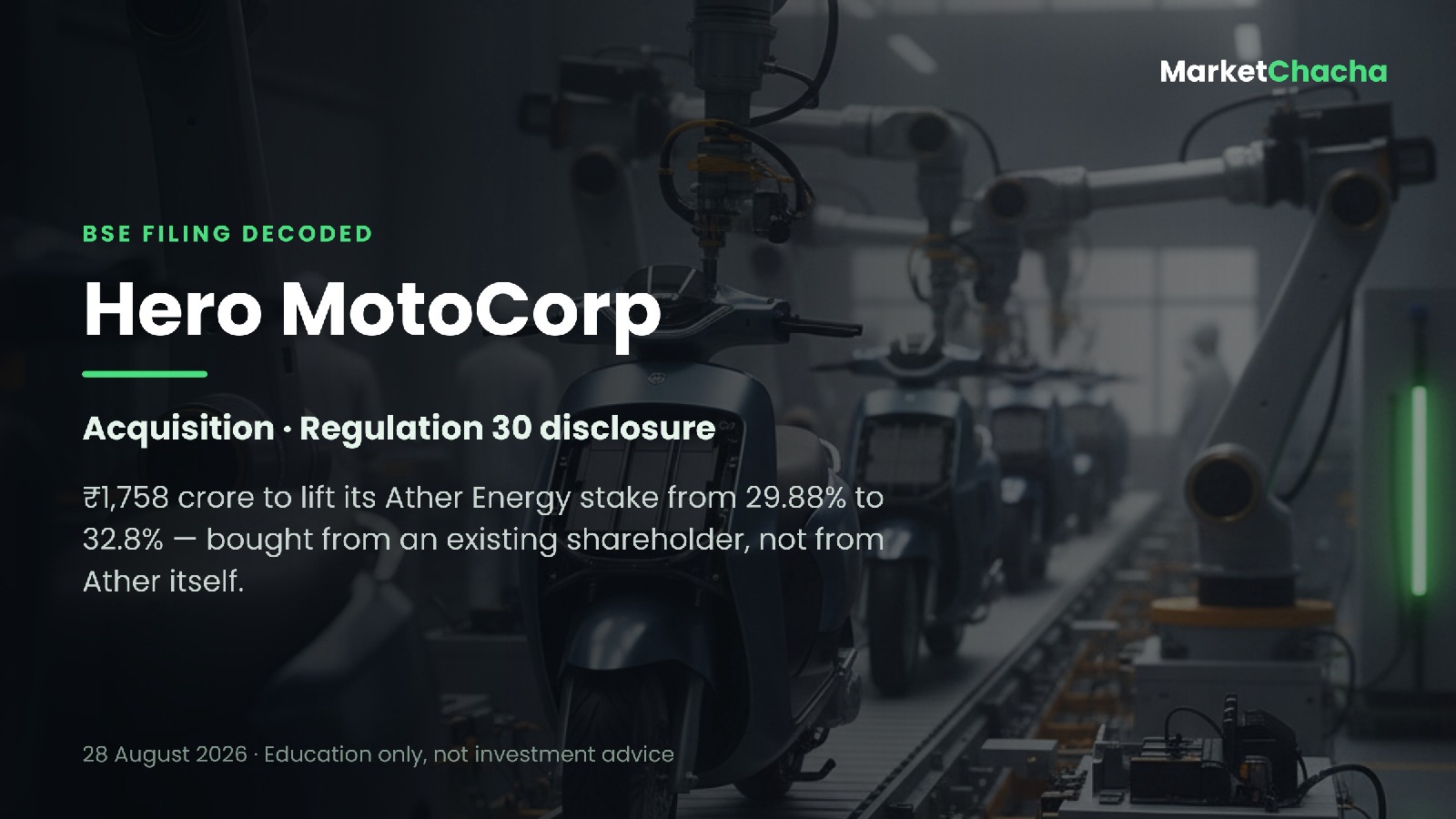
Hero MotoCorp told the exchanges on the evening of 27 August 2026 that its board has approved buying more shares in electric-scooter maker Ather Energy — a cash purchase of up to ₹1,758 crore (about $184 million) that lifts Hero's holding from 29.88% to up to 32.8%. This is a Regulation 30 "acquisition" disclosure, and it is a different deal from the ₹960 crore convertible-warrant subscription Hero completed on 25 August.
What was announced
- What Hero is buying: additional equity shares of Ather Energy Limited, purchased from an existing Ather shareholder — not newly issued shares from Ather.
- Size: up to ₹1,758 crore in cash (≈ $184.01 million).
- Stake: from 29.88% (fully diluted, as of 25 August 2026) to up to 32.8%.
- Timeline: the company said completion is expected by 3 September 2026.
- Approvals: the filing states no regulatory approvals are required.
- Seller: not named in the disclosure.
The market reaction landed on Ather, not Hero. On 28 August, Ather Energy was up 4.83% at ₹1,567.50 in early trade and was quoted around ₹1,603 by early afternoon; Hero MotoCorp rose a comparatively modest 1.05% to ₹5,608.50, trading near ₹5,616 mid-session.
What this type of filing means
Under Regulation 30 of SEBI's Listing Regulations, a listed company must tell the exchanges about events a reasonable investor would consider price-sensitive. An acquisition of shares in another company is on that list, which is why a deal like this appears as a formal BSE/NSE filing rather than only as a press release.
Two distinctions are worth learning from this one filing, because beginners mix them up constantly:
- Secondary purchase vs. primary investment. Here Hero is buying shares from another shareholder. The ₹1,758 crore goes to that seller — not a single rupee reaches Ather's bank account. Contrast that with Hero's warrant subscription earlier in August, where the money was newly issued capital that Ather can actually spend. A secondary purchase changes who owns the company; a primary investment funds the company.
- Associate vs. subsidiary. Owning roughly a third of a company is normally treated as significant influence, not control. So Ather stays an associate in Hero's consolidated accounts, carried under the equity method: Hero books its share of Ather's profit or loss as a single line, and does not add Ather's revenue to its own topline. Crossing 32.8% does not turn Ather's ₹1,217 crore quarterly revenue into Hero revenue.
You may also wonder why an acquirer can go from 29.88% to 32.8% without making an open offer to all shareholders. Under SEBI's Takeover Regulations, someone already holding 25% or more may generally add up to 5% in a financial year — the so-called creeping acquisition limit — before a mandatory open offer is triggered. A step of roughly 2.9 percentage points sits inside that, which is consistent with the filing's statement that no regulatory approvals are needed. Always check the filing itself rather than assuming.
Why it matters / potential impact
- Strategic, not financial. Hero's core business is petrol motorcycles. India's electric two-wheeler market is where the growth and the competition are. Buying more of Ather rather than building an equivalent EV business from scratch is Hero choosing to own a bigger slice of a proven challenger.
- Cash out, no new asset created. Because this is a secondary purchase, Hero's balance sheet swaps ₹1,758 crore of cash for a larger investment in an associate. Hero runs essentially zero net debt and generated ₹5,449 crore of net profit over the trailing twelve months, so the cheque is affordable — but it is real money leaving the company.
- A bigger share of Ather's losses. Ather is still loss-making, with a trailing twelve-month net loss of about ₹390 crore. Under the equity method a larger stake means Hero absorbs a larger slice of that loss in its consolidated profit. As rough arithmetic on those figures, roughly a third of ₹390 crore is around ₹125–130 crore a year — meaningful, but small against Hero's own ₹5,449 crore. (That is our own illustrative calculation, not a reported number.)
- Ather's trend is improving. Q1 FY27 revenue was ₹1,216.92 crore, up 88.8% year on year, with the net loss narrowing to ₹51.09 crore from ₹178.23 crore, and EBITDA turning positive at ₹9.45 crore (a 1% margin, versus roughly −16% a year earlier). FY26 turnover was ₹3,671.76 crore against ₹2,255 crore in FY25. Hero is adding to a position that is getting less loss-making, not more.
- Why Ather's stock moved more than Hero's. A large, committed strategic buyer paying cash for a sizeable block is a signal about the price a well-informed industry player will pay. For Hero — a ₹1.12 lakh crore company — a ₹1,758 crore outlay is a rounding error on the market cap; for Ather it is a validation event.
Is it expensive?
Hero MotoCorp trades at a P/E of about 20.6x with a market cap of roughly ₹1,12,459 crore (share price ₹5,616, 28 August 2026), a P/B of 4.9x, ROE of 28.3%, ROCE of 35.9% and a dividend yield of 3.3%. That is a fair-to-undemanding multiple for a business earning those returns on capital with effectively no debt — it is not a bargain, but it is not a growth premium either.
The natural named comparison is Bajaj Auto, which trades at a P/E of about 27.4x on a market cap of roughly ₹3,22,757 crore (P/B 8.9x, ROE 28.7%). Almost identical returns on equity, materially higher multiple. TVS Motor, at a market cap of about ₹2,09,141 crore, is also valued well above Hero despite being a smaller profit pool. In short: Hero is the cheapest of the big three listed Indian two-wheeler makers on earnings, and the market has been paying up for peers it believes have moved faster on EVs and exports. That discount is precisely the gap deals like this one are meant to close — whether they do is the open question.
Ather Energy itself has no meaningful P/E because it is loss-making. On a market cap of about ₹63,458 crore against roughly ₹3,672 crore of FY26 turnover and a P/B of 16.3x, it is priced as a high-growth story, not on current earnings. Read that as: rich, and dependent on the growth continuing.
These are honest framings of where valuations sit today, not targets or recommendations.
The business
Hero MotoCorp is India's largest two-wheeler manufacturer by volume. It makes and sells motorcycles and scooters — the mass-market commuter motorcycle is its historic engine — plus electric scooters under its own Vida brand, and it sells engines, spare parts and related financial services. Beyond India it sells across Asia, Africa, Latin America and the Middle East. Ather Energy is an investment in an associate, a separate listed company Hero does not consolidate; so this filing affects Hero's balance sheet and its EV strategy, not the operations of its core petrol two-wheeler business.
Ather Energy, founded in 2013 and based in Bengaluru, designs and builds electric two-wheelers largely in-house — vehicle architecture and chassis, battery packs and battery management, the vehicle control unit, motor controller, transmission and touchscreen dashboard — and also runs its own fast-charging network, software, accessories and insurance offerings.
Beginner takeaway
When you see an "acquisition" filing, the first question is not how big but who gets the money. Money paid to a selling shareholder changes the ownership register; money paid to the company funds its growth. The second question is what stake results, because that decides whether the target shows up in the buyer's accounts as one equity-method line or as fully consolidated revenue. Here the answers are: an existing shareholder, and an associate stake of about a third — so Hero is deepening a bet on India's EV transition without taking Ather onto its own income statement.
FAQ
Does Ather Energy get the ₹1,758 crore? No. Hero is buying existing shares from another shareholder, so the cash goes to that seller. Ather's own funding came from the separate convertible-warrant deal earlier in August.
Does Hero now own Ather? No. At up to 32.8% Hero is a large minority shareholder with significant influence, not control. Ather remains an independently listed company with its own board and management.
Why did Ather's shares rise more than Hero's? The deal is far more significant relative to Ather's size, and a strategic buyer paying cash for a large block is read as a vote of confidence in Ather. For Hero, ₹1,758 crore is small against a ₹1.12 lakh crore market cap.
Will this show up in Hero's revenue? No. As an associate, Ather contributes only Hero's share of Ather's profit or loss as a single line in the consolidated accounts — which today means a share of losses, not a boost to revenue.
As of 28 August 2026 (filing dated 27 August 2026). Source: official BSE/NSE filing — read it directly here. We summarise filings for education and may make errors, so always verify against the official document. Educational content only — not investment advice, not a buy/sell recommendation.
This article is for educational and informational purposes only. It is not financial advice, investment recommendation, or a solicitation to buy or sell securities. Investing involves significant risks. I am not a SEBI-registered investment advisor. Readers should consult their own financial advisor and conduct their own research before making any investment decisions.
Comments
Join the conversation
Sign in to join the conversation.
Follow replies, add your view, and take part in the discussion.
Sign in to commentLoading comments...