

Cochin Shipyard: what the government's OFS filing actually means
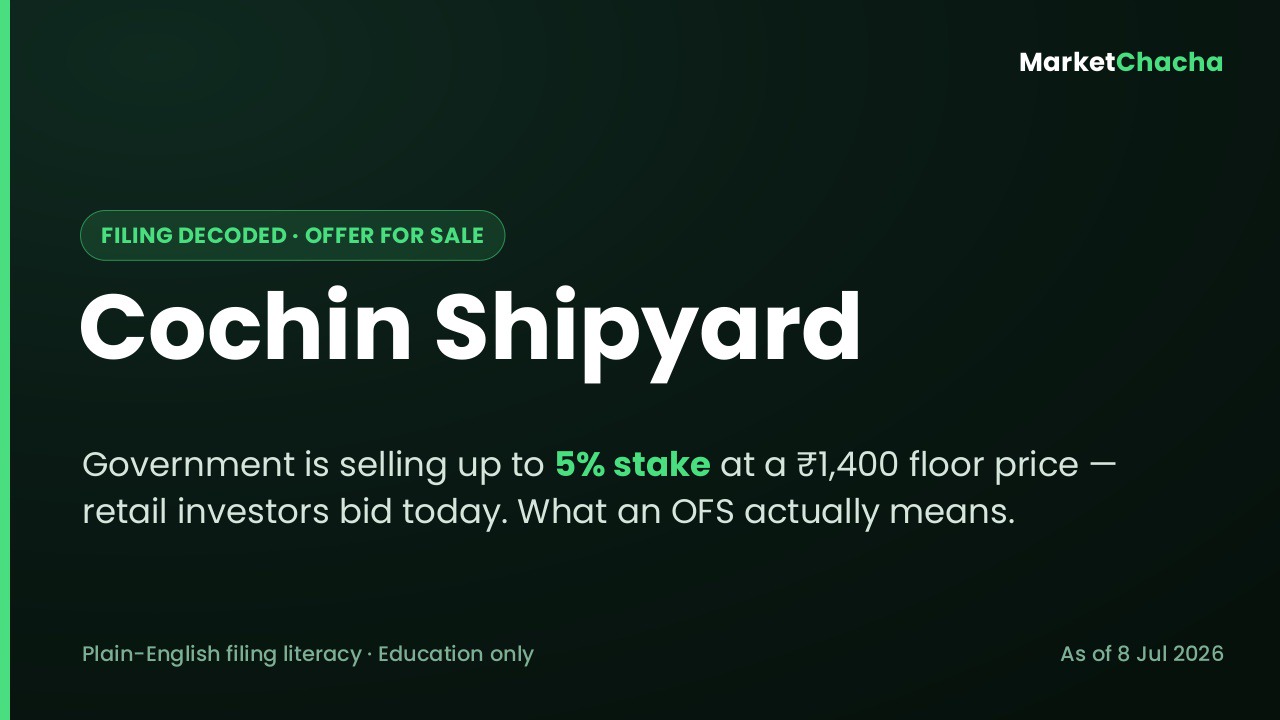
Cochin Shipyard isn't the one making the announcement here — its biggest shareholder is. The Government of India, which owns 67.91% of the company, has filed an Offer for Sale (OFS) to sell up to a 5% stake at a floor price of ₹1,400 per share. Large institutional and non-retail investors bid on 7 July; retail investors get their window today, 8 July.
What was announced
On 6 July 2026 (evening), the President of India — acting through the Ministry of Ports, Shipping & Waterways and the promoter of Cochin Shipyard — notified the exchanges of an OFS to pare its holding.
- Base offer: 2.52% of equity, with an additional green-shoe (oversubscription) option of 2.52% — so up to roughly 5.04% in total.
- Floor price: ₹1,400 per share — about a 7% discount to the previous close of ₹1,504.75.
- Schedule: non-retail investors bid on 7 July; retail investors on 8 July (today).
- Reaction: the stock fell around 4% as the OFS opened — a normal response to a discounted stake sale.
What an "Offer for Sale" (OFS) actually means
An OFS is a fast, exchange-based mechanism a large existing shareholder (here, the government) uses to sell part of its stake directly to the market — usually over one or two days. It is not the company raising fresh money and it does not create new shares, so there is no dilution of earnings per share. The shares simply change hands from the promoter to new buyers. The seller sets a floor price (the minimum), and the discount to the market price is the incentive that gets the block absorbed quickly. A green-shoe option lets the seller offload extra shares if demand is strong.
Why it matters / potential impact
Two things are usually at play. First, a big block of shares hitting the market at a discount creates near-term supply overhang, which is why the price often drifts toward the floor for a day or two — that is a liquidity effect, not a verdict on the business. Second, the government reducing its stake nudges up the company's public float, which over time can improve liquidity and index eligibility. For a PSU, stake sales are also part of the government's routine disinvestment and fiscal-management programme. None of this changes Cochin Shipyard's order book, cash flows or earnings — the operating business is unaffected by who owns the shares.
Is it expensive?
Even after the dip, Cochin Shipyard trades at a P/E of about 62 with a market cap near ₹39,650 crore (a SEBI mid-cap). That is a rich multiple — it prices in years of strong defence and shipbuilding order flow. For context, larger peer Mazagon Dock Shipbuilders is a large-cap at roughly ₹1.03 lakh crore market cap and a lower P/E of about 41; Garden Reach Shipbuilders (GRSE) is the third listed defence-yard peer. So within the shipbuilding pack, Cochin Shipyard is the pricier, smaller name on earnings multiples. This is framing, not a target or a buy/sell call.
The business
Cochin Shipyard is India's largest shipbuilding and maintenance facility and a defence PSU. It designs, builds and repairs ships and offshore structures across two main segments: shipbuilding (defence vessels plus commercial ships) and ship repair. Its landmark project was INS Vikrant, India's first indigenously built aircraft carrier. Because this is a stake sale by the owner and not a company action, it affects the whole share register equally — not any one division of the business.
Beginner takeaway
An OFS is a shareholder selling, not the company raising money — so there's no dilution, and the dip is usually a short-term supply effect rather than bad news about the business. The government trimming a PSU stake is routine. Watch the order book and margins, not the OFS-week wobble, to judge the company itself.
FAQ
Does an OFS reduce the value of my existing shares? Not through dilution — no new shares are created. Any price drop is a temporary supply/discount effect as the block gets absorbed.
Can retail investors buy in the OFS? Yes. A portion is reserved for retail, who bid on the dedicated retail day (8 July here) and often get a small additional discount to the floor price.
Why would the government sell at a discount to the market price? The discount is the incentive that lets a large block clear quickly in one or two days without hammering the price further.
Is the government exiting Cochin Shipyard? No. Even after selling up to ~5%, it remains the dominant promoter with well over 60% ownership.
As of 8 July 2026. The OFS was filed with BSE on 6 July 2026. Source: official BSE filing — read it directly here. We summarise filings for education and may make errors, so always verify against the official document. Educational content only — not investment advice, not a buy/sell recommendation.
This article is for educational and informational purposes only. It is not financial advice, investment recommendation, or a solicitation to buy or sell securities. Investing involves significant risks. I am not a SEBI-registered investment advisor. Readers should consult their own financial advisor and conduct their own research before making any investment decisions.
Comments
Join the conversation
Sign in to join the conversation.
Follow replies, add your view, and take part in the discussion.
Sign in to commentLoading comments...