

IREDA (NSE: IREDA): the full file — the numbers, the owners, and what the filings actually show
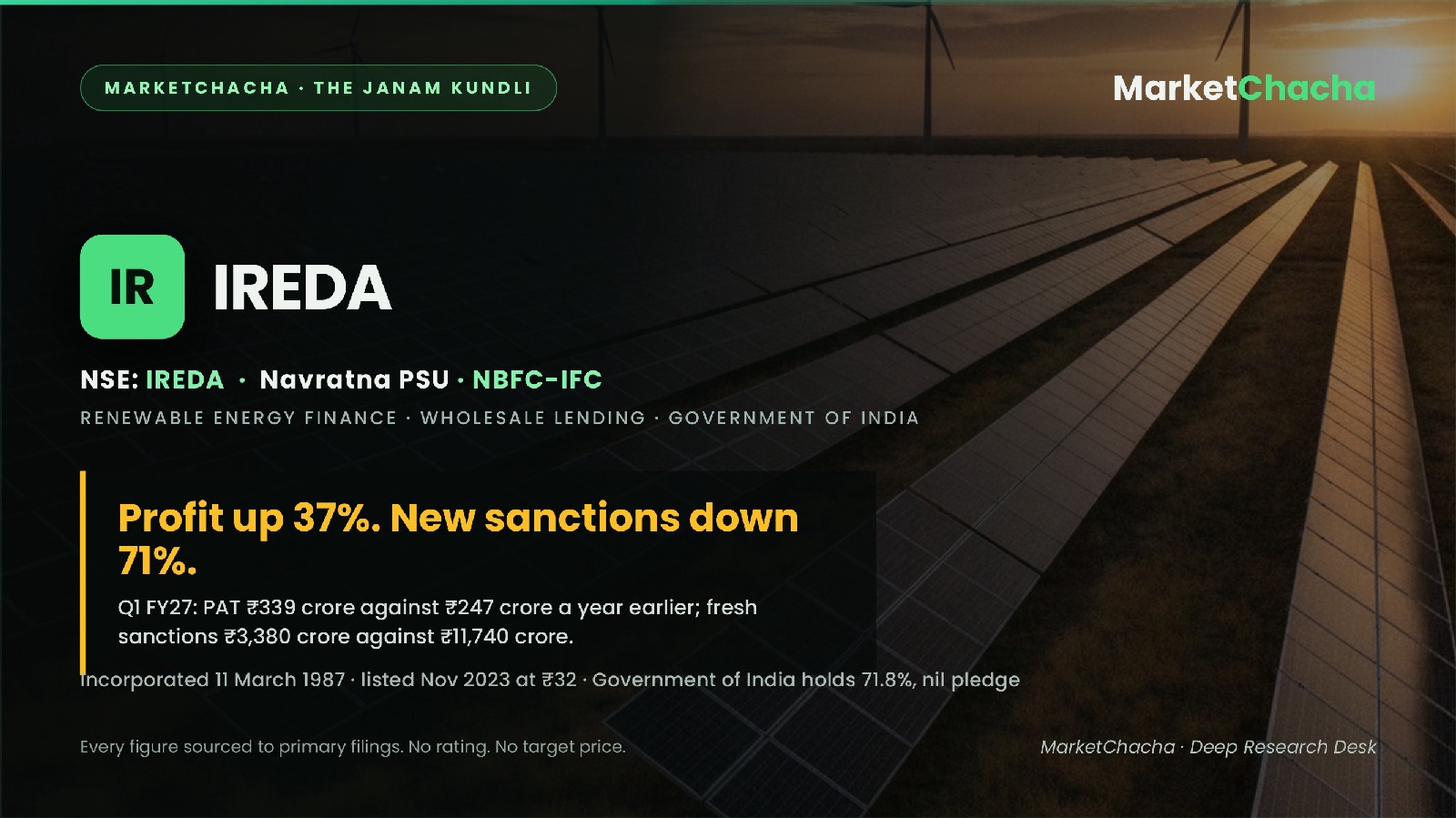
IREDA borrows money — from bond markets, Indian banks and foreign development agencies — and lends it to people building solar parks, wind farms, small hydro plants and, increasingly, factories and storage projects that serve them. It makes money on the gap between what it pays and what it charges, which in FY26 came to a net interest income of ₹3,275 crore.
What the record shows is a lender that has compounded income and profit at roughly 31% a year for five years, that is majority-owned by the Government of India with not a single promoter share pledged, that has no offshore entity anywhere in its structure — and whose gross non-performing assets, measured in rupees rather than percentages, are 96% higher than they were eighteen months ago, while fresh sanctions in the June 2026 quarter fell 71%. All of those things are true at the same time. This is the file.
Origin — the company's birth certificate
The Indian Renewable Energy Development Agency Limited was incorporated on 11 March 1987, under the administrative control of what is now the Ministry of New and Renewable Energy (MNRE). It was not built to be a stock; it was built to be an instrument of policy — the nodal agency through which the Government routes subsidies, generation-based incentives and refinance schemes into the renewable sector.
Over the years it acquired the formal apparatus of a financial institution: notified as a Public Financial Institution, and registered with the Reserve Bank of India as an NBFC — Infrastructure Finance Company. The Government infused ₹1,500 crore of equity in March 2022. In April 2024 the Department of Public Enterprises conferred Navratna status.
It listed on 29 November 2023 at an issue price of ₹32, having raised roughly ₹2,150 crore through a mix of fresh equity and an offer for sale by the Government. It has never changed its name.
The business — what they actually sell
IREDA sells project finance. It has one product line — credit — and the differentiation lies in which projects it will underwrite and at what tenure, not in what it manufactures.
The book is spread across the renewable stack. As on 31 December 2024, the disclosed segment mix was solar 26%, wind 16%, small hydro 12%, co-generation, biomass, waste-to-energy and energy efficiency 2%, and "others" 38% — a category that has been growing as the company pushes into manufacturing, transmission, storage and energy-transition infrastructure. Term loans are outstanding across 23 states and 4 union territories.
The loan book has gone from ₹59,698 crore (31 March 2024) to ₹76,282 crore (31 March 2025) to ₹93,069 crore (31 March 2026) — a two-year compound growth rate of 24.9% — and to ₹94,936 crore at 30 June 2026.
Who actually buys from them
This is where an Indian lender's disclosure gets thinner than a US filer's. IREDA does not publish a named customer-concentration note of the "one customer = X% of revenue" kind. What it and its rating agency do publish is more useful anyway.
ICRA's rating rationale of 19 March 2025 records that IREDA's top 20 borrowers accounted for 260% of net worth as on 31 March 2024, down from 315% a year earlier. That is the concentration number that matters for a wholesale lender: twenty relationships representing more than two and a half times the entire equity cushion. It is normal for infrastructure NBFCs — PFC and REC run comparable structures — and it is the reason a single borrower going wrong shows up in the P&L rather than disappearing into the average.
The counterparty mix has been shifting. At 30 June 2026, the private sector was 77% of the book (₹72,756 crore), up from 73% in March 2026 and 72% a year earlier. Lending to state electricity utilities fell 13.1% quarter-on-quarter and 4.1% year-on-year to ₹18,416 crore, taking their share from 24% to 19%. Read plainly: the book is becoming less sovereign-adjacent and more private-credit.
Where it is actually made — the funding side
A lender's "plant" is its liability book, and IREDA's is genuinely unusual. As on 31 December 2024 the borrowing mix was bonds 37%, bank and financial-institution loans 44%, and foreign-currency loans 19%. The foreign currency comes from development institutions — JICA (Japan), KfW (Germany), the Asian Development Bank, the World Bank, the European Investment Bank and the Nordic Investment Bank — at tenures running out to forty years. Roughly 19% of total borrowings carry a Government of India guarantee.
That long-dated, cheap, guaranteed funding is the competitive asset. It is also the source of a line item that hurt the March 2026 quarter: a ₹34 crore foreign-exchange translation loss, which pushed other operating expenses up 148% year-on-year. Borrowing in yen and euro for forty years is cheap; it is not free of accounting weather.
Five years of numbers
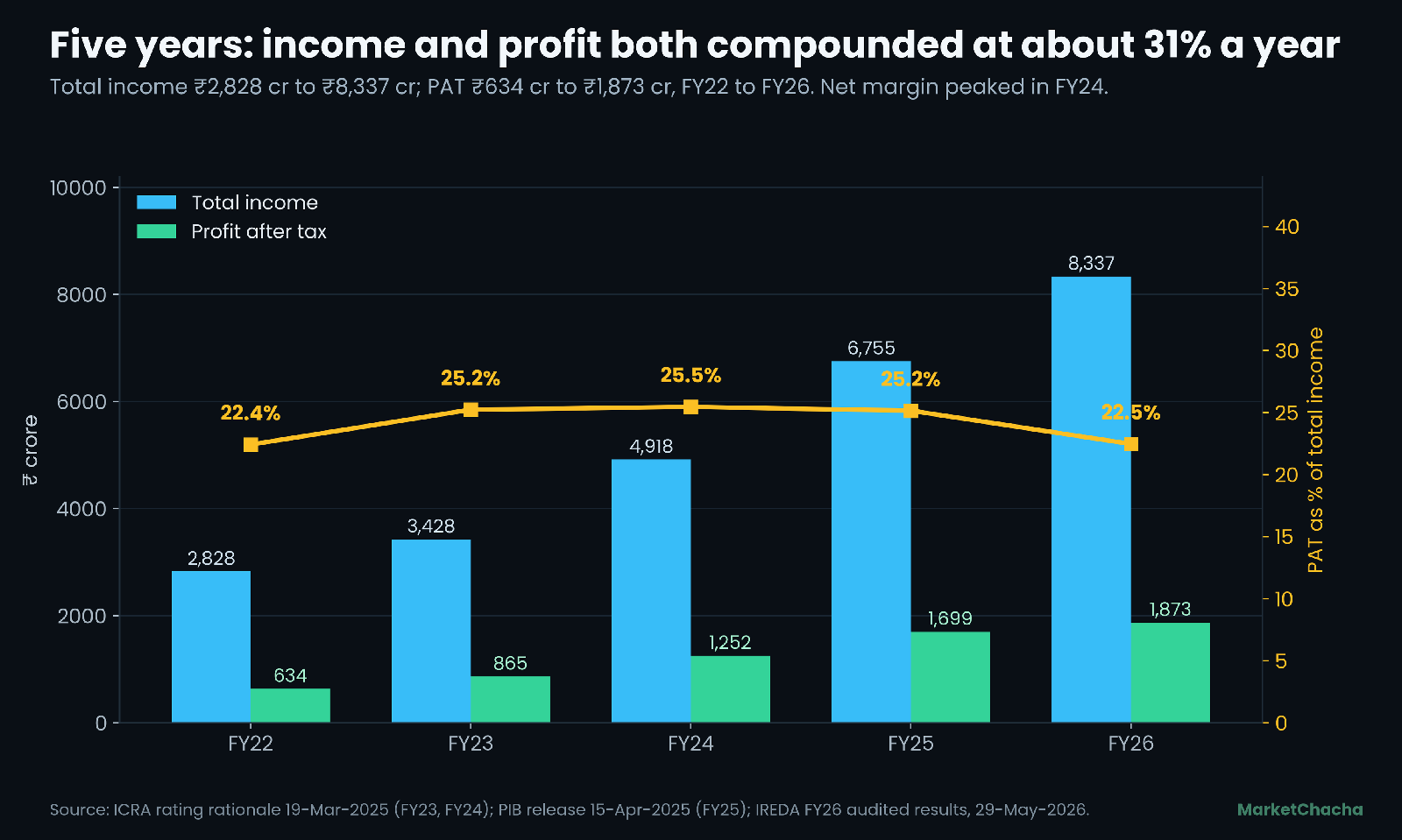
| ₹ crore | FY22 | FY23 | FY24 | FY25 | FY26 |
|---|---|---|---|---|---|
| Total income | 2,828 | 3,428 | 4,918 | 6,755 | 8,337 |
| Profit after tax | 634 | 865 | 1,252 | 1,699 | 1,873 |
| PAT as % of income | 22.4% | 25.2% | 25.5% | 25.2% | 22.5% |
| Gross NPA (%) | 5.2% | 3.2% | 2.4% | 2.45% | 3.49% |
| Net worth | — | 5,935 | 8,559 | 10,266 | 13,781 |
The arithmetic. Total income ₹2,828 cr → ₹8,337 cr over four years is a compound rate of (8,337 ÷ 2,828)1/4 − 1 = 31.0%. PAT ₹634 cr → ₹1,873 cr is 31.1%. Loan book ₹59,698 cr (FY24) → ₹93,069 cr (FY26) is 24.9% a year. Those are strong numbers and they are not in dispute.
Price. From the ₹32 issue price on 29 November 2023 to ₹113.6 on 5 September 2026 is +255% over about 2.8 years, a compound rate near 58%. From the all-time high of ₹310 struck on 15 July 2024, the stock is down about 63%. Both facts belong in the same sentence.
Income statement, FY26 vs FY25
| ₹ crore | FY25 | FY26 | Change | % |
|---|---|---|---|---|
| Interest earned | 6,575 | 8,179 | +1,604 | +24.4% |
| Interest expended | 4,141 | 4,905 | +764 | +18.5% |
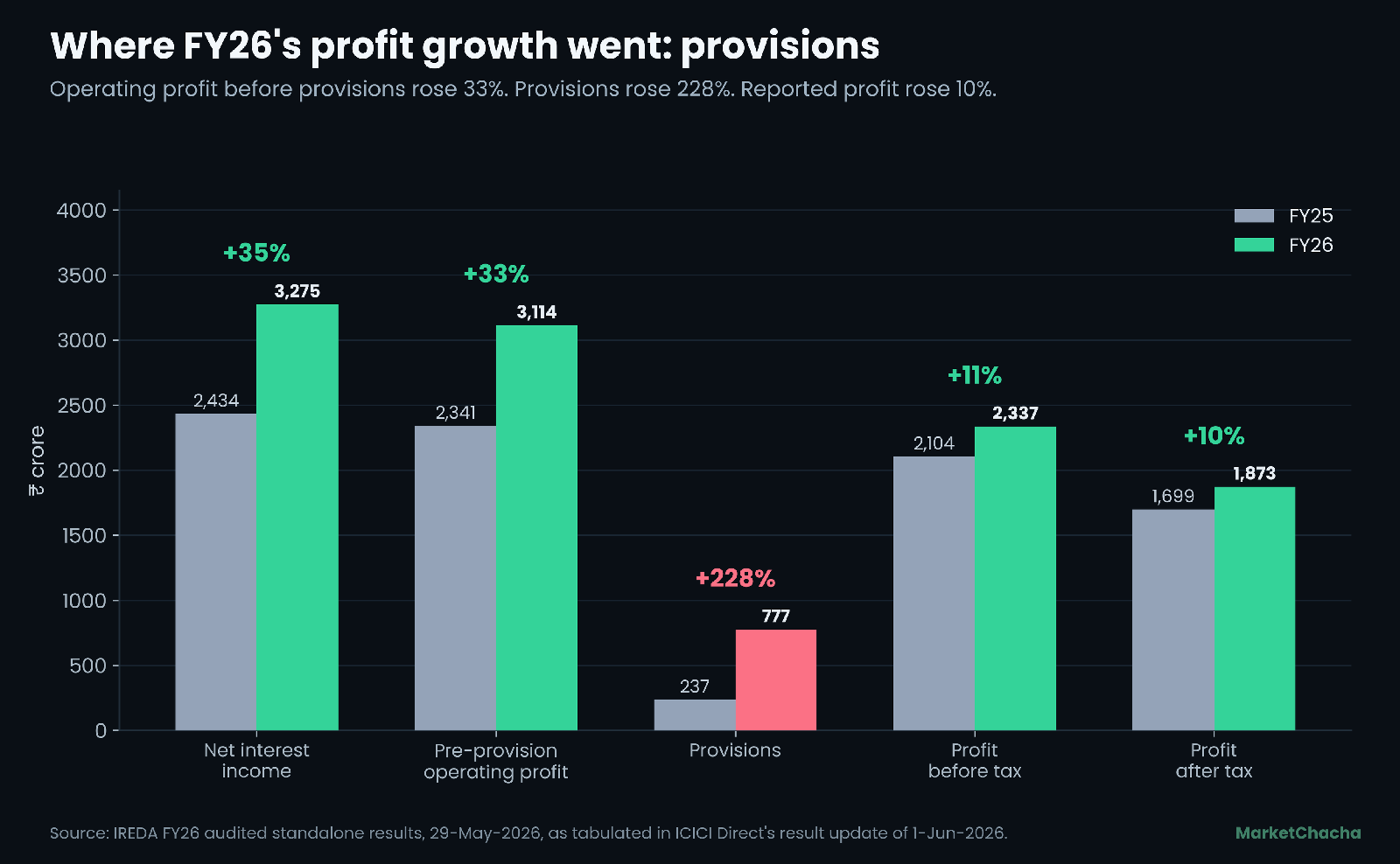
| Net interest income | 2,434 | 3,275 | +841 | +34.5% |
| Non-interest income | 180 | 158 | −22 | −12.2% |
| Operating expenses | 273 | 319 | +46 | +16.9% |
| Pre-provision operating profit | 2,341 | 3,114 | +773 | +33.0% |
| Provisions | 237 | 777 | +540 | +227.8% |
| Profit before tax | 2,104 | 2,337 | +233 | +11.1% |
| Tax | 405 | 464 | +59 | +14.6% |
| Profit after tax | 1,699 | 1,873 | +174 | +10.3% |
| EPS (₹) | 6.3 | 6.7 | +0.4 | +5.5% |
| Return on equity | 16.5% | 13.6% | −2.9 pp | — |
Balance sheet, FY26 vs FY25
| ₹ crore | FY25 | FY26 | Change | % |
|---|---|---|---|---|
| Share capital | 2,688 | 2,809 | +121 | +4.5% |
| Reserves and surplus | 7,578 | 10,972 | +3,394 | +44.8% |
| Net worth | 10,266 | 13,781 | +3,515 | +34.2% |
| Borrowings | 61,935 | 74,588 | +12,653 | +20.4% |
| Other liabilities and provisions | 4,665 | 5,432 | +767 | +16.4% |
| Advances | 74,272 | 90,197 | +15,925 | +21.4% |
| Investments | 626 | 910 | +284 | +45.4% |
| Cash and equivalents | 491 | 717 | +226 | +46.0% |
| Total assets | 76,866 | 93,802 | +16,936 | +22.0% |
Cash flow
| ₹ crore | FY24 | FY25 |
|---|---|---|
| Cash flow from operations | −11,099 | −14,459 |
We could not verify the FY26 operating cash-flow figure from the audited statements and have not reproduced an estimate.
What moved, and why. Three lines carry the year. Net interest income rose 34.5% — faster than the 21.4% growth in advances — because the cost of borrowings fell while the book grew, lifting net interest margin. Reserves rose 44.8%, but only part of that is retained profit: ₹2,006 crore came in from the June 2025 QIP. And provisions rose 227.8%, which is the entire story of why a 33% rise in operating profit became a 10.3% rise in reported profit.
Earnings quality. The PBT move is almost entirely core. Non-interest income actually fell ₹22 crore and is now just 6.8% of PBT (FY25: 8.6%) — there is no other-income cushion propping up this result, and no favourable tax swing either; the effective tax rate rose from 19.3% to 19.9%. What compressed the bottom line was a real, cash-relevant credit charge, not an accounting one. The other side of that: return on equity fell from 16.5% to 13.6%, because equity grew 34% while profit grew 10%.
The latest quarter, decoded
| Q1 FY26 | Q4 FY26 | Q1 FY27 | YoY | QoQ | |
|---|---|---|---|---|---|
| Revenue from operations (₹ cr) | 1,947.6 | — | 2,249.5 | +15.5% | — |
| Profit after tax (₹ cr) | 246.9 | 492.8 | 338.5 | +37.1% | −31.3% |
| Loan book (₹ cr) | 79,941 | 93,069 | 94,936 | +18.8% | +2.0% |
| Gross NPA (₹ cr) | 3,302 | 3,245 | 3,568 | +8.1% | +10.0% |
| Gross NPA (%) | 4.13% | 3.49% | 3.76% | −37 bps | +27 bps |
| Net NPA (%) | 2.06% | 1.29% | 1.23% | −83 bps | −6 bps |
| Fresh sanctions (₹ cr) | 11,740 | — | 3,380 | −71.2% | — |
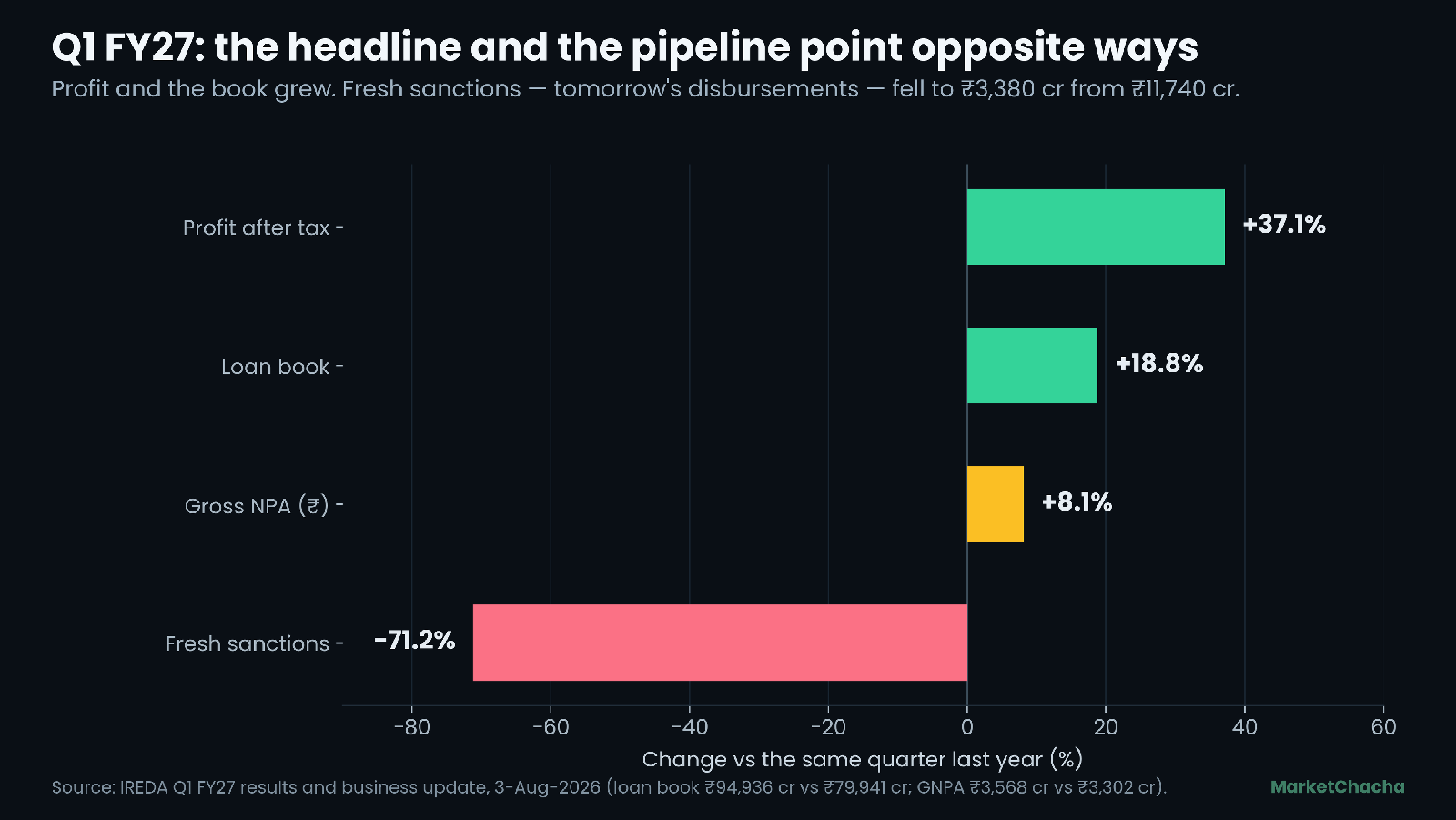
The headline — "PAT up 37%" — is true and is measured against a weak base: Q1 FY26 profit had itself fallen 35.6% year-on-year. Measured sequentially against the March quarter, profit is down 31.3%.
Two things deserve the reader's attention more than the PAT line. First, gross NPA rose in both rupees (+10.0% QoQ) and as a ratio (+27 bps QoQ) in the June quarter, even as the year-on-year ratio comparison improved. Second, and more forward-looking: fresh sanctions of ₹3,380 crore against ₹11,740 crore a year earlier. Sanctions are the pipeline that becomes disbursement, which becomes next year's loan book, which becomes the year-after's interest income. Loan-book growth has already slowed from +6.6% QoQ in the March quarter to +2.0% in June. A benign reading exists and IREDA has offered versions of it before: sanctions are lumpy in wholesale lending, a single large sanction can move a quarter, and the company has said it is applying more selective underwriting after the stress of the past two years. Both readings are consistent with the number; only the next two quarters will separate them.
Who owns it — and where those owners are registered
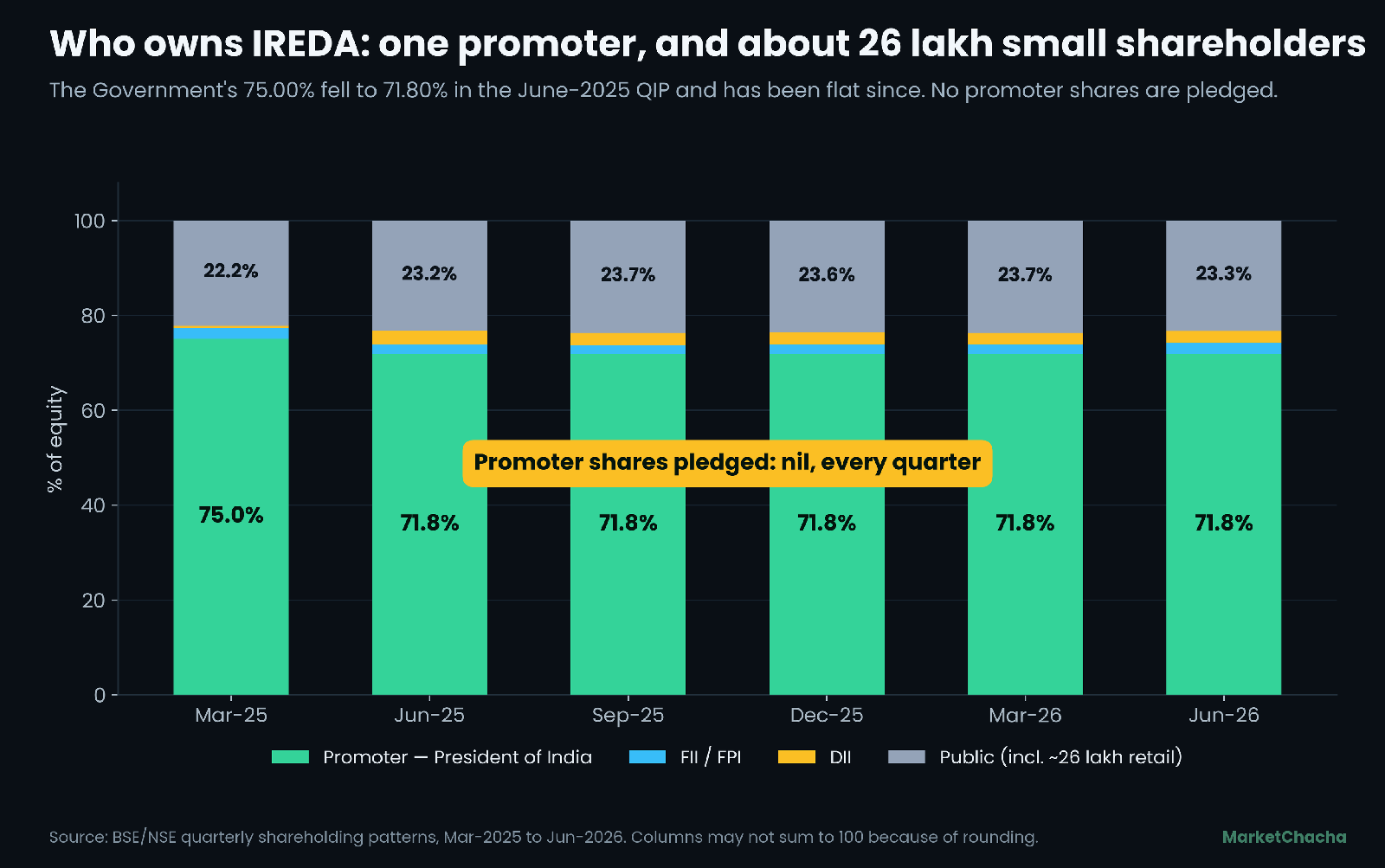
The promoter is the President of India, acting through the Secretary, MNRE — a single folio holding 71.80% at 30 June 2026. It held 75.00% until the June 2025 QIP diluted it. Nil shares are pledged, in every quarter on record. There is no promoter family, no holding company, no cross-holding.
Institutional ownership is small and static: FII/FPI 2.5% and DII 2.4% at June 2026, against 2.0% and 3.0% a year earlier. No individual foreign portfolio investor is disclosed above 1% in the public shareholding pattern — which means there is no named Mauritius, Singapore or Cayman vehicle to point at. That is a finding, not an omission: the free float here is overwhelmingly domestic and retail.
How retail? The BSE shareholding pattern for March 2025 records 26,48,952 individual shareholders holding up to ₹2 lakh each, together owning 20.25% of the company. Roughly one in every four IREDA shares is held by a small Indian investor. That is a materially different ownership base from almost any other Indian NBFC of this size, and it is why the stock's 63% drawdown from its July 2024 peak is a household-level event rather than an institutional one.
The structure — and what is not in it
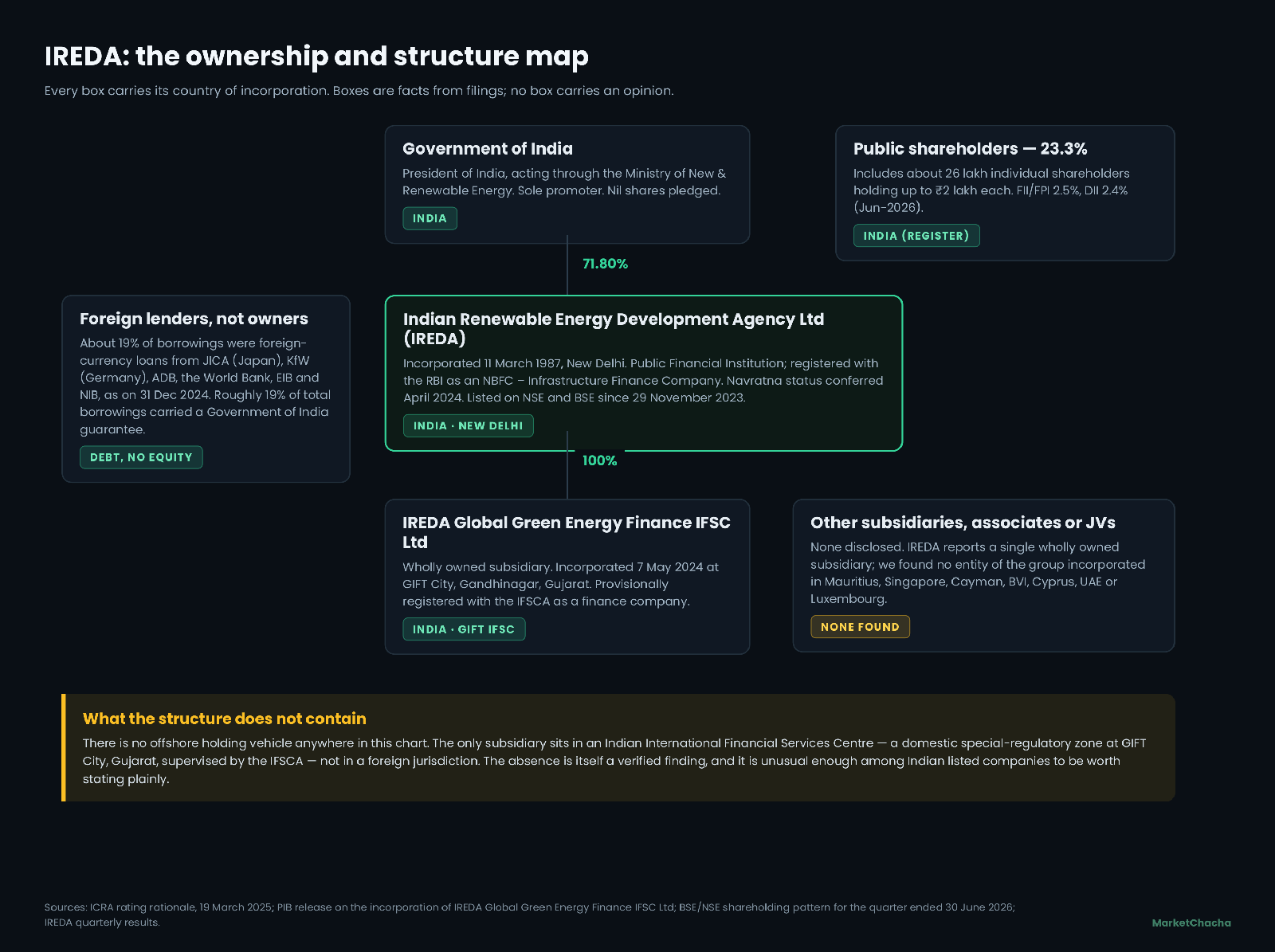
IREDA has one wholly owned subsidiary: IREDA Global Green Energy Finance IFSC Limited, incorporated 7 May 2024 at GIFT City, Gandhinagar, Gujarat, and provisionally registered with the IFSCA as a finance company. The RBI issued its no-objection on 8 February 2024.
We looked for the usual offshore layer — Mauritius, Singapore, Cayman, BVI, Cyprus, UAE, Luxembourg — and found none. A GIFT City IFSC entity is a domestic special-regulatory zone inside India, supervised by an Indian regulator; it is not a foreign jurisdiction, and it does not obscure beneficial ownership, because the beneficial owner is the Government of India. Foreign institutions appear in this file only as lenders — JICA, KfW, ADB, the World Bank, EIB, NIB — never as owners. A structure this plain is rare enough among Indian listed companies that it deserves to be stated rather than assumed.
Capital history — every time they raised money
- March 2022 — Government of India equity infusion of ₹1,500 crore.
- 21–23 November 2023 — IPO at a price band of ₹30–32, issued at ₹32, raising roughly ₹2,150 crore through a fresh issue plus an offer for sale by the Government; ₹643 crore came from anchor investors on 20 November 2023. Listed 29 November 2023 at ₹50, a 56% premium.
- June 2025 — QIP. The board set a floor price of ₹173.83 per share under the SEBI ICDR pricing formula and opened the issue on 5 June 2025. It placed 12.15 crore shares at ₹165.14, raising ₹2,005.90 crore. The issue price is roughly 5% below the floor — the discount that ICDR permits — and the Government's stake fell from 75.00% to 71.80%. The authorisation had been for up to ₹5,000 crore; about 40% of it was used.
- No bonus, no split, no rights issue, no buyback, and no preferential allotment to any related party appears in the record we reviewed.
Share count went from 268.8 crore (FY25) to 280.9 crore (FY26) — dilution of 4.5%, all of it the QIP. Dividend for FY26 was ₹1.35 per share (₹0.60 interim, ₹0.75 final), a payout of about 20% of EPS.
Who runs it, and the regulatory record
The Chairman and Managing Director through this period has been Shri Pradip Kumar Das. The board, per ICRA's description, comprises two executive directors, two government nominees from MNRE and four independent directors. Being a Government company, directors are appointed by the President of India through MNRE — the board itself does not choose them.
The auditor. Statutory accounts for FY26 were audited without qualification, and the Comptroller and Auditor General of India conducted a supplementary audit under Section 143(6)(a); the CAG reported that nothing came to light requiring comment on or supplement to the statutory auditor's report. No auditor resignation, no mid-term change, and no qualified opinion appears in the record we reviewed.
Exchange penalties. This is the one live compliance item. NSE and BSE fined IREDA ₹2.03 lakh for non-compliance with SEBI LODR board-composition norms for the quarter ended 31 March 2026, and a further ₹14.2 lakh for the quarter ended 30 June 2026 — covering board composition, the requirement for a woman director, and committee constitution. The board met on 1 September 2026 and resolved to seek a waiver, on the ground that the power to appoint directors vests with the President of India and is exercised through MNRE. The fact is that a listed company has been repeatedly penalised for board-composition breaches; the benign and probably correct reading is that the breach is the owner's to fix, not the management's.
Credit ratings. ICRA rates the long-term borrowing programmes and Tier-II subordinated debt [ICRA]AAA (Stable), perpetual bonds [ICRA]AA+ (Stable) — one notch lower because coupon servicing on those is additionally conditional on regulatory capital and reported profits — and commercial paper [ICRA]A1+. The long-term rating was upgraded to AAA in FY2023 and reaffirmed since. There is no "Issuer Not Cooperating" tag and no downgrade in the three-year rating history. ICRA's stated negative trigger is explicit and worth remembering: a significant decline in the Government's shareholding, or net stage 3 exceeding 40% of Tier I capital on a sustained basis.
The Gensol accounts. On 9 July 2026 IREDA issued an order classifying its loan accounts of Gensol Engineering Ltd (₹453.77 crore) and Gensol EV Lease Pvt Ltd (₹218.97 crore) — ₹672.74 crore in total — as "fraud" under the applicable RBI Master Directions, and reported both accounts to the Reserve Bank of India as those Directions require. IREDA has stated it carries an 85% provision against the exposure. Separately, IREDA had moved the NCLT Ahmedabad bench under Section 7 of the Insolvency and Bankruptcy Code citing a default of ₹510 crore, and the tribunal admitted both companies into the corporate insolvency resolution process in June 2025; IREDA has also filed before the Debt Recovery Tribunal. Two points of context, both material: a "fraud" classification by a lender is an administrative and reporting step prescribed by the RBI, made by the lender on its own findings; it is not a judicial finding, it can be contested, and the underlying matters are before the NCLT and other fora. Nothing in this paragraph is MarketChacha's assertion about any company or person — it is IREDA's own disclosed classification and the NCLT's own order, and the borrower's position on both is a matter for those proceedings.
Forensic checks — what the accounts show
| Check | What we found | A benign explanation |
|---|---|---|
| Cash from operations ÷ PAT | Deeply negative: CFO −₹11,099 cr (FY24) and −₹14,459 cr (FY25) against PAT of ₹1,252 cr and ₹1,699 cr. FY26 not verified. | For a growing lender this ratio is meaningless as a fraud check. Loan disbursements sit inside operating cash flow, so any NBFC growing its book 20%+ a year must show a large operating outflow, funded by financing inflows. A positive CFO here would signal a shrinking book, not health. |
| Cash pile vs interest earned | Cash and equivalents ₹717 cr on total assets of ₹93,802 cr — 0.76%. | No large idle "cash" balance to interrogate. Liquidity is held instead as ₹9,230 cr of unutilised sanctioned bank lines (Dec-24). |
| Implied cost of debt | FY26 interest expended ₹4,905 cr ÷ average borrowings of ₹68,262 cr = 7.19%. | Consistent with the 6.6%–7.05% cost of funds disclosed on differing definitions, and with a AAA-rated sovereign-owned issuer. No anomaly. |
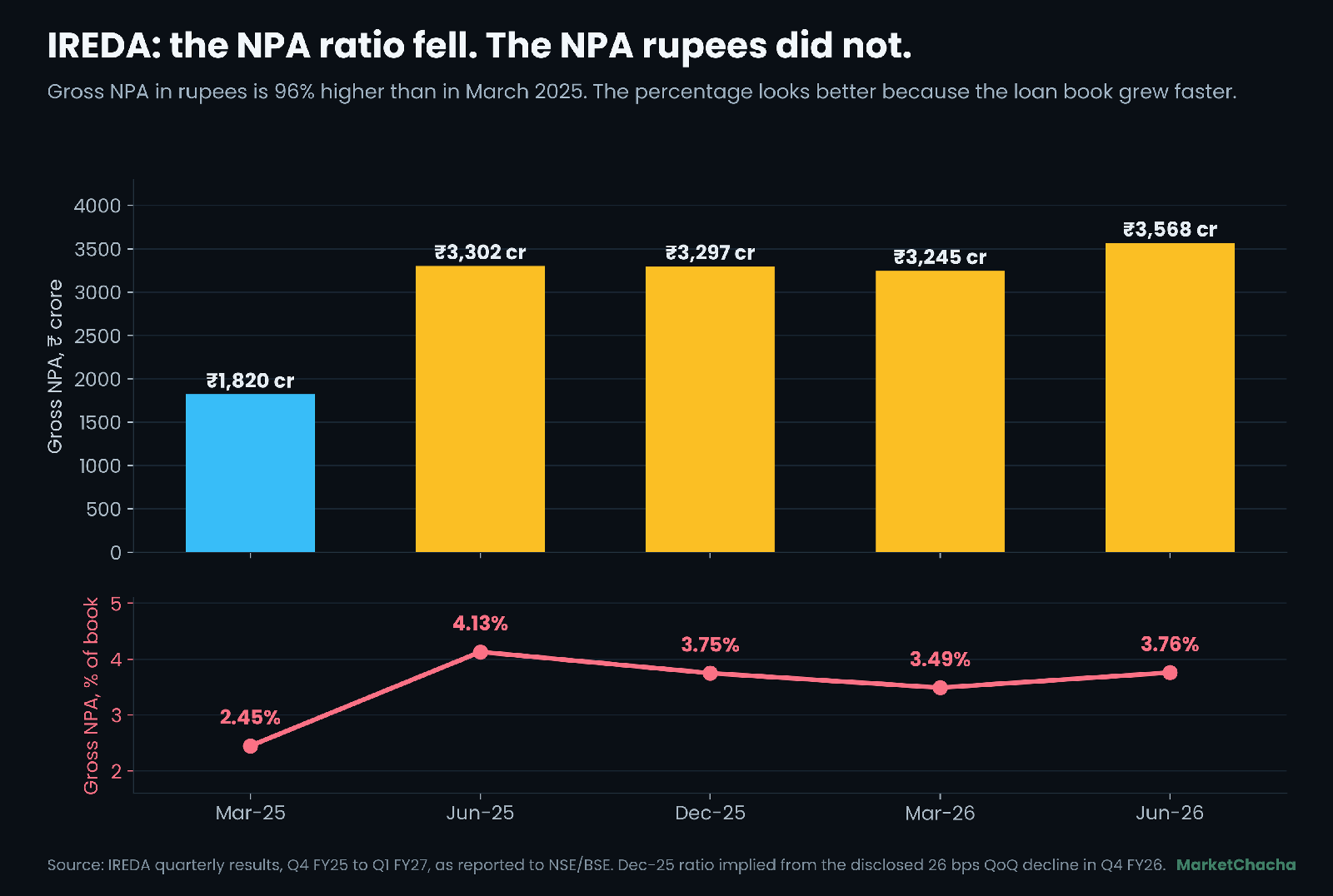
| Asset quality (the receivables equivalent) | Gross NPA in rupees: ₹1,820 cr (Mar-25) → ₹3,245 cr (Mar-26) → ₹3,568 cr (Jun-26), +96% in 15 months. The ratio fell from 4.13% to 3.76% year-on-year only because the book grew 18.8%. | Provision coverage rose from 63.9% (Mar-26) to 68.2% (Jun-26) and net NPA fell to 1.23%, so the recognised stress is being provided against, not carried at face value. |
| Credit cost | FY26 provisions ₹777 cr ÷ average advances ₹82,235 cr = 0.94%, against roughly 0.36% in FY25 on the same method. | A single large account (Gensol, 85% provided) explains much of the step-up; management has described the approach as conservative recognition. |
| Borrower concentration | Top 20 borrowers = 260% of net worth (Mar-24), improved from 315% (Mar-23). | Structural for wholesale infrastructure lending; PFC and REC operate similarly. It raises the variance of outcomes, not the mean. |
| Loans overdue >90 days not classified as NPA | ICRA records that as on 31 March 2024, 1.5% of the loan book (₹874 cr) was overdue more than 90 days but not classified as stage 3 because of judicial dispensation, largely on projects with Andhra Pradesh discoms as off-takers. | The non-classification is court-permitted, not discretionary, and 60% provision cover was carried against those assets. It nonetheless means the headline GNPA understates overdues by that amount on that date. |
| Auditor | Unqualified statutory opinion for FY26; CAG supplementary audit with no comment. No resignation or mid-term change found. | — |
| Promoter pledge / insider selling | Nil pledge in every quarter. The Government sold no shares in the secondary market; its stake fell only through the QIP's fresh issue. | — |
| Subsidiaries and jurisdictions | One subsidiary, in GIFT City, Gujarat, India. Zero offshore entities. | — |
| Related-party transactions | Not verified. We could not open the FY26 annual report's RPT note. IREDA routes MNRE subsidies and incentive schemes as an agency, and the promoter is the Government, so related-party disclosure here has a different character from a family-promoted company. | — |
| Other income as % of PBT | FY26: ₹158 cr ÷ ₹2,337 cr = 6.8%; FY25: 8.6%. Falling. | Profit is core, not propped up by non-operating items. |
| Dilution | +4.5% share count in FY26, entirely the QIP at ₹165.14. No preferential allotment to related entities found. | — |
Where the multiple sits
At ₹113.6 (5 September 2026), against FY26 EPS of ₹6.67 and book value of ₹49.06 per share, IREDA trades at roughly 17.0× earnings and 2.3× book. Two named listed peers in the same business of lending to Indian power and infrastructure: REC Ltd at about 7.2× earnings and 1.1× book, and Power Finance Corporation at about 4.6× earnings and 0.69× book. We state the gap; we do not tell you what it should be. Whether a 25% loan-growth mandate and a AAA rating justify a multiple two to three times the peer set is exactly the judgement this report declines to make for you.
What we could not verify
- FY26 cash flow statement. We could not open the audited FY26 cash-flow statement; the FY24 and FY25 operating figures above come from secondary compilation of the filed accounts.
- The FY26 related-party transactions note, the full subsidiary schedule in the annual report, and the name of the statutory auditor firm appointed by the CAG.
- Segment mix and borrower concentration after December 2024. The 260%-of-net-worth top-20 figure is as on 31 March 2024; we found no update.
- Whether the ₹874 crore of judicially-dispensed overdues has since been resolved, recovered or reclassified. This is the single most important unverified item in the file.
- Balance-sheet and quarterly line detail in this report is drawn from IREDA's filed results as tabulated by ICICI Direct's 1 June 2026 result update, not read directly off the audited statements. We have flagged one internal inconsistency in that document: it gives FY26 cost of funds as both 7.05% (text) and 6.6% (ratio table), on what appear to be different definitions.
- ASM/GSM surveillance status. We found no record of IREDA being placed under NSE/BSE Additional or Graded Surveillance Measures, but we could not confirm the current framework lists directly, so treat this as unverified rather than as a clean bill.
- Sep-2025 quarter GNPA in rupees, which is why that point is absent from the NPA chart.
What would change the picture
- The Q2 FY27 sanction number. One weak quarter is noise; two consecutive quarters of sanctions running at a third of the prior year would confirm the pipeline is contracting rather than lumpy.
- Gross NPA in rupees, not per cent. The ratio can improve while the rupee number rises for as long as the book grows. Track ₹3,568 crore, and track it against the pace of book growth.
- Provision coverage. 68.2% at June 2026. A fall would mean recognition is outrunning provisioning; a rise, the reverse.
- Recovery on the Gensol exposure through the CIRP. ₹672.74 crore is 4.9% of net worth and 85% provided — any write-back is upside to reported profit, any shortfall is already largely absorbed.
- The next shareholding pattern. ICRA's explicit negative rating trigger is a significant decline in the Government's stake. The QIP authorisation had ₹3,000 crore of headroom left.
- Whether the board-composition penalties stop. The waiver request is pending; the fix requires MNRE to appoint directors.
- The next CAG supplementary audit and statutory auditor's report.
Sources
- ICRA rating rationale, Indian Renewable Energy Development Agency Limited, 19 March 2025 (revised) — icra.in. Incorporation date, Navratna status, borrowing mix, top-20 concentration, judicial-dispensation overdues, FY23/FY24 financials, rating history.
- Press Information Bureau, "IREDA Reports Highest Ever PAT of ₹1,699 Crore for FY 2024-25", 15 April 2025 — pib.gov.in.
- Press Information Bureau, incorporation of IREDA Global Green Energy Finance IFSC Limited — pib.gov.in.
- IREDA FY26 audited standalone and consolidated results, board meeting 29 May 2026 (dividend, net worth, loan book, CAG supplementary audit) — reported at psuconnect.in and indianmasterminds.com.
- ICICI Direct result update on IREDA, 1 June 2026 — FY25/FY26 P&L, balance-sheet and Q4 FY26 variance tables, and the Jun-25 to Mar-26 shareholding series. PDF. (Cited for its tabulation of company-filed data; its rating and target price are not used here.)
- IREDA Q1 FY27 results and business update, 3 August 2026 — PAT, loan book, NPAs, sanctions, private/public mix. saurenergy.com, indianmasterminds.com.
- BSE/NSE quarterly shareholding patterns, March 2025 and June 2026, incl. the 26,48,952 individual-shareholder count — as compiled at Trendlyne and Angel One.
- QIP, June 2025 — floor price ₹173.83 and issue details: Business Standard, Outlook Business.
- IPO, November 2023 — price band, dates, anchor book, listing: Chittorgarh, Business Today.
- Gensol fraud classification, 9 July 2026, and RBI reporting — ScanX, Whalesbook.
- NCLT Ahmedabad admits Gensol Engineering and Gensol EV Lease to CIRP on IREDA's Section 7 petition, June 2025 — Business Standard.
- NSE/BSE fines for board-composition non-compliance, ₹2.03 lakh (Q4 FY26) and ₹14.2 lakh (quarter ended 30 June 2026), and the board's waiver request of 1 September 2026 — ScanX, PSU Connect.
- Share price ₹113.6 (5 September 2026), 52-week range ₹163.35 / ₹108.65, market capitalisation ₹32,728 crore — INDmoney, Bajaj Broking. All-time high ₹310 on 15 July 2024 — Business Today.
- Peer multiples for REC Ltd and Power Finance Corporation, September 2026 — INDmoney, Bajaj Broking.
FAQ
Is IREDA's asset quality improving or deteriorating? Both statements can be defended from the same filings, which is why the distinction matters. The ratio improved year-on-year (4.13% → 3.76% gross, 2.06% → 1.23% net) and provision coverage rose to 68.2%. The rupee amount of gross NPA rose from ₹1,820 crore in March 2025 to ₹3,568 crore in June 2026, and rose 27 basis points sequentially in the June quarter. The ratio improved partly because the denominator grew 18.8%.
Why did FY26 profit grow only 10% when operating profit grew 33%? Provisions. They went from ₹237 crore to ₹777 crore, up 228%. Pre-provision operating profit was ₹3,114 crore; the extra ₹540 crore of provisioning absorbed most of the incremental operating gain. Return on equity fell from 16.5% to 13.6% as a result, helped down further by the equity raised in the QIP.
Does IREDA have offshore subsidiaries or unnamed foreign owners? No, on the record we reviewed. It has one wholly owned subsidiary, at GIFT City in Gujarat — an Indian IFSC, not a foreign jurisdiction. No individual FPI is disclosed above 1% of equity. Foreign institutions such as JICA, KfW, ADB and the World Bank appear as lenders, not shareholders.
What is the Gensol exposure, exactly? ₹672.74 crore across Gensol Engineering (₹453.77 crore) and Gensol EV Lease (₹218.97 crore). On 9 July 2026 IREDA classified both accounts as "fraud" under RBI Master Directions and reported them to the RBI; it states it carries an 85% provision. The NCLT admitted both companies to insolvency in June 2025 on IREDA's petition. These are IREDA's disclosures and the tribunal's orders; the classification is an administrative step by the lender and the matters remain before the relevant fora.
Why does the sanctions number matter more than the profit number? Sanctions become disbursements, disbursements become the loan book, and the loan book generates interest income. Q1 FY27 sanctions of ₹3,380 crore were 71% below the year-ago quarter, and sequential loan-book growth has already slowed from 6.6% to 2.0%. Profit reflects last year's lending; sanctions reflect next year's.
Why is IREDA's price-to-book so much higher than REC's or PFC's? That is the question this report deliberately leaves open. The facts are: IREDA at roughly 2.3× book and 17× FY26 earnings; REC at about 1.1× and 7.2×; PFC at about 0.69× and 4.6×. IREDA is smaller, growing faster, exclusively renewable-focused and rated AAA; it also carries higher gross NPAs than either peer and its promoter stake, unlike theirs, has begun to be diluted. Which of those facts should dominate a valuation is a judgement for the reader.
Independent research for education and discussion only. Not investment advice, not a recommendation, and not a rating — we issue no buy/sell calls and no target prices. Every figure is sourced from the primary documents linked above; figures can be restated and we can make mistakes, so always verify against the original. Nothing here alleges wrongdoing by any company or individual: where a fact raises a question we state the fact, cite it, and give the benign explanation alongside. Offshore holding structures, pledging and preferential allotments are all legal and common — they are disclosed here as facts, not as accusations.
This article is for educational and informational purposes only. It is not financial advice, investment recommendation, or a solicitation to buy or sell securities. Investing involves significant risks. I am not a SEBI-registered investment advisor. Readers should consult their own financial advisor and conduct their own research before making any investment decisions.
Comments
Join the conversation
Sign in to join the conversation.
Follow replies, add your view, and take part in the discussion.
Sign in to commentLoading comments...