

Credo Technology (CRDO): the full file — the numbers, the owners, and what the filings actually show
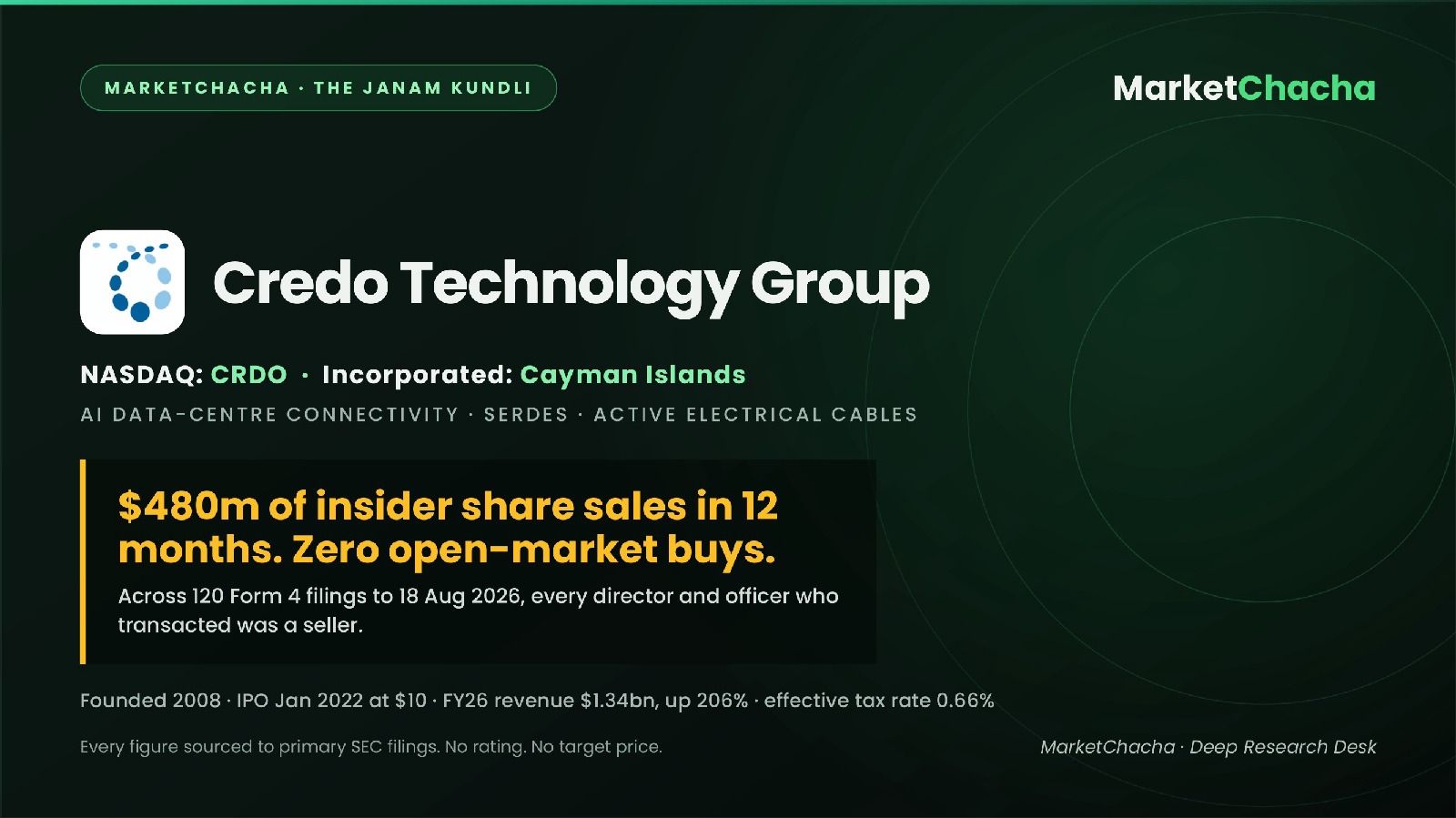
Credo Technology sells the plumbing that moves data around an AI data centre — SerDes chiplets, retimers, optical DSPs and, most visibly, the copper "active electrical cables" (AECs) that link racks of AI accelerators together. It makes money by selling those parts to a small number of very large buyers, and by licensing its IP.
In the year to 2 May 2026 its revenue tripled to $1.34 billion and it earned $472 million after tax on an effective tax rate of 0.66%. Over the same twelve months, its directors and officers sold $479.7 million of stock into the market and bought none.
Both of those sentences come from primary filings. This is the whole file — the birth certificate, the buyers, the plants, the numbers, the owners, the jurisdictions and the record — with a link to every document. No rating. No target price. You decide.
Origin — the company's birth certificate
Credo was founded in 2008, per the FY2026 Form 10-K. Its co-founders include Chi Fung (Lawrence) Cheng and Pantas Sutardja, both of whom sit in the FY2025 proxy's beneficial-ownership table as 5%-adjacent individual holders. The listed entity is Credo Technology Group Holding Ltd, a Cayman Islands exempted company. Its registered mailing address, as stated on the cover of every filing, is c/o Maples Corporate Services Limited, PO Box 309, Ugland House, Grand Cayman. Operations run out of San Jose, California, and Asia.
It listed on 27 January 2022 on the Nasdaq Global Select Market under CRDO. The IPO priced 20,000,000 shares at $10.00, of which 18,383,800 were new shares sold by the company for roughly $183.8 million gross. On 17 August 2026 the shares closed at $259.90 — a return of about +2,499% from the IPO price over roughly four and a half years, a compound rate near 104% a year. The 52-week range is $86.48 to $308.67. The company has never paid a dividend and, as of 8 June 2026, had 47 shareholders of record (almost all shares are held in street name, so this number says nothing about the number of beneficial owners).
The path was not smooth. On 14 February 2023 Credo disclosed that its largest customer had cut its demand forecast; the stock fell 46.8% to $10.30 the next day. Several plaintiffs' firms announced investigations at the time. That is worth holding in mind while reading the customer section below.
The business — what they actually sell
Credo describes itself as a provider of high-speed connectivity solutions for data infrastructure. The product families are AECs (copper cables with active silicon inside), optical DSPs, line-card PHYs / retimers, SerDes chiplets and SerDes IP licensing. The company runs a fabless model: it designs, others manufacture.
Revenue is disclosed on a single-segment basis, so a clean product-by-product split is not disclosed in the annual report. What is disclosed is the geography of shipment, and it moved violently in FY2026:
| Revenue by shipment destination ($'000) | FY2026 | FY2025 | FY2024 |
| United States | 768,051 | 65,097 | 49,569 |
| Hong Kong | 378,230 | 243,727 | 70,162 |
| Mainland China | 80,924 | 80,055 | 28,264 |
| Taiwan | 22,727 | 3,624 | 21,286 |
| Rest of world | 85,184 | 44,272 | 23,689 |
| Total | 1,335,116 | 436,775 | 192,970 |
US-destination revenue went from $65m to $768m in one year. Credo notes in the same filing that destination of shipment "may differ from the end customer's principal offices" — contract manufacturers take delivery on behalf of end customers, which is why Hong Kong remains large.
Who actually buys from them
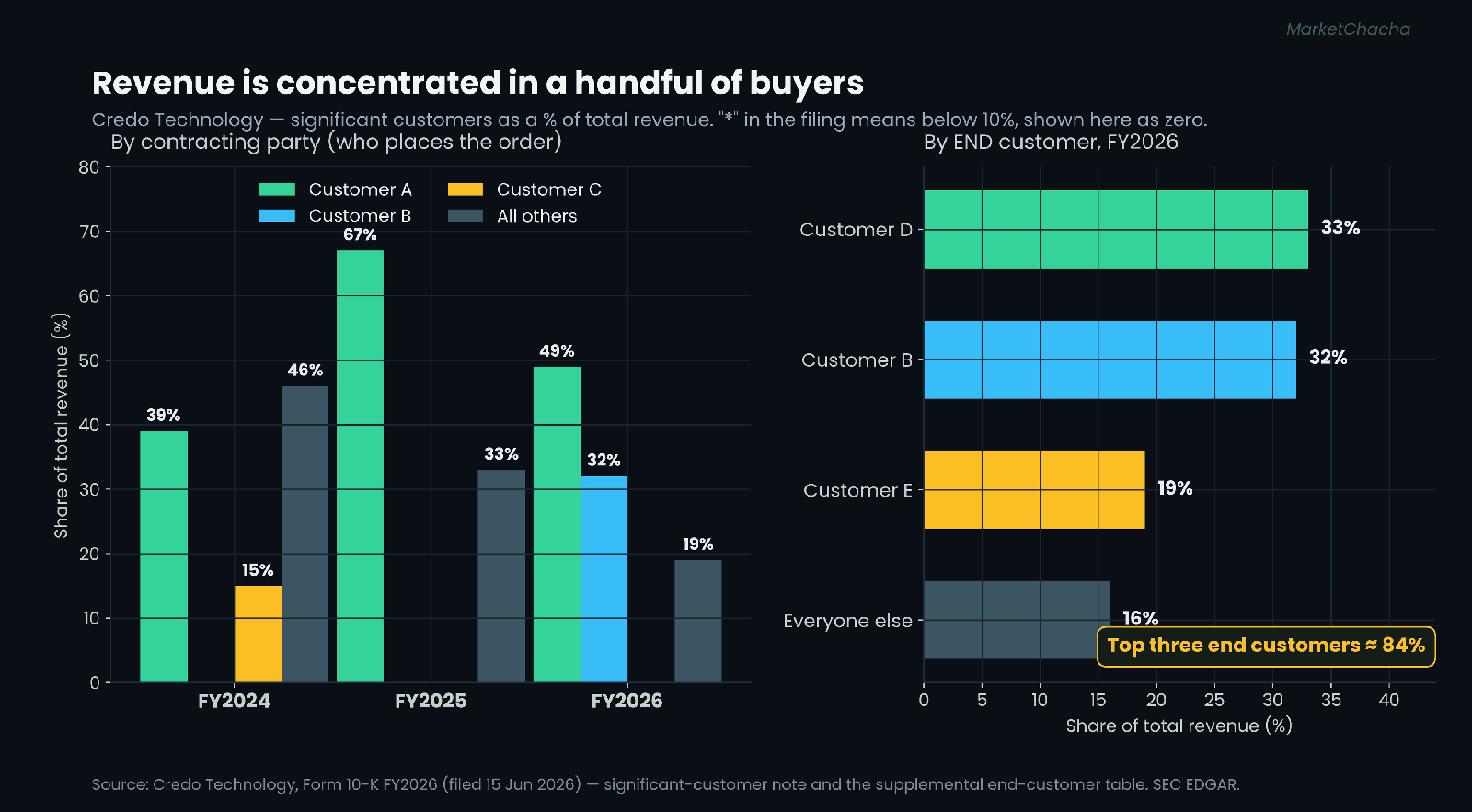
This is the most important table in the filing, and Credo gives it twice — once by contracting party, once by end customer.
| % of total revenue | FY2026 | FY2025 | FY2024 |
| Customer A (contracting party) | 49% | 67% | 39% |
| Customer B | 32% | <10% | <10% |
| Customer C | <10% | <10% | 15% |
And on an end-customer basis, which the company supplies voluntarily: Customer D 33%, Customer B 32%, Customer E 19% in FY2026 — roughly 84% of revenue from three end customers. In FY2025, Customer D alone was 63%. On the receivables side at 2 May 2026: Customer A 53%, Customer B 20%, Customer C 19% of total accounts receivable.
Credo does not name these customers in the 10-K. It does name one buyer elsewhere: the revenue-recognition note discloses a warrant issued to Amazon.com NV Investment Holdings LLC, accounted for as an equity instrument with the vested value amortised as a reduction of revenue. That warrant was exercised in FY2026 for 3,761,000 ordinary shares, with no cash proceeds to Credo.
Neutral context: customer warrants are a standard way for a large buyer to extract economics in exchange for volume commitments, and the accounting (contra-revenue) is the prescribed treatment. The fact worth holding is structural, not moral — a business where three end buyers are 84% of revenue is a business whose revenue line is a function of a very small number of capex decisions. Credo says so itself in Item 1A.
Where it is actually made — plants and supply chain
Credo owns no fab. Per the FY2026 10-K:
- Wafers: "In fiscal year 2026, we exclusively used Taiwan Semiconductor Manufacturing Company Limited (TSMC) for semiconductor wafer production."
- Assembly and test: Amkor, ASE, KYEC and Sigurd for ICs; BizLink for AEC products.
- Contracts: "Except for our agreement with BizLink... we do not maintain long-term supply contracts with TSMC" — and none of these vendors has given contractual capacity assurances. Credo estimates a foundry or assembly transition would take 9 to 12 months.
Physical footprint (Item 2, leased square feet at 2 May 2026): United States 143,945; Mainland China 99,088; Taiwan 56,259; Canada 8,200; Hong Kong 7,083; Singapore 2,874 — 317,449 sq ft in total. Property and equipment by location tells the same story from a different angle: Taiwan $68.1m of the $101.6m net book value, versus $14.7m in the US. Headcount at year-end was 807 full-time equivalents, of whom 616 are engineers; 477 sit in Asia and 330 in North America. That works out to roughly $1.65m of revenue per employee.
So: a Cayman-registered, California-managed company whose chips are made in Taiwan, packaged across Asia, whose largest single asset base sits in Taiwan, and whose second-largest office is in mainland China. Every one of those is disclosed. Each is also a live exposure to export controls and cross-strait policy, which the 10-K discusses at length in Item 1A.
Five years of numbers
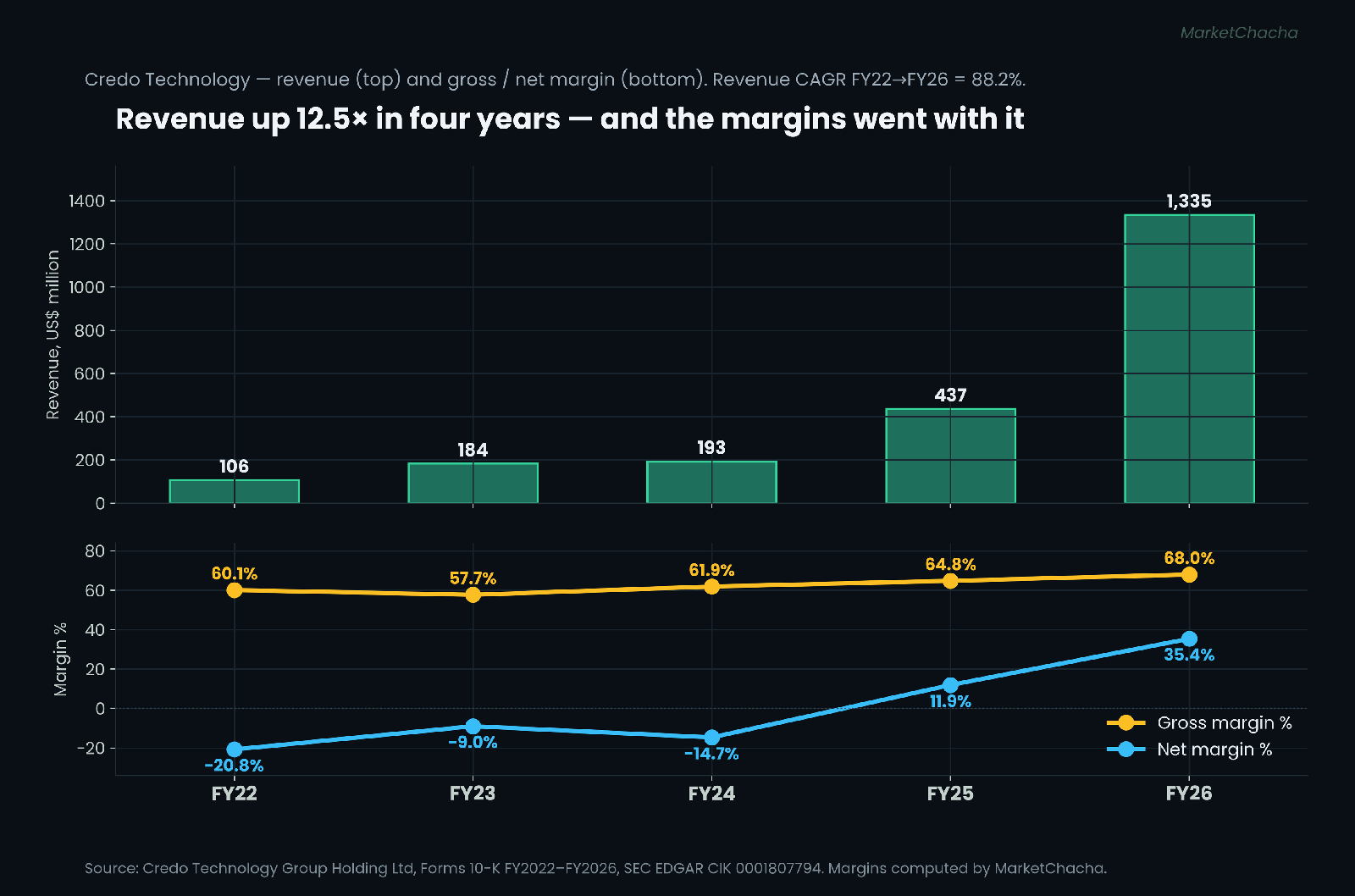
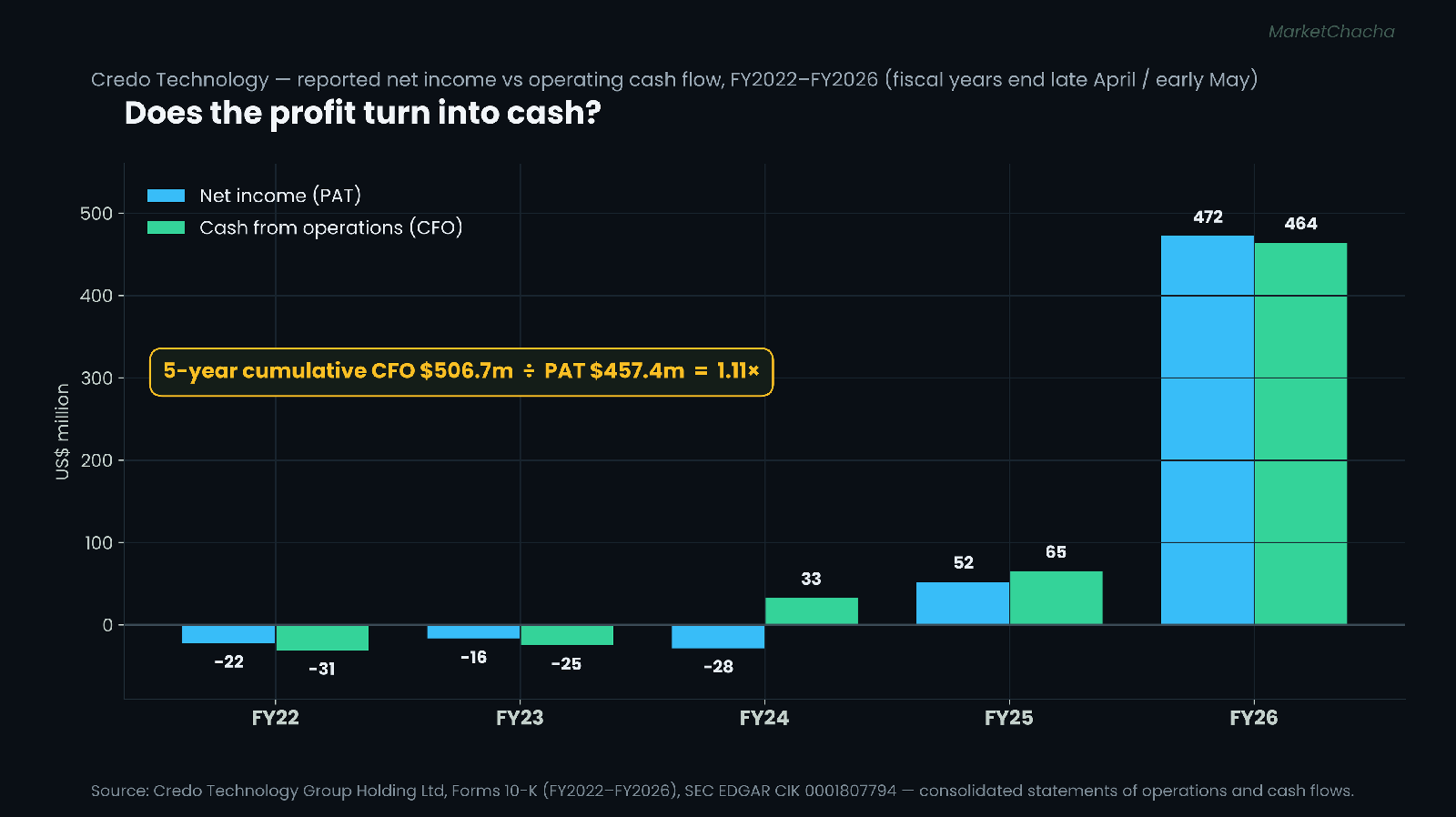
| $ million | FY2022 | FY2023 | FY2024 | FY2025 | FY2026 |
| Revenue | 106.5 | 184.2 | 193.0 | 436.8 | 1,335.1 |
| Gross margin | 60.1% | 57.7% | 61.9% | 64.8% | 68.0% |
| Operating profit | (22.0) | (21.2) | (37.1) | 37.1 | 445.0 |
| Net profit | (22.2) | (16.5) | (28.4) | 52.2 | 472.3 |
| Cash from operations | (30.8) | (24.6) | 32.7 | 65.1 | 464.3 |
Revenue CAGR FY2022→FY2026 = (1,335.1 ÷ 106.5)1/4 − 1 = 88.2%. Diluted EPS went from a $(0.18) loss in FY2024 to $2.51 in FY2026. At $259.90 that is a trailing P/E of about 103.5×; on FY2026 closing equity of $2,063.6m and a market capitalisation of roughly $48.5bn, price-to-book is about 23.5×. For a named listed comparator, Astera Labs (NASDAQ: ALAB) — the closest pure-play peer in AI connectivity — carried a market capitalisation of roughly $55.5bn on a trailing P/E reported around 283× on 18 August 2026. Both numbers are what they are; neither is a judgment.
Income statement — FY2026 vs FY2025
| $'000 | FY2026 | FY2025 | Change | % |
| Revenue | 1,335,116 | 436,775 | +898,341 | +205.7% |
| Cost of revenue | 426,767 | 153,866 | +272,901 | +177.4% |
| Gross profit | 908,349 | 282,909 | +625,440 | +221.1% |
| Gross margin | 68.0% | 64.8% | +3.2 pp | — |
| Research & development | 279,381 | 146,867 | +132,514 | +90.2% |
| Selling, general & admin | 183,963 | 98,918 | +85,045 | +86.0% |
| Total operating expenses | 463,344 | 245,785 | +217,559 | +88.5% |
| Operating profit | 445,005 | 37,124 | +407,881 | +1,098.7% |
| Operating margin | 33.3% | 8.5% | +24.8 pp | — |
| Other income, net | 30,430 | 17,746 | +12,684 | +71.5% |
| Profit before tax | 475,435 | 54,870 | +420,565 | +766.5% |
| Tax | 3,156 | 2,687 | +469 | +17.5% |
| Effective tax rate | 0.66% | 4.90% | −4.24 pp | — |
| Net profit | 472,279 | 52,183 | +420,096 | +805.0% |
| Net margin | 35.4% | 11.9% | +23.5 pp | — |
| Diluted EPS ($) | 2.51 | 0.29 | +2.22 | +765.5% |
| Memo: share-based compensation | 182,638 | 77,355 | +105,283 | +136.1% |
Balance sheet — FY2026 vs FY2025
| $'000 | FY2026 | FY2025 | % |
| Cash and cash equivalents | 1,164,952 | 236,328 | +393% |
| Short-term investments | 278,334 | 195,010 | +42.7% |
| Accounts receivable | 233,377 | 162,144 | +43.9% |
| Inventories | 250,831 | 90,029 | +178.6% |
| Property and equipment, net | 101,605 | 63,631 | +59.7% |
| Goodwill | 92,798 | — | new |
| Intangible assets, net | 29,262 | — | new |
| Total assets | 2,295,619 | 809,257 | +183.7% |
| Accounts payable | 107,345 | 56,158 | +91.1% |
| Total liabilities | 232,007 | 127,675 | +81.7% |
| Borrowings | nil | nil | — |
| Additional paid-in capital | 1,672,060 | 765,173 | +118.5% |
| Retained earnings / (deficit) | 389,117 | (83,162) | turned positive |
| Total shareholders' equity | 2,063,612 | 681,582 | +202.8% |
Cash flow — FY2026 vs FY2025
| $'000 | FY2026 | FY2025 |
| Cash from operations (CFO) | 464,292 | 65,083 |
| Cash from investing (CFI) | (253,528) | 111,990 |
| Cash from financing (CFF) | 717,629 | (7,728) |
| Capital expenditure | (57,300) | (36,100) |
| Free cash flow (CFO − capex) | 406,992 | 28,983 |
What moved, and why. The revenue tripling did the heavy lifting: gross profit rose $625m while operating costs rose only $218m, so 70% of the incremental gross profit dropped to operating profit. Gross margin improved 3.2 points; the 10-K attributes the revenue increase primarily to "significant increase in volume unit shipment". Three balance-sheet lines moved more than 40%: cash (+393%, driven by the equity raise below), inventories (+179%) and goodwill/intangibles (from nil, on the Hyperlume and Comira acquisitions for $112.9m of cash). CFF of +$717.6m is almost entirely the at-the-market share sale.
Earnings quality. The PBT increase of $420.6m is overwhelmingly operating: operating profit contributed $407.9m of it, other income only $12.7m. Other income fell from 32.3% of PBT in FY2025 to 6.4% in FY2026 — the profit got more core, not less. The one line worth naming plainly is tax: the charge was $3.156m on $475.4m of pre-tax profit, so essentially none of the FY2026 profit growth was consumed by tax. That is explained in the company's own reconciliation, discussed below. Share-based compensation of $182.6m is a real cost that is added back in CFO; it equals 13.7% of revenue and 38.7% of net profit.
The latest quarter, decoded
Credo does not file a Q4 10-Q, so the quarter below is computed by MarketChacha as the FY2026 full-year figure minus the nine months reported in the Q3 10-Q (period ended 31 January 2026). The prior-year quarter is derived the same way.
| $ million | Q4 FY26 (Feb–May 26) | Q3 FY26 | QoQ | Q4 FY25 | YoY |
| Revenue | 437.0 | 407.0 | +7.4% | 170.1 | +156.9% |
| Gross profit | 298.0 | 278.9 | +6.8% | 114.2 | +160.9% |
| Gross margin | 68.2% | 68.5% | −0.3 pp | 67.1% | +1.1 pp |
| Research & development | 90.6 | 78.5 | +15.4% | — | — |
| Operating profit | 155.9 | 149.6 | +4.2% | 33.8 | +361.2% |
| Net profit | 169.2 | 157.1 | +7.7% | 36.5 | +363.6% |
Decoded: sequential growth slowed sharply — +7.4% QoQ against +51.7% in the prior quarter. Gross margin was flat to slightly down. R&D grew 15.4% QoQ, more than twice the revenue growth rate, which is why operating profit (+4.2%) grew more slowly than revenue. And note that net profit ($169.2m) exceeds operating profit ($155.9m) — the gap is interest on the newly raised cash pile plus a near-zero tax charge, i.e. two non-operating contributors. On a strictly operating read, the quarter decelerated even as the headline stayed enormous.
Who owns it — and where those owners are registered
From the FY2025 proxy (holdings as at 31 July 2025, on 172,914,100 shares then outstanding):
| Holder | Shares | % |
| Entities affiliated with The Vanguard Group | 16,355,363 | 9.84% |
| Entities affiliated with BlackRock, Inc. | 11,365,226 | 6.7% |
| Entities affiliated with JPMorgan Chase & Co | 5,494,410 | 3.2% |
| Chi Fung (Lawrence) Cheng — co-founder | 7,241,651 | 4.19% |
| Pantas Sutardja — co-founder | 5,894,244 | 3.41% |
| Yat Tung (Job) Lam | 3,686,577 | 2.13% |
| William (Bill) Brennan — CEO | 2,401,760 | <1% |
| All directors and named executives (11) | 20,485,926 | 11.84% |
Later 13F aggregations reported BlackRock at roughly 19.8m shares (about 10.6%) as at 31 March 2026, with Vanguard, JPMorgan, Point72, State Street, Geode, T. Rowe Price, AllianceBernstein and Wellington also among the largest holders; those are third-party aggregations of 13F data rather than a single filing, and are flagged as such.
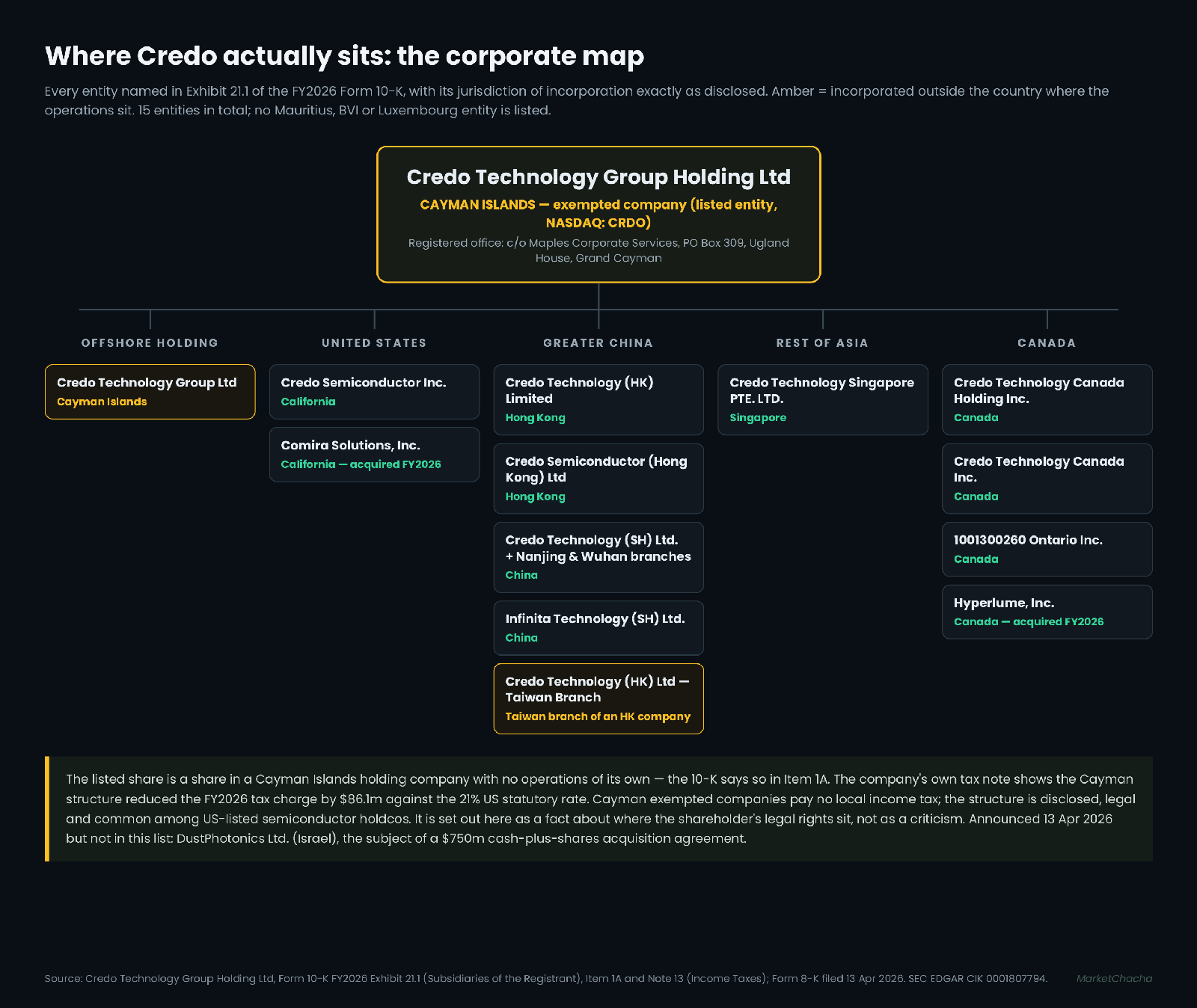
The jurisdiction chain. Exhibit 21.1 of the FY2026 10-K lists 15 entities. Two are Cayman Islands (the listed holdco and Credo Technology Group Ltd). Two are California. Two are Hong Kong, plus a Taiwan branch of a Hong Kong company. Two are China, plus Nanjing and Wuhan branches. One is Singapore. Four are Canada, including Hyperlume, Inc., acquired in FY2026. There is no Mauritius, BVI, Cyprus or Luxembourg entity in the list.
Neutral context, stated once: Item 1A says plainly that "Credo Technology Group Holding Ltd is a holding company incorporated as an exempted company under the laws of the Cayman Islands with no operations of its own", that Cayman shareholder-rights precedent is more limited than under US law, and that enforcing a US judgment against the company or its PRC or Hong Kong subsidiaries may be difficult. Separately, the FY2026 tax reconciliation shows the "Foreign rate differential: Cayman Islands" line reducing the tax charge by $86,088 thousand, or 18 percentage points, against the 21% US statutory rate. Cayman exempted companies pay no local income tax; the structure is disclosed, legal and common among US-listed semiconductor holdcos. It is set out here as a fact about where the shareholder's legal rights and the group's tax base sit — not as a criticism.
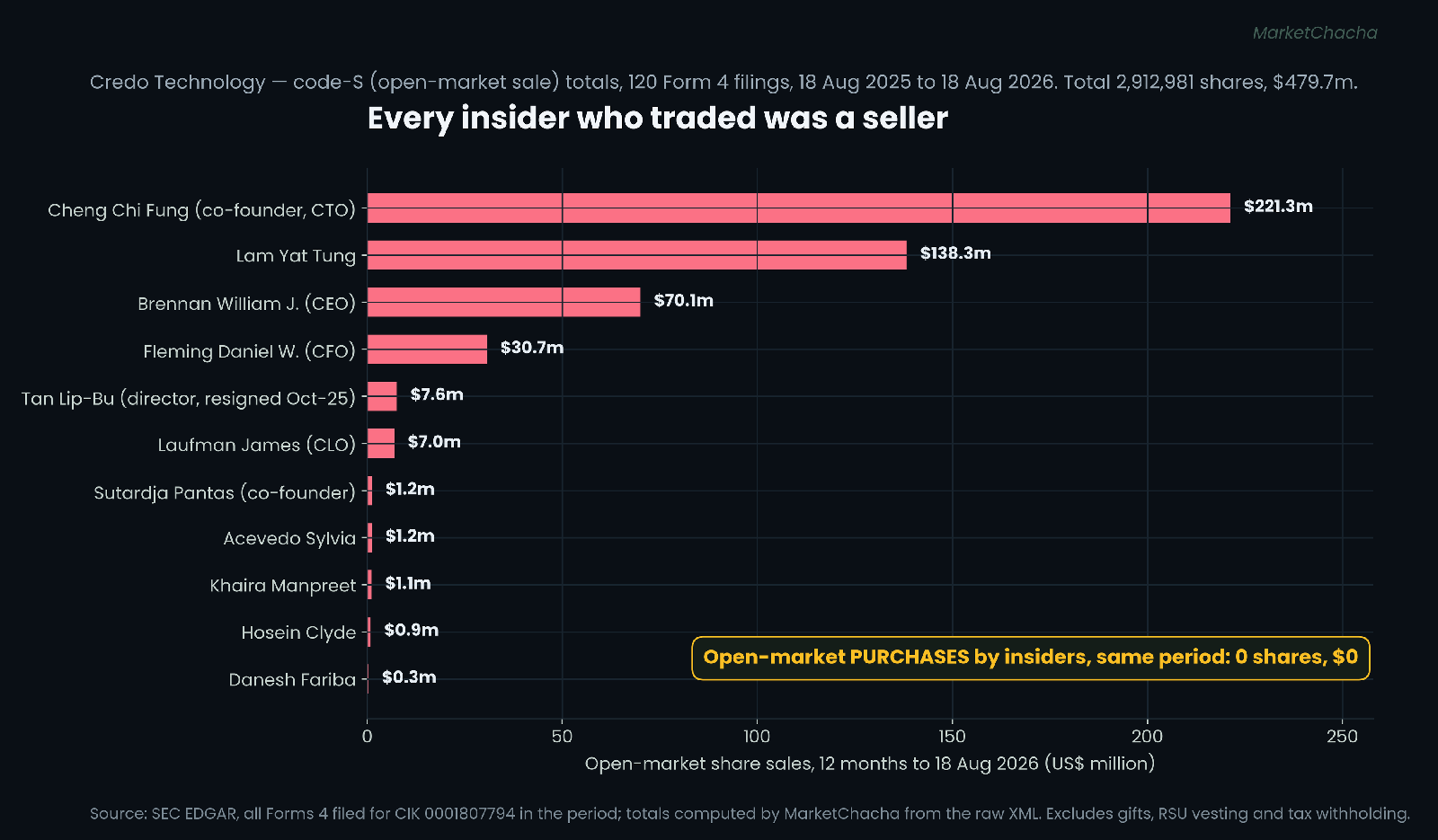
Insider dealing. MarketChacha parsed every Form 4 Credo insiders filed in the twelve months to 18 August 2026 — 120 filings. Transaction code S (open-market sale) totals 2,912,981 shares for $479.7 million. Transaction code P (open-market purchase) totals zero shares, $0. Every director and officer who transacted was a seller. The two largest were Cheng Chi Fung ($221.3m) and Lam Yat Tung ($138.3m); CEO Bill Brennan sold $70.1m and CFO Daniel Fleming $30.7m.
The benign explanation is in the filings themselves and is material: the Form 4 footnotes state the sales were "effected pursuant to a Rule 10b5-1 trading plan" adopted months in advance — Cheng's family trust plan on 5 September 2025, Lam's on 15 April 2026. Pre-scheduled 10b5-1 selling by founders after a share price that has multiplied, where almost all executive pay is delivered in equity and selling is the only way to realise it, is ordinary and is what these plans exist for. The fact remains that in a year when revenue tripled, not one insider bought a share in the open market.
Capital history — every time they raised money
From the consolidated statements of shareholders' equity across the FY2024–FY2026 filings:
- Jan 2022 — IPO. 20.0m shares at $10.00; 18.38m new, gross proceeds to the company about $183.8m.
- Dec 2023 — secondary public offering. 10,440,000 new shares, net proceeds $173.4m (prospectus supplement 424B5 filed 6 December 2023).
- FY2026 — at-the-market programme. Following a shelf registration (S-3ASR) and prospectus supplement filed 6 October 2025, Credo issued 4,820,000 shares under an ATM for net proceeds of $736,327 thousand — an average of roughly $152.8 per share. This single line is the largest capital event in the company's history and explains the $1.16bn cash balance.
- FY2026 — customer warrant exercise. 3,761,000 shares issued to the Amazon warrant holder, no cash proceeds.
- Equity plans. 5,835,000 shares issued in FY2026 for $7.1m; $19.2m of shares withheld for RSU tax.
- Buybacks: none disclosed. Dividends: none, ever. Debt: none on the balance sheet.
Dilution: shares outstanding went 148,651k (Apr 2023) → 164,305k → 171,169k → 185,419k (May 2026), i.e. +24.7% in three years. Weighted-average diluted shares were 188,232k in FY2026 versus 181,158k in FY2025.
And the largest commitment of all. On 13 April 2026 Credo and its California subsidiary signed a share purchase agreement to acquire 100% of DustPhotonics Ltd. (Israel) for upfront consideration of $750,000,000 in cash plus approximately 0.92 million ordinary shares, with contingent consideration of up to a further ~3.21 million shares on financial milestones. The shares are issued unregistered under Section 4(a)(2)/Reg D/Reg S with piggyback registration rights. Read alongside the October 2025 ATM, the sequence is: raise $736m of equity, then commit $750m of cash. Both are disclosed; the ordering is a fact readers can weigh for themselves.
Who runs it, and the wider web
CEO: William (Bill) Brennan. CFO: Daniel Fleming. Chief Legal Officer & Secretary: James Laufman. Board members named in the FY2025 proxy include Chi Fung (Lawrence) Cheng, Pantas Sutardja, Yat Tung (Job) Lam, Clyde Hosein, Fariba Danesh, Manpreet Khaira and Sylvia Acevedo.
Board change. An 8-K filed 29 October 2025 discloses that Lip-Bu Tan resigned from the board effective 23 October 2025. The filing states the resignation "was not due to any disagreement with the Company on any matter relating to the Company's operations, policies, or practices." Brian Kelleher — SVP of Hardware Engineering at NVIDIA from 2005 to 2024 — was elected a Class III director effective 27 October 2025 and determined to be independent.
Auditor. Ernst & Young LLP, San Jose (PCAOB ID 42), auditor since 2018. The FY2026 opinion is unqualified, with an accompanying unqualified opinion on internal control over financial reporting. The single critical audit matter is the excess-and-obsolete inventory reserve. There is no Item 4.01 8-K (auditor dismissal or resignation) in the company's filing history. Fees per the FY2025 proxy: audit $1,963,770; audit-related nil; tax nil; other $3,600 — so 99.8% of the auditor's fees are audit fees.
CEO pay. An 8-K filed 1 June 2026 discloses a one-time special performance-based RSU award to Mr Brennan, 100% performance-vesting across six tranches of 239,500 shares each over a period ending 30 June 2031, requiring both a revenue hurdle ($2.5bn rising to $7.5bn of trailing four-quarter revenue) and a share-price hurdle ($244.70 rising to $489.40). The Compensation Committee states this is intended to be his only equity award for approximately five years. The top tranche implies revenue roughly 5.6× the FY2026 level.
Related-party transactions. The FY2025 proxy discloses, in total: registration rights under the members agreement; standard director and officer indemnification agreements; and one item — a family member of CEO Bill Brennan accepted employment as ESG Manager from 30 September 2025, at compensation exceeding $120,000 a year "determined in accordance with our compensation policies applicable to other employees of similar title and responsibility." Nothing else meets the $120,000 disclosure threshold. That is an unusually thin related-party section for a company of this size, and the disclosure of the family hire is what the rule is designed to produce.
The regulatory and surveillance record
- SEC enforcement: no SEC litigation release, administrative proceeding or AAER naming Credo Technology was located.
- Litigation: Item 3 states Credo is "not presently a party to any litigation the outcome of which, we believe, if determined adversely to us, would individually or taken together have a material adverse effect on us." Following the February 2023 guidance disclosure, several plaintiffs' law firms publicly announced investigations; those are law-firm press releases, not filings, and no resulting material proceeding appears in Item 3 of any subsequent 10-K.
- Auditor / CFO resignations: none in the period reviewed. No Item 4.01 filing exists.
- Item 9C (foreign jurisdictions that prevent inspections): "Not applicable" — Credo's auditor is US-based and PCAOB-inspectable, so the HFCAA delisting mechanism does not apply despite the China operations.
- Exchange surveillance: the ASM/GSM framework is an Indian-exchange mechanism and has no US equivalent; Credo trades normally on Nasdaq Global Select.
- Credit ratings: none located, and none required — the company has no borrowings.
Forensic checks — what the accounts show
| Check | What we found | A benign explanation |
| 1. 5-yr cumulative CFO ÷ PAT | CFO $506.7m ÷ PAT $457.4m = 1.11×. FY2026 alone: 464.3 ÷ 472.3 = 0.98× | Nothing to explain away — reported profit is converting into cash. |
| 2. Cash vs interest earned | Cash + short-term investments $1,443.3m at year end. Other income net $30.4m on an average balance of ~$937m = implied yield 3.25% | Consistent with US short-term rates over the period; most of the cash only arrived in October 2025. |
| 3. Implied interest rate on debt | Not applicable — no borrowings disclosed on the FY2026 or FY2025 balance sheet | — |
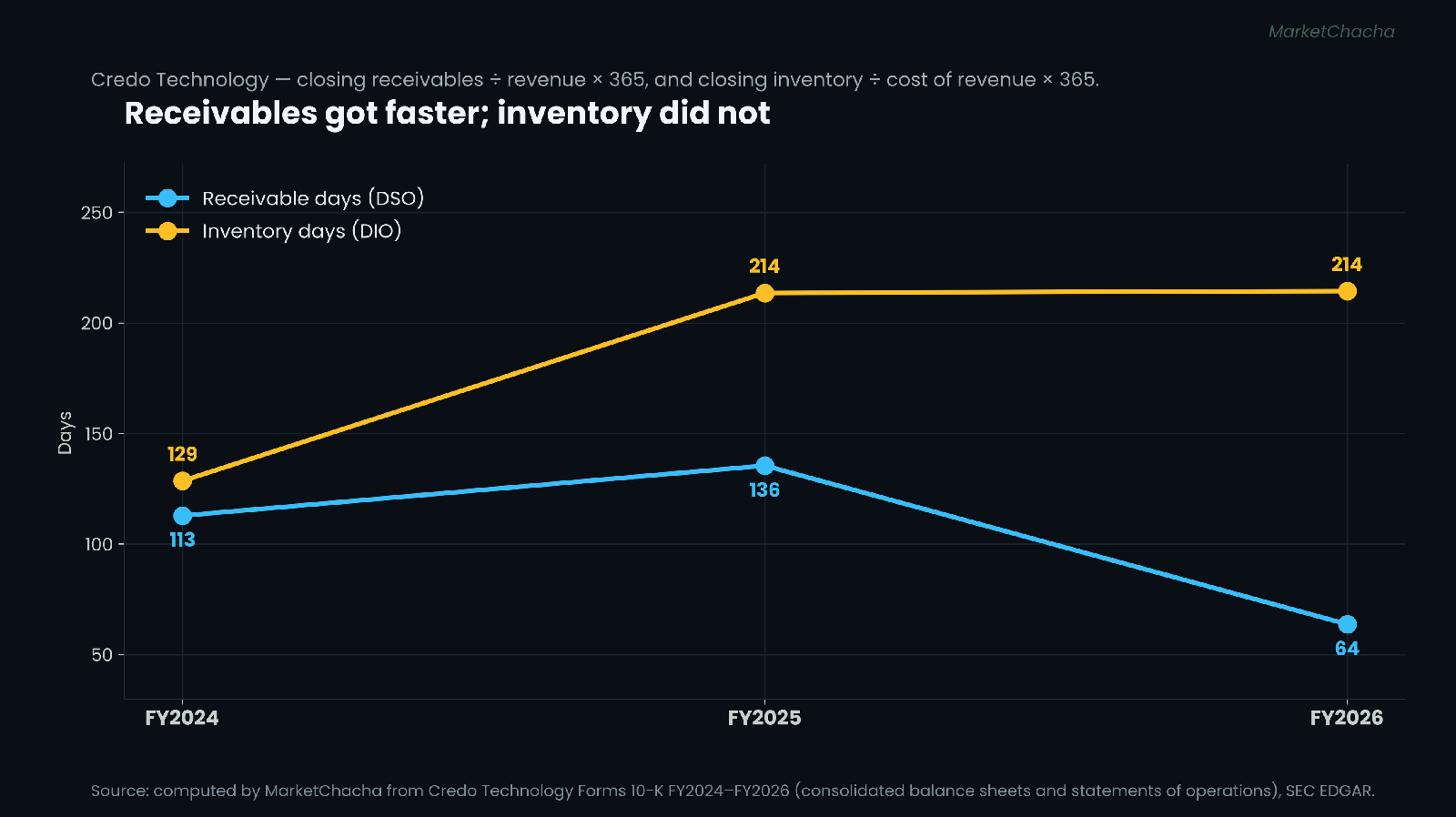
| 4. Receivable and inventory days | DSO 113 (FY24) → 136 (FY25) → 64 (FY26). DIO 129 → 214 → 214 | DSO improving while revenue triples is the opposite of the revenue-inflation pattern. Flat 214-day inventory alongside a $174m inventory build is consistent with stocking ahead of demand; it is also the line that hurts first if demand slips. |
| 5. Related-party transactions | One disclosed item above the $120k threshold: a CEO family member employed as ESG Manager. RPT as a % of revenue is immaterial | Disclosed, benchmarked to standard pay policy, and reviewed under the company's RPT policy. |
| 6. Insider net selling | 12 months to 18 Aug 2026: $479.7m sold, $0 bought, across 120 Form 4s | Footnotes confirm Rule 10b5-1 plans adopted in advance; founders diversifying after a large price rise, with equity as the main pay vehicle. |
| 7. Auditor | EY since 2018. Unqualified opinion on both financials and ICFR. No change, no resignation, no qualification in five years. 99.8% of fees are audit fees | — |
| 8. Subsidiaries and jurisdictions | 15 entities. Cayman ×2, California ×2, Hong Kong ×2 (+Taiwan branch), China ×2 (+2 branches), Singapore ×1, Canada ×4. No Mauritius / BVI / Cyprus / Luxembourg | Cayman holdco is standard for this cohort; the operating entities sit where the engineers and customers are. |
| 9. Dilution and issuance | Shares +24.7% in 3 years. FY2026 ATM: 4.82m shares for $736.3m net (~$152.8/share). Customer warrant: 3.761m shares for no cash | ATM issued into strength at market prices, not at a discount to a related party. The warrant was a disclosed commercial arrangement charged against revenue as it vested. |
| 10. Other income as % of PBT | 6.4% (FY26) vs 32.3% (FY25) | Profit became more operating in character, not less. |
| 11. Capex vs depreciation, asset turnover | Capex $57.3m vs D&A $34.6m = 1.65×. Asset turnover (revenue ÷ average total assets) = 0.86× | Capex is mostly mask sets and R&D compute, per the MD&A. Asset turnover is depressed by the $1.44bn of cash and investments sitting idle at year end. |
| 12. Tax | Effective rate 0.66%. The reconciliation names the drivers: Cayman rate differential −$86.1m (−18pp), share-based comp −$73.4m (−15pp), R&D credit −$32.0m (−7pp), offset by a valuation-allowance movement +$78.6m (+17pp) | Each component is a standard, disclosed US GAAP item. Note the two largest reliefs — the Cayman differential and the share-comp deduction — are structurally linked to the share price and the group structure, not to operating performance. |
What we could not verify
- The names of Customers A, B, C, D and E. Credo does not disclose them. We can only confirm Amazon as the counterparty to the warrant; nothing in the filings ties Amazon to any lettered customer, and we have not made that link.
- Revenue by product line. Not disclosed — Credo reports one segment.
- Beneficial ownership above the 13F/13G layer. The proxy names only institutional aggregates and individuals. Ultimate beneficial owners behind fund vehicles are not publicly identifiable, which is normal.
- Q4 FY2026 figures. Derived arithmetically (full year minus reported nine months), not filed as a standalone statement. Small rounding differences are possible.
- 13F holdings after 31 March 2026. The most recent aggregations we could reach are as at that date; Q2 2026 filings were not individually verified.
- Whether the DustPhotonics acquisition has closed, and the final accounting for it. The agreement was signed 13 April 2026; we did not locate a closing 8-K.
- Gross margin by geography or customer, and the pricing terms of any customer warrant arrangement beyond the Amazon disclosure.
What would change the picture
- The next 10-Q (Q1 FY2027, quarter to early August 2026). Two things to look at: whether sequential revenue growth reaccelerates from +7.4%, and what happens to the $250.8m inventory line.
- The FY2026 proxy, due within 120 days of 2 May 2026, for the updated beneficial-ownership table and any new related-party items.
- The customer-concentration note in the next annual report. Customer A went 39% → 67% → 49%. Whether concentration keeps broadening or re-concentrates is the single most consequential number in the filing.
- Closing 8-K and purchase-price allocation for DustPhotonics — $750m of cash leaving a $1.16bn balance, and how much of it lands in goodwill.
- Form 4 flow. Whether new 10b5-1 plans are adopted, and whether any insider buys in the open market.
- Any Item 4.01 8-K (auditor change) or a change in the critical audit matter around inventory.
- Concentration of supply. Credo says it used TSMC exclusively in FY2026 and has no long-term capacity contract; any disclosure of a second foundry, or of a capacity prepayment, changes the risk profile.
Sources
- Credo Technology Group Holding Ltd, Form 10-K for FY2026 (filed 15 June 2026) — Items 1, 1A, 2, 3, 5, 7, 8, 9C; consolidated financial statements and notes.
- Exhibit 21.1 — Subsidiaries of the Registrant (FY2026 10-K).
- Form 10-K for FY2025 (filed 2 July 2025).
- Form 10-K for FY2024 (filed 24 June 2024).
- Form 10-Q for the quarter ended 31 January 2026 (filed 3 March 2026) — nine-month figures used to derive Q4.
- Definitive Proxy Statement (DEF 14A), filed 25 August 2025 — beneficial ownership, audit fees, related-party transactions.
- Form 8-K filed 13 April 2026 — Item 3.02, DustPhotonics Ltd. share purchase agreement.
- Form 8-K filed 29 October 2025 — Item 5.02, board resignation and appointment.
- Form 8-K filed 1 June 2026 — FY2026 results and the CEO special performance RSU award.
- Prospectus supplement (424B5) filed 6 October 2025 — the at-the-market equity programme.
- All Forms 4 filed for CIK 0001807794 — 120 filings from 18 August 2025 to 18 August 2026; insider totals computed by MarketChacha from the raw XML.
- SEC XBRL company facts, CIK 0001807794 — five-year financial series.
- Credo announces pricing of initial public offering, 27 January 2022 — IPO price and size.
- Market price, market capitalisation and 52-week range as at 17–18 August 2026; Astera Labs comparator statistics.
FAQ
Is Credo Technology an Indian or a US company? Neither, strictly. It is incorporated in the Cayman Islands, headquartered and managed from San Jose, California, listed on Nasdaq, and has most of its employees in Asia. The share you buy is a share in a Cayman holding company that, in its own words, has "no operations of its own".
Why is the tax rate only 0.66%? The company's own reconciliation names the drivers: a Cayman Islands rate differential worth $86.1m, a share-based compensation deduction worth $73.4m and an R&D credit worth $32.0m, partly offset by a $78.6m valuation-allowance movement. All are standard, disclosed US GAAP items. Two of the three largest reliefs are tied to the share price and the group structure rather than to trading performance.
How concentrated is the customer base, exactly? On a contracting-party basis, one customer was 49% of FY2026 revenue and a second was 32%. On the end-customer basis Credo supplies voluntarily, three customers were 33%, 32% and 19% — roughly 84% of the total. The company does not name any of them.
Should the insider selling worry me? That is your call, and this report does not make it. The verified facts: $479.7m of open-market sales and zero open-market purchases over twelve months, with the Form 4 footnotes confirming the sales ran through Rule 10b5-1 plans adopted in advance. Pre-scheduled selling by founders whose pay is almost entirely equity is ordinary; the absence of any buying is simply also true.
Does Credo have any debt? No borrowings appear on the FY2026 or FY2025 balance sheet. Total liabilities of $232.0m are trade payables, accruals and lease obligations against $2,063.6m of equity and $1,443.3m of cash and short-term investments — before the $750m cash commitment for DustPhotonics.
What is the biggest single-point-of-failure in the filings? The company states it used TSMC exclusively for wafer production in FY2026, holds no long-term supply contract with TSMC, has no contractual capacity assurance from any manufacturer, and estimates 9 to 12 months to transition foundries. That is disclosed in Item 1A, not inferred.
Independent research for education and discussion only. Not investment advice, not a recommendation, and not a rating — we issue no buy/sell calls and no target prices. Every figure is sourced from the primary documents linked above; figures can be restated and we can make mistakes, so always verify against the original. Nothing here alleges wrongdoing by any company or individual: where a fact raises a question we state the fact, cite it, and give the benign explanation alongside. Offshore holding structures, pledging and preferential allotments are all legal and common — they are disclosed here as facts, not as accusations.
This article is for educational and informational purposes only. It is not financial advice, investment recommendation, or a solicitation to buy or sell securities. Investing involves significant risks. I am not a SEBI-registered investment advisor. Readers should consult their own financial advisor and conduct their own research before making any investment decisions.
Comments
Join the conversation
Sign in to join the conversation.
Follow replies, add your view, and take part in the discussion.
Sign in to commentLoading comments...