

GK Energy: what their latest filing actually means
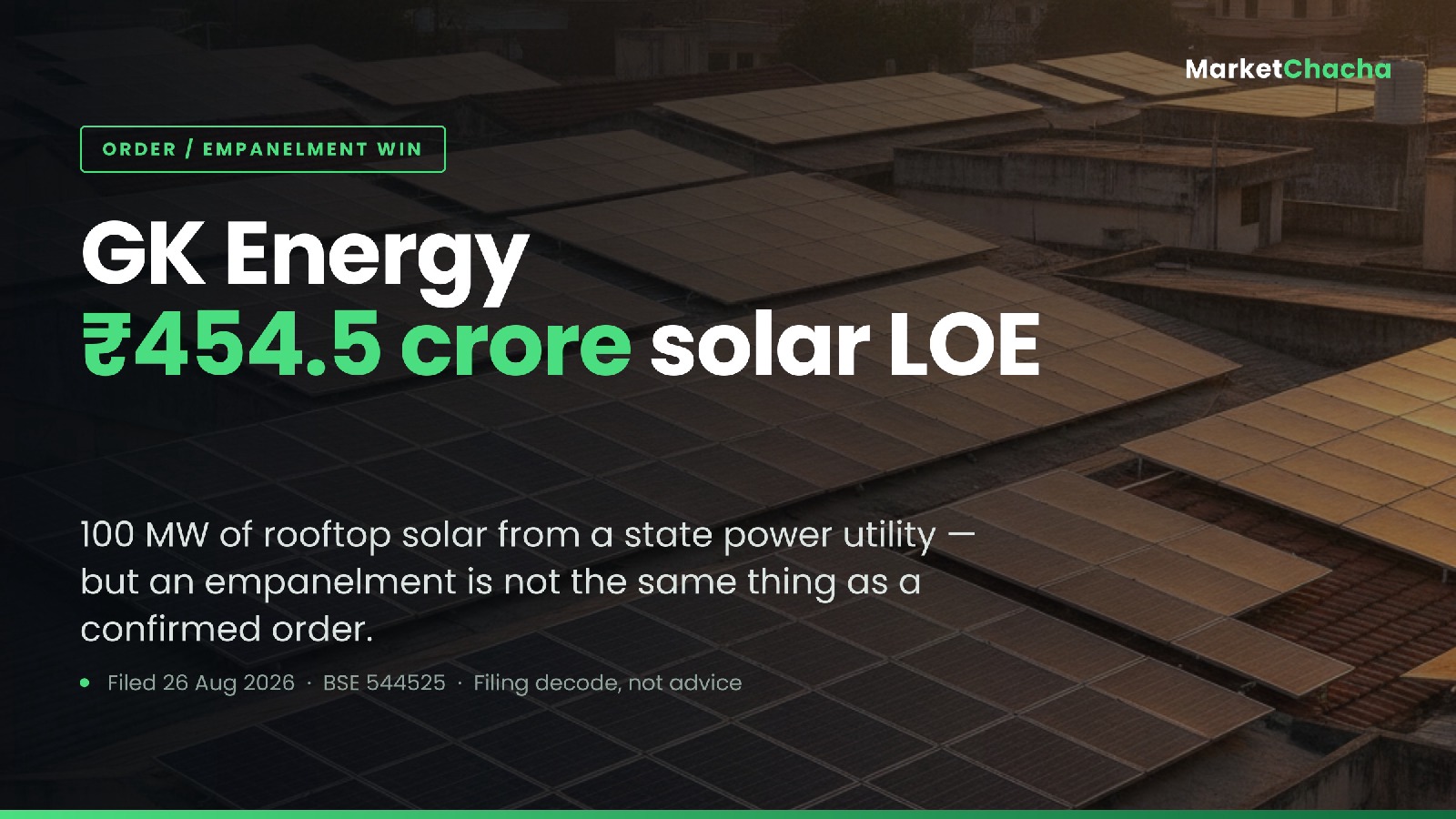
GK Energy Ltd told the exchanges on 26 August 2026 that it has received a Letter of Empanelment (LOE) from a state government-owned power distribution utility for 100 MW of grid-connected rooftop solar — one lakh (100,000) systems of 1 kW each — worth roughly ₹454.50 crore including GST. The stock jumped about 8% on the day and was still up around 4% in trade on Friday, 28 August. The interesting part for a beginner is the word empanelment, because it does not mean quite the same thing as an order.
What was announced
- Instrument: a Letter of Empanelment (LOE), not a work order or an LOA against a signed contract.
- Counterparty: a "leading state government-owned power distribution utility" — the discom was not named in the disclosure.
- Size: 100 MW, structured as 1,00,000 grid-connected rooftop solar PV systems of 1 kW each.
- Value: approximately ₹454.50 crore including GST, at a rate of ₹45,450 per kW. (Sanity check: 1,00,000 kW × ₹45,450 = ₹454.5 crore. The arithmetic ties out.)
- Scope: design, engineering, supply, installation, testing and commissioning — plus operations and maintenance for five years.
- Filing date: 26 August 2026.
What this type of filing means
Indian listed companies disclose new business under SEBI's LODR rules, and the announcements come in several flavours that beginners often read as identical. They are not.
- LOE — Letter of Empanelment. The buyer has approved you onto a panel of qualified vendors and allocated you a capacity ceiling at a fixed rate. It is permission to execute up to that amount. It is not a guarantee that the full amount gets executed.
- LOI / LOA — Letter of Intent / Award. A step firmer: the buyer intends to award, or has awarded, a specific scope to you.
- Work order / purchase order. The actual instruction to start, usually with quantities and dates. This is what most reliably converts into revenue.
In rooftop solar under schemes like PM Surya Ghar, empanelment is the normal first step. The vendor is put on the discom's panel; individual households then register, choose an empanelled vendor and get the system installed, with the subsidy flowing through. So the ₹454.5 crore is best read as an addressable ceiling over a period, not a cheque already in the post. How much of it converts depends on consumer registrations, subsidy disbursement pace and the company's own installation capacity.
This is also why a company can file another announcement months later saying an earlier LOE has been amended or enhanced — GK Energy itself did exactly that on its solar-pump empanelment in December 2025.
Why it matters / potential impact
Taken at face value, ₹454.5 crore is a meaningful number against a company with a market capitalisation of roughly ₹2,837 crore — the announced ceiling is around 16% of the company's entire market value. That is why a mid-cap moves 8% on this and a Reliance-sized company would not move at all on the same rupee figure. Order size only matters relative to the size of the business receiving it.
Three things worth thinking through, without predicting anything about the share price:
- Diversification of the revenue base. GK Energy's core has been solar agricultural water pumps under PM-KUSUM. Rooftop solar for households is an adjacent but different customer, different install profile and different subsidy scheme. If it converts, it reduces dependence on a single government programme — a real structural positive. If it does not, the concentration stays where it was.
- Working capital, not just margin. EPC businesses that serve government schemes typically fund materials and installation up front and get paid against milestones and subsidy release. A large ceiling can therefore consume cash before it produces profit. For any EPC company, the receivables and cash-flow lines in the next results are usually more informative than the headline order number.
- The five-year O&M tail. The annuity-like maintenance element is generally steadier and higher-margin than one-time installation, but it is also a five-year obligation on 100,000 small distributed systems, which is an execution and servicing commitment, not free money.
The honest summary: this is a genuine positive datapoint on the demand side, with the conversion rate as the open question. No price prediction, no recommendation.
Is it expensive?
As reported on Screener.in, GK Energy trades at roughly ₹140 per share, a market cap of about ₹2,837 crore, a P/E of about 12.7 and a P/B of about 3.2 (book value around ₹43.6). Its 52-week range is ₹240 / ₹87.2, so the stock sits well below its high despite this week's move.
Against a named listed peer: Premier Energies trades at about ₹1,004, a market cap of roughly ₹45,572 crore, a P/E of about 27.4 and a P/B of about 10.6. So GK Energy is optically much cheaper — under half the peer's earnings multiple and under a third of its book multiple.
But "cheaper" and "better value" are not synonyms, and it is worth being clear about why the gap exists rather than treating it as a free lunch:
- These are not the same business model. Premier Energies manufactures solar cells and modules (a capital-intensive product business with its own capacity and pricing cycle) alongside EPC. GK Energy is primarily a services/EPC installer. Manufacturing and EPC do not normally carry the same multiple, in either direction.
- GK Energy is far smaller and much more recently listed (it came to market in September 2025). Short listed histories mean less visible track record through a full cycle, and small caps generally carry wider valuation swings.
- Its revenue has been concentrated on government scheme execution, which brings policy and payment-timing risk that the market discounts for.
So: low double-digit earnings multiple is genuinely modest in absolute terms and versus this peer, but the discount is attached to identifiable risks — scale, concentration and scheme dependence — rather than being an oversight. Whether the discount is too wide or about right is exactly the judgement an investor has to make for themselves. Multiples also shift with every quarter's earnings, so always re-check the current figure rather than relying on a number in an article.
The business
GK Energy is an engineering, procurement and construction (EPC) company in solar, not a panel manufacturer. Its main activity to date:
- Solar agricultural water pumps — its core, executed under Component B of the PM-KUSUM scheme, replacing diesel and grid-powered irrigation pumps with solar ones for farmers.
- Geographic base — Maharashtra, Haryana, Rajasthan, Uttar Pradesh and Madhya Pradesh, states that together account for roughly 82% of total sanctioned pump volume under the programme.
- Track record — over 100,000 solar pump systems installed to date.
- Adjacent work — participation in state-level solar initiatives, of which this rooftop empanelment is the newest and largest example.
Because the company is fairly focused rather than a sprawling conglomerate, a 100 MW rooftop empanelment is not a small slice of one division — it is a new leg for the whole business. That is a useful contrast with, say, a large diversified group where a big order in one subsidiary barely registers at the consolidated level.
Beginner takeaway
Read the noun in the announcement, not just the number. An empanelment is a ceiling you are allowed to execute against; a work order is a job you have been told to start — and the gap between the two is where a lot of headline order values quietly go missing. Then scale the number against the company's market cap and revenue base to judge whether it is genuinely transformative or just a nice press release. Finally, for EPC businesses, follow the cash: the next couple of quarterly results, especially receivables and operating cash flow, will say far more about whether this converted than the announcement itself did.
FAQ
Is a Letter of Empanelment the same as winning a ₹454 crore order? No. It means GK Energy has been approved onto a state discom's vendor panel with an allocated capacity of 100 MW at a fixed per-kW rate. The revenue only arrives as individual rooftop installations are actually registered, executed and paid for.
Why did a mid-cap jump 8% on ₹454 crore when a large-cap would not move? Because materiality is relative. ₹454.5 crore is roughly 16% of GK Energy's ~₹2,837 crore market cap. The identical figure at a company worth ₹5 lakh crore would be a rounding error.
What is PM-KUSUM Component B, which keeps coming up with this company? It is the central government scheme segment that subsidises standalone solar-powered agricultural water pumps for farmers. It has been GK Energy's core revenue engine, which is why this rooftop win is being read as diversification.
What should I actually watch from here? Follow-up exchange filings that convert the empanelment into work orders or report executed capacity, and the next quarterly results — particularly revenue mix, receivables and operating cash flow. Those tell you the conversion rate; the announcement alone does not.
As of Friday, 28 August 2026. Filing date: 26 August 2026. Source: official BSE/NSE filing — read it directly here (BSE scrip code 544525; see the company's corporate announcements). Valuation figures as reported by Screener.in. We summarise filings for education and may make errors, so always verify against the official document. Educational content only — not investment advice, not a buy/sell recommendation.
This article is for educational and informational purposes only. It is not financial advice, investment recommendation, or a solicitation to buy or sell securities. Investing involves significant risks. I am not a SEBI-registered investment advisor. Readers should consult their own financial advisor and conduct their own research before making any investment decisions.
Comments
Join the conversation
Sign in to join the conversation.
Follow replies, add your view, and take part in the discussion.
Sign in to commentLoading comments...