

US CPI decoded: 3.4% didn't move — so why did Fed hike odds jump to 86%?
The numbers
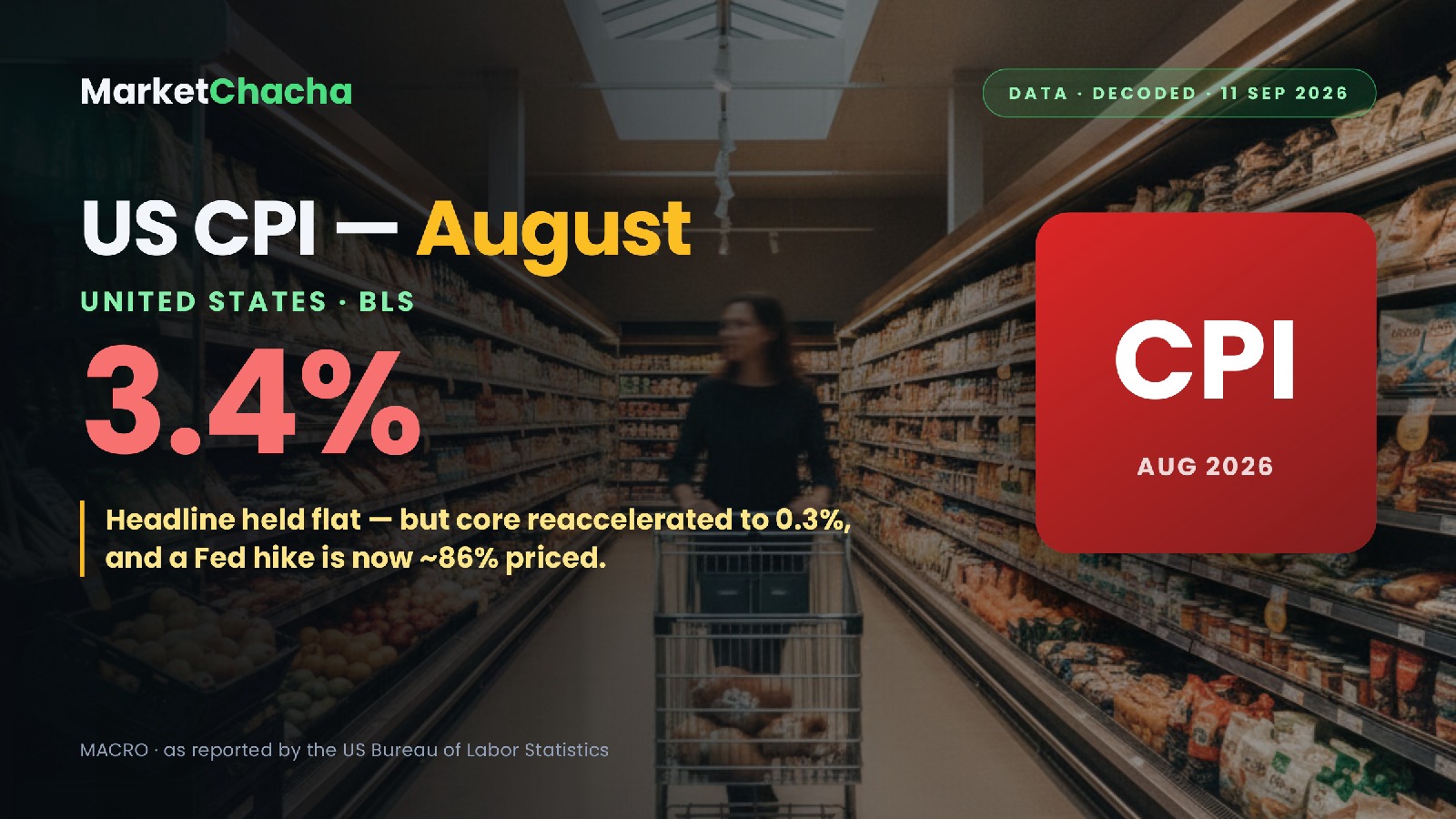
The Bureau of Labor Statistics released August CPI at 8:30 am ET on Friday. Headline consumer prices rose 0.4% on the month, seasonally adjusted, after just 0.1% in July. The 12-month rate came in at 3.4% — exactly where it sat in July, and exactly what economists expected.
Core CPI — everything except food and energy — rose 0.3% on the month against the 0.2% consensus, after 0.2% in July. The core annual rate ticked down to 2.4% from 2.5%.
The engine was fuel. Gasoline jumped 3.9% in August and is up 27.4% over the year. Fuel oil rose 10.1% on the month and 52.0% over 12 months. The whole energy index is +16.3% YoY. BLS says gasoline alone accounted for over a third of the monthly all-items increase.
What it means
Here's the trap in that 3.4%. A year-on-year number is a sum of twelve monthly prints — so it can sit perfectly still while the newest month gets much hotter, because an old hot month is simultaneously rolling out of the window. That's precisely what happened. August's monthly pace was four times July's, and the annual figure didn't budge.
Same story one layer down. Core's annual rate fell to 2.4% — a friendly headline. But 0.3% a month, repeated for a year, compounds to roughly 3.7%. The Fed watches the run-rate, not the trailing average, and the run-rate just sped up.
Traders read it that way. CME FedWatch odds of a quarter-point rate hike at the 16 September FOMC jumped to around 86%, up from roughly 48% a month ago, as reported by 24/7 Wall St. Note the direction — this is a Fed being priced to tighten, not cut, the same week the ECB lifted its deposit rate to 2.50%.
One more data point landed the same morning. University of Michigan preliminary September sentiment printed 47.8 versus 51.0 expected — the second-lowest reading on record — and consumers' one-year inflation expectation jumped to 4.6% from 4.0%. Energy is technically outside core. Petrol prices are not outside anyone's head.
Who it touches
- Rate-sensitive equities — utilities, REITs, unprofitable growth. An 86%-priced hike raises the discount rate on every distant cash flow.
- Banks — higher-for-longer helps net interest margin, but only until credit costs catch up.
- Airlines — airline fares rose 2.7% in August and 23.4% over the year, which is pricing power; jet fuel at these crude levels is the offsetting cost.
- Consumer staples and grocers — food at home was flat on the month and up only 2.2% YoY. Volume, not price, is doing the work now.
- Insurers — motor vehicle insurance fell 0.8%, a second straight monthly decline, unwinding one of 2024–25's biggest inflation contributors.
- Indian markets — a hiking Fed means a firmer dollar and tighter FII flows. That is the channel through which a Washington print reaches Dalal Street.
What to watch
The FOMC decision on Wednesday, 16 September, 2:00 pm ET is the confirmation or the flip. With a hike this heavily priced, the surprise risk now sits on the dovish side — a hold would be the shock. After that, September CPI publishes Wednesday, 14 October, and the single number to check first is core month-on-month: 0.2% says August was a blip, another 0.3% says it's a trend.
As of 4:15 pm ET, 11 September 2026. Sources: US Bureau of Labor Statistics — CPI August 2026, 24/7 Wall St. (CME FedWatch odds), CNBC (Michigan sentiment). For discussion and education only — not investment advice. Verify before acting.
This article is for educational and informational purposes only. It is not financial advice, investment recommendation, or a solicitation to buy or sell securities. Investing involves significant risks. I am not a SEBI-registered investment advisor. Readers should consult their own financial advisor and conduct their own research before making any investment decisions.
Comments
Join the conversation
Sign in to join the conversation.
Follow replies, add your view, and take part in the discussion.
Sign in to commentLoading comments...