

Why did ACV Auctions rocket ~44% today? Copart's $1.9B cash buyout, decoded
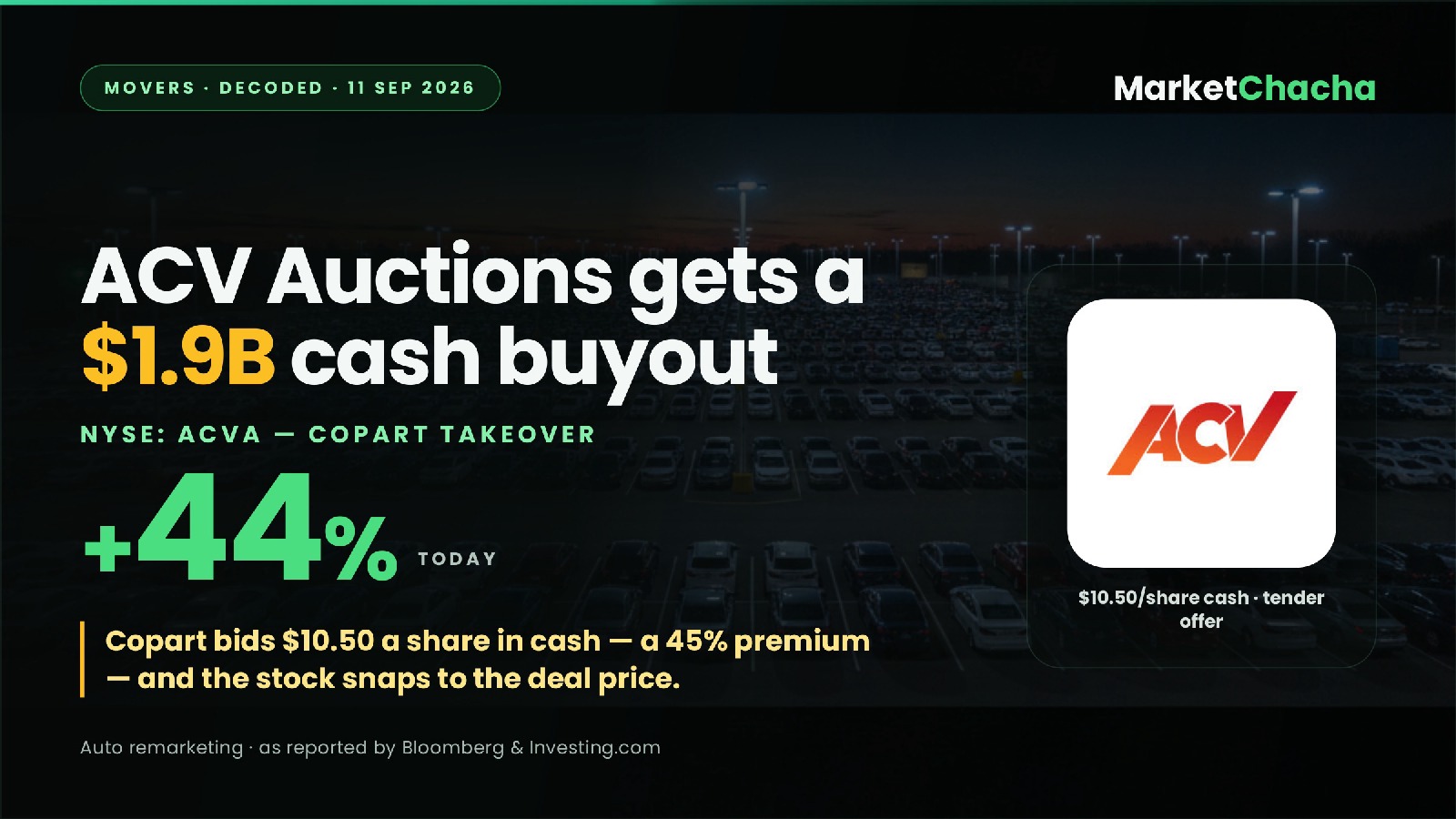
ACV Auctions (NYSE: ACVA) exploded about +44% to trade near $10.50 after Copart (NASDAQ: CPRT) agreed to buy the whole company for cash. The stock closed at just $7.22 the day before. This isn't an earnings pop or a hot data point — it's a takeover, and takeovers move a stock differently. Here's what actually happened and why it matters.
What happened
Copart signed a definitive agreement to acquire ACV for $10.50 a share in cash — a ~45% premium and about $1.9 billion in total, Copart's biggest-ever deal. It's structured as a tender offer (Copart asks shareholders to hand in their shares at $10.50), expected to close by year-end 2026, after which ACV becomes an independent Copart subsidiary run by its current team.
Because the offer is cash, the stock didn't drift — it snapped straight up to just under the deal price. From here ACVA basically stops trading on its business and starts trading on one question: will the deal close? The small gap left below $10.50 is the arbitrage spread — the sliver a trader pockets if it completes on schedule.
Why Copart wanted it
Copart is the king of salvage — it auctions wrecked and totaled cars, mostly for insurance companies. ACV is a different animal: a digital dealer-to-dealer marketplace for whole, drivable used cars. Buying ACV pushes Copart out of its insurance-totaled niche and into the far bigger dealer-wholesale flow. ACV already runs marketplace GMV of about $2.7 billion a quarter and moved 211,472 vehicles in Q2 2026 — instant scale in a channel Copart didn't have.
Is it expensive?
ACV isn't profitable, so there's no P/E to quote — it guided to a 2026 net loss of $50–54 million. On sales it's cleaner: the ~$1.9B price against 2026 revenue guidance of $845–855 million works out to roughly 2.2x forward sales. Compare that to the obvious listed peer, OPENLANE (NYSE: KAR) — the other digital wholesale platform — which trades near a $3.28B market cap on $1.93B of trailing revenue, about 1.5x sales. So Copart is paying a richer multiple than KAR fetches in the open market. That fits: you pay up to take out a faster grower, and the 45% premium is the sweetener that gets a board to say yes.
The business
ACV runs online wholesale auctions where used-car dealers buy and sell from each other, plus the services around it — vehicle inspections (its detailed condition reports are the real selling point), valuation data, transport, and financing. Its take rate is lean: fees run about $360 per vehicle, roughly half what Manheim or KAR charge. That price edge is exactly why a bigger player wanted it.
Who it touches
- OPENLANE (KAR) — the direct digital rival now faces an ACV backed by Copart's balance sheet and insurer relationships. The fight for dealer wholesale just got heavier.
- Manheim (Cox Automotive) — the roughly 42%-share incumbent of physical whole-car auctions now stares at a bigger combined online challenger.
- Carvana — bought ADESA's US physical auction sites in 2022; the remarketing map keeps redrawing around it.
- Copart shareholders — management calls the deal neutral to EPS in year one and accretive after, so near-term this is a growth bet, not an earnings kicker.
What to watch
It's a cash tender offer, so ACVA's upside is effectively capped at $10.50 unless a rival bidder appears — unlikely at this premium. The real risk is regulatory: folding a salvage giant and a fast-growing dealer platform under one roof can invite an antitrust look, and any slip past year-end widens the arb spread. Keep an eye on the tender's minimum-shares threshold and whether regulators ask a second time for information.
As of 12:18 PM ET, 11 Sep 2026. Sources: Investing.com, The Irish Times, ACV Auctions IR. For discussion and education only — not investment advice. Verify before acting.
This article is for educational and informational purposes only. It is not financial advice, investment recommendation, or a solicitation to buy or sell securities. Investing involves significant risks. I am not a SEBI-registered investment advisor. Readers should consult their own financial advisor and conduct their own research before making any investment decisions.
Comments
Join the conversation
Sign in to join the conversation.
Follow replies, add your view, and take part in the discussion.
Sign in to commentLoading comments...