

HP beat, raised guidance, and still fell ~6% — because it sold 16% fewer PCs
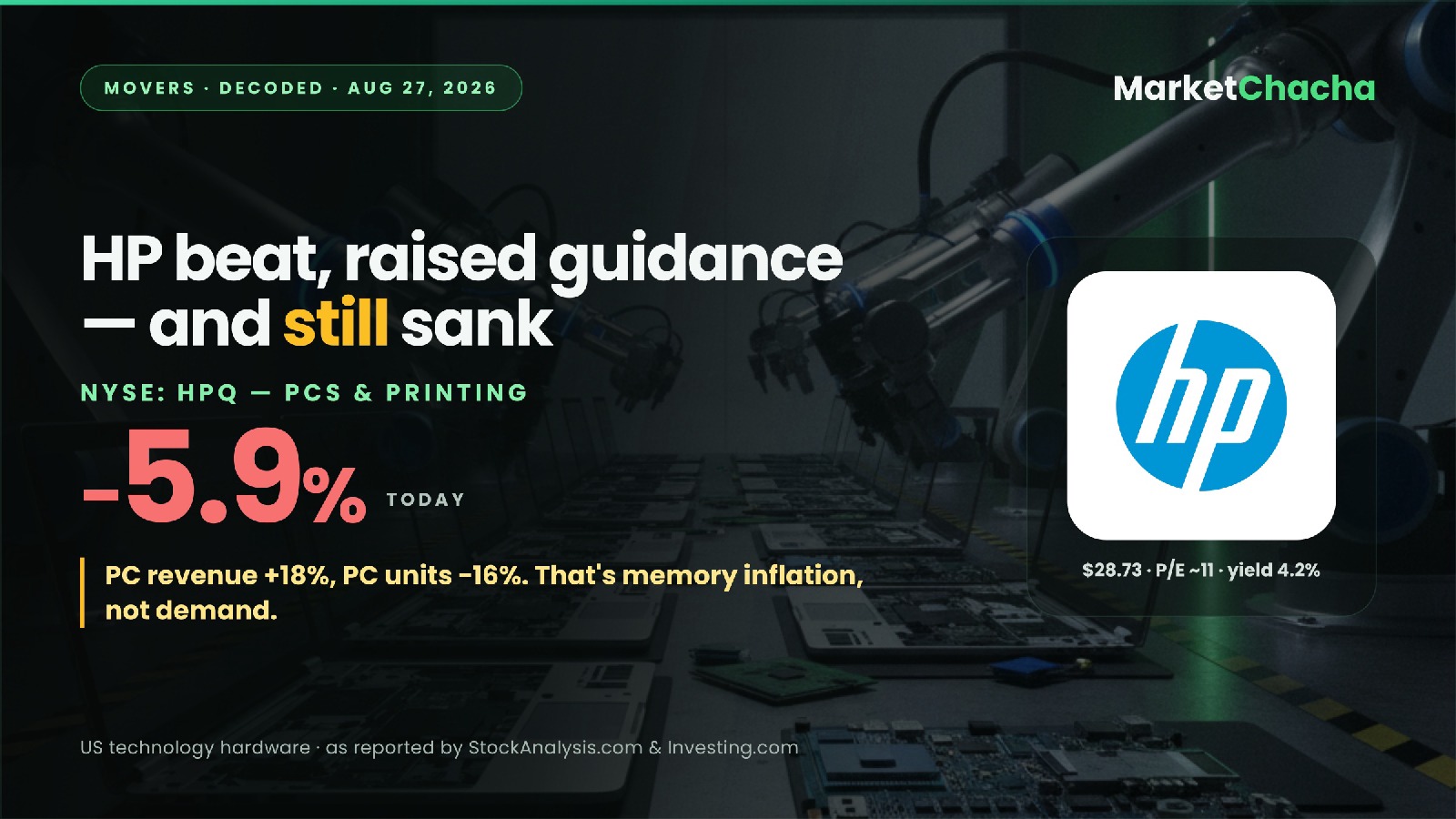
HP Inc. (NYSE: HPQ) beat on revenue, beat on profit, raised its full-year guidance — and the stock still fell about 5.9% on Thursday, to $28.73, per StockAnalysis.com. It dropped over 9% in Wednesday's after-hours session first, per Investing.com. When a company clears every bar and gets sold anyway, the story is never in the headline number. It's in the mix.
What happened
HP's fiscal Q3 (quarter ended July) landed well ahead of the street. Revenue came in at $15.7 billion, up 12.5% year on year, against a consensus of about $14.34 billion — a beat of roughly $1.3 billion, per Investing.com. Non-GAAP EPS was $0.83 versus $0.66 expected. Management then lifted full-year FY26 non-GAAP EPS guidance to $3.19–$3.29, above the ~$3.04 analysts had penciled in, and raised free cash flow guidance to $3.0–$3.2 billion.
On paper, that's a clean quarter. The market disagreed within minutes.
Why it moved: revenue up 18%, units down 16%
Here's the line that did the damage. HP's Personal Systems division — the PC business — booked $11.8 billion in revenue, up 18%. But total PC units shipped fell 16%, per Investing.com. Commercial PC revenue rose 22% and consumer PC revenue rose 10%, all while HP shipped meaningfully fewer machines.
Do the arithmetic on those two reported figures and the average selling price of an HP PC is up roughly 40% year on year. HP isn't selling more computers. It's selling far fewer computers at much higher prices.
That's not a demand story — it's a cost story being passed to the customer. Memory chips (DRAM, the working memory in every laptop, and NAND, the storage) have repriced violently because AI data centres are absorbing the supply. TrendForce data reported by Tom's Hardware in July put DRAM contract prices up 13–18% quarter-on-quarter in Q3 2026, after jumps of roughly 60% in Q2. A laptop maker either eats that or charges for it. HP charged for it, and buyers bought fewer laptops.
You can see the squeeze land in the margin. Personal Systems operating margin was 4.6% — which management itself described on the call as below HP's long-term range. And GAAP EPS actually fell 11.3% to $0.71, even as the adjusted number rose. Note too that the $0.83 non-GAAP figure included $0.11 of one-off tariff refunds; strip that and the beat is far thinner.
What management actually guided to
The guidance raise was real, but the near-term shape was not reassuring. CFO Karen Parkhill told analysts HP expects the PC unit market to shrink by a high-teens percentage in the second half of the calendar year, and that Q4 will be the trough for Personal Systems margin. Q4 non-GAAP EPS guidance of $0.69–$0.79 sits below the $0.83 HP just delivered. On costs, she said HP expects them to keep rising in FY27, just at a slower rate.
Investors heard a company telling them the next quarter is the worst one. HP is also navigating this without a permanent chief executive — Enrique Lores resigned in February 2026 and board member Bruce Broussard has been running the company on an interim basis since, per HP's own announcement.
The business: what HP actually is
- Personal Systems (~75% of revenue): laptops, desktops, workstations. $11.8bn this quarter, but only 4.6% operating margin. High revenue, thin profit.
- Printing (~25% of revenue): printers and, crucially, supplies. $3.9bn, revenue down 2%, but at 18.1% operating margin. Small business, most of the profit.
This matters for reading the quarter. The bit that grew is the low-margin bit. The bit that actually makes money shrank. HP is not an AI hardware company — unlike Dell, it has no meaningful AI-server business to offset a bad PC cycle.
Is it expensive?
No — and that's rather the point. HP trades on a P/E of about 11, a forward P/E near 9.6, a market cap of roughly $26.3 billion and a 4.2% dividend yield, per StockAnalysis.com. In absolute terms that's a cheap, income-style multiple — the market is pricing HP as a slow-melting cash machine, not a growth company.
Compare that with its closest listed peer, Dell Technologies (NYSE: DELL): a $302.6 billion market cap on a trailing P/E of about 37 and forward P/E near 24, with the stock up roughly 256% over 52 weeks, per StockAnalysis.com. Same "PC maker" label; the market values Dell at more than three times HP's earnings multiple and eleven times its market cap, because Dell's AI-server business gets credit HP's laptop business does not. Cheap can stay cheap when nobody believes the earnings grow. That framing cuts both ways, and neither is a recommendation.
Who else this touches
- Memory makers are the other side of this trade. Every dollar squeezing HP's margin is landing on the income statements of Micron, SK Hynix, Samsung and Western Digital. HP's pain is their pricing power.
- India — Dixon Technologies. HP manufactures PCs and laptops in India through a partnership with Dixon under the IT Hardware PLI scheme, per Business Standard and Dixon's own release. Dixon is paid largely on volumes assembled. A high-teens decline in global PC units is a headwind to the ramp, even if India's localisation mandate cushions it.
- Indian IT hardware distributors such as Redington move HP boxes into the channel. Rising ASPs help revenue optics; falling units do not help volume-linked economics.
- Corporate IT buyers everywhere, India included. If HP is raising prices ~40% per machine to protect a 4.6% margin, the refresh cycle you budgeted for last year now costs materially more.
The one risk that flips this
Memory prices. The entire bear case rests on component inflation persisting. TrendForce's own data already shows the rate of increase decelerating — from ~60% quarterly jumps to 13–18%. If DRAM and NAND pricing flattens through FY27 while HP keeps the higher selling prices it has already pushed through the channel, that 4.6% Personal Systems margin snaps back hard, and a stock on 9.6x forward earnings does not need much to re-rate. Equally, if unit declines steepen past the high-teens HP guided to, the pricing lever stops working — you cannot charge more for machines nobody is buying.
The thing worth taking away: when you read "revenue up 18%," always ask whether that came from more customers or higher prices. For HP this quarter, it was entirely the second one.
As of 11:30 a.m. ET, Aug 27, 2026. Sources: HP Inc. Q3 FY2026 results release (GlobeNewswire), Investing.com, StockAnalysis.com (HPQ), StockAnalysis.com (DELL), Tom's Hardware / TrendForce, HP leadership transition, Business Standard (HP–Dixon India). For discussion and education only — not investment advice. Verify before acting.
This article is for educational and informational purposes only. It is not financial advice, investment recommendation, or a solicitation to buy or sell securities. Investing involves significant risks. I am not a SEBI-registered investment advisor. Readers should consult their own financial advisor and conduct their own research before making any investment decisions.
Comments
Join the conversation
Sign in to join the conversation.
Follow replies, add your view, and take part in the discussion.
Sign in to commentLoading comments...