

Hindustan Unilever: what their latest filing actually means
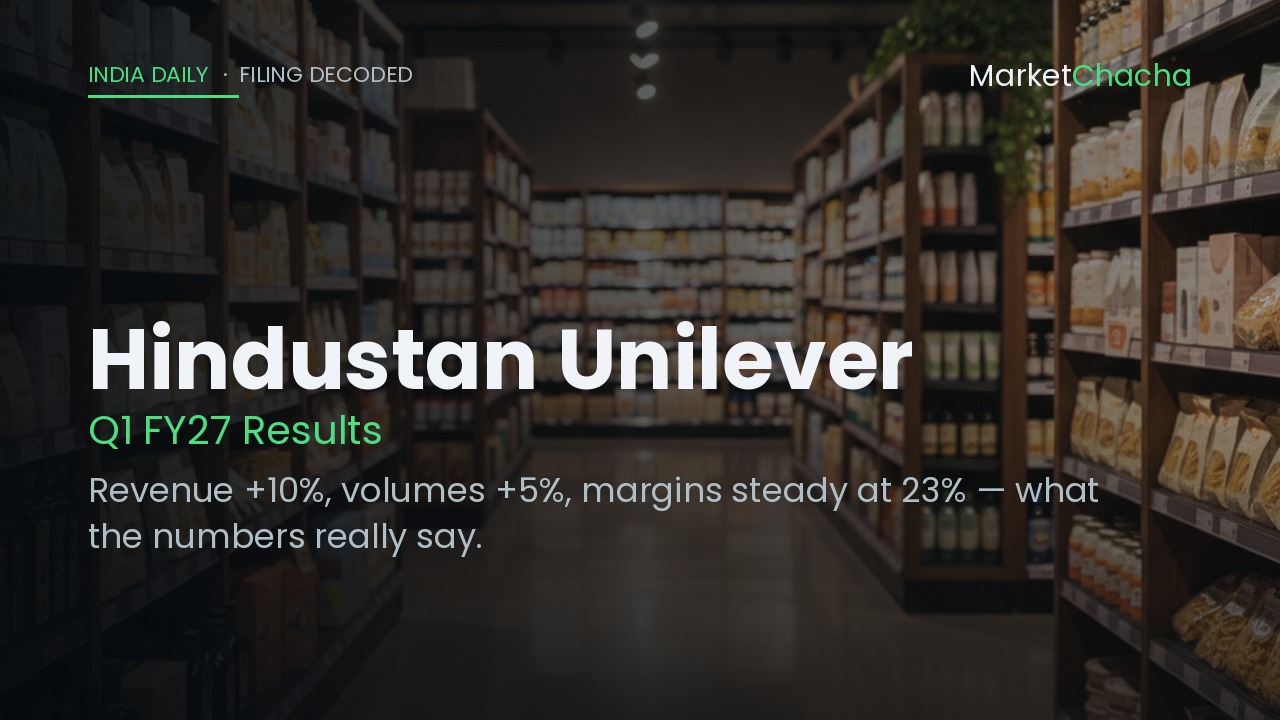
Hindustan Unilever (HUL), India's largest FMCG company, filed its April–June 2026 (Q1 FY27) results with the exchanges. The one-line story: sales grew a healthy 10% and volumes grew 5%, profitability held steady, and the small 2% dip in reported net profit is a base-year quirk — not a slowdown.
What was announced
At its board meeting on 28th July 2026, HUL approved its unaudited results for the quarter ended 30th June 2026 and filed them along with an investor presentation and press release. The headline numbers (consolidated):
- Turnover / sales: ₹17,184 crore, up 10% year-on-year.
- Underlying volume growth: 5% — i.e. HUL genuinely sold more product, not just charged more.
- EBITDA: ₹3,947 crore, up 8%; EBITDA margin 23.0%, down 40 basis points but within the company's guided range.
- Profit before tax (before exceptional items): ₹3,707 crore, up 9%.
- Profit after tax (before exceptional items): ₹2,731 crore, up 9%.
- Reported net profit: ₹2,680 crore, down 2% — but only because the year-ago quarter had a one-off tax credit that flattered its base.
What this type of filing means
This is a quarterly results filing (a "board meeting outcome" under SEBI's disclosure rules). A few terms worth knowing:
- Unaudited + limited review: quarterly numbers aren't fully audited like the annual accounts; auditors do a lighter "limited review." Normal for quarterly results.
- Underlying volume growth (UVG): the change in actual quantity sold, stripping out price hikes and any acquisitions/disposals. For an FMCG company this is the single most-watched number — it tells you whether people are buying more, or the company is just raising prices.
- Exceptional items: one-off gains or costs (restructuring, asset sales, tax credits) that aren't part of normal operations. Analysts strip these out to compare "like for like," which is why HUL reports profit both "before exceptional items" and as a final reported figure.
Why it matters
For a giant like HUL, the quality of growth matters more than the headline. 5% volume growth on top of 10% revenue growth means demand is real, not just price-led — a good sign for the broader consumer economy. Margins holding at 23% shows cost pressures (raw materials, competition) are being managed. The reported profit falling 2% looks negative at a glance, but the "before exceptional items" profit rising 9% is the truer picture of how the underlying business did.
Is it expensive?
HUL trades at a P/E of about 33 with a market capitalisation of roughly ₹5.1 lakh crore (its price-to-book is very high, typical for an asset-light company carrying large brand goodwill). For context on where that sits among large FMCG names: Nestlé India trades far richer at a P/E of about 72, while ITC is much cheaper at roughly 17. So HUL's valuation is rich versus the broad market but middle-of-the-pack for premium consumer staples — investors pay up for its brands and steady cash flows, but not as extremely as they do for Nestlé. This is context, not a target or a buy/sell call.
The business
HUL sells everyday household and personal products across four segments (Q1 revenue in brackets): Home Care — detergents, dishwash like Surf Excel, Vim (~₹6,554 cr); Beauty & Wellbeing — shampoos, skincare, health drinks like Horlicks (~₹4,083 cr); Personal Care — soaps, oral care such as Lux, Lifebuoy, Pepsodent (~₹2,624 cr); and Foods — tea, coffee, ketchup, Knorr, Kissan (~₹3,480 cr). Because it's this diversified, a result like this reflects the whole consumer basket, not one product line.
Beginner takeaway
HUL had a solid, steady quarter: more products sold, stable margins, and a headline profit dip that's just an accounting base effect. For a company this size, "boring and steady" is usually the goal. Watch volume growth in coming quarters — that's the real health check for FMCG.
FAQ
Why did net profit fall 2% if everything grew? The year-ago quarter had a one-time tax credit that inflated its profit. Comparing against that flattered base makes this quarter look slightly lower, even though the underlying business grew ~9%.
What is "underlying volume growth" and why do people obsess over it? It's how much more product was actually sold, ignoring price rises. It shows whether demand is genuinely expanding — which price-led growth alone can't tell you.
Is a 40 bps margin dip a worry? Not really. A 0.4 percentage-point move within the company's own guided range is minor and often driven by input-cost timing or mix.
As of 28 July 2026 (filing dated 28 July 2026). Source: official BSE filing — read it directly here. We summarise filings for education and may make errors, so always verify against the official document. Educational content only — not investment advice, not a buy/sell recommendation.
This article is for educational and informational purposes only. It is not financial advice, investment recommendation, or a solicitation to buy or sell securities. Investing involves significant risks. I am not a SEBI-registered investment advisor. Readers should consult their own financial advisor and conduct their own research before making any investment decisions.
Comments
Join the conversation
Sign in to join the conversation.
Follow replies, add your view, and take part in the discussion.
Sign in to commentLoading comments...