

TCS: what their latest filing actually means
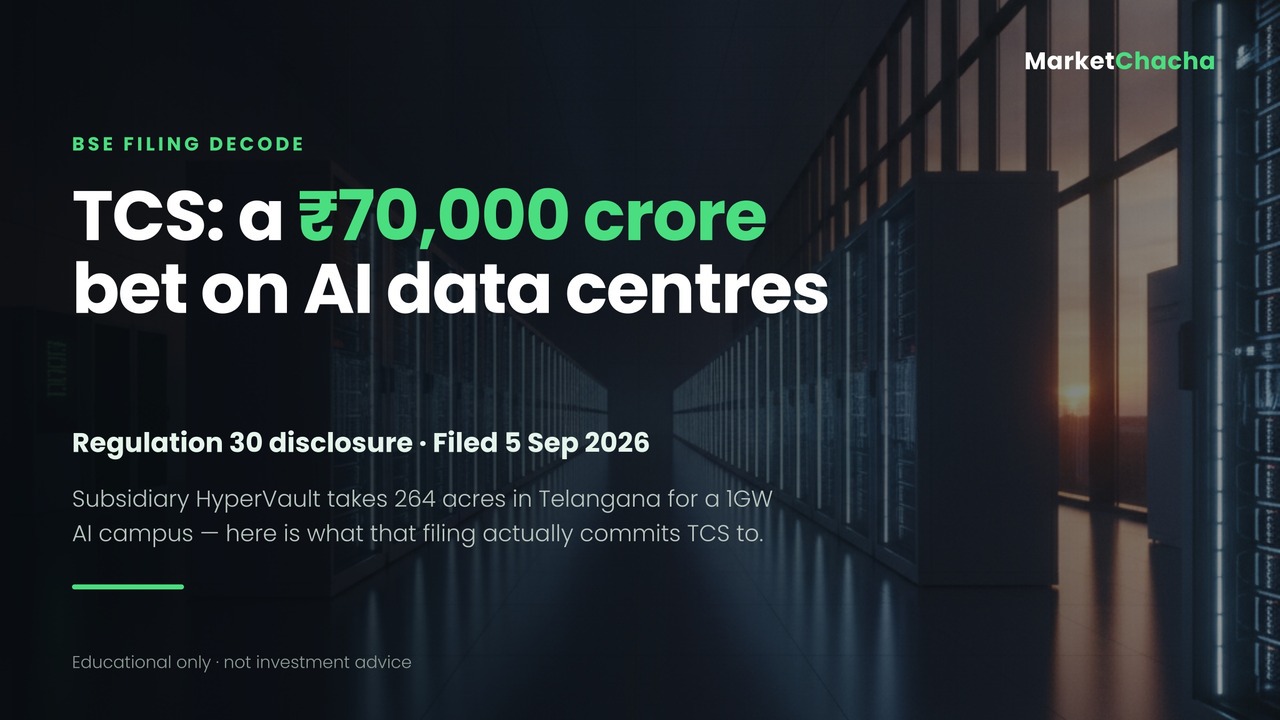
Tata Consultancy Services filed a Regulation 30 disclosure with BSE on Saturday, 5 September 2026, enclosing a press release from its subsidiary HyperVault AI Data Center Limited. HyperVault will build a large-scale AI data centre campus on 264 acres in Hyderabad, Telangana, with capacity of up to 1 gigawatt and investment of up to ₹70,000 crore, developed in phases. Because it landed on a weekend, Monday 7 September is the first session in which the market can actually react to it.
What was announced
- Who filed: TCS (BSE scrip 532540), on behalf of subsidiary HyperVault AI Data Center Limited.
- When: Filed with BSE at 15:21 IST on 5 September 2026, under the "Company Update" category as a press-release enclosure.
- What: A 264-acre AI data centre campus in Hyderabad, Telangana.
- Size: Capacity "up to 1GW"; investment "up to ₹70,000 crore", built out in phases "aligned with customer demand".
- Who it is for: Frontier AI companies and hyperscalers, with high-density, liquid-cooled GPU deployments — the kind of racks ordinary cloud data centres cannot cool.
- Design claims: Green energy and water-neutral design principles; thousands of direct and indirect jobs expected.
- Partner: TPG, already a strategic investor in HyperVault.
TCS CEO and MD K Krithivasan framed it as part of the company's "Infrastructure-to-Intelligence" strategy — pairing AI-ready infrastructure with TCS's existing cloud, engineering and AI services.
What this type of filing means
This is a Regulation 30 disclosure. Under SEBI's Listing Obligations and Disclosure Requirements (LODR) rules, a listed company must tell the exchanges about any event that is "material" — broadly, anything a reasonable investor would want to know before trading the stock. Large capital commitments, new business lines and big subsidiary announcements all qualify.
Two things are worth understanding about a filing shaped like this one:
- It is a press release enclosed as a filing, not a contract. TCS is disclosing an intention and a land parcel, not a signed customer order. The exchange filing makes the statement legally accountable, but it does not convert ₹70,000 crore into committed spending.
- "Up to" is doing a lot of work. "Up to ₹70,000 crore" and "up to 1GW" are ceilings across a multi-year, phased build. The actual money spent depends on how much capacity customers contract for. Treat it as the size of the runway, not the size of the cheque.
A useful sanity check: in a separate announcement on 20 November 2025, TCS said TPG would invest up to ₹8,820 crore into HyperVault as part of a combined TCS + TPG commitment of up to ₹18,000 crore (equity plus debt) over the following few years, with TPG ending up with 27.5–49% of HyperVault and TCS keeping majority control. So the amount actually committed so far is roughly a quarter of Saturday's headline number, and it is shared with a partner.
Why it matters / potential impact
- It changes what kind of company TCS is. TCS has historically been asset-light: it sells people's time and software, and its capital expenditure is modest relative to revenue. A gigawatt-scale data centre campus is heavy infrastructure — land, power, cooling, long build cycles. That is a different capital and risk profile.
- Balance sheet. TCS generates strong cash (FY26 operating cash flow was 106.7% of net income) and has historically returned most of it to shareholders. Building infrastructure competes with that cash. The TPG partnership and debt at the HyperVault level are how TCS is trying to limit the drag on its own books.
- Returns profile. Data centres typically earn steadier but lower returns on capital than IT services. If HyperVault becomes large relative to TCS, blended return on capital could drift down even if profits rise in absolute terms — something to watch rather than assume.
- Utilisation risk is the real risk. A phased build tied to "customer demand" is a sensible way to avoid it, but GPU capacity that nobody contracts for is expensive idle steel. Watch for future filings that name anchor customers or announce contracted capacity.
- Context on the core business. FY26 revenue was $30,017 million, down 0.5% year-on-year (down 2.4% in constant currency), with a 25% operating margin. Growth in the services business has been flat; that is part of why an adjacent growth engine is being built.
Note that TCS shares did not spike on this. In the opening half-hour of Monday 7 September, TCS traded around ₹2,282 against Friday's close of ₹2,304 — roughly 1% lower. The market's read appears to be that this is a long-dated, capital-hungry option rather than near-term earnings.
Is it expensive?
On the numbers reported by Tickertape as of 4 September 2026, TCS trades at a P/E of about 16.9, a P/B of about 7.7 and a dividend yield of about 4.8%, on a market capitalisation of roughly ₹8.33 lakh crore. GuruFocus puts the trailing P/E at 16.7 against a 10-year median of 26.8 — roughly 37% below its own long-run average. The IT services sector P/E is about 22.4.
Peer comparison — Infosys: trading at a P/E of about 15.4, P/B of about 4.9 and a dividend yield of about 4.3%, on a market cap of roughly ₹4.54 lakh crore. So TCS is about 1.8x Infosys's size and carries a modest P/E premium and a much higher P/B (TCS runs on a smaller equity base, which flatters both its return on equity and its P/B).
Honest framing: TCS is not expensive by its own history — a high-teens P/E on India's largest IT company, with a near-5% dividend yield, is at the cheaper end of where this stock has traded for a decade. But cheap-versus-history is not the same as cheap: the multiple has compressed because revenue is flat and the market is unsure what AI does to the headcount-linked services model. You are being asked to judge whether that de-rating is temporary or structural. This is not a target price or a recommendation.
The business
TCS is India's largest IT services company — roughly 584,519 employees at the end of FY26 — selling software development, maintenance, consulting, cloud migration and business process services to large global enterprises. FY26 revenue was $30.0 billion with a 25% operating margin and net profit of $5.94 billion.
- By industry (FY26): BFSI 32.0%, Consumer Business 15.5%, Life Sciences & Healthcare 10.4%, Manufacturing 8.8%, Technology & Services 8.4%, Energy/Resources/Utilities 6.0%, Communications & Media 5.8%, Regional Markets & Others 13.1%.
- By geography (FY26): North America 48.6%, UK 17.4%, Continental Europe 15.4%, Asia Pacific 8.3%, India 5.9%, Middle East & Africa 2.5%, Latin America 1.9%.
Important: HyperVault is a subsidiary, and a new one. Today it contributes essentially nothing to those numbers. This filing affects a small, future slice of TCS — it does not change what the other 99%-plus of the company does tomorrow morning.
Beginner takeaway
A big number in a filing is a ceiling on a plan, not money that has been spent. "Up to ₹70,000 crore, phased, aligned with customer demand" is a very different commitment from a signed order of the same size, and the market usually prices it that way — which is why TCS did not jump on the news. The useful habit is to read past the headline figure and ask three questions: how much is actually committed, who else is paying, and what has to go right for the spending to earn a return.
FAQ
Does this mean TCS is spending ₹70,000 crore right now? No. It is an "up to" figure for a phased, multi-year build tied to customer demand. The disclosed committed amount so far is up to ₹18,000 crore jointly from TCS and TPG, per the November 2025 announcement.
Why did the stock not go up on such a large announcement? Because it adds long-dated capital spending rather than near-term profit, and because the market already knew about HyperVault from the November 2025 TPG announcement. This filing added the site and the scale, not a brand-new business.
What is Regulation 30 and why do I keep seeing it? It is the SEBI LODR rule that forces listed companies to disclose material events to the exchanges promptly, so all investors learn the same thing at the same time. Most "Announcement under Regulation 30" filings are routine; a few, like this one, are not.
What should I watch next on this? Future filings that name anchor customers or contracted capacity, the phasing of actual capital expenditure in quarterly results, and whether TCS's dividend and buyback policy changes as spending ramps up.
As of 7 September 2026. Source: official BSE/NSE filing — read it directly here. We summarise filings for education and may make errors, so always verify against the official document. Educational content only — not investment advice, not a buy/sell recommendation.
This article is for educational and informational purposes only. It is not financial advice, investment recommendation, or a solicitation to buy or sell securities. Investing involves significant risks. I am not a SEBI-registered investment advisor. Readers should consult their own financial advisor and conduct their own research before making any investment decisions.
Comments
Join the conversation
Sign in to join the conversation.
Follow replies, add your view, and take part in the discussion.
Sign in to commentLoading comments...