

Adani Power: what their latest filing actually means
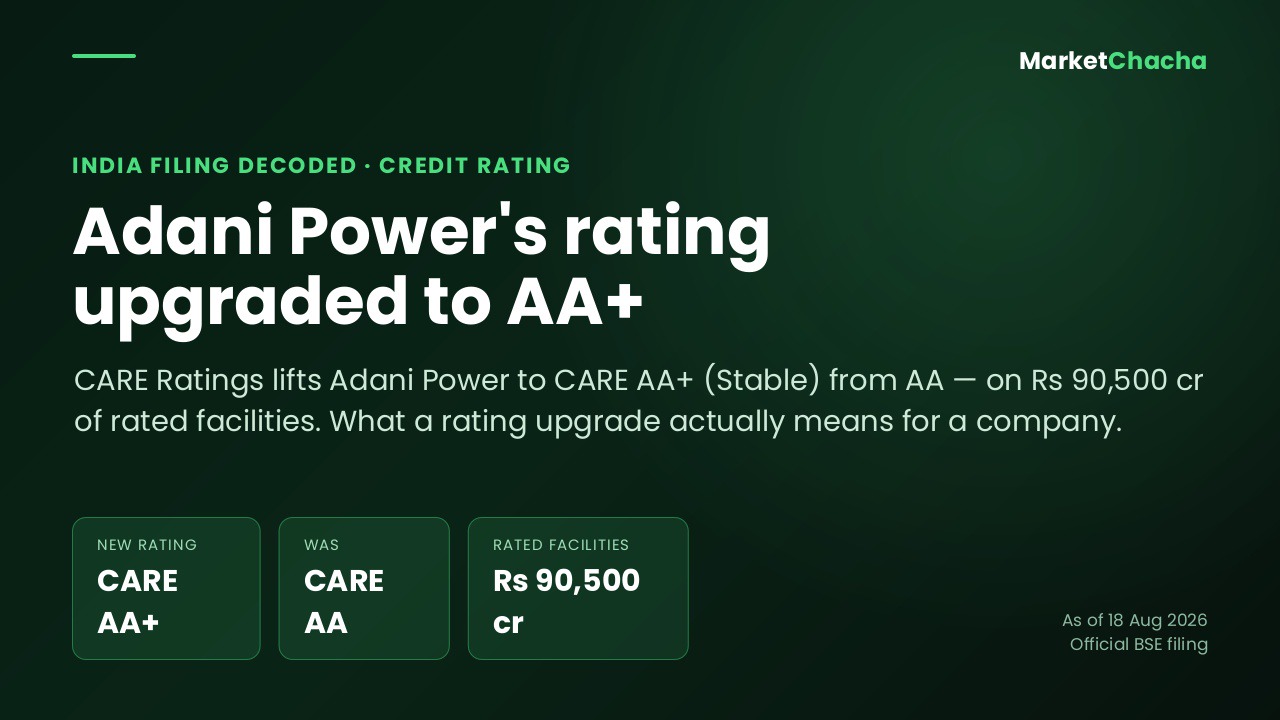
Adani Power told the exchanges on 18 August 2026 that CARE Ratings has upgraded its credit rating to CARE AA+ (Stable), from CARE AA (Stable), across long-term bank facilities, non-convertible debentures and short-term facilities that together add up to a huge Rs 90,500 crore of rated debt. In plain terms, an independent rating agency now judges the company a notch safer to lend to than it did before.
What was announced
CARE Ratings, one of India's registered credit-rating agencies, reviewed Adani Power's debt and raised the grade one step:
- Long-term bank facilities (Rs 52,950 crore, enhanced from Rs 42,950 crore): upgraded to CARE AA+; Stable from CARE AA; Stable.
- Long-term / short-term facilities (Rs 15,050 crore): long-term upgraded to AA+; Stable; short-term reaffirmed at CARE A1+ (the top short-term grade).
- Non-convertible debentures (Rs 11,000 crore existing + Rs 11,500 crore newly assigned): rated AA+; Stable.
- Total rated facilities: Rs 90,500 crore.
CARE said the upgrade reflects Adani Power's sustained strong financial and operational performance, its scale and diversified plant portfolio, long- and medium-term power purchase agreements (PPAs) that give it revenue visibility, improved fuel security, strong cash generation and a stronger capital structure.
What this type of filing means
A credit rating is a scorecard on how safely a company can repay its borrowings — it is about the debt (bondholders and banks), not directly about the share price. Ratings run from AAA (safest) downward: AAA, AA+, AA, AA-, A+, and so on. Adani Power moved from AA to AA+, i.e. up one notch, still one step below the top AAA band. "Stable" is the outlook — the agency does not expect the rating to change soon. "A1+" is the highest grade on the separate short-term scale used for money a company borrows for under a year.
Why does an upgrade matter? A higher rating usually lets a company borrow more cheaply, because lenders demand less interest for taking on what is now seen as lower risk. Over a Rs 90,500 crore debt book, even a small drop in interest cost is meaningful. It also widens the pool of investors — many pension and insurance funds can only buy very highly rated bonds.
Why it matters / potential impact
For a capital-intensive business like power generation, financing cost is one of the biggest line items after fuel. A rating upgrade signals the agency believes Adani Power's cash flows and balance sheet have strengthened enough to service its debt comfortably, and can translate into lower interest outgo on future borrowing and refinancing — which supports profit. It is also a credibility marker for a group that has faced scrutiny over leverage in the past. What it is not: a rating upgrade is not a forecast of the stock going up, and it says nothing about whether the shares are cheap or expensive today.
Is it expensive?
Adani Power trades at a P/E of about 33 with a market capitalisation of roughly Rs 3.9 lakh crore (share price near Rs 204, up about 76% over the past year), on a very high P/B of around 26. Against peers, that valuation looks rich: NTPC, the far larger state-owned generator, trades at only about 12x earnings (market cap ~Rs 3.3 lakh crore); Tata Power sits around 24x; and JSW Energy, a closer private-IPP comparison, trades around 38x. So Adani Power is priced well above NTPC and Tata Power but roughly in line with the most aggressively valued private peer — the market is clearly pricing in strong growth. This is honest framing, not a target or a buy/sell call.
The business
Adani Power is India's largest private-sector thermal power producer, operating a fleet of coal-fired plants across states including Gujarat, Maharashtra, Karnataka, Rajasthan, Chhattisgarh and Madhya Pradesh, with a total capacity in the high-teens of gigawatts and further expansion under way. A large share of its output is tied up under long- and medium-term PPAs with state distribution companies, which is exactly why CARE highlighted "revenue visibility." Because this rating covers the whole company's debt, the upgrade is a company-wide event, not a one-division story.
Beginner takeaway
A credit-rating upgrade is a vote of confidence from an independent agency that a company can repay its debts more safely than before, which can lower its borrowing costs over time. It is good news for the company's financial health, but it is separate from valuation — Adani Power's stock still trades at a rich multiple versus most power peers. Treat the two facts independently.
FAQ
Does a rating upgrade mean the share price will go up? No. Ratings assess the safety of the company's debt, not the value of its shares. The stock can rise or fall regardless.
What's the difference between AA+ and AAA? AAA is the highest safety grade; AA+ is one notch below it. Adani Power is now in the second-highest band, which is still considered very strong.
Who decides these ratings? SEBI-registered credit-rating agencies such as CARE, CRISIL and ICRA. They are paid to assess a company's debt and must disclose their methodology; different agencies can rate the same company slightly differently.
Why does a company announce this to the exchange? SEBI's disclosure rules (Regulation 30) require listed companies to promptly inform investors of material events, and a change in credit rating is one of them.
As of 18 August 2026. Source: official BSE/NSE filing — read it directly here. We summarise filings for education and may make errors, so always verify against the official document. Educational content only — not investment advice, not a buy/sell recommendation.
This article is for educational and informational purposes only. It is not financial advice, investment recommendation, or a solicitation to buy or sell securities. Investing involves significant risks. I am not a SEBI-registered investment advisor. Readers should consult their own financial advisor and conduct their own research before making any investment decisions.
Comments
Join the conversation
Sign in to join the conversation.
Follow replies, add your view, and take part in the discussion.
Sign in to commentLoading comments...