

HCLTech: what its latest filing actually means
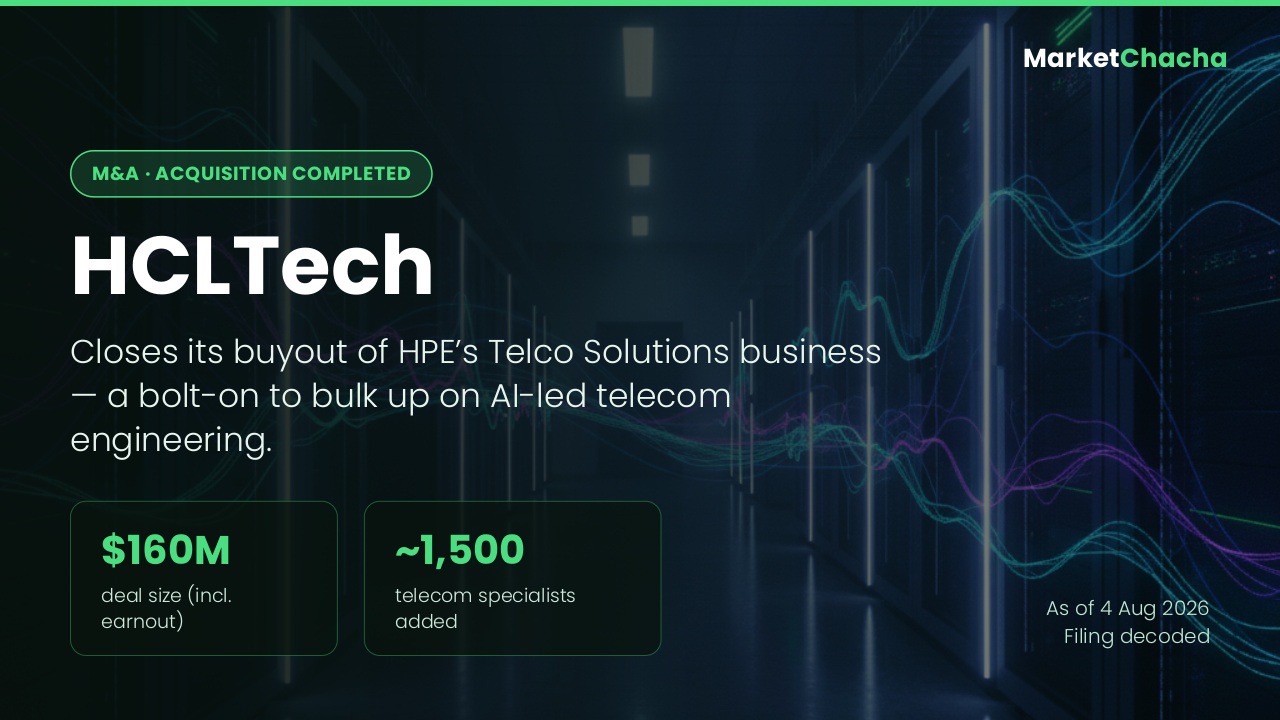
HCL Technologies (HCLTech) told the exchanges it has completed its acquisition of HPE’s Telco Solutions business — a deal it first announced back in December 2025. In plain terms: HCLTech has now legally taken over a telecom-software unit from Hewlett Packard Enterprise, folding in the people, products and customer contracts that come with it.
What was announced
This is a “completion of acquisition” filing — the deal is done and closed, not just proposed. The key facts:
- What was bought: HPE’s Telco Solutions business, a unit that builds software for telecom operators. Its products reportedly help run over 1 billion devices across 200+ deployments worldwide.
- Price: up to US$160 million (roughly ₹1,400 crore), which includes a $15 million performance-linked earnout — part of the payout depends on the business hitting targets after the handover.
- People: around 1,500 product-engineering and telecom specialists move over to HCLTech.
- Timeline: announced December 2025, and the transaction closed on 1 August 2026. This builds on HCLTech’s earlier 2024 takeover of HPE’s Communications Technology Group (CTG).
What this type of filing means
There is an important difference between two words companies use in M&A filings:
- “Signed / agreed to acquire” — the two sides have a deal on paper, but it still needs approvals and conditions to be met. Nothing has changed hands yet.
- “Completed / closed” (this filing) — all conditions are met, money and ownership have actually transferred, and from now on the acquired unit’s revenue and costs start showing up inside HCLTech’s own accounts.
Because HCLTech announced this deal in December 2025, the market has largely known it was coming. So a “completion” filing is usually more of a milestone confirmation than a fresh surprise — it tells you the deal cleared and integration begins, rather than revealing brand-new information.
Why it matters / potential impact
- It’s a “bolt-on”, not a mega-deal. At ~$160 million against a company that earns billions of dollars a year in revenue, this is small in size — it adds a capability, it doesn’t transform the company overnight.
- The logic is telecom + AI. HCLTech is stacking up telecom-software assets (CTG in 2024, Telco Solutions now) to sell more engineering and software to the world’s telecom operators as they modernise their networks.
- Watch the integration, not the headline. With acquisitions, the value shows up later — in whether the acquired team is retained, whether the products keep their customers, and whether the earnout targets are hit. A carve-out (pulling a unit out of a big parent like HPE) always carries some execution risk.
None of this is a reason to predict where the share price goes — a bolt-on of this size rarely moves a company this large on its own.
Is it expensive?
HCLTech trades at a P/E of about 21, with a market capitalisation near ₹3.69 lakh crore and a P/B around 4.9 (Screener/Trendlyne, early August 2026). For an IT-services company that’s on the richer end. Compare it to its larger peers:
- TCS — P/E ~15, market cap ~₹8.95 lakh crore (India’s biggest IT firm).
- Infosys — P/E ~14.5.
- Wipro — P/E ~14, market cap ~₹1.86 lakh crore.
The broad IT-software sector average sits around P/E 19. So at ~21, HCLTech is priced above both its largest rival TCS and the sector average. Investors have historically paid a small premium for HCLTech partly because of its higher-margin software (HCLSoftware) and engineering mix and its steady dividend record — but “richer than peers” is the honest label here. This is context, not a target price or a buy/sell call.
The business
HCLTech is one of India’s big-four IT firms. It earns money in three broad segments:
- IT & Business Services — the largest slice: running and modernising clients’ IT systems, applications and infrastructure.
- Engineering & R&D Services (ERS) — helping companies design and build products (chips, devices, networks). This telecom acquisition sits here, plus in its software arm.
- HCLSoftware — its own software products and platforms, the higher-margin part.
So this deal strengthens one specific capability (telecom engineering and software), not the whole company at once.
Beginner takeaway
HCLTech has finished buying a telecom-software unit from HPE for up to $160 million and gained about 1,500 specialists. It’s a small, strategic “bolt-on” that deepens HCLTech’s telecom bench — a milestone to note, not a company-changing event. The thing to watch from here is execution: whether the team stays and the products keep their customers.
FAQ
Does “completed acquisition” mean the share price will jump? Not necessarily. The deal was announced in December 2025, so the market already knew about it — a completion filing mostly confirms a known event rather than delivering a fresh surprise.
What is a “carve-out”? It’s when a company buys just one slice of a bigger firm (here, one business unit of HPE) rather than the whole company. The tricky part is separating that unit cleanly from its old parent—systems, staff and customers all have to be moved over.
What is an “earnout”? Part of the price ($15 million here) is paid only if the acquired business hits agreed performance targets after the sale. It protects the buyer if the unit underperforms.
Is $160 million a big deal for HCLTech? No — relative to a company worth about ₹3.7 lakh crore that earns billions in revenue, it’s small. It’s meaningful for the capability it adds, not for the money involved.
As of 4 August 2026. Source: official BSE filing dated 3 August 2026 (deal closed 1 August 2026) — read it directly here. We summarise filings for education and may make errors, so always verify against the official document. Educational content only — not investment advice, not a buy/sell recommendation.
This article is for educational and informational purposes only. It is not financial advice, investment recommendation, or a solicitation to buy or sell securities. Investing involves significant risks. I am not a SEBI-registered investment advisor. Readers should consult their own financial advisor and conduct their own research before making any investment decisions.
Comments
Join the conversation
Sign in to join the conversation.
Follow replies, add your view, and take part in the discussion.
Sign in to commentLoading comments...